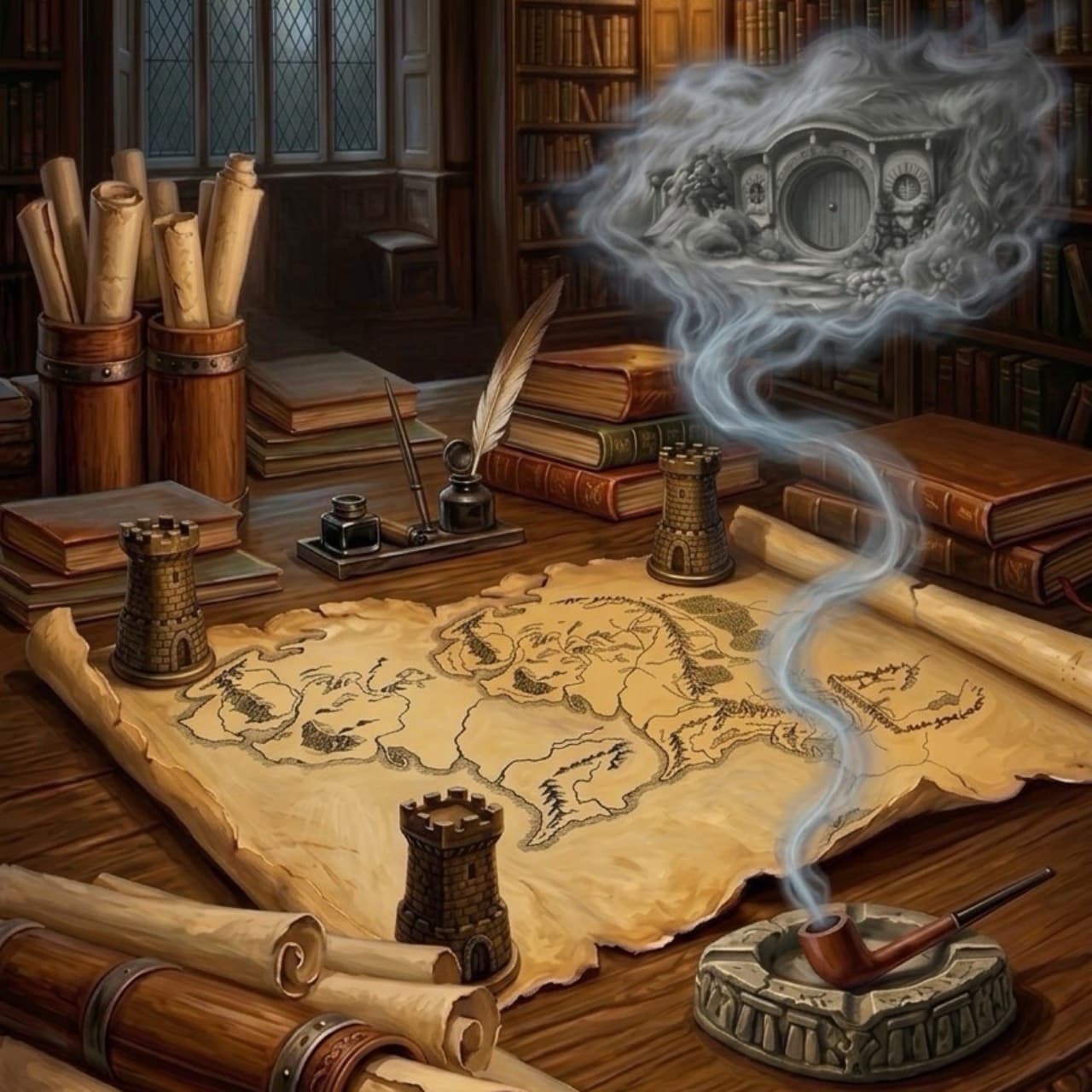

Almost always, when he finished a major piece of work, he would gladly mark the completion of a new article or lecture with a pint of good beer, or something stronger, without the slightest embarrassment. But not this time. This time there was no desire to celebrate. Before him lay the fruits of his labor—carefully rewritten in calligraphic handwriting and bound into folders. He had never done anything more complex or more interesting. But what next? He had no answer to that question...
Ah, what work it had been! An unequal, exhausting battle with fragile, half-decayed scrolls in ancient wooden cases, as if they had been waiting for him in a God-forgotken storage room. From time immemorial, someone, unwilling to hand over to the executioner and the flames books that were unwelcome to the Church, had stuffed them into a sealed basement closet and walled it up with stone. How fortunate it was that he had been assigned to sort through this, in the dean’s words, “black-book nonsense.” And how remarkable that it was he who discovered, among medieval alchemical and magical treatises, the cases inscribed with unknown circular symbols.
His conscience did not trouble him. Not when he carried the manuscripts home, nor when he realized the meaning of his discovery. He knew all too well the research plans of museums and universities, laid out years and decades in advance. In the end—he had not stolen the manuscripts. He had been assigned to sort them, and he did. Where exactly was a minor detail.
Year after year, wrapped in tobacco smoke, forcing his way through unknown symbols, names, and titles, he reconstructed languages and chronicles of an entirely different world, before which Atlantis and Avalon, Valhalla and Faërie, the Isles of the Blessed and Shambhala paled into insignificance, for it was all of them at once—and even more.
Alas, long ago, after careful inquiries with geologists and archaeologists, he had come to understand that “his” world had left no trace behind. So what did he have in the end? Half-decayed parchments? He would only be accused of forgery sooner or later. He had no desire to be known as a charlatan or a deranged “conjurer of spirits.” Yes, it was bitter to remain the only person on Earth acquainted with the beauty of a truly remarkable discovery. But it seemed there was nothing to be done. He already had a reputation as a “storyteller.”
And besides, he thought, a fairy tale is an excellent solution! Would it not be logical if a man who has studied fairy tales for so many years were to write one himself? And then we shall see.
He exhaled a small ring of smoke and, watching it, seemed to see with his own eyes a hole in the ground beneath a hill...
Viacheslav Sannikov "Almost True". Part I "Humans"