
The king was going to war again. Accompanied by a small detachment of knights, he moved at an unhurried pace along the stretched-out marching column. Old bones and aching scars would have preferred the soft cushions of a wagon seat to a saddle, but warriors must see their leader as strong, vigorous, and confident. That was precisely why he behaved as he always did on campaigns—making daily marches within the main column, inspecting mounted patrols, and exchanging rough jokes with old comrades-in-arms.
Both knights and common soldiers loved the king. He had never suffered defeat; from his campaigns they often returned with rich plunder and only rarely with heavy losses. In the middle of a march, upon noticing a bird flying high in the sky, he could halt the army and arrange an archery contest, generously exchanging the spoils received from a skilled archer for a precious bracelet or a ring. At rest stops, field tournaments were often held, where even the poorest soldier was granted the right to cross blunted weapons with the renowned knights of the royal circle and earn rank and spurs. Ballads were composed about him, folk songs, and even fairy tales. One of these the old king had recently overheard by the fire of spearmen, and it now would not leave his mind. Any tale is an exaggerated truth, but one detail of this story seemed like senseless nonsense.
At last, the king found himself at the head of the column and, making his way toward the forward scout party, was able to remain alone with his thoughts for a brief moment. He remembered himself as a nineteen-year-old, beardless, thin youth, marching not at the head of an army but of a mere detachment on his first campaign. Few from the retinue of the formidable Dragon’s Head hastened to swear fealty to the heir who had not yet even been crowned. Fifty knights with their squires and attendants, and two hundred archers and spearmen—that was all he had managed to gather then. Behind his back, he could almost continuously hear the grumbling of men who were not going to conquer—but to die, having followed him only by the call of honor.
To suffer less from those wounding words, he armed himself with javelins, a light shield, and attached his father’s sword to his belt (which he could hardly wield at all), and remained with the forward scouts. Thus, together with several young squires, he was the first to see the barbarians. At least a thousand heavily armed cutthroats. They advanced confidently, without formation or scouts, shouting songs in their monstrous tongue, believing they had nothing to fear. At their head, on a huge black warhorse, rode a mercenary from distant lands—a true monster in a sealed ancient crested helmet and equally ancient breastplate adorned with eagles.
While studying the enemy, he did not notice the knights who had already caught up with him. Speaking loudly among themselves, they were not even advising him on what to do, but deciding how they would enter their final battle. And then he surprised even himself. It was as if some whirlwind had seized him. Later, seasoned warriors would explain that this was called battle madness and taught him how to control it.
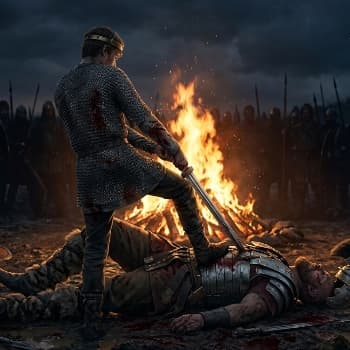
With a wild cry, he charged straight at the enemy commander. The latter rushed to meet him, encouraged by the howls of his horde and swinging a heavy battle axe above his head. Yielding to the same whirlwind, the young man made the only right decision—throwing his javelin not at the rider, but at the horse. The wounded animal reared up and collapsed onto its side, pinning the mercenary beneath it. Drawing his expensive blade from its scabbard—adorned with strange chimeras with rubies in their mouths—the heir leapt from his horse, throwing his entire weight onto the sword that pierced the forged plate armor and became stuck in it...
Until evening, his knights hunted down and cut to pieces the scattered, panicked barbarians. The peasants hiding in nearby forests killed and captured by the dozens those whom, only the day before, they had considered invincible monsters.
And at night, by the light of the fire, within a circle of knightly shields, he pulled the sword still lodged in the enemy’s armor and was crowned according to ancient custom—with the head of a bear killed for that purpose. That was how it all truly happened. But these memories could not answer the question that troubled the king.
In the evening, after waiting until the sentries had been posted and the camp had fallen silent, the old king approached the tent of his chronicler, who had volunteered to accompany him on this war. A gray-haired servant of God, by candlelight, carefully formed letters in a parchment book laid out on a light campaign table.
“Good evening, honored sir,” the king greeted as he entered the tent.
“A good night, rather,” the chronicler replied, carefully setting aside his stylus.
“Would you not tell me, perhaps you remember the name of the mercenary, the leader of the barbarians, defeated by me in the very first battle after my father’s death?” the king asked quietly, embarrassed that his memory was failing him.
“I remember,” the old man replied. “His name was Peter.”
“Does this name mean anything?”
“Yes. In the language of the Hellenes it means ‘stone,’” the chronicler explained.
“I thank you, honored sir,” the king smiled at how simple the solution to the tale had turned out to be, and left the tent.
Viacheslav Sannikov "Almost True". Part I "Humans"