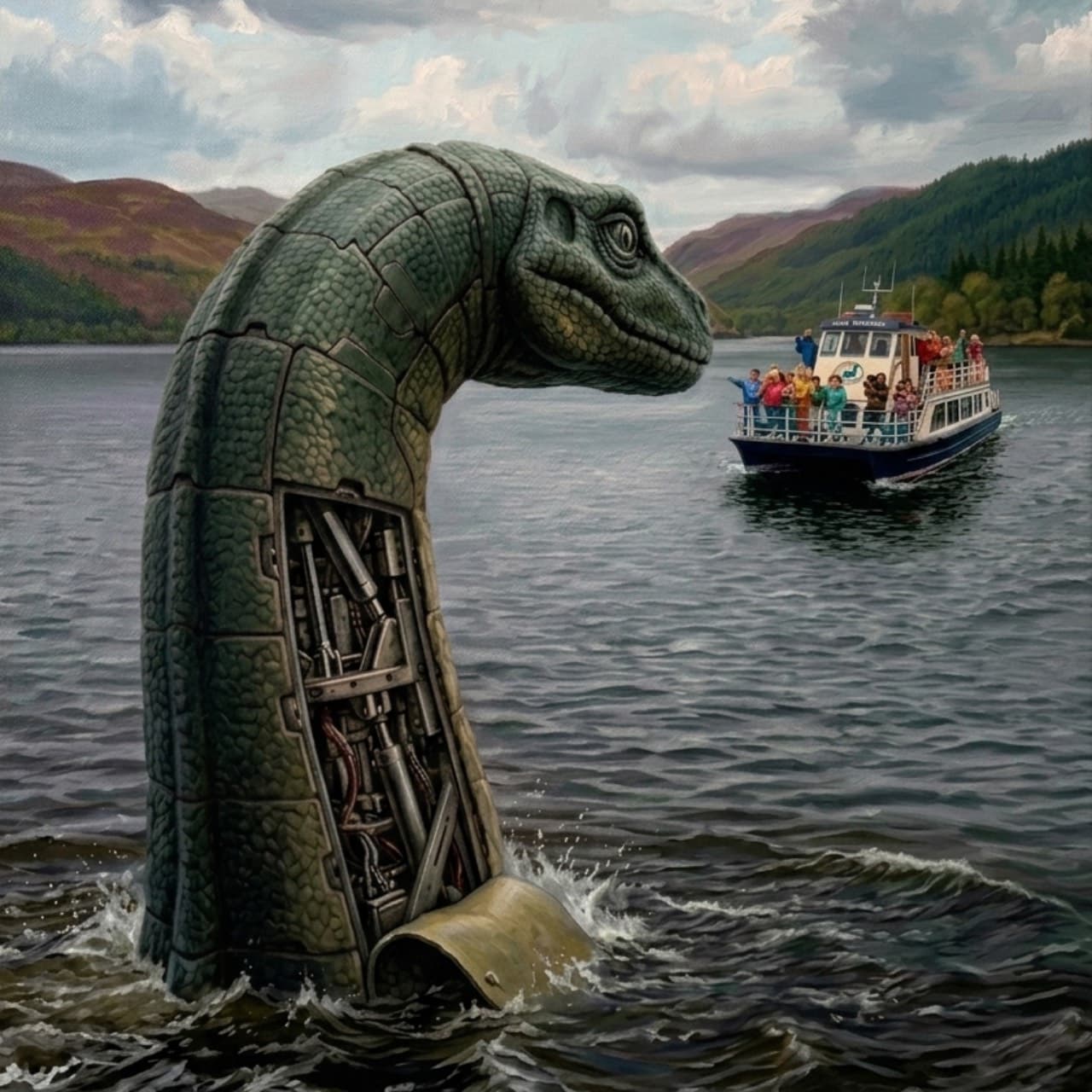

Having changed out of his fisherman’s clothes into his uniform and stowed away the disguise in his locker, the commander poured himself a cup of coffee from the vending machine. Taking a sip from his cherished mug dating back to the days of the Mark I, he slowly opened the door to the Control Room, deliberately giving his subordinates enough time to notice him and react.
“Captain in the Control Room!” barked the lieutenant. The executive officer of the secret Kelpie Base lacked experience, but he knew his service well and performed it impeccably, determined to earn an early promotion to lieutenant commander.
“At ease,” the commander replied to his deputy’s greeting (the operators traditionally did not interrupt their work to salute), then looked at the main display. The water was murky. As always, there was nothing to rely on except the instruments.
“Report.”
The commander could already see that a third of the usual circuit had been completed and that the time for the “attack” was approaching, but tradition was tradition. Listening to the report, he noted with satisfaction its precision—nothing unnecessary, nothing omitted.
The commander settled into his chair, issued a few routine steering commands to the helmsmen—not so much out of necessity as, once again, because tradition demanded it—and began preparing for the operational run. He glanced briefly at the plan. Nothing unusual. Routine work that his subordinates could handle without his involvement. Quite different were the “attacks” on fishing boats and pleasure craft, which demanded truly masterful execution. Any mistake could end in disaster—it was all too easy to capsize or ram such fragile little vessels. Fortunately, such “attacks” were carried out only rarely, no more than once every two or three seasons.
And ever since the unmanned Mark IV, operated remotely from the former headquarters of the base, had entered service, everything had become much simpler. Packed with the most advanced instruments, the drone could operate for days without returning for maintenance, recharging, or refueling. It possessed a flawless design and superb mechanical systems and could, when necessary, function entirely without human intervention. Strictly speaking, even now the operators were not actually piloting the ingenious machine—they were merely monitoring it to make sure its software suffered no malfunctions.
The engineer who had introduced the Mark IV to the crew had admired his creation and compared operating it to driving a Mars rover. But the commander preferred its predecessors. Inside their cramped compartments, he had felt every movement of the steel body with every fiber of his being, every change in speed, depth, or the engine’s pulse.
He had never actually served aboard the Mark I. It had been scrapped immediately after the war, and the commander had seen it only in photographs and scale models—a barrel-shaped hull with broad rudder fins and almost no mechanization of its primary “weapon.” The only thing he had inherited from it was his mug.
The future commander had begun his service aboard the Mark II, a far more elegant machine, with eighteen adjustable “weapon” positions that could be changed while underway. But his true love had been the Mark III, whose hull was enclosed within a special fully mechanized rubber-plastic outer skin designed by brilliant hydrodynamics specialists. It was aboard the Mark III that he had risen to the rank of commander and become commander of the base itself. He knew every one of its strengths and weaknesses and could operate it without even looking at the instruments. Yet, as an experienced officer, he understood that progress could not be stopped, and he had already begun preparing himself to hand over command to a representative of the next generation within a year or two.
Now it seemed almost funny to remember how outraged he had been when he first learned what Kelpie Base actually was. And how easily he had been persuaded after being shown the figures for the revenue that Britain—and, along with it, the Royal Navy—received thanks to this outrageous idea. They said it had first occurred to one of the admirals while he was puzzling over ways to increase the Navy’s budget. The admiral had been an obsessive collector of ancient legends, and it was precisely that hobby which had inspired the idea of building the Mark I.
Now, of course, the commander no longer regarded his work as a deception. After all, people love ghost stories and mysteries. Why not give them the opportunity to enjoy one born on the shores of an ancient Scottish loch?
The commander sighed and forced himself away from his thoughts. Thirty seconds remained before they entered the show run.
Today, Nessie was scheduled to raise her head and neck above the surface for exactly three seconds.
Viacheslav Sannikov "Almost True". Part I "Humans"