
“Son, here’s why I called you over. I’m old, and I’m going to die soon. Don’t interrupt your father; I know what I’m saying. I’ve seen death as many times as I’d like to see millions in my bank account. I can recognize death, and I’m not afraid of it. I’m afraid that I won’t have time to tell you this story.
“Maybe I wouldn’t have dared before. But since Hollywood went ahead and made a movie about it, I figure it’s okay. Yes, yes, a goddamn movie! They had me sign a non-disclosure agreement on a piece of paper so terrifying that, I swear to God, I almost crapped my pants. Nowadays, I definitely would. In this lousy nursing home, every second person wears diapers, and so do I. But that’s not the point. So—the paper, yeah.
“We signed one before, and then another one after. And believe me—both of them smelled of a firing squad and the electric chair. And that was the best-case scenario. And now people watch a movie about it! They watch it and scarf down popcorn. Or they don’t watch it and grope girls. That’s why I decided to tell everything. There isn’t a single word of truth in that damn movie. Which movie? Well, you’re the one who took me to see it. Last year, back when they still let your old man out on shore leave from this barge of lepers. The Philadelphia Experiment. What? Of course I was in it, that’s what I’m talking about. No, don’t write this down. Just remember it. You do have a memory, don’t you? Or did they only teach you how to count money at your university?
“I don’t know how things went on the Eldridge, but they sent two eggheads aboard our boat for this business. Turned out to be decent guys. In glasses, yeah. One of them confessed to me later that they were just plain glass. Wore them just to look important, yeah. Well, I could understand that. I was the youngest officer on that cursed submarine. They only shoved my diploma into my hands because of the war. Otherwise, I would’ve been studying for another year. The moment I got into the Navy, I started growing out my mustache and beard. I know, damn it, that I’ve told you this a hundred times. Are you in a hurry? You come to see your old man three times a year, and maybe you’re seeing him for the last time—and you’re in a hurry somewhere? The old man wants to tell you something that nobody else knows, to spit on his signature under the papers stamped with the Washington turkey, and you’re already bored? What? I won’t get worked up if you stop working me up and quit fidgeting in that chair.
“It was forty-three. We’d already gone out on patrol five times that year. And that’s not counting standing watch. When they told us that the Sea Wolf had been chosen for the experiment, we were thrilled. Oh, we were riding high, yeah. You think everyone was a hero like in the movies? We wanted to live. In a war, if the bombs aren’t falling, that’s a vacation. Training attacks, experimental equipment—anything, as long as people weren’t trying to kill you every single minute. Yeah. So, these eggheads—one was called Mr. Oxford, the other Mr. Chelsea. Fake names, of course. Who’d give us their real ones? They unloaded all our torpedoes and crammed the torpedo room full of their gear.
“For a week we sailed back and forth along the coast—submerged and on the surface. And then came October 23rd. I remembered it, yeah. I had nothing to do, so I was hanging around the control room. We were making a mock attack on that very Eldridge. The Skipper was staring into the periscope, Mr. Oxford was stuck in the torpedo room, and Mr. Chelsea was standing next to Nelson—our one-eyed navigator—whispering instructions to him. And then something happened. The Skipper said the Eldridge just vanished. Completely vanished. There was no glow—no blue, no green. And Norfolk disappeared, too.
“Our Skipper was a real old salt. He’d already hit twenty-seven. For a submariner in the war, that’s an ancient age.
“So, our Skipper. He didn’t start panicking or shaking. He just got even meaner. We surfaced and looked around. I went up to the bridge myself then. There was a coastline, but it definitely wasn’t Norfolk. There was no city at all. Just sand, greenery, heat. And daytime. You see what I mean? We started this whole circus in the morning. Around nine o’clock. And it was October. But here, the sun was at its zenith. And a heat like I’d never seen even in summer.
“Naturally, the Skipper and Nelson took the eggheads by the throat. I almost felt sorry for them. They were sweating them this way and that. But even though they were four-eyes, they didn’t turn out to be yellow. They kept denying everything until our pirates told them they were about to make them walk the plank. They dragged them out onto the deck, and the Skipper pulled his Colt out of its holster. And he made such a ferocious face—it was terrifying. Well, they forgot all about military secrets. Started muttering something about electromagnetic radiation, about the warping of space. The whole idea, they said, was to keep the Eldridge from picking us up on radar or sonar. And they, on the destroyer, I mean, were supposed to jam us so we couldn’t see them. But what ended up happening and why—they had no clue.
“The Skipper calmed down, sent the four-eyes back to their lair to figure out their gadgets—something had fried down there—ordered everyone inside, and dove to periscope depth until nightfall to stay out of trouble. While all this was going on, we tried to contact headquarters by radio. No dice—total silence on the airwaves. No signals at all. No military, no civilian. It was as if Marconi had never existed.
“As soon as it got dark, we surfaced again. The Skipper and Nelson set about fixing our position—by instruments and by the stars. The engines were shut down; we were just drifting in the sea. I looked over and saw our navigators whispering among themselves, and all three of their eyes between the two of them were as wide as portholes. So I walked up and told them to cough it up, tell me what was wrong. They grimaced, but after all, I was an officer. Well, they said, believe it or not, but this doesn’t smell like Norfolk, or the Chesapeake Bay, or even the Atlantic. By all accounts, we’re in the Persian Gulf or something like it.
“You get it, right? What a total nightmare dropped on our heads. I tugged at my beard, nodded, and thought to myself—we’ve got some real H.G. Wells going on here. Throwing a fifteen-hundred-ton submarine that kind of distance was, as far as I could tell, the discovery of the century. Believe it or not, despite the whole situation, I already started dreaming about how our Mr. Oxford and Mr. Chelsea could use this trick to send a bomb—one to Adolf, another to Tojo. A little present. Yeah.
“Anyway, we spent the rest of the night sitting on the bottom—away from trouble—and in the morning the Skipper decided to come up a bit. What if some allies turned up? No. Not a single steamer. Only wooden tubs under sail. So as not to catch their eyes, we just hung around at periscope depth. Luckily, it started to storm. The sailboats hid away, and we were able to surface properly. To have a smoke, catch our breath. That storm was nothing to us—we’d been in worse. Listen, listen. Here comes the best part.
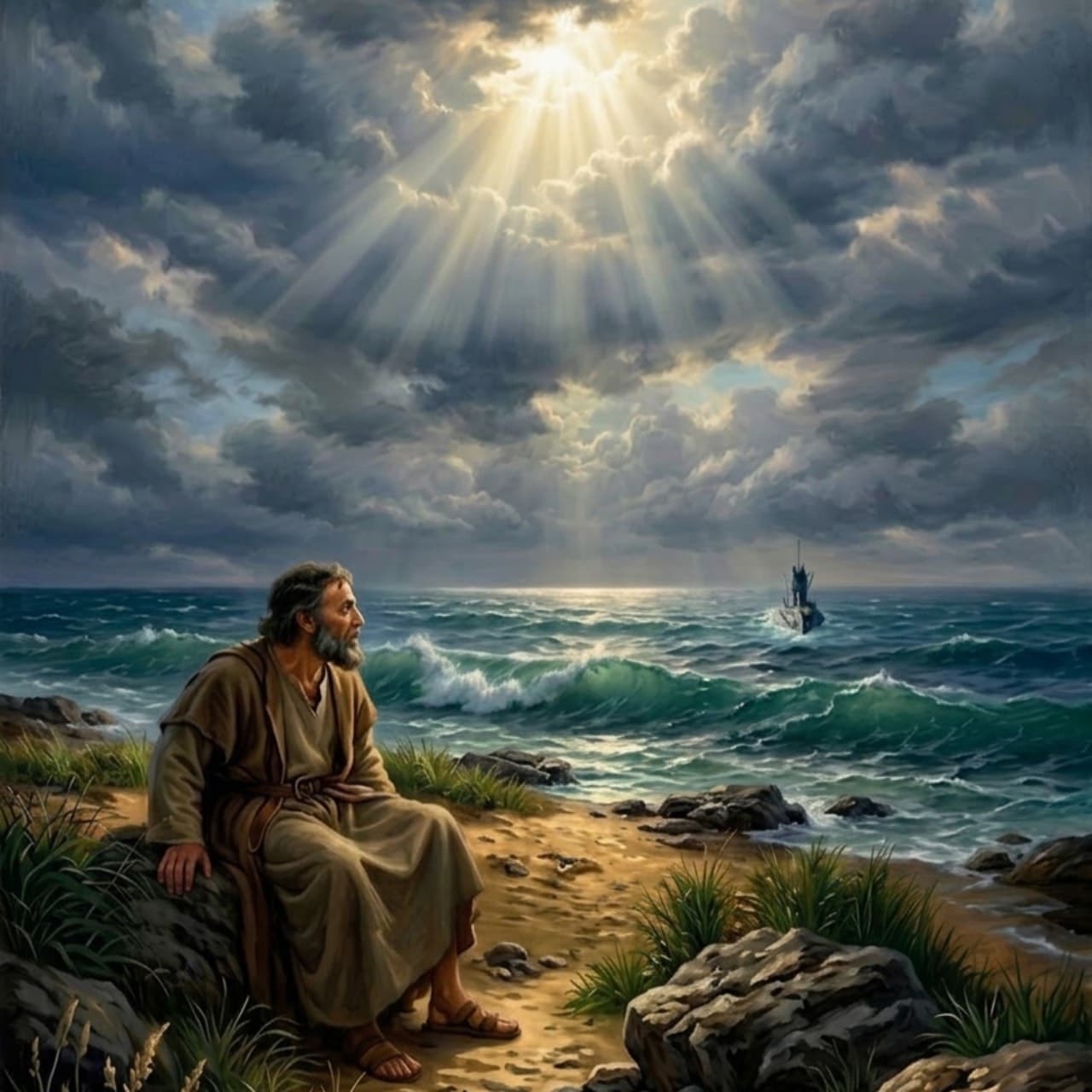
“We’re standing on the bridge, smoking. Suddenly we look out—there’s a man floundering in the sea. About fifty yards away from us. Looks like he fell off one of those wooden tubs under sail. And we could see clearly that he was about to go under—he could barely move his arms. I’ve seen enough drowning men to know what I’m talking about. Well, our Skipper immediately ordered ‘Forward!’ Secrecy was one thing, but a man overboard is sacred. We would’ve fished out a Jap, let alone a peaceful native.
“What can I tell you? A not-so-old guy in some kind of robe—like a cloak with a belt. Shaggy. Hook-nosed. Already unconscious. He’d swallowed a bit of water, but he was alive and breathing. We dragged him into the sickbay and locked him in. Who knows what kind of local bugs you could catch from him, you know how it is. And besides—a savage has no business running around a warship.
“About two hours later, the guard comes running—our rescued man is awake. I walk up to the door and stop dead in my tracks. Our drowning victim is praying. In Hebrew! Can you picture that? You know I was an atheist before the war. Precisely because of the cheder your grandfather David forced me to go to. We had a real American cheder—spacious, bright, and they didn’t beat the students with a strap, but I wasn’t exactly diligent and often got a smack on the back of the head from the melamed. How I hated him back then! But that day, standing by the sickbay door, I was grateful to Rebbe Waltzman. I heard the prayers of the man kneeling with dried seaweed in his tangled hair, and my heart was pounding like crazy.
“Thanks to the man praying in my sickbay, I understood everything right away. At first, they didn’t believe me. But our eggheads scratched their heads, scribbled a dozen formulas in their notebooks, and announced that my words explained everything, and now they knew how to tune their gear.
“It took them another twenty-four hours to get everything sorted, and we came back home. Though, for some reason, we ended up in the port of Baltimore.
“But before we returned, I waited until our guest, exhausted from his endless prayers and lamentations, fell asleep, and put him under with some basic ether anesthesia. I was afraid to put him under too deep, and once he was out in the fresh air, he came to a little, his bleary eyes tracing the conning tower, the hull, and our emblem—a killer whale with torpedoes in its flippers.
“It took the inflatable motorboat an hour to take him to the beach and get back. The sailors carried our guest further up from the shoreline—onto the grass under the trees, just in case: who knew when he’d wake up.
“Of course, we wrote a ton of reports, answered a hundred thousand questions in a thousand interrogations and medical exams. And then we signed another terrifying paper and went right back to fighting the war. What did you think? There was a shortage of experienced submariners. Mind you, they didn’t give us the Sea Wolf back. And we never ran into our eggheads again. But judging by what I’ve read over my lifetime—they and their buddies visited plenty of other places. Oh, yeah, you did figure out the name of that poor devil we pulled out of the water, right? What he called himself in his prayers? You didn’t? Well, I hope you’re not that slow at your job. His name was Jonah...”
Viacheslav Sannikov "Almost True". Part I "Humans"