
Only during the first night’s halt, after checking the mooring lines, the anchors, and the sentries, with the snores of his exhausted and drunken companions filling the darkness, was he finally able to piece together the scattered fragments of the day into a single mosaic.
The greatest day of his life.
There they were, sailing into a harbor ravaged by the wrath of the sea god who had turned away from his own children. The wreckage of ships and shattered buildings was their only obstacle; the stench of sea creatures left to rot ashore and of the dead inhabitants of the land was their only enemy.
There he was among his companions, carrying the same spear, shield, and helmet as they did (only the royal sword of sky-metal marked him as more than an ordinary hoplite—as their leader), almost running with a springing stride through the ruins of what had once been two-story houses, while the island’s inhabitants wandered among the debris, clearing away the rubble with complete indifference to everything around them.
There stood the palace—damaged, but not collapsed as the raiders had feared (they had no desire whatsoever to dig through ruins in search of treasure). And memory showed him the proper entrances—for day after day he had spoken with the fugitive master builder who had constructed it. Then came the brief, fierce fight through the maze of passages and corridors against the palace guards—experienced, skillful, and excellently armed, yet too few in number and caught completely by surprise, and therefore quickly overcome.
No one here had expected a raid from a handful of vassals who had paid tribute for generations. No one imagined that murderers and plunderers were hurrying toward the palace, rather than the inhabitants of the subject cities who had come to offer help, carrying weapons only for protection on the road.
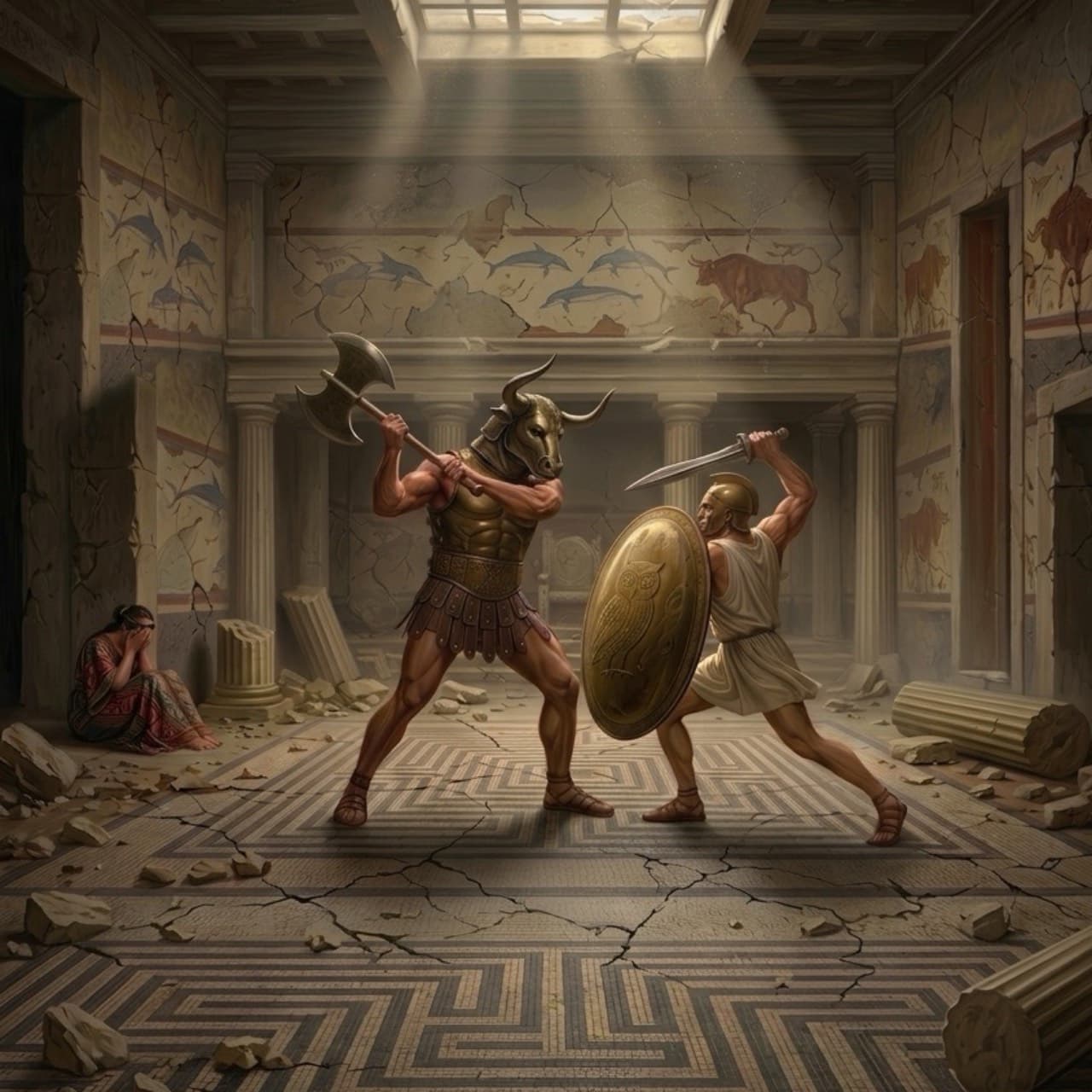
Then came the duel with the enemy prince.
It did not last long, for the arrogant giant had donned his famous horned helmet, which left him with almost no peripheral vision in the dimly lit hall. A sidestep to evade the swing of the heavy labrys, a thrust of the “heavenly” xiphos into his side, where the breastplate ended, and then—a merciful finishing blow to the neck.
After that came the plunder. The road to the secret treasuries was shown by the king’s own daughter, who sought protection from the leaders of the raiders and was therefore willing to do anything to avoid the fate that usually befell the women of fallen cities. She had no idea that the attackers were only a tiny band, and that they had no interest in women. Gold and escape were their desires—not lust.
How they gathered the spoils, how they herded the unfortunate inhabitants of the palace toward the sea to force them to carry the loot, even how they set sail again—he could not remember. He came back to himself only once they were already at sea, when another swallow of wine finally drove away the fever of battle.
Only then did he realize that everything had succeeded.
The vengeful monster was dead. Its sister, now a trophy of war, lay curled up in terror at his feet. And the bronze helmet in the shape of a bull’s head, which had inspired fear in the people of every city along the coast, now stood impaled upon a pike beside the owl figurehead on the prow.
Everything seemed exactly as it should be.
And yet something gnawed inside his chest, preventing the young prince from relaxing.
Only when he cast another glance across the deck of his ship did he understand what it was.
The symbol of victory—the white sail—had, in the heat of the moment, been cut up into sacks to make packing the treasure easier.
Alas, any hope of a triumphant return to his home harbor would have to be forgotten.
Viacheslav Sannikov "Almost True". Part I "Humans"