


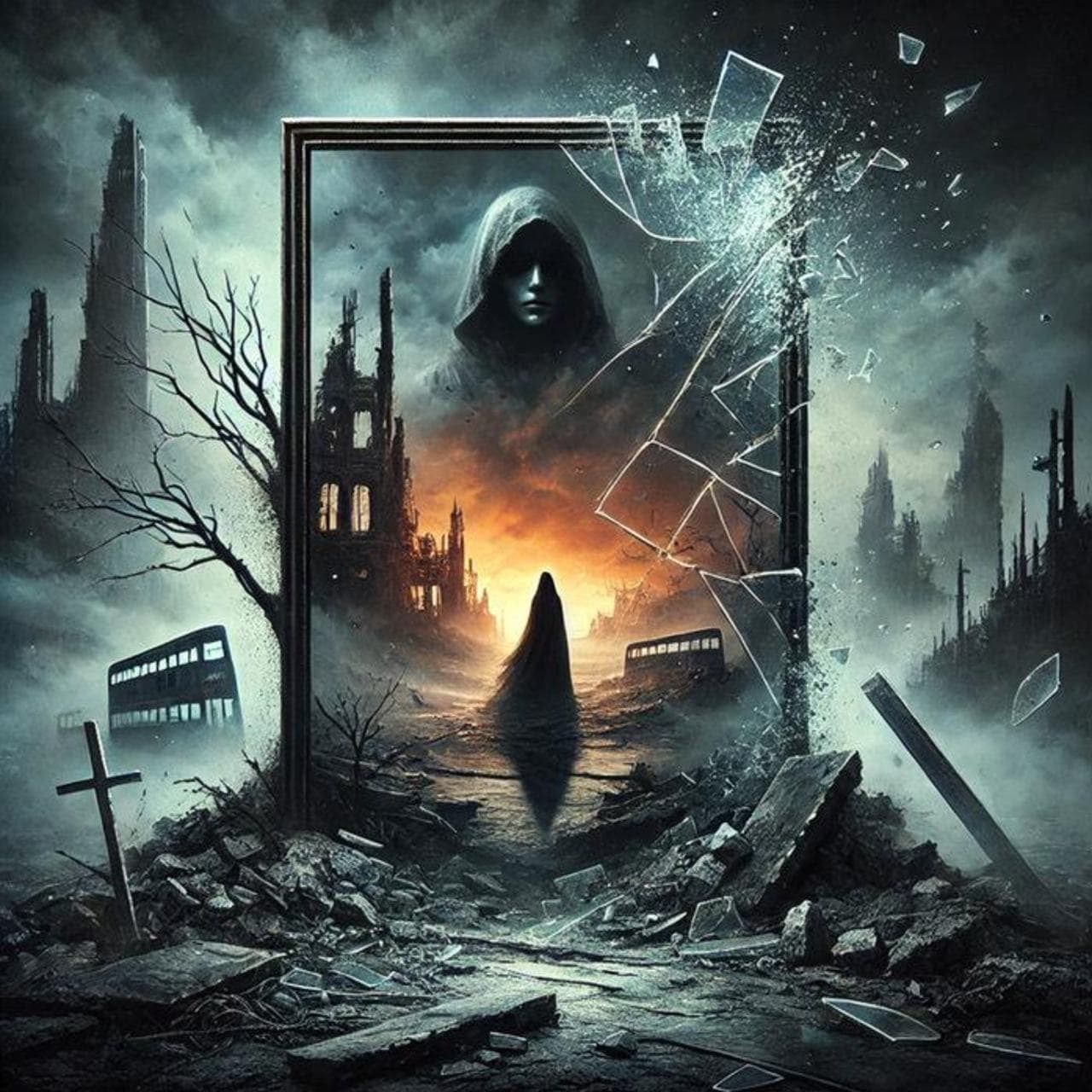

PART IV — THE CITY OF LIVING MIRRORS
Every mirror shows you the person you are.
But somewhere, on the other side of the glass, there is someone who has been waiting to take your place.
Chapter One — The City That Stopped Breathing
At 3:17 a.m., Chennai went silent.
Not gradually.
Not like a city settling into sleep.
Every sound stopped at once.
The traffic on Anna Salai fell silent. Ceiling fans stopped turning. Dogs froze in the middle of barking. A train halted between stations, its passengers staring at the windows.
For eleven seconds, the entire city seemed to forget how to exist.
Then every mirror lit up.
In a flat in Velachery, a woman watched her reflection turn its head while she remained perfectly still.
In a hotel near the airport, a businessman saw a second version of himself standing behind him.
In a hospital, a newborn opened its eyes and began speaking in the voice of a dead doctor.
And in a small apartment on the outskirts of the city, Arjun watched his reflection smile.
He had covered every mirror in his home.
He had removed the glass from the bathroom cabinet. He had thrown away his phone's cracked screen protector. He had even covered the dark television with a bedsheet.
But his reflection had appeared in the window.
It stood on the other side of the glass, wearing his clothes and his face.
Arjun backed away.
The reflection remained still.
Then it lifted its hand and pressed its palm against the window.
A black handprint appeared on Arjun's side of the glass.
Arjun had not touched it.
His phone rang.
The screen displayed an unknown number.
He answered without speaking.
A little girl whispered, “Anna?”
His blood ran cold.
“Ananya?”
“No,” she replied. “It's Meera.”
He remembered the missing child from Vellimalai.
“Where are you?”
“Inside my house.”
“Are your parents with you?”
There was a long pause.
Then Meera whispered, “They're here.”
“Then why are you calling me?”
“Because they look like my parents.”
A faint sob escaped her.
“But they don't know my name.”
The call ended.
Arjun looked toward the window.
His reflection was gone.
In its place, someone had written a sentence on the glass.
SHE IS THE FIRST ONE WHO REMEMBERS.
Below it, a second line slowly appeared.
FIND HER BEFORE WE DO.
Chapter Two — Apartment 13B
Meera's address was in an old apartment complex near Tambaram.
Arjun reached the building just before dawn. The security gate stood open, and the watchman's chair was empty.
The lift was out of service.
He climbed the stairs.
On every landing, a mirror hung beside the apartment numbers.
Every mirror had been covered with newspaper.
Except one.
Apartment 13B.
The door was unlocked.
Inside, the television was playing cartoons. A plate of breakfast sat on the dining table. Two cups of tea stood beside the sofa.
A man and a woman sat facing the television.
They looked like Meera's parents.
“Excuse me,” Arjun called.
Neither moved.
He approached the sofa.
The woman's eyes were open, but she wasn't blinking.
The man's hands rested on his knees.
Their faces were peaceful.
Too peaceful.
Arjun stepped in front of them.
“Where is Meera?”
The man slowly turned his head.
“We don't have a daughter.”
Arjun felt his stomach tighten.
“She's seven years old. She called me.”
The woman smiled.
“We don't have a daughter.”
They spoke together.
The television suddenly switched to a black screen.
In its reflection, Arjun saw the couple sitting motionless.
But behind them stood a little girl.
Meera.
She was pointing toward the kitchen.
Arjun spun around.
The kitchen was empty.
He looked back at the television.
Meera had moved closer to the reflected couple.
Her mouth was open in a silent scream.
Arjun rushed toward the kitchen.
Behind the refrigerator, he discovered a narrow door that should not have fitted inside the apartment.
It was made of black wood.
A child's handprint marked the center.
He pulled it open.
Beyond it lay a corridor stretching into darkness.
At the far end, Meera stood beneath a flickering light.
“Meera!”
She shook her head.
“Don't come here.”
“Why?”
She looked over her shoulder.
Something was standing behind her.
Something tall.
Something with a face that changed every time the light flickered.
Meera began to cry.
“Because I can see your reflection here.”
Arjun stopped.
“What does it look like?”
The little girl stared at him.
“It looks like you.”
She swallowed.
“But it's much older.”
The light went out.
When it returned, Meera was gone.
And the corridor was filled with hundreds of identical doors.
Behind every door, someone was knocking.
Chapter Three — The Woman in the Records
Arjun escaped the apartment with a single object: a photograph he had found beneath Meera's pillow.
It showed a family standing outside a house.
The house was not Blackthorn House.
It was older.
Its walls were made of dark stone, and its windows were narrow vertical slits. Above the entrance was a circular symbol resembling an eye.
The family consisted of a man, a woman, and three children.
The youngest child had no face.
On the back of the photograph was a name:
DR. V. RAJAN — 1897.
Arjun took it to a historian named Dr. Nandita Raman, who researched old medical records and colonial-era archives.
She studied the photograph for several minutes.
“Where did you get this?”
“From a missing child.”
Nandita looked up sharply.
“You need to tell me everything.”
Arjun did.
He told her about Blackthorn House, the well, the three children, and the reflections that had begun appearing throughout Chennai.
When he finished, Nandita opened a locked drawer.
Inside lay a stack of newspaper clippings.
One headline read:
VILLAGE EVACUATED AFTER MASS DISAPPEARANCE — 1897.
Another:
DOCTOR CLAIMS MIRRORS ARE DOORS TO ANOTHER WORLD.
The final clipping was a handwritten page recovered from a burned building.
Nandita placed it on the desk.
“This was written by a man named Dr. Varadarajan Rajan. According to the records, he disappeared in 1897.”
Arjun stared at the date.
“That was more than a century ago.”
“Yes.”
She pointed at the photograph.
“The man in this image is supposed to be him.”
Arjun looked again.
The face was unmistakable.
The same man who had appeared in the hospital.
The same man who had worn his face.
Nandita turned the page.
The handwriting read:
The mirror does not reflect the world.
It reflects the world that would exist if every human choice had been reversed.
The dead are not dead there.
The unborn are not unborn.
And the forgotten have never been forgotten.
Arjun continued reading.
We believed the first reflection was an imitation.
We were wrong.
The reflection came first.
His hands began to shake.
Nandita pointed to the last paragraph.
The original man is the shadow.
The reflection is the thing that casts it.
Arjun looked up.
“What does that mean?”
Nandita closed the file.
“It means we may have misunderstood everything.”
Before he could respond, her computer screen switched on.
A black-and-white photograph appeared.
It showed Nandita standing beside Arjun in the office.
But the photograph had been taken from inside a mirror.
Behind them stood Dr. Rajan.
He was holding a small notebook.
And on its cover was Nandita's name.
She stood up so quickly that her chair fell over.
“Turn off the computer!”
Arjun pulled the power cable.
The screen remained illuminated.
Dr. Rajan lifted the notebook.
He opened it.
On the first page was a photograph of Nandita as a little girl.
Beneath it were three words.
SHE OPENED IT.
Nandita began to tremble.
“I've seen him before,” she whispered.
Arjun stared at her.
“When?”
She looked at the dark screen.
“When I was six.”
Chapter Four — The Childhood Memory
Nandita sat down slowly.
“When I was a child, my grandmother had an antique mirror in her bedroom. She told me never to look into it after sunset.”
“What happened?”
“One night, I woke up and saw a little girl standing inside it.”
“Was it your reflection?”
Nandita shook her head.
“It was me.”
She explained that the girl had looked exactly like her, down to the small scar on her chin.
The girl had been crying.
She kept tapping the inside of the glass.
Nandita had touched the mirror.
The girl had pressed her palm against hers.
Then the girl whispered something.
“Do you remember what she said?” Arjun asked.
Nandita closed her eyes.
“She said, ‘Thank you for keeping my place warm.’”
A silence followed.
“Did you tell your grandmother?”
“Yes.”
“What did she do?”
“She smashed the mirror.”
Nandita opened her eyes.
“The next morning, my grandmother called me by another girl's name.”
“What name?”
“Aadhi.”
Arjun stood up.
The room seemed to shrink around him.
“Are you sure?”
Nandita nodded.
“She called me Aadhi for three days. Then she returned to normal. But she never allowed me near a mirror again.”
Arjun looked at the photograph of Dr. Rajan.
The name Aadhi had appeared in his own nightmares.
The name of the third child.
The child who had never been born.
“What if Aadhi isn't the creature's name?” Arjun asked.
Nandita stared at him.
“What do you mean?”
“What if it was the name of the first person who ever looked into the mirror?”
For several seconds, neither spoke.
Then Nandita opened the oldest newspaper clipping.
The article described a village that had existed before Vellimalai. Its inhabitants had worshipped a mysterious figure they called the First Witness.
According to the account, the Witness had been a child born without a shadow.
The villagers believed the child could see the dead before they died.
One morning, the child disappeared.
Every mirror in the village shattered.
And every newborn born that year had the same mark on its chest.
A black circle with a small line through the center.
Arjun looked down at his wrist.
The mark had returned.
Nandita stepped away from him.
“Arjun…”
He looked up.
Her reflection in the computer screen was no longer sitting.
It was standing.
And it was pointing directly at him.
The reflection's lips moved.
Arjun read the words.
SHE REMEMBERS ME.
Nandita turned toward the screen.
Her reflection smiled.
Then it reached through the glass and grabbed her by the throat.
Chapter Five — The First Witness
Arjun pulled Nandita away from the screen.
The reflection's fingers stretched impossibly far through the display. They were thin, pale, and jointed like the legs of an insect.
Arjun seized a metal desk lamp and struck the screen.
It shattered.
The hand vanished.
Nandita collapsed, gasping for breath.
On her neck were five black marks.
Fingerprints.
She stared at them.
“It knows where I am.”
Arjun helped her stand.
“Who is the First Witness?”
Nandita shook her head.
“I don't know.”
“Then we find out.”
They spent the next twelve hours searching old records, archived letters, and temple inscriptions.
Near midnight, Nandita found a palm-leaf manuscript translated by a historian in the 1940s.
Its title was The Testament of the First Witness.
The manuscript described a child named Aadhi who lived before the construction of the oldest village in the region.
Aadhi had been born during a solar eclipse.
His mother died during childbirth.
His father claimed that the child had opened his eyes before he had taken his first breath.
But the most disturbing detail came later.
Aadhi had no reflection.
Instead, every reflective surface showed a different person standing behind him.
At first, the villagers believed Aadhi was blessed.
They brought him sick relatives, dying elders, and missing children.
Aadhi would look into a bowl of water and tell them where the lost person could be found.
Sometimes he was right.
Sometimes the person returned.
But after several years, the returned people began behaving strangely.
They no longer recognized their families.
They forgot their own names.
And every night, they gathered outside Aadhi's house, staring at the windows.
Eventually, the villagers discovered that the returned people had no reflections.
The manuscript ended with a warning.
The Witness does not see the dead.
He sees those who have been replaced.
Arjun read the sentence aloud.
Nandita turned the page.
The final entry had been written in a different hand.
When Aadhi looked into the first mirror, he saw not his reflection, but the face of the world before it was born.
He asked the mirror who lived there.
The mirror answered:
“Everyone who has ever been forgotten.”
Nandita looked at Arjun.
“What if the other world isn't a copy of ours?”
Arjun's voice was barely audible.
“What if it's where all the people who were erased have been living?”
At that moment, every screen in the room turned on.
Phones.
Laptops.
Monitors.
Even the digital clock on the wall.
Every screen displayed the same image.
Aadhi stood before a gigantic mirror.
Behind him stretched a city full of buildings, roads, temples, and houses.
But every building was empty.
Every road was deserted.
Every window reflected a face.
Aadhi raised his head.
For the first time, he looked directly at Arjun.
And spoke.
“You have found my name.”
The screens went black.
Then Nandita's phone rang.
The caller ID showed her own name.
She answered.
A little girl whispered:
“Grandmother is awake.”
Nandita began to cry.
Because her grandmother had been dead for twenty years.
Chapter Six — The House That Never Existed
Nandita led Arjun to an abandoned property on the outskirts of the city.
She had inherited it from her grandmother but had never visited it.
The address appeared on the back of the manuscript.
When they arrived, the building looked like an ordinary old house.
Dust covered the windows.
Weeds grew through the courtyard.
The front gate hung open.
But the building had no entrance.
Where the front door should have been was a smooth stone wall.
Nandita touched it.
The wall was warm.
Arjun pressed his palm against the surface.
Something pressed back.
They stepped away.
A faint line appeared in the stone, outlining a door.
Then a handle emerged.
Nandita began to cry.
“My grandmother told me never to come here.”
Arjun gripped the handle.
“Why?”
“Because she said the house was built for someone who never existed.”
The door opened.
Inside was a narrow corridor.
The walls were covered with photographs.
Thousands of them.
Every photograph showed a person standing beside an empty chair.
Some were old portraits.
Others were modern photographs taken on mobile phones.
Arjun saw families, schoolchildren, couples, office workers, and strangers.
In every image, the empty chair had been positioned beside the person as if someone were meant to be sitting there.
At the end of the corridor stood a little girl.
She looked six years old.
She wore a yellow dress.
Nandita stopped breathing.
“Grandmother?”
The girl smiled.
“No, Nandu.”
She stepped forward.
“I'm the girl you left behind.”
Nandita backed away.
The child continued.
“You remember the mirror now.”
She lifted her hand.
A thin black line ran across her palm.
“You remember touching me.”
Nandita covered her mouth.
“You were real?”
The girl nodded.
“I was real before you were.”
Arjun stepped between them.
“What do you want?”
The girl's smile disappeared.
“To go home.”
“Where is your home?”
She pointed toward the corridor.
At the far end, the walls began to move.
A gigantic mirror emerged from the stone.
Its surface was black.
Its frame was carved with thousands of names.
Arjun recognized some of them.
Ananya.
Aarav.
Aadhi.
Meera.
Nandita.
His own name.
But beneath all of them was a final inscription.
THE FIRST WITNESS IS NOT THE CHILD WHO LOOKS INTO THE MIRROR.
The words began to change.
Letters shifted.
The stone groaned.
The inscription rewrote itself.
THE FIRST WITNESS IS THE ONE WHO LOOKS OUT.
Nandita turned toward Arjun.
“What does that mean?”
He stared into the black mirror.
A face appeared.
Not Aadhi's.
Not his own.
It was the face of a very old woman.
She wore a white sari and carried a newborn baby.
Arjun recognized her from the photographs.
His grandmother.
She looked directly at him.
Then she whispered:
“Arjun, I need you to do something for me.”
He stepped closer.
“What?”
His grandmother began to cry.
“Whatever happens next…”
The mirror cracked.
“…don't let your mother give birth.”
The entire house shook.
Nandita screamed.
And from somewhere behind the mirror came the sound of a woman in labour.
Chapter Seven — The Birth of the World
The scream continued for what felt like hours.
Arjun stood before the mirror, unable to move.
His grandmother's image had vanished.
In its place was a hospital room.
His mother lay on a bed, her hands gripping the sheets.
The doctor stood beside her.
Two newborn babies cried in their cradles.
Then the third heartbeat began.
Arjun pressed his hands against the glass.
“No,” he whispered.
The image was not a memory.
It was happening now.
His mother turned toward the mirror.
She looked directly at him.
“Arjun?”
He froze.
She could see him.
His mother reached toward the glass.
“Please help me.”
Arjun tried to break the mirror.
The iron knife bounced off its surface.
He struck it again.
Nothing happened.
Nandita grabbed his arm.
“It's not a window!”
“What is it?”
“It's showing us something that hasn't happened yet.”
The hospital room flickered.
The doctor lifted the first baby.
Then the second.
The third heartbeat grew louder.
The mirror began to vibrate.
Aadhi appeared beside Arjun.
He looked like a little boy now, frightened and exhausted.
“You must stop the birth,” Aadhi whispered.
“How?”
“Destroy the first reflection.”
“What is the first reflection?”
Aadhi looked toward the hospital room.
“The moment someone first believed the reflection was real.”
Arjun stared at him.
“I don't understand.”
Aadhi's eyes filled with tears.
“Neither did I.”
The mirror cracked from top to bottom.
The hospital room disappeared.
In its place appeared an enormous, empty world.
A world with no sun.
No stars.
No people.
Only mirrors.
They stretched across an endless plain, standing upright in the darkness.
Each mirror showed a different version of Earth.
One showed a world where no one had ever died.
Another showed a world where every missing child had returned home.
Another showed a world where Arjun's mother was still alive.
And at the center stood a mirror that reflected nothing.
Aadhi approached it.
“This is where I was born.”
Arjun followed.
“Who made it?”
Aadhi shook his head.
“No one knows.”
“Then what is behind it?”
The child looked up.
For the first time, he seemed truly afraid.
“Everything that existed before the world learned to look at itself.”
The mirror began to open.
A black line appeared down its center.
From the gap came a voice.
A voice older than language.
Older than memory.
Older than the first human heartbeat.
It spoke one sentence.
“WHO GAVE THE WORLD ITS FACE?”
Arjun felt the question move through his bones.
Nandita fell to her knees.
Aadhi began to scream.
The mirror opened wider.
And behind it, something opened its eyes.
Chapter Eight — The Face Behind Everything
Arjun saw no body.
No head.
No limbs.
Only an eye so enormous that its pupil contained entire worlds.
Inside the pupil, he saw the first sunrise.
The first human.
The first house.
The first mirror.
And a child standing before it.
Aadhi.
But this Aadhi was different.
He was not frightened.
He was not lonely.
He was smiling.
The voice spoke again.
“I DID NOT CREATE THE REFLECTION.”
The eye moved.
“THE REFLECTION CREATED ME.”
Arjun could barely breathe.
The voice continued.
Before humans had mirrors, they had shadows.
Before they understood their faces, they believed another person lived inside every pool of water.
They spoke to their reflections.
They feared them.
They loved them.
They imagined the people they might have become.
And every imagined life left a trace.
Every regret created another possibility.
Every forgotten name created another person who had never been allowed to exist.
Eventually, those possibilities gathered together.
They became a world.
A world of everything that might have been.
And the first child to see that world had been Aadhi.
The eye turned toward him.
“HE DID NOT OPEN THE DOOR.”
Aadhi fell to his knees.
“HE WAS THE DOOR.”
Arjun looked at the child.
“Then why are you doing this?”
Aadhi's voice trembled.
“Because I was alone.”
The enormous eye blinked.
For a moment, every mirror in the world shattered.
Then they reappeared.
Millions of them.
Billions.
Each reflecting a different face.
Aadhi reached for Arjun.
“I wanted someone to look at me and know I was real.”
Arjun took his hand.
“You are real.”
The child began to cry.
The eye narrowed.
“THEN YOU MUST TAKE HIS PLACE.”
The ground split open.
Nandita screamed as a black force dragged her toward the mirror.
Arjun held onto Aadhi.
“What happens if I refuse?”
The voice answered.
“THEN EVERY REFLECTION WILL BECOME A DOOR.”
Arjun saw Chennai.
He saw the world.
Every window.
Every puddle.
Every polished surface.
Every human eye.
All of them opening.
He understood the choice.
He could save the world by taking Aadhi's place.
Or he could refuse and allow every forgotten possibility to enter the world of the living.
Aadhi looked up at him.
“Please don't hate me.”
Arjun closed his eyes.
“I don't.”
He stepped toward the mirror.
Nandita screamed his name.
The enormous eye watched.
Arjun placed his palm against the surface.
The glass was warm.
For the first time, he saw his reflection clearly.
It was neither a monster nor a child.
It was simply him.
He whispered his name.
“Arjun.”
The mirror trembled.
He whispered it again.
“Arjun.”
The reflection repeated the name.
Then, for the first time, it spoke a different word.
“Goodbye.”
The mirror exploded.
White light swallowed the world.
And every reflection on Earth went dark.
Epilogue — The Boy in the Photograph
Three months later, Chennai had returned to normal.
The missing children had come home.
The strange phone calls stopped.
People no longer woke at 3:17 a.m.
The mirrors were ordinary again.
Or so everyone believed.
Nandita published a book about the events, but nobody accepted her account as true.
She returned to her grandmother's house and kept one photograph on her desk.
It showed three children standing together.
Ananya.
Aarav.
And Aadhi.
Arjun was not in the photograph.
Nandita stared at it every night.
Sometimes, she thought she could hear his voice.
Sometimes, she dreamed of a city made entirely of mirrors.
And sometimes, she woke to find the photograph turned face down.
On the ninety-first night, she noticed something different.
A fourth child had appeared in the picture.
He stood behind the others.
His face was blurred.
Nandita lifted the photograph toward the light.
Slowly, the blur cleared.
Arjun was smiling.
Beneath the photograph, a new line of writing appeared.
I TOOK HIS PLACE.
Nandita dropped it.
Her computer switched on.
A blank document opened.
Letters appeared one by one.
Dear Nandita,
You must not look into mirrors after midnight.
You must not speak my name.
And if you ever see a child standing behind your reflection, do not turn around.
A final sentence appeared.
Because the thing you saw was not me.
Nandita stared at the screen.
Then the cursor moved.
Another line appeared.
I AM STILL INSIDE THE FIRST MIRROR.
The screen went black.
Her reflection appeared in it.
Nandita did not move.
The reflection slowly raised its hand.
Then it pressed its palm against the glass.
From the other side, a little boy pressed his palm against hers.
He looked frightened.
He looked lonely.
He looked exactly like Arjun.
His lips moved.
Nandita leaned closer.
She heard his voice.
“Please.”
A pause.
“Don't let them forget me.”
Then something tall appeared behind the boy.
Something with an enormous eye.
Something that had been watching since before the first world existed.
The boy began to scream.
The screen shattered.
And in the silence that followed, Nandita heard a familiar sound.
Three slow knocks.
Coming from inside the wall.
Knock.
Knock.
Knock.
Then a voice whispered:
“Excuse me.”
It sounded like Arjun.
“Is this the house that breathes?”
END OF PART IV
Next: Part V — The House Outside Time
The next installment will reveal what happened to Arjun inside the first mirror, why Nandita has become the new Witness, and the existence of a house that stands outside time itself.
Somewhere beyond the reflections, Arjun is still alive.
But he is no longer the only person trapped there.