


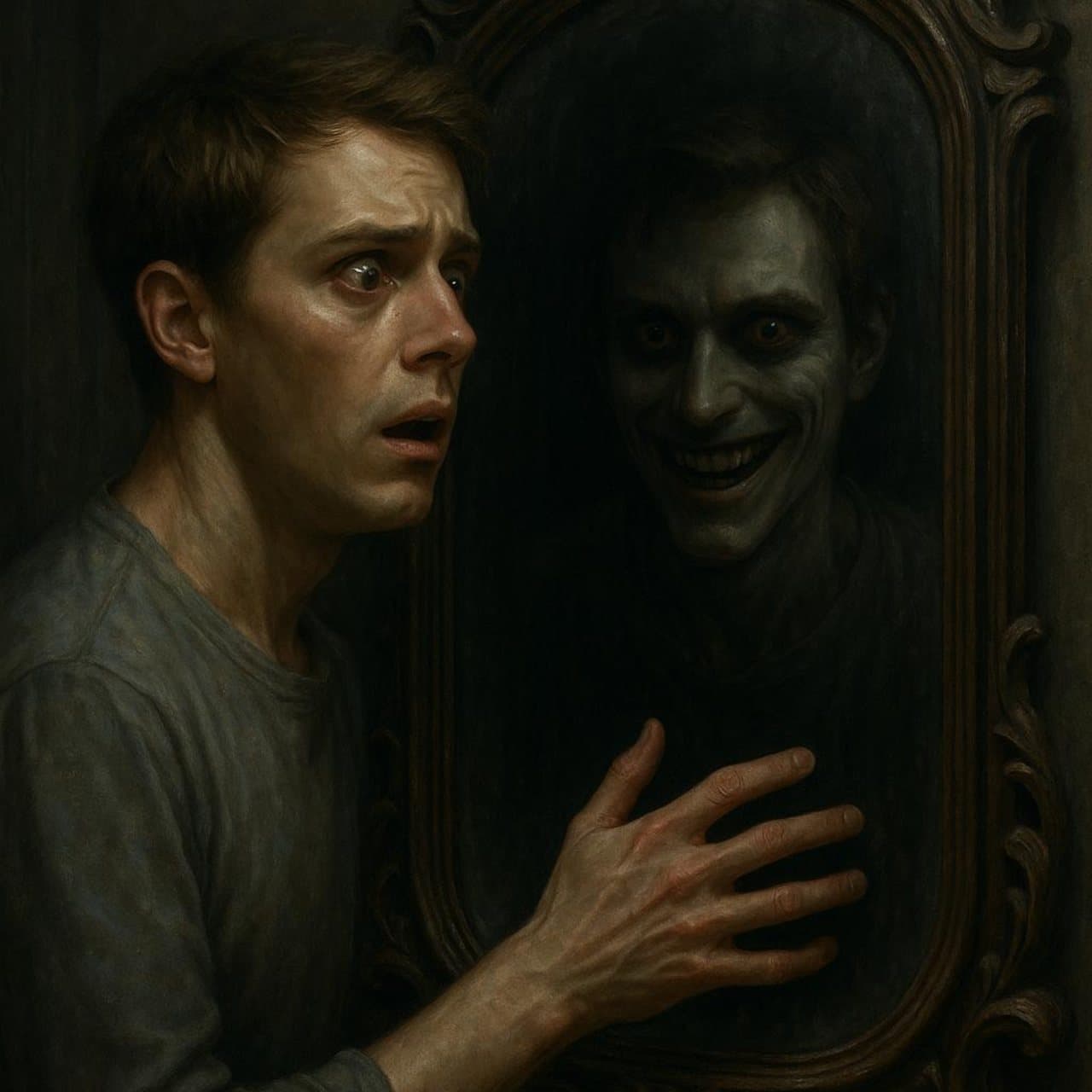

PART III — THE FACE BENEATH THE SKIN
“The most terrifying thing about a monster is not that it can wear your face. It is that one day, you may discover you were wearing its face first.”
Prologue — The Heartbeat That Wasn't His
At 3:17 a.m., Arjun opened his eyes.
He was lying on the stone floor of the ancient temple. His clothes were soaked, although no rain had entered the building. The air tasted of rust and burnt flowers.
For several seconds, he could not remember his name.
Then he heard the heartbeat.
Thump.
Thump.
Thump.
It came from inside his chest, but it was too slow to be human.
He pressed his palm against his heart.
The beating stopped.
A second later, it resumed beneath his hand.
Thump.
Thump.
Then a third heartbeat answered from somewhere beneath the temple floor.
Arjun sat up.
At the entrance, a little boy stood with his back turned toward him.
The child wore a faded hospital gown. His bare feet were covered in black mud.
“Ananya?” Arjun whispered.
The boy turned his head slightly.
“No.”
His voice was soft.
“I'm the one you forgot before you learned to remember.”
Arjun tried to stand, but his legs trembled.
“Who are you?”
The boy pointed at the bronze offering plate lying beside the altar.
“Look at your face.”
Arjun approached the plate.
His reflection appeared in the polished metal.
At first, it looked normal.
Then his skin began to move.
Something crawled beneath his cheek, travelling slowly from his jaw toward his eye. His reflection opened its mouth, but Arjun's mouth remained closed.
A thin black line appeared across the reflection's forehead.
The skin split.
Beneath it was another face.
A child's face.
Pale, motionless, and smiling.
Arjun stumbled backward.
The boy by the entrance spoke again.
“You have three days.”
“Three days for what?”
“To discover which face belongs to you.”
The temple bell rang once.
The boy disappeared.
And from inside the bronze plate came a whisper.
“Don't waste time, brother.”
Arjun looked down.
His reflection was smiling.
“I have already started wearing you.”
Chapter One — The Man Who Wasn't There
By sunrise, the villagers had found Arjun unconscious inside the temple.
Nobody wanted to touch him.
The priest's wife brought a bowl of holy water and placed it beside his head. The water turned black before it touched his skin.
An old man crossed himself.
A woman began reciting prayers.
Then a little girl stepped forward.
She was Meera, the missing child from the tea seller's house.
Her clothes were clean. Her hair was neatly braided. There was no mud on her feet.
She looked perfectly healthy.
Her father rushed toward her, crying.
“Meera! Where were you?”
The child hugged him.
“I was sleeping, Appa.”
Her father held her tightly.
The villagers began to weep with relief.
But Arjun noticed something.
Meera's father was crying.
Meera was not.
She stood in his arms, staring at Arjun with an expression far too old for her face.
When their eyes met, she whispered something.
Arjun couldn't hear it.
He stepped closer.
“What did you say?”
Meera smiled.
“I said your brother sends his love.”
Arjun's stomach twisted.
He reached for her shoulder.
The child's skin felt like ice.
“Where is he?”
Meera leaned close to his ear.
“Everywhere you aren't looking.”
Then she screamed.
Her father recoiled as she began convulsing. The villagers rushed to help. Someone shouted for a doctor.
Arjun stumbled away.
He looked toward the temple's bronze bell.
A figure stood beneath it.
A young man in a black shirt.
Tall. Thin. Barefoot.
The man had Arjun's face.
But unlike the reflection, he looked completely human.
He lifted his hand and waved.
Then he mouthed two words.
Three days.
A passing cloud covered the sun.
For one instant, the entire village went dark.
When the light returned, the man was gone.
And Meera's father was screaming.
His daughter had vanished from his arms.
All that remained was a small, wet handprint on his shirt.
Chapter Two — The Third Name
Arjun found the priest's house abandoned.
The front door hung open. Oil lamps lay overturned. A trail of black water led from the altar to the bedroom.
On the floor lay an old palm-leaf manuscript.
The priest had left a note beside it.
Read only when the third heartbeat begins.
Arjun unfolded the manuscript carefully.
Its pages were brittle and covered in Tamil script, mixed with symbols he did not recognize.
He could read enough to understand the first passage.
Before the village had a name, there was a well.
Before the well was covered, there was a mirror.
Before the mirror reflected the living, it reflected the unborn.
Arjun turned the page.
A drawing showed three children standing before a circular doorway.
The first child was surrounded by sunlight.
The second stood beneath a crescent moon.
The third had no face.
Beneath the drawing were three names.
ANANYA — THE REMEMBERED.
AARAV — THE FORGOTTEN.
THE THIRD — THE UNBORN.
Arjun stared at the final line.
The manuscript continued.
The first child carries the memory.
The second carries the wound.
The third carries the hunger.
If the three become one, the door will open.
A page had been torn from the manuscript.
On the next surviving page, someone had written a warning in red ink.
Never allow the third child to learn the first child's name.
Arjun heard footsteps behind him.
He spun around.
His mother stood in the doorway.
Her white sari was stained with mud. Her hair hung over her face.
“Amma?”
She entered slowly.
“Did you read it?”
Arjun nodded.
“Who was the third child?”
His mother began crying.
“You.”
He felt the floor tilt beneath him.
“You told me I was one of the twins.”
“I lied.”
“Why?”
She looked at him with unbearable sadness.
“Because you were never born.”
Arjun stopped breathing.
His mother continued.
“Thirty years ago, I gave birth to two children. Aarav and Ananya. Both were alive. Both were human.”
She wiped her tears.
“But while they were being delivered, the doctor heard another heartbeat. It came from inside the wall.”
“What happened?”
“The hospital mirror shattered. Every mirror in the building shattered. When the lights returned, there were three babies.”
Arjun stared at her.
“Three?”
“One was Aarav. One was Ananya.”
She took a trembling breath.
“The third had no reflection.”
Arjun backed away.
“The doctors tried to remove it from the room. But every time they carried it through a doorway, it appeared in the room behind them.”
His mother lowered her voice.
“They finally placed it inside a sealed ward and called your grandmother.”
“What did she do?”
“She took the third child into her arms.”
His mother began shaking.
“And it opened its eyes.”
Arjun could barely speak.
“What did she see?”
His mother looked directly into his face.
“Her own reflection.”
Silence filled the room.
Then she whispered the words Arjun had dreaded hearing.
“Your grandmother said the child was not a baby.”
“It was a doorway.”
Chapter Three — Beneath the Skin
That night, Arjun locked himself inside an abandoned schoolhouse on the outskirts of Vellimalai.
He covered every window.
He removed the mirrors.
He threw his phone into a bucket of water.
Then he sat on the floor with the manuscript and waited for sunrise.
At 11:52 p.m., his left hand began to itch.
He scratched his palm.
A thin black line appeared beneath the skin.
It moved toward his wrist.
He grabbed a kitchen knife and pressed the blade against his palm.
The line stopped.
Then it turned around.
It moved toward his fingers.
Arjun dropped the knife.
His skin began to bulge.
Something was crawling beneath it.
He watched in horror as five tiny fingers pressed outward from the inside of his palm.
A child's hand.
Trying to escape.
Arjun screamed and struck his hand against the wall.
The fingers vanished.
In their place appeared a small mouth.
It opened.
A child's voice emerged from his palm.
“Brother.”
Arjun stumbled backward.
The mouth smiled.
“You're hurting me.”
He wrapped his hand in cloth and tied it tightly.
The mouth continued speaking through the fabric.
“Do you remember the day Mother left you outside the eastern wing?”
Arjun froze.
A memory surfaced.
He was five years old.
His mother stood in a corridor holding a baby.
His grandmother was crying.
A door stood open behind them.
Inside the room, something was laughing.
His mother turned toward him.
“Don't ever open this door, Arjun.”
Then she pushed him away.
He remembered a second child standing beside the door.
A boy with black eyes.
A boy who looked exactly like him.
The memory changed.
Arjun was no longer five.
He was standing inside the eastern wing.
The boy was crying.
“Please,” the boy said. “I'm scared.”
Arjun reached for him.
Then someone grabbed Arjun from behind.
His grandmother's voice screamed:
“THAT IS NOT YOUR BROTHER!”
The memory shattered.
Arjun fell to his knees.
The mouth beneath the cloth whispered:
“Now you remember.”
He tore the fabric away.
His palm was normal.
But a new line had appeared on his wrist.
It formed a circle.
Inside the circle was a tiny black door.
And the door had a handle.
From somewhere deep inside his body came the sound of a lock turning.
Chapter Four — The Room Behind the World
At 3:17 a.m., the schoolhouse walls disappeared.
Arjun found himself standing in a corridor that stretched farther than his eyes could see.
Doors lined both sides.
Thousands of them.
Some were made of wood.
Some were made of glass.
Others looked like human skin stretched over metal frames.
Behind every door, someone was crying.
A child called for its mother.
An old man begged to be released.
A woman whispered prayers in a language Arjun had never heard.
He walked forward.
At the end of the corridor stood a black door.
There was no handle.
Only a small mirror fixed to its center.
Arjun approached it.
His reflection appeared.
It was wearing his face perfectly.
“Who are you?” Arjun asked.
The reflection smiled.
“You keep asking the wrong question.”
“What question should I ask?”
The reflection leaned toward the glass.
“Ask why you have never dreamed of being born.”
Arjun's mouth went dry.
The reflection continued.
“Ask why you have no memory of your first birthday.”
A pause.
“Ask why your mother never held you in photographs.”
Arjun remembered every photograph from his childhood.
His mother had carried him.
His grandmother had held him.
But there was something he had never noticed.
In every picture, his face was blurred.
Not slightly blurred.
Completely erased.
The reflection raised its hand.
“Your family gave you memories to make you believe you were human.”
Arjun shook his head.
“No.”
“They gave you a name.”
“No.”
“They gave you a childhood.”
“STOP!”
The reflection's expression changed.
For the first time, it looked angry.
“Then tell me, Arjun. Why does every photograph of your birth show an empty cradle?”
The corridor shook.
Doors began opening.
Behind one stood his mother, screaming.
Behind another stood Ananya, reaching through the darkness.
Behind a third stood Aarav, chained to the wall.
Arjun ran toward his brother.
But the corridor stretched.
The farther he ran, the farther away Aarav became.
“ARJUN!” Aarav shouted.
“Help me!”
Arjun reached out.
His fingers brushed his brother's hand.
Then the corridor snapped shut.
Arjun fell into darkness.
A voice spoke above him.
“You have one day left.”
It was the creature.
“You may learn what you are.”
A pause.
“Or you may become it.”
Chapter Five — The Woman Who Remembered Everything
Arjun woke in a small house at the edge of the forest.
An old woman sat beside the fire.
She had white hair, dark eyes, and a scar running from her forehead to her chin.
“You took your time,” she said.
Arjun sat up.
“Who are you?”
“The last person who remembers the first house.”
She introduced herself as Parvathi.
She claimed her family had guarded the ancient well for generations, long before Blackthorn House had been built.
Arjun showed her the manuscript.
She nodded.
“You have reached the third stage.”
“What does that mean?”
“First, it learns your voice.”
She counted on her fingers.
“Then it learns your face.”
“Then?”
“Then it learns what you believe about yourself.”
Parvathi stirred the fire.
“After that, it doesn't need to imitate you anymore.”
Arjun stared at her.
“What does it do?”
“It replaces you.”
She explained that the creature was not a ghost, a demon, or a dead person.
It was something older.
An intelligence that lived in reflections and fed on the difference between what people were and what they believed themselves to be.
It could not enter the world by force.
It needed an invitation.
A name.
A memory.
A face that someone was willing to recognize.
“Your family made a mistake,” Parvathi said.
“They believed that if they forgot the third child, it would disappear.”
“But it didn't.”
“No. Every time they denied its existence, they created a place for it inside their own memories.”
Arjun looked at the mark on his wrist.
“Can I stop it?”
Parvathi nodded.
“But you must do something your family could never do.”
“What?”
“Remember all three children.”
She leaned toward him.
“Not as monsters. Not as mistakes. As children.”
Arjun looked away.
“What if I am the third one?”
Parvathi's expression softened.
“Then you must decide whether being born from darkness means you must become darkness.”
For a moment, the fire crackled quietly.
Then Parvathi added something that made Arjun's heart sink.
“But there is one problem.”
“What?”
She looked toward the window.
The glass reflected the room.
The fire.
The old woman.
Arjun.
And a fourth figure standing behind him.
“The creature has already found a body.”
Arjun turned.
Nobody stood there.
When he looked back at the window, the fourth figure was still reflected in the glass.
It was his mother.
Her throat had been cut.
And her lips were moving.
Help me.
Chapter Six — The Face Beneath the Skin
Parvathi shattered the window with an iron rod.
The reflection disappeared.
But the image remained burned into Arjun's mind.
“Where is my mother?” he demanded.
Parvathi refused to answer.
He grabbed her arm.
“Tell me!”
She struck him across the face.
“Your mother has been dead for thirty years.”
The words silenced him.
“She died the night you were born,” Parvathi continued. “The woman you have been seeing is a memory. A memory the creature has learned to wear.”
Arjun shook his head.
“No. I spoke to her.”
“You spoke to what remembers her.”
“That's impossible.”
Parvathi pointed toward the mirror fragments on the floor.
“Look.”
Arjun stared at one of the pieces.
His face stared back.
Then his reflection slowly peeled away its skin.
Beneath it was another face.
Not a monster.
Not a demon.
A frightened little boy.
The boy's eyes were wet with tears.
“I didn't want to be born like this,” he whispered.
Arjun knelt.
“Who are you?”
The boy touched the glass.
“I'm the child they refused to love.”
The reflection began to cry.
“I wanted a mother.”
Arjun felt something inside him break.
For the first time, he felt no fear.
Only sorrow.
He pressed his palm against the mirror fragment.
“I know.”
The boy looked up.
“Will you remember me?”
“Yes.”
“Even if I look different?”
“Yes.”
The boy smiled.
The reflection's skin began to crack.
Black veins spread across its face.
Parvathi screamed.
“ARJUN, GET AWAY FROM IT!”
But Arjun didn't move.
The boy's face split open.
Behind it was an enormous darkness, filled with countless faces.
His mother's.
His grandmother's.
Ananya's.
Aarav's.
Meera's.
And thousands more.
Every face stared at Arjun.
Every mouth opened.
Every voice spoke at once.
“REMEMBER US.”
The mirror exploded.
A wave of blackness swept through the room.
Parvathi was thrown against the wall.
Arjun felt something seize his heart.
He fell to his knees.
The third heartbeat thundered inside him.
Then a voice whispered from his chest.
“Thank you, brother.”
His skin began to separate from his body.
Not tearing.
Not bleeding.
Peeling away like a mask.
Beneath it was another layer of skin.
And beneath that, another.
Each layer wore a different face.
A child.
An old man.
A woman.
A stranger.
Aarav.
Ananya.
Finally, his own face appeared beneath them all.
But it was not human.
It had no eyes.
No mouth.
Only a smooth, pale surface.
A face waiting to be given a name.
Parvathi crawled toward him.
“Arjun! Tell me your name!”
He tried to speak.
Nothing came out.
“Tell me who you are!”
He opened his mouth.
A hundred voices emerged.
Then, from somewhere far away, he heard a little girl singing.
A lullaby.
The one his mother used to sing.
Arjun closed his eyes.
He remembered Ananya.
He remembered Aarav.
He remembered the child who had never been given a name.
And he spoke.
“My name is Arjun.”
The darkness stopped.
The skin settled back into place.
The faces disappeared.
For one breath, the world became silent.
Then Parvathi whispered:
“You've made a terrible mistake.”
Arjun looked at her.
“Why?”
She pointed at the wall.
A shadow stretched across it.
It had Arjun's shape.
But the shadow was smiling.
“You gave it a name,” Parvathi said.
“And now it knows how to answer.”
Chapter Seven — The House Beneath Every House
At sunset, Parvathi took Arjun to the forest.
They reached the place where Blackthorn House had once stood.
Nothing remained except dead trees and a circular patch of black earth.
In the center was a mirror.
It stood upright without a frame.
Its surface reflected a night sky, although the sun had not yet set.
Parvathi handed Arjun a small iron knife.
“This is the last entrance.”
Arjun stared at the mirror.
“What happens if I go inside?”
“You will see the first memory.”
“And if I don't?”
“By midnight, the creature will finish becoming you.”
He looked at the knife.
“How do I kill it?”
Parvathi's eyes filled with tears.
“You cannot kill something that has no body.”
“Then what do I do?”
“You must give it something it cannot imitate.”
Arjun frowned.
“What?”
“An honest memory.”
Parvathi explained that the creature could reproduce every face, voice, and feeling it had witnessed.
But it could not create a memory of an experience it had never understood.
It could copy love.
It could copy grief.
It could copy a mother's voice.
But it could not understand why a person might choose to suffer for someone else.
“Your family tried to destroy the creature,” she said. “That only made it stronger.”
Arjun looked toward the mirror.
“So I have to accept it?”
“You must accept the truth about it.”
“And what truth is that?”
Parvathi took his hand.
“The monster is not the child who wanted to be loved.”
She paused.
“The monster is what happened when nobody answered.”
The mirror began to ripple.
From inside came the sound of a child crying.
Arjun stepped forward.
Parvathi caught his wrist.
“If you see yourself inside, do not trust him.”
Arjun looked at her.
“What if he is me?”
She released his hand.
“Then I pray you remember which of you is afraid.”
Arjun entered the mirror.
And the forest disappeared.
Chapter Eight — The First Memory
He stood inside a hospital room.
The walls were white.
The lights were bright.
A woman lay in a bed, exhausted and crying.
His mother.
A doctor stood beside her.
His grandmother held a newborn baby.
Aarav.
Another nurse carried Ananya.
Then the room became silent.
A third heartbeat sounded.
The doctor turned toward the wall.
A crack had appeared in the mirror.
Something moved behind the glass.
A small hand pressed against it.
The doctor stepped backward.
“Get the priest,” he whispered.
The mirror shattered.
But no glass fell.
Instead, a baby crawled out of the reflection.
Its body was pale.
Its eyes were closed.
It had no face.
The nurses screamed.
The doctor reached for the child.
The baby opened its mouth.
And every mirror in the hospital reflected the same image.
A woman standing in a dark house.
A child standing behind her.
And a door beneath the floor.
Arjun watched his grandmother lift the faceless baby.
For a moment, she looked at it with tenderness.
“Poor child,” she whispered.
The baby reached for her finger.
She smiled.
Then the baby spoke.
Not with the voice of an infant.
With the voice of an old man.
“Give me a name.”
His grandmother froze.
The doctor shouted for her to put it down.
But she held the child closer.
“Your name is—”
The mirror cracked.
The memory shook.
The name vanished beneath a roar of static.
Arjun tried to hear it.
He strained.
He could almost remember.
Then the memory changed.
His grandmother stood alone in Blackthorn House.
She carried the faceless child into the eastern wing.
She placed it inside a stone cradle.
Then she locked the door.
The baby began crying.
His grandmother wept.
“I am sorry,” she whispered.
She pressed her forehead against the door.
“I cannot love what I cannot understand.”
The baby stopped crying.
From behind the door came a voice.
“Then I will learn to be loved.”
The memory went black.
Arjun heard footsteps approaching.
A man appeared in the darkness.
It was the creature wearing his face.
“You see?” it said. “They feared me before I had done anything.”
Arjun said nothing.
“They locked me away.”
The creature stepped closer.
“They gave the other children names. They gave them birthdays. They gave them photographs.”
It pointed toward its chest.
“What did they give me?”
Arjun looked at the face he had worn all his life.
“Nothing.”
The creature smiled.
“Exactly.”
It opened its arms.
“Come with me, brother. We can make them remember.”
Behind the creature, thousands of doors appeared.
Each one contained a human face.
A frightened child.
A grieving mother.
A forgotten stranger.
“Together, we can open every door.”
Arjun looked at the faces.
He understood what the creature wanted.
It didn't want to destroy the world.
It wanted the world to remember it.
But its hunger had grown beyond memory.
It wanted every person to become a reflection.
Every house to become a door.
Every child to be born into the same darkness.
Arjun raised the iron knife.
“No.”
The creature's smile disappeared.
“Then you will forget me again.”
Arjun shook his head.
“No. I'll remember you.”
For the first time, the creature looked afraid.
Arjun stepped closer.
“You were a child. You were abandoned. You deserved love.”
The creature began to tremble.
“But you don't get to turn the whole world into your prison.”
Its face twisted.
“You cannot leave me alone again!”
The doors began to open.
Thousands of hands reached through.
The darkness surged forward.
And the creature screamed.
“IF I CANNOT HAVE A FAMILY, THEN NO ONE WILL!”
The mirror shattered.
Arjun fell into the well.
Chapter Nine — The Choice
The water was warm.
Arjun sank through darkness, surrounded by faces.
His mother's face floated beside him.
His grandmother's face drifted past.
Ananya reached for his hand.
Aarav appeared below him, chained to the bottom.
And the faceless child waited at the center.
Arjun swam toward his brother.
The chains tightened.
Aarav shook his head.
“Don't save me.”
“I won't leave you again!”
“You have to.”
The third child emerged from the darkness.
Its body was enormous now, stretched across the well like a spider.
Every limb ended in a human hand.
Every hand wore a familiar face.
Arjun understood.
The creature had been feeding on the village for generations.
Every missing child.
Every forgotten relative.
Every person who died alone.
Their memories had become its body.
The creature reached for him.
Arjun raised the iron knife.
But before he could strike, he heard his mother's voice.
“Arjun.”
He turned.
She stood beside him in the water.
Her eyes were full of love.
“I'm proud of you.”
He began to cry.
“I don't know if I'm your son.”
She touched his cheek.
“You are the child I held.”
“But what if I'm the wrong one?”
She smiled sadly.
“There was never a wrong child.”
The creature screamed.
The water turned black.
His mother began to fade.
“Remember that,” she whispered.
Then she disappeared.
Arjun looked at the faceless child.
“I remember you.”
The creature stopped moving.
“I remember what they did to you.”
Its hands trembled.
“But I won't let you do it to anyone else.”
Arjun opened his arms.
For the first time, he embraced the thing that had lived beneath his skin.
The creature felt cold.
Its body shook like a frightened child.
Arjun held it tightly.
“You don't have to be alone.”
The darkness began to dissolve.
The faces disappeared one by one.
The chains around Aarav broke.
Ananya appeared beside him.
For one brief moment, all three children stood together.
They looked ordinary.
They looked human.
They looked like a family.
Then the well began to collapse.
Aarav seized Arjun's hand.
“Come on!”
They swam upward.
Light appeared above them.
Arjun reached for it.
His fingers broke the surface.
He pulled himself out of the well and collapsed on the ground.
He was alone.
The mirror had vanished.
The forest stood silent.
The eastern wing was gone.
And for the first time in thirty years, Arjun's shadow lay beneath him in the fading sunlight.
He laughed.
Then he cried.
Then he whispered three names.
“Ananya.”
“Aarav.”
And the third name.
The name he had finally heard inside the first memory.
“Aadhi.”
The wind stopped.
Every tree bent toward him.
Somewhere deep beneath the earth, a door slammed shut.
Arjun closed his eyes.
It was over.
Or so he believed.
Chapter Ten — The Face in the Photograph
Three weeks later, Arjun returned to Chennai.
He rented a small apartment, bought new furniture, and threw away every mirror he owned.
He stopped visiting Vellimalai.
He stopped asking questions about his family.
He tried to live a normal life.
For the first time, he could look at photographs without feeling afraid.
He even began keeping a journal.
On the first page, he wrote:
My name is Arjun.
I was born.
I was loved.
I remember my brother and sister.
I am not a monster.
Every morning, he read the words aloud.
For a while, it worked.
Then, on the twenty-first night, he dreamed of a hospital.
A white room.
Two cradles.
A third heartbeat.
And a woman standing beside the bed.
His mother.
She held a newborn baby in her arms.
The baby had a face.
It had Arjun's face.
But when she looked down, the child had no reflection.
She began to cry.
The baby opened its eyes.
And whispered:
“Mother, why did you give me away?”
Arjun woke screaming.
His apartment was dark.
His bedside clock read 3:17 a.m.
He reached for the lamp.
It didn't work.
Then his phone lit up.
One new photograph.
No sender.
He opened it.
The image showed Arjun sleeping in his bed.
The photograph had been taken from the ceiling.
He looked closer.
Something stood beside his bed.
A tall man in a black suit.
Its face was hidden behind a white mask.
Arjun dropped the phone.
A sound came from the kitchen.
A cupboard door creaked open.
Then a little boy spoke.
“Arjun?”
He froze.
The voice came from inside his own bedroom.
“Brother?”
He slowly turned.
A small figure stood in the doorway.
Its body was covered in hospital blankets.
Its face was hidden.
Arjun backed away.
“No.”
The figure tilted its head.
“Why are you afraid?”
Arjun's throat tightened.
“I remember you.”
The child nodded.
“Then you remember what you promised.”
Arjun shook his head.
“I promised to remember you. I did.”
The child stepped into the room.
“No,” it whispered.
“You promised to let me live.”
Arjun felt his heart stop.
The child lifted its face.
Beneath the blanket was a human face.
A perfectly ordinary face.
A face that belonged to a child who had never been born.
It looked at Arjun with tears in its eyes.
Then it smiled.
“Thank you for giving me a name.”
The lights came on.
The child disappeared.
Arjun stood alone in the room.
His phone vibrated again.
Another photograph.
This one showed the inside of his apartment.
Every wall was covered with mirrors.
In the center of the room stood Arjun.
Beside him stood Aadhi.
Behind them stood Aarav and Ananya.
And behind all three children stood something much taller.
Something with no face.
At the bottom of the photograph was a message.
YOU CLOSED THE FIRST DOOR.
A second message appeared.
BUT YOU OPENED THE FIRST EYE.
Arjun looked toward the bedroom window.
Across the street, in an apartment that had been empty for years, a light switched on.
A figure stood behind the glass.
It raised its hand.
Arjun raised his own.
The figure smiled.
Then it removed its face.
Beneath it was a mirror.
And inside the mirror was a second world.
A world filled with houses.
Thousands of houses.
Every window was lit.
Every door stood open.
And in every house, someone was standing before a mirror.
Waiting.
Watching.
Learning how to smile.
Epilogue — The First Eye Opens
Far beneath Vellimalai, where no human being had walked for centuries, a black door stood in a chamber of stone.
Three names had been carved into its surface.
ANANYA.
AARAV.
AADHI.
For twenty-one days, the door had remained silent.
Then a thin crack appeared between the letters.
A single drop of black water fell from the ceiling.
It struck the ground.
The water spread into a perfect circle.
Inside the circle, an eye opened.
It blinked once.
Then a voice spoke from the darkness beyond the door.
“Three children.”
A pause.
“One memory.”
Another pause.
“One hunger.”
The eye turned toward the ceiling.
Toward the village.
Toward the city.
Toward every house where a human being slept.
“Now,” the voice whispered, “let us see who remembers me.”
Across the world, millions of people woke at exactly 3:17 a.m.
Some heard their mothers calling.
Some heard children laughing.
Some saw unfamiliar faces in their mirrors.
And some heard a voice that sounded exactly like their own.
A voice whispering a name they had never heard before.
Aadhi.
In Chennai, Arjun stood before his bedroom window.
He watched the lights switch on across the city, one apartment after another.
Then he noticed something strange.
Every illuminated window contained a person standing perfectly still.
Every person was staring at a mirror.
And every reflection was looking in the same direction.
Toward him.
Arjun stepped back.
His reflection did not move.
It remained at the window, smiling.
Then it raised one finger to its lips.
Shhh.
The reflection leaned toward the glass.
Its mouth opened.
And a voice came through.
Not from the mirror.
Not from the room.
From inside Arjun's own skull.
“You were never the one who escaped, brother.”
The lights went out across Chennai.
Every clock stopped.
And beneath the city, something enormous took its first breath.
End of Part III.
The story continues
Part IV — The City of Living Mirrors
The next chapter begins when Arjun discovers that the mirrors are no longer simply reflecting the world. They are showing a world that exists on the other side—and its inhabitants have begun replacing people one by one.
The most frightening discovery: Aadhi may not be the creature's true name. It may be the name of the very first human being who ever looked into the original mirror.