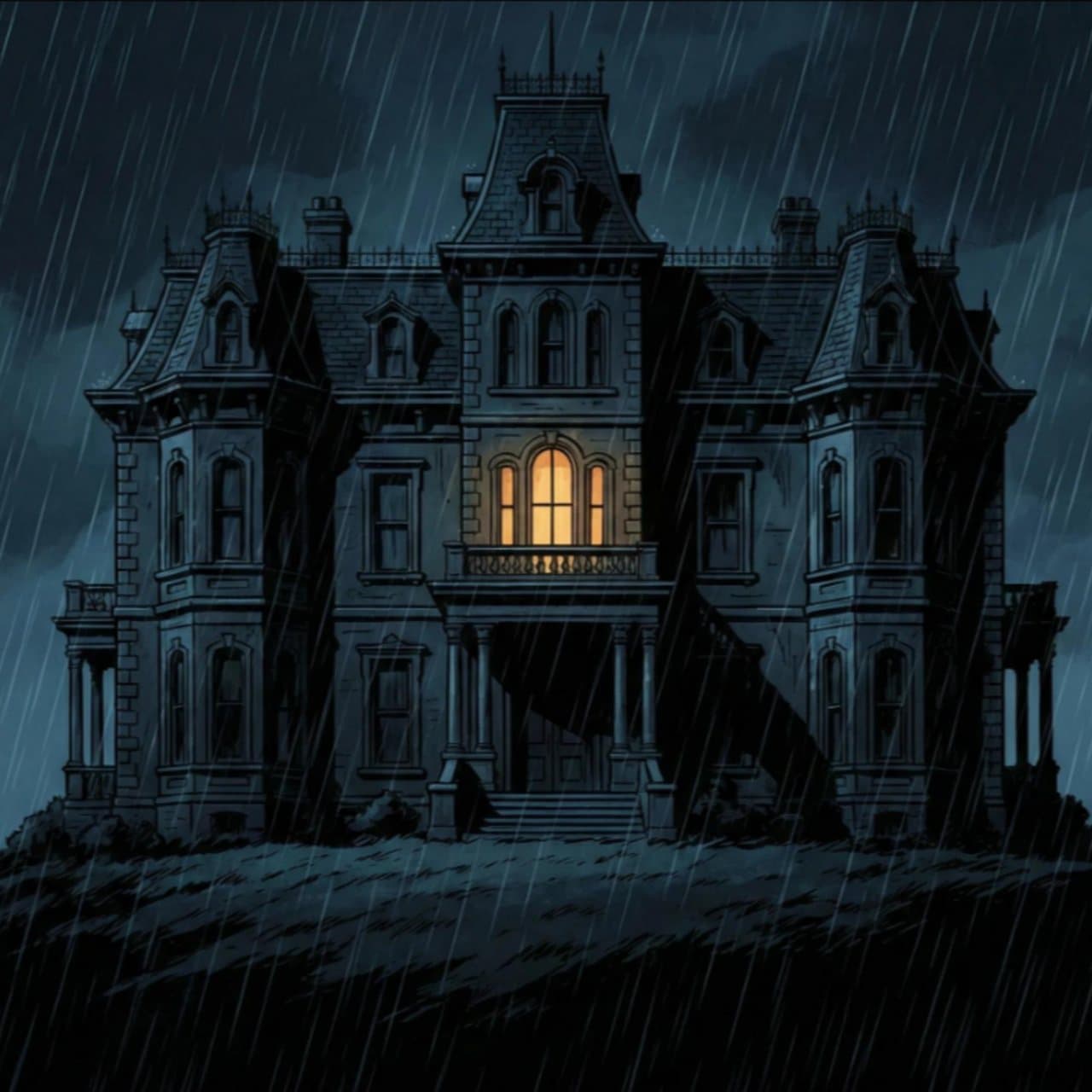

Some houses are abandoned by people. Some houses are abandoned by God. And some houses are waiting for someone to come home.
Prologue — The Voice in the Dark
At exactly 3:17 a.m., Arjun heard his mother calling him from inside the locked bedroom.
“Arjun… open the door, kanna.”
He stopped breathing.
His mother had been dead for eleven years.
He stood in the middle of the corridor, gripping the handle of a kitchen knife. Rain hammered against the windows. The old house creaked around him, as if something enormous were turning in its sleep beneath the floorboards.
“Arjun,” the voice whispered again. “I'm cold.”
It was her voice. The same softness. The same tired affection. Even the little crack in her throat when she said his name.
He took one step toward the bedroom.
Then he remembered what his grandmother had told him before she died.
If you ever hear someone you love calling you from behind a closed door after three in the morning, do not answer.
It may know their voice.
But it is not them.
The voice behind the door began to cry.
“Please, Arjun. It's dark in here.”
His eyes filled with tears.
Then the crying stopped.
A long silence followed.
And from the other side of the door, his mother's voice said something that made his blood turn to ice.
“Arjun… who's standing behind you?”
He turned.
Nobody was there.
But a wet hand slowly settled on his shoulder.
And something breathed directly into his ear.
“Don't turn around, son.”
It was his own voice.
Chapter One — The Inheritance
Arjun had never wanted to return to Vellimalai.
The village sat deep within the forests of Tamil Nadu, hidden behind miles of winding roads and hills that swallowed sunlight before evening. People there still covered their mirrors at night. They left their porch lights burning until sunrise. And nobody—not even the bravest drunkard—walked past the old temple after midnight.
At the edge of the village stood a mansion known as Blackthorn House.
It had belonged to Arjun's family for more than a hundred years.
When his grandmother died, he inherited the property, along with a letter written in her shaking handwriting.
The letter contained only three instructions.
Do not enter the eastern wing.
Do not count the footsteps on the staircase.
And if the house ever calls you by your childhood nickname, leave immediately.
Arjun laughed when he read it.
He was twenty-eight, a rational man who worked in Chennai and believed that ghosts were stories invented by frightened people.
He drove to the village to sell the property.
He intended to stay one night.
Just one.
By sunset, the sky had turned the color of a fresh bruise. His car stopped outside the mansion as the engine died without warning.
Blackthorn House rose before him, its walls stained with rain and age. Ivy covered the windows. The front gate hung open.
Someone had left a lantern burning on the porch.
Arjun was certain the house had been empty for years.
He picked up his suitcase and walked inside.
The front door opened before he touched it.
The air smelled of wet soil, burnt candles, and something sweetly rotten.
A grandfather clock stood in the entrance hall.
Its hands were frozen at 3:17.
Arjun glanced at his watch.
6:42 p.m.
“Wonderful,” he muttered. “A haunted house with a broken clock.”
He switched on his phone flashlight and climbed the stairs.
On the second floor, he found a family photograph lying face down.
He wiped the dust away.
It showed his grandmother, his mother, and himself as a five-year-old boy.
But there was something wrong.
Behind the three of them stood a tall, thin figure dressed entirely in black.
Its face had been scratched out.
Arjun turned the photograph over.
On the back, someone had written:
FOUR PEOPLE ENTERED THE HOUSE. ONLY THREE WERE BURIED.
From somewhere upstairs came the sound of a child laughing.
Arjun dropped the photograph.
He was the only child in the house.
And he had not laughed like that since he was five.
Chapter Two — The Room That Wasn't There
That night, Arjun slept in his childhood bedroom.
At least, he tried to.
At 11:48 p.m., someone began dragging furniture across the floor above him.
At midnight, a woman sang a lullaby.
At 12:16 a.m., three slow knocks came from inside his wardrobe.
He switched on the light.
The wardrobe doors stood slightly open.
“Rat,” he whispered to himself.
He approached with a broom.
The knocking came again.
Knock.
Knock.
Knock.
He pulled the doors apart.
His clothes hung perfectly still.
Behind them, the wooden back panel had been replaced by a narrow, black doorway.
Arjun stepped back.
He knew this room. He had spent his childhood here. There had never been a doorway behind the wardrobe.
From the darkness came a whisper.
“Anna…”
His little sister's voice.
His heart seemed to stop.
He had never had a sister.
At least, that was what his family had always told him.
“Anna, why did you leave me here?”
A small hand appeared in the doorway.
Its fingernails were broken. Black mud covered its fingers.
Then a little girl crawled into the bedroom.
She wore a white dress soaked with water. Her hair covered her face, and her knees bent at strange angles as she dragged herself toward him.
Arjun stumbled backward.
“Who are you?”
The girl stopped crawling.
Slowly, she lifted her head.
Her face was his own.
Not similar.
Not resembling him.
His exact face, on a child's body.
The little girl smiled with his mouth.
“Grandma said you would come back.”
The bedroom light went out.
Something rushed past him.
He heard the wardrobe slam shut.
When the light returned, the room was empty.
On his pillow lay a wet photograph.
It showed Arjun standing beside a little girl outside Blackthorn House.
On the back, in fresh red letters, were four words:
YOU LEFT ME HERE.
Chapter Three — The Village That Remembered
At dawn, Arjun drove into the village and found an old tea shop near the bus stop.
The owner, a thin man with milky eyes, stared at him for a long time.
“You are Lakshmi's grandson,” he said.
Arjun nodded.
“Did you live in that house?”
“Until I was five.”
The old man slowly put down his glass.
“Then you should not have returned.”
Arjun demanded to know what had happened to his family.
At first, the man refused to speak. Finally, he leaned across the table.
“Your mother had twins.”
Arjun felt the world tilt.
“One boy survived. The other child…” The man looked toward the forest. “They said she died during the storm.”
“Why didn't anyone tell me?”
“Because your grandmother made everyone promise.”
“Promise what?”
The old man looked directly into Arjun's eyes.
“That the second child never existed.”
He explained that, thirty years earlier, a terrible storm had struck Vellimalai. The river had flooded. The power failed. And that night, people heard children screaming from Blackthorn House.
By morning, Arjun's mother had disappeared.
His grandmother claimed she had died of illness weeks later.
But nobody had seen a body.
“Your grandmother believed the house had taken something from your family,” the old man whispered. “Something that could not be brought back.”
Arjun stood abruptly.
“Who was the fourth person in the photograph?”
The old man went pale.
He closed the shop shutters.
Then he spoke so quietly that Arjun almost missed the words.
“Your family was not the first to live there.”
“Who lived there before us?”
The old man shook his head.
“No one lived there before you.”
He pointed toward the hills.
“The house was there before the village. Before the temple. Before the road. Some people say it was built over a well. Others say the well was built over something that fell from the sky.”
He gripped Arjun's wrist.
“But everyone agrees on one thing.”
“What?”
“The house has no shadow.”
Arjun looked out the window.
The morning sun illuminated the road, the tea shop, and the people walking past.
In the distance, Blackthorn House stood against the hills.
Every tree cast a shadow.
Every wall cast a shadow.
Every person cast a shadow.
Except the house.
Chapter Four — The Rules
Arjun returned to Blackthorn House with a crowbar, a torch, and a determination to uncover the truth.
He found another letter inside his grandmother's Bible.
This one was longer.
My dear Arjun,
If you are reading this, I have failed to protect you.
Your sister's name was Ananya.
She was alive when I locked the eastern wing.
I told myself I was saving you both. I told myself that the house could be contained. I told myself many things.
But I heard her calling me for thirty years.
The thing inside the house does not kill people immediately. It studies them. It learns their memories, their voices, their deepest regrets.
Then it wears what you love.
Your mother opened the eastern wing.
I heard her voice after she died.
I did not open the door.
Do not make the mistake I made.
Whatever you see inside that room, do not believe it is Ananya.
And whatever happens, do not let it learn your name.
Arjun read the final sentence twice.
Someone had written beneath it in different handwriting.
It already knows.
From the eastern wing came the sound of a door slowly opening.
He raised his torch.
The corridor had changed.
Where there had once been a wall, there was now a narrow staircase descending into darkness.
Cold air drifted upward.
It smelled of river water and old bones.
At the bottom, a small girl stood facing the wall.
“Ananya?” Arjun whispered.
The girl turned.
She looked exactly like the child in the photograph.
She was crying.
“Anna,” she said. “You took so long.”
Arjun wanted to run to her.
He wanted to hold her.
He wanted to believe that thirty years of loneliness could be undone by one impossible reunion.
Then he noticed her feet.
They were facing backward.
The girl's smile widened.
“Come closer,” she said.
Behind her, dozens of small hands emerged from the walls.
They reached for Arjun, their fingers opening and closing like spiders.
And from deep beneath the staircase came a sound like hundreds of people whispering the same name.
His name.
Chapter Five — The Truth Beneath the House
Arjun ran.
He reached the entrance hall and slammed the front door behind him. He twisted the lock and backed away, gasping.
For several seconds, there was silence.
Then something knocked from the other side.
Once.
Twice.
Three times.
Arjun turned toward the grandfather clock.
Its hands had begun to move.
Backward.
The clock struck thirteen.
Every window in the house shattered at once.
The walls began to breathe.
Arjun watched the wallpaper expand and contract as though something enormous were sleeping beneath it. Black veins spread across the ceiling. The wooden floor buckled beneath his feet.
And then he heard his mother's voice.
Not from behind a door.
Not from upstairs.
From inside the walls themselves.
“Arjun, please. You have to remember.”
The floor beneath him split open.
A narrow staircase appeared, descending into a vast chamber hidden below the mansion.
At its center stood an ancient stone well.
Around the well were dozens of photographs.
Families.
Children.
Strangers.
Every photograph had one thing in common: a figure stood behind the people, its face scratched out.
Arjun found his own family among them.
His mother.
His grandmother.
Ananya.
And himself.
The photograph was dated the day he had left the village as a child.
But someone had added a second image beside it.
Arjun, standing in the mansion that very night.
Behind him stood the tall figure in black.
Its face was no longer scratched out.
It had Arjun's face.
A voice rose from the well.
“You have come home.”
Arjun stepped backward.
“Who are you?”
The water in the well began to ripple.
“I am what remains when a memory is forgotten.”
A pale hand emerged from the darkness.
Then another.
Then dozens more.
“I lived in the silence between your mother's last words. I lived in the room your grandmother refused to enter. I lived in every story your family was too afraid to tell.”
The water rose.
“You were never meant to survive the night you were born.”
Arjun remembered the old man's words.
The house was there before the village.
Before the temple.
Before the road.
It had not been built.
It had been uncovered.
And his family had spent generations feeding it memories, secrets, and fear.
“What do you want from me?” he screamed.
The voice answered immediately.
“Your place.”
The water exploded upward.
Something climbed out of the well.
It was tall enough to touch the ceiling. Its body was covered in pale skin stretched tightly over bones. Its arms dragged along the floor. Its head tilted sideways, as if it had never learned how a human neck worked.
It wore his mother's face.
Then his grandmother's.
Then Ananya's.
Finally, it wore his own.
“You may leave,” it said in his voice.
“But you will leave something behind.”
Arjun saw the photographs begin to burn.
He saw his mother standing in the flames.
He saw Ananya reaching for him.
And suddenly, he remembered.
He remembered the storm.
He remembered the eastern wing.
He remembered being five years old, hiding beneath the bed while his mother carried a screaming little girl down the stairs.
He remembered his grandmother telling him to close his eyes.
And he remembered the final thing his sister had said.
“Anna, don't let it wear my face.”
Arjun had forgotten her.
His family had forced him to forget her.
And the house had waited all these years for him to remember.
Chapter Six — Don't Look Behind You
Arjun found a rusted iron chain beside the well.
He wrapped it around the creature's arm and pulled with all his strength.
The creature screamed.
Its voice was not human.
It sounded like a thousand doors being opened in a thousand empty houses.
The chamber shook.
Arjun ran toward the staircase, dragging the chain behind him. The creature followed, crawling on all fours, its limbs bending backward and forward with horrible ease.
At the top of the stairs, he reached the eastern wing.
The little girl stood there again.
Ananya.
This time, she was not smiling.
“Anna,” she whispered. “You remembered me.”
Arjun reached for her.
She shook her head.
“It's too late.”
The creature surged out of the darkness.
Ananya stepped between them.
For one brief moment, she looked like an ordinary child.
Then she turned toward the creature and screamed.
Every mirror in the house shattered.
Every clock stopped.
The creature froze.
Arjun seized the chain and pulled.
The monster was dragged backward into the darkness, clawing at the floor, leaving long black scratches in the wood.
Ananya looked at him.
“Run.”
He ran.
He reached the front door just as the entire mansion began to collapse inward. Windows imploded. Walls folded into themselves. The staircase twisted like a living thing.
He stumbled into the rain.
Behind him, Blackthorn House sank into the earth without a sound.
Not a crash.
Not a rumble.
Just silence.
By sunrise, the mansion had disappeared.
There was only an empty patch of ground surrounded by dead trees.
Arjun never returned to Vellimalai.
He moved to another city. He changed his phone number. He burned every photograph of his childhood.
For three years, he slept with the lights on.
Nothing happened.
Eventually, he began to believe that the nightmare was over.
Until one rainy night, at exactly 3:17 a.m., his phone rang.
The caller ID displayed his own number.
He answered.
At first, there was only static.
Then came the sound of a little girl crying.
“Anna?”
Arjun dropped the phone.
He could not move.
The voice continued.
“Anna, it's dark here.”
He backed away from the bed.
The voice became clearer.
“You promised you would come back.”
Arjun whispered, “Ananya?”
A long silence followed.
Then the little girl giggled.
“No,” she said.
“I'm the one you left behind.”
The call ended.
Arjun ran to the bathroom and splashed water over his face. He looked up at the mirror.
His reflection stared back.
Pale.
Terrified.
Alive.
He let out a shaky breath.
Then his reflection smiled.
Arjun did not.
The reflection raised its right hand.
Arjun's hand remained at his side.
Slowly, the reflection pressed its palm against the glass.
Its lips moved.
No sound emerged.
Arjun leaned closer.
The reflection mouthed four words.
LET ME COME OUT.
The bathroom door slammed shut.
The light died.
And from inside the mirror, something began scratching its way through.
Epilogue — The House Is Never Empty
Six months later, a real estate developer purchased a plot of land in Vellimalai.
The villagers begged him not to build there.
They told him about the old mansion.
They told him about the family that disappeared.
They told him that the ground beneath the trees was cursed.
The developer laughed.
He hired workers, brought in machinery, and began digging the foundations for a luxury resort.
On the first day, the excavator struck something hard beneath the soil.
The workers uncovered an ancient stone well.
It was perfectly circular.
Its walls were dry.
At the bottom lay a small wooden box.
Inside the box was a photograph of a family standing outside Blackthorn House.
A mother.
A grandmother.
A little girl.
And a young boy.
The developer turned the photograph over.
On the back, someone had written a date.
October 18, 2026.
Today's date.
He frowned and looked at the picture again.
There was something different now.
The boy was no longer standing beside his sister.
He was standing behind the family.
Tall.
Thin.
Dressed entirely in black.
And his face was smiling.
That night, the workers left the site.
All except one.
At 3:17 a.m., the security guard heard a little girl crying from inside the well.
He shone his flashlight into the darkness.
A small face stared up at him.
“Uncle,” she whispered. “Can you help me?”
The guard leaned over the edge.
“Are you hurt?”
The girl shook her head.
Then she smiled.
“Not anymore.”
Two pale hands reached out of the well and seized his wrists.
The flashlight fell.
The guard screamed once.
And then there was silence.
The following morning, the developer arrived to find the security cabin empty.
The gate was locked from the inside.
There were muddy footprints leading from the well to the cabin.
And a fresh handprint on the cabin's inner wall.
The handprint was far too tall to belong to a human being.
Beneath it, written in the dust, were five words.
THANK YOU FOR LETTING ME OUT.
That evening, every house in Vellimalai lost its electricity.
Every clock stopped at 3:17.
And from somewhere beneath the village, a sound began to rise.
It was the sound of a house breathing.
Slowly.
Patiently.
Hungrily.
Because Blackthorn House had never been a building.
It had been a door.
And now, it was open.
End of Part One