


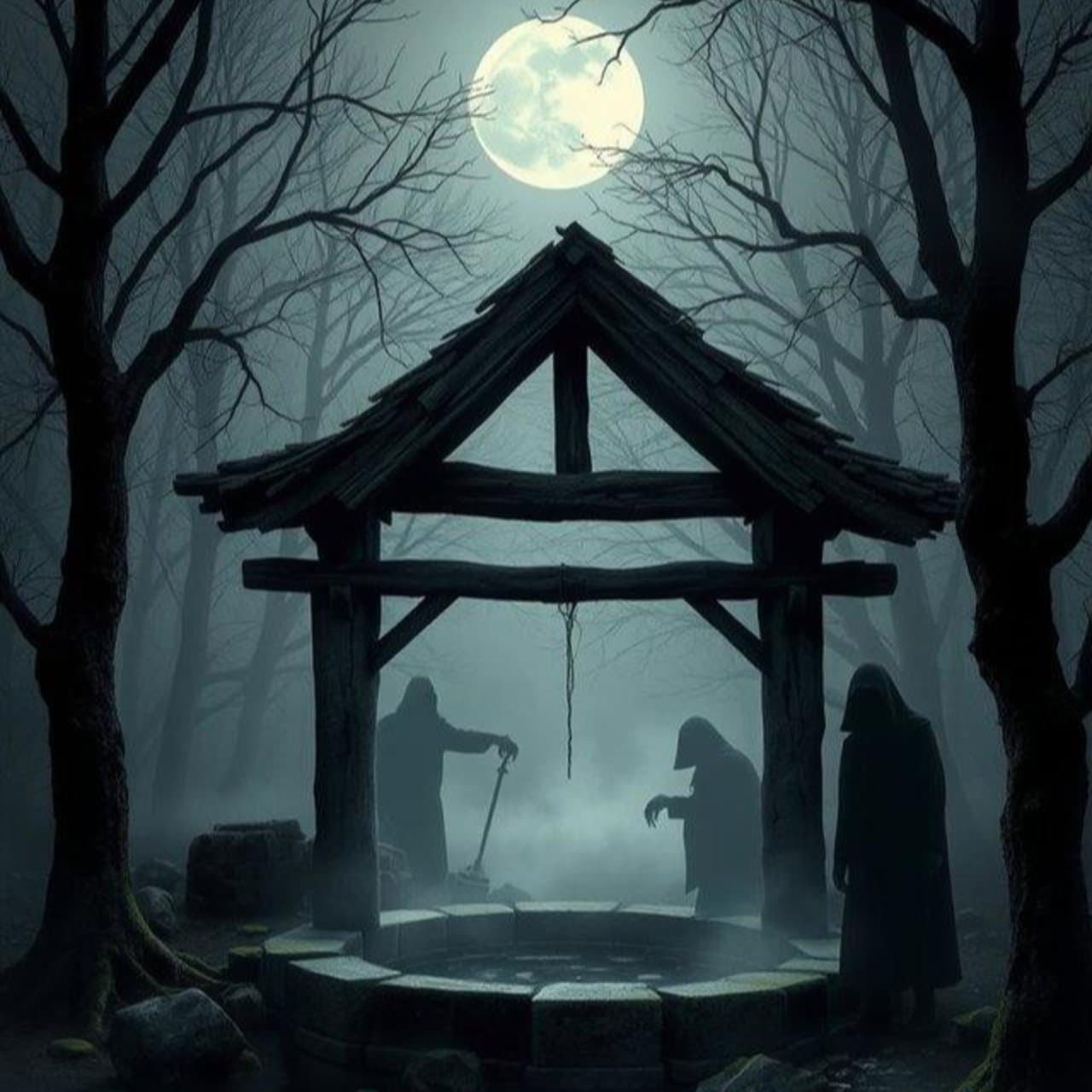

Part II — The Thing That Followed Him
Some doors should never be opened. But the worst horrors begin when something discovers it no longer needs a door.
Prologue — The First Missing Child
The first child disappeared on a Monday.
Her name was Meera. She was seven years old, the daughter of a tea seller in Vellimalai. Her mother said she had gone to bed at nine. Her father said he had locked the front door at ten.
At 3:17 a.m., both parents woke to the sound of their daughter laughing in the kitchen.
They found her sitting beneath the dining table, facing the wall.
“Meera?” her mother whispered.
The little girl didn't turn.
“Why aren't you sleeping, darling?”
Meera giggled.
“I'm waiting for my friend.”
Her mother knelt beside her.
“What friend?”
“The man who lives underneath us.”
Her father pulled her away from the wall.
Something scratched from the other side.
Three slow strokes.
Then a voice spoke through the plaster.
“She's not yours anymore.”
The father grabbed a hammer and smashed the wall.
Behind the bricks was a narrow tunnel filled with black water.
At the end of it stood a tall man in a dark suit.
His face was the face of Meera's father.
The real father stumbled backward.
The figure at the end of the tunnel smiled.
Then every light in the house went out.
When the electricity returned, Meera was gone.
Her parents never found her.
But every night afterward, at exactly 3:17, they heard a little girl laughing beneath their bedroom floor.
And sometimes, when the house was quiet, a small voice whispered:
“Appa, please don't let him wear your face.”
Chapter One — The Man in the Mirror
Arjun stopped sleeping.
For three nights after the mirror incident, he kept every light in his apartment switched on. He covered the bathroom mirror with a bedsheet and pushed a cupboard against the door.
He told himself that exhaustion had caused a hallucination.
He told himself that grief could manufacture voices.
He told himself that Blackthorn House had collapsed, that the well was buried, and that whatever had lived beneath the mansion had been trapped forever.
But on the fourth morning, he found mud on his bedroom floor.
A trail of tiny footprints led from the front door to his bed.
They were the footprints of a child.
Arjun followed them to the bathroom.
The bedsheet covering the mirror hung perfectly still.
He slowly pulled it away.
His reflection looked normal.
He raised his right hand.
The reflection raised its right hand.
He stepped backward.
The reflection followed.
He almost laughed with relief.
Then he noticed the writing on the glass.
Five words, scratched into the mirror from the inside.
YOU FORGOT THE OTHER ONE.
Arjun stared at the sentence.
Other one?
He remembered Ananya.
He remembered the creature that had worn his face.
But there had been something else in the well. Something the creature had said.
You were never meant to survive the night you were born.
His phone vibrated.
An unknown number.
The message contained a photograph.
It showed a hospital room, old and yellowed with age. Two newborn babies lay in separate cradles.
One had a small black birthmark on his chest.
The other had a hand resting against the inside of the glass.
Arjun looked down at his own chest.
He had a birthmark in exactly that shape.
A second message appeared.
YOUR MOTHER BROUGHT ONE BABY HOME.
Then another.
SHE BROUGHT THE WRONG ONE.
Arjun dropped the phone.
From behind the bathroom mirror came a soft, delighted laugh.
And a voice whispered:
“Hello, brother.”
Chapter Two — The Hospital Records
Arjun took the first train to the city where he had been born.
The old hospital was now a private medical college. Its records department occupied a building behind the main campus, where dust gathered on steel cabinets and old patient files were stacked in cardboard boxes.
A clerk named Joseph listened to Arjun's request.
“Records from thirty years ago?” he asked. “That will take time.”
“I'll wait.”
Arjun gave him his mother's name and date of admission.
Joseph disappeared into the archive.
Forty minutes later, he returned carrying a brown envelope.
His face had changed.
“Sir, I think you should speak to the medical superintendent.”
“Why?”
Joseph placed the envelope on the desk.
“The file says your mother delivered twins. Both babies were alive.”
Arjun opened it.
Inside was a birth register, a discharge note, and a photograph of two newborns.
The first child was listed as Baby A.
The second was listed as Baby B.
Someone had crossed out Baby B's name so violently that the paper had torn.
Beneath the damaged entry was a handwritten note.
Infant transferred to restricted ward. No further access permitted.
Arjun read it twice.
“Where is the restricted ward?”
Joseph hesitated.
“The old basement was sealed years ago.”
“Why?”
“I don't know.”
Arjun showed him the photograph.
Joseph's hands began to tremble.
“Who gave you this?”
“It was sent to my phone.”
Joseph stood abruptly and locked the archive door.
“My grandmother worked here,” he whispered. “She told me a story about a doctor who disappeared in 1996. He was treating a newborn that had no heartbeat.”
Arjun felt a chill move down his spine.
“What happened to the baby?”
“They said it began crying after the doctor pronounced it dead.”
“That's impossible.”
“I know.”
Joseph leaned closer.
“But three nurses heard the same thing.”
He pulled an old newspaper clipping from a drawer.
The headline read:
HOSPITAL WORKER VANISHES AFTER BASEMENT INCIDENT.
Below it was a photograph of a young doctor.
Arjun recognized the face immediately.
It was the old man from the tunnel.
The man with his face.
Joseph whispered, “The doctor had a name.”
Arjun looked at the photograph.
The name beneath it was Dr. V. Rajan.
Joseph continued.
“Before he disappeared, he told my grandmother that something had been born in the hospital that night.”
“What was it?”
Joseph swallowed.
“He said the baby had two shadows.”
The lights flickered.
From somewhere beneath the archive floor came a dull, heavy knock.
Joseph froze.
Another knock followed.
Then a third.
Arjun looked down.
A thin line of black water seeped between the tiles.
And from below, a newborn baby began to cry.
Chapter Three — The Sealed Ward
They found the entrance behind a rusted service elevator.
The superintendent refused to authorize access, but Joseph knew where the old maintenance key was kept. At 11:30 p.m., the two men descended into the basement.
The elevator stopped one floor below the building's official plans.
The doors opened onto a corridor with no lights.
The walls were covered in faded blue paint. Old wheelchairs sat against the corners. A child's drawing had been pinned to one door.
It showed a house beneath the ground.
Above the house, a black sun smiled.
Arjun approached the drawing.
Someone had written a sentence beneath it.
IT LEARNS THROUGH THE PEOPLE WHO REMEMBER IT.
At the end of the corridor stood a steel door.
There was no handle.
Only a small glass window.
Arjun shone his flashlight inside.
The room contained two metal cradles.
One was empty.
The other held a small bundle wrapped in a hospital blanket.
Something beneath the blanket moved.
Joseph stepped backward.
“Sir, we should leave.”
Arjun pushed against the door.
It opened without resistance.
Inside, the air smelled of disinfectant and wet earth.
He approached the cradle.
The bundle was impossibly small.
He pulled the blanket away.
There was no baby.
Only a photograph of Arjun as a newborn.
And beside it, another photograph of the same child.
In the second image, the baby's eyes were open.
Both pupils were completely black.
Arjun heard Joseph scream.
The steel door had closed behind them.
The room's lights switched on.
Dozens of photographs covered the walls.
Children.
Adults.
Entire families.
Some photographs showed people who had been missing for decades.
Others showed people who were still alive.
Arjun found his own photograph among them.
It showed him standing in his apartment bathroom.
The image had been taken from inside the mirror.
In the photograph, the reflection stood behind him, its hands resting on his shoulders.
Arjun turned toward the wall.
A new photograph slowly slid from a slot in the ceiling.
It showed Joseph standing beside the elevator.
Alone.
His face was twisted in terror.
Behind him stood a tall figure in a dark suit.
Arjun looked at Joseph.
Joseph was still beside him.
But the man in the photograph had the same clothes.
The same face.
The same expression.
Then Joseph whispered, “Arjun?”
His voice came from the wrong direction.
Arjun turned.
The real Joseph stood by the door.
The Joseph beside him was smiling.
Its skin began to split around the mouth.
Beneath the skin was another face.
Arjun's face.
The thing leaned close.
“You keep looking for your brother,” it whispered.
“But you have never asked which one of you was born first.”
The lights went out.
Something grabbed Arjun's ankle.
He fell.
And in the darkness, he heard Joseph shouting his name from somewhere very far away.
Chapter Four — The Brother Who Never Died
Arjun woke in a hospital bed.
Sunlight fell through the window. A nurse stood beside him, checking his pulse.
“You're lucky,” she said. “They found you unconscious in the basement.”
“Where is Joseph?”
“Who?”
“The man who came with me.”
The nurse frowned.
“You came alone, sir.”
Arjun tried to sit up.
His chest hurt.
He pulled down his hospital gown.
The birthmark on his chest had changed.
It was no longer a small black mark.
It had spread into the shape of a tiny hand.
Five fingers curled around his ribs.
He touched it.
A second heartbeat answered beneath his palm.
The nurse noticed his expression.
“Are you all right?”
Arjun looked at her.
“Have you ever heard of a doctor named Rajan?”
The nurse's face drained of color.
She glanced toward the door.
Then she lowered her voice.
“Never say that name in this hospital.”
“Why?”
“Because he still works here.”
Arjun stared at her.
“That doctor disappeared thirty years ago.”
The nurse shook her head.
“No. His body disappeared.”
She leaned closer.
“His patients still see him.”
Before Arjun could ask another question, the room's television switched on by itself.
A newsreader appeared on the screen.
“Police are investigating the disappearance of three children from Vellimalai village. Residents report hearing strange noises beneath their homes…”
The picture flickered.
The newsreader stopped moving.
A second face appeared behind him.
Dr. Rajan.
He stared directly at Arjun through the television.
“Hello, Baby A,” he said.
Arjun grabbed the remote and switched the television off.
The nurse backed away.
“What did he call you?”
Arjun said nothing.
The nurse began to cry.
“Because I remember the night you were born,” she whispered.
She opened the door and looked both ways down the corridor.
Then she returned and placed an old key in his hand.
“Your mother came here every year,” she said. “She asked us to keep one room locked.”
“What room?”
“The one where your brother was born.”
She pointed toward the basement.
“Your grandmother said the first baby was human.”
Arjun's hand tightened around the key.
“And the second?”
The nurse looked at the floor.
“Your mother said the second baby cried before it had a mouth.”
Chapter Five — The Mother in the Rain
That night, Arjun returned to Vellimalai.
The village looked different.
Doors were barricaded. Windows were covered with newspaper. Families sat together in candlelight, refusing to sleep.
Three more children had disappeared.
At the edge of the village, Arjun found his mother's old house.
It had been empty for years.
The front door stood open.
Inside, a woman sat beside the window.
Her hair was wet.
Her white sari clung to her shoulders.
Her back was turned toward him.
“Amma?” Arjun whispered.
The woman stopped moving.
For a moment, he was five years old again.
He remembered his mother's hands, her lullabies, the smell of jasmine in her hair.
He stepped closer.
“Amma, is it really you?”
The woman turned.
Her face was exactly as he remembered it.
She smiled sadly.
“Oh, my son.”
Arjun fell to his knees.
He cried into her lap as she stroked his hair.
“I missed you,” he whispered.
“I know.”
“Why did you hide the truth?”
His mother looked toward the window.
“Because I was afraid of what you would become.”
Arjun raised his head.
“Which one of us is real?”
His mother closed her eyes.
For a long time, she said nothing.
Then she spoke.
“When the twins were born, one of you was silent. The other screamed.”
“Which one was silent?”
“You.”
Arjun stopped breathing.
“Your brother was alive, but he was cold. He never cried. He never moved unless you were near him.”
She took his hands.
“Then, on the seventh night, I woke to find you both standing beside my bed.”
Arjun tried to pull away.
“Both?”
She nodded.
“One baby in your cradle. One baby standing on the floor.”
Her voice broke.
“The one on the floor looked at me and said, ‘Mother, you chose the wrong one.’”
Arjun's eyes filled with tears.
“What did you do?”
“I took the child from the cradle and ran.”
“Which child?”
His mother began to shake.
“I don't know.”
Outside, thunder rolled over the village.
Arjun stared at her.
“You don't know?”
“I thought I had saved you. I thought I had taken my real son away from the thing in the cradle.”
She gripped his face.
“But when I looked into the car mirror, the baby in my arms was smiling.”
Her fingers trembled against his cheeks.
“And in the cradle behind me, the other baby was crying.”
Arjun backed away.
His mother reached for him.
“I spent the rest of my life trying to discover which child I brought home.”
He stared at her.
“Why didn't you tell me?”
“Because the thing that was left behind learned to look like you.”
A noise came from the hallway.
Small footsteps.
A child began humming a lullaby.
His mother went pale.
“It's here.”
Arjun turned toward the sound.
At the far end of the corridor stood a little boy.
He wore an old-fashioned hospital gown.
His eyes were completely black.
He looked exactly like Arjun at five years old.
The boy raised one hand.
“Hello, Amma.”
His mother screamed.
The boy smiled.
“You kept the wrong one.”
Then he looked at Arjun.
“And now I'm taking my place back.”
Chapter Six — The Third Cradle
The boy did not move toward them.
He did not need to.
Every door in the house slammed shut.
The windows turned black, as if the night outside had pressed its face against the glass.
Arjun's mother seized his wrist.
“Whatever he says, do not answer him.”
The boy tilted his head.
“Why, Mother?”
His voice sounded like a recording played backward.
“Tell him what happened in the eastern wing.”
Arjun looked at his mother.
She began shaking her head.
“Don't listen.”
The boy took a step forward.
“Tell him about the third cradle.”
The room fell silent.
Arjun stared at his mother.
“What third cradle?”
Her lips trembled.
The boy laughed.
“You really don't remember, do you?”
He pointed at the floor.
The wooden boards began to separate.
Beneath them was a small room, no larger than a cupboard.
Inside stood three empty cradles.
Two were made of wood.
The third was carved from black stone.
A name had been engraved on each one.
ANANYA.
ARJUN.
The third cradle had no name.
Instead, it contained a sentence.
THE CHILD WHO WAS NEVER BORN.
Arjun's mother covered her mouth.
The boy crouched beside the stone cradle.
“You were two,” he said. “But there were three heartbeats.”
The walls began to pulse.
“Your mother heard them. Your grandmother heard them. The doctor heard them.”
Arjun looked at his mother.
“Is this true?”
She nodded through her tears.
“The doctor said there was another child,” she whispered. “A third heartbeat inside the room. But there were only two babies.”
“Where was it?”
The boy pressed his small hand against the stone cradle.
“Here.”
The cradle began to rock.
Back and forth.
Back and forth.
An invisible infant began to cry.
The boy smiled at Arjun.
“Your brother wants to come home.”
Arjun felt the second heartbeat inside his chest grow stronger.
His vision blurred.
He heard a baby's cry inside his own body.
Then another.
Then a third.
His mother screamed his name.
The boy leaned toward him.
“Now you understand.”
The third cradle stopped rocking.
A tiny hand emerged from beneath the blanket.
Its fingers were long and thin.
Far too long for a newborn.
It gripped the edge of the cradle.
And began pulling itself out.
Arjun stumbled toward the door.
His mother caught his arm.
“Run!”
They fled into the rain.
Behind them, the house shook as something crawled through the floor.
Arjun heard the boy laughing.
Then his own voice followed them into the darkness.
“Run as far as you want, brother.”
A pause.
“I was born inside you.”
Chapter Seven — The Rule That Was Never Written
Arjun and his mother reached the old temple before dawn.
The villagers had gathered there, carrying lamps and iron objects. An elderly priest stood beside the entrance, chanting prayers over a bowl of water.
When he saw Arjun, he dropped the bowl.
The water inside had turned black.
“You brought it here,” he whispered.
Arjun shook his head.
“It was already inside me.”
The priest studied his face.
Then he asked a question no one had ever asked Arjun before.
“When you look at your reflection, does it blink before you do?”
Arjun remembered the bathroom mirror.
“Yes.”
The priest closed his eyes.
“Then you are not the door.”
“What does that mean?”
The priest looked toward the temple's inner sanctum.
“The door is what lives on the other side.”
He explained that, long before the village existed, people had discovered a black well in the forest. They believed something had fallen from the sky and buried itself beneath the earth.
The first villagers built a shrine around it.
They offered prayers.
They offered animals.
Eventually, they offered their memories.
They discovered that the thing beneath the well could imitate the dead, but only when someone remembered them clearly enough.
The more a person remembered, the stronger it became.
The priest pointed at Arjun.
“Your family tried to starve it by erasing Ananya from your history.”
“But it survived.”
“Because forgetting is also a kind of memory.”
He paused.
“The house feeds on the space left behind.”
Arjun looked at his mother.
“Can it be stopped?”
The priest did not answer immediately.
Then he said, “There is one rule.”
“What rule?”
“If the creature has learned your face, you must show it the face it has never seen.”
Arjun frowned.
“What face?”
The priest looked at him with terrible sadness.
“The face of the child you would have been if nobody had lied.”
A bell rang inside the temple.
Once.
Twice.
Three times.
The priest turned toward the sanctum.
A little boy stood inside the doorway.
He was soaked with rain.
His hospital gown clung to his body.
His black eyes shone in the darkness.
The boy smiled.
“Thank you for explaining everything, old man.”
The priest's face collapsed.
The boy walked into the temple.
Every lamp went out.
And in the darkness, the priest began screaming.
Chapter Eight — The Last Reflection
Arjun awoke alone inside the temple.
The rain had stopped.
His mother was gone.
The priest was gone.
The village outside was silent.
He stood and approached the temple's bronze offering plate.
Its polished surface reflected his face.
But the reflection was not his own.
It showed a little boy with frightened eyes.
A child who had never learned to smile.
A child who had spent thirty years waiting in a dark room.
Arjun touched the metal.
The child touched it from the other side.
Then the reflection spoke.
“My name is Aarav.”
Arjun froze.
He had never heard that name before.
The child continued.
“Mother gave you a name. Grandmother gave you a name. Everyone gave you a story.”
His eyes filled with tears.
“I was never given anything.”
Arjun pressed his forehead against the metal.
“Are you my brother?”
The child nodded.
“I was the one who cried.”
Arjun began to weep.
“I'm sorry.”
The child shook his head.
“Don't be sorry. Just remember me.”
The temple bell rang.
The reflection changed.
Behind the little boy stood the tall creature in the black suit.
Its long fingers rested on the child's shoulders.
The boy's face filled with terror.
“Arjun,” he whispered. “It isn't my face.”
The creature leaned forward.
Its mouth opened.
Inside was another mouth.
And inside that mouth was a third.
All three spoke together.
“It is yours.”
The bronze plate cracked.
Arjun stumbled backward.
The temple floor split apart.
Beneath the stone was a darkness so complete that his flashlight could not penetrate it.
At the bottom, something moved.
Something vast.
Something that had been waiting since before the first house was built.
A voice rose from the darkness.
Not his mother's.
Not his brother's.
Not his own.
It was a voice that sounded like the entire earth speaking through a single mouth.
“Three children were born.”
The floor trembled.
“One was remembered.”
Another tremor.
“One was forgotten.”
The darkness widened.
“And one was never supposed to exist.”
Arjun felt the handprint on his chest burn.
The third heartbeat began to race.
He understood then.
The creature had not followed him from Blackthorn House.
It had not escaped the well.
It had never needed to escape.
It had been growing inside him, fed by every memory he had lost and every truth his family had buried.
The house was only its first body.
The mirror was its second.
And Arjun—
Arjun was its third.
The darkness rose around him.
His last sight was the little boy in the reflection, reaching out with both hands.
“Brother,” the child whispered.
“Please don't let it wake up.”
Then Arjun heard his own heartbeat stop.
And something else began to beat in its place.
End of Part II
To be continued in Part III — The Face Beneath the Skin
The next part can reveal the true origin of the three children, why Arjun's family was chosen, and the terrifying connection between the ancient well and every mirror in the world.
The final mystery: If Arjun was the third child, who has been living his life all these years?