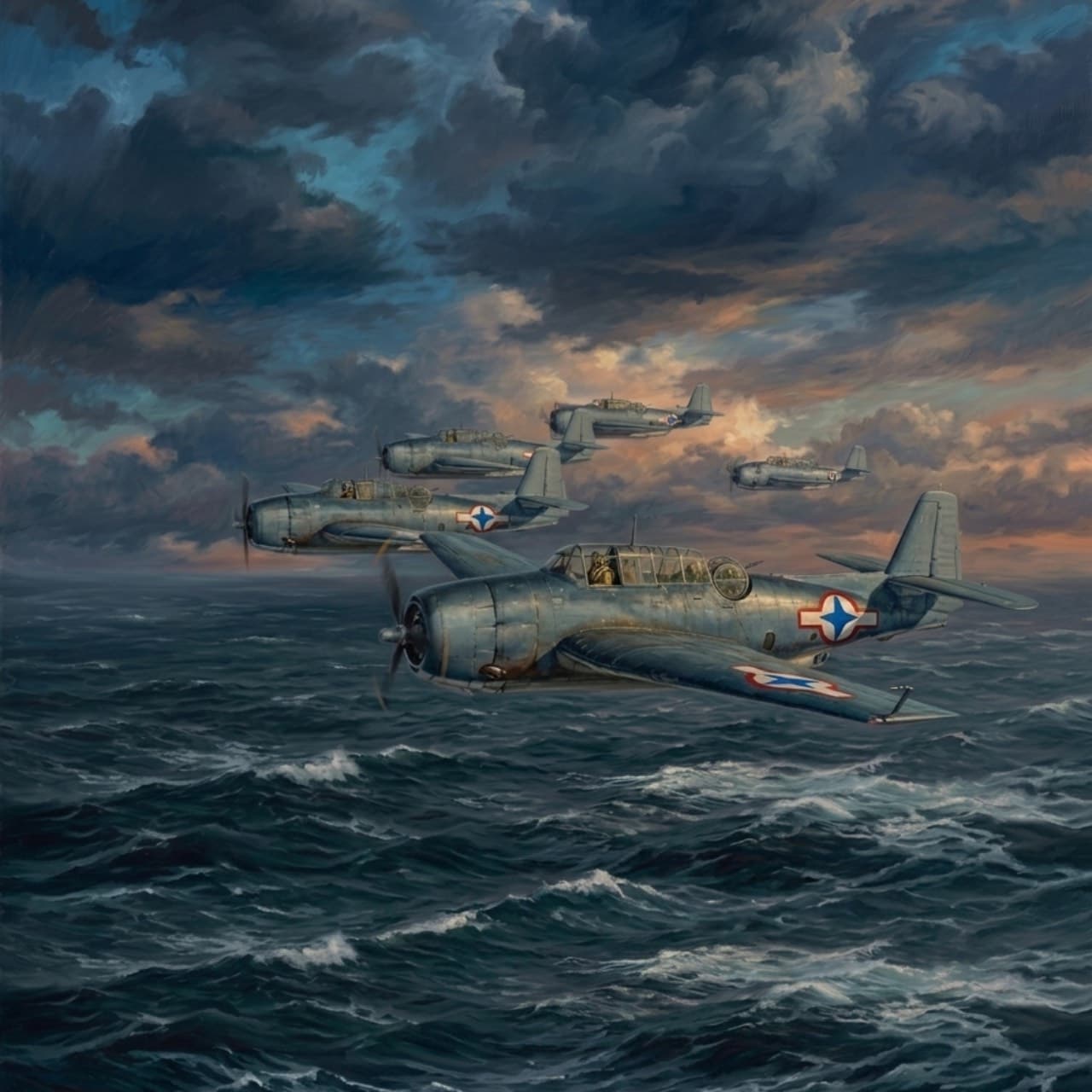

In the briefing room, a stocky admiral with a weathered face stood before the fourteen pilots seated in the front row. He spoke calmly, without any theatrics—the way experienced commanders talk shop with their subordinates, friendly yet keeping a professional distance, as they debrief a successful mission.
“Boys, I want to say once again that you have done a magnificent job serving your country. On behalf of the President, the Navy, and the Marine Corps, I want to offer you our sincerest apologies for having to participate blindly, so to speak, in a dangerous and complex experiment. Unfortunately, the parameters of the test left us no other choice. I want to note that under the most trying conditions, you acquitted yourselves flawlessly. Thanks to your courage, our great nation has become even stronger. Regrettably, even now I cannot—I simply do not have the right to—speak with you about the nature of the experiment or its results. Furthermore, boys, I don’t know the half of it myself. However, you will definitely get the answers to all your questions, as you still have a whole lot of work to do with our eggheads.” The admiral gestured toward the back row, where two young men in glasses—one wearing a suit jacket, the other a vest—sat next to a lean, gray-haired general. “Right now, boys, march on over for another medical checkup. Don’t sour your faces; they’ve put together a team of genuinely gorgeous nurses for you. After that, you’ll be transferred to a special base. Yes, you catch my drift. You’ll have to live in isolation for a while. But the conditions over there are such that you’ll be remembering it for the rest of your lives. That’s all, boys, dismissed. We’ll meet again later and talk in more detail.” The admiral snapped to attention and saluted.
The pilots jumped up, saluted back, and headed for the exit.
Waiting until the door closed behind the last of them, the admiral let out a sigh, sat down at the table, wiped his forehead with a handkerchief, and poured himself some water from a carafe. While he emptied the glass in large gulps, the general and the eggheads moved over to the newly vacated front row.
“I never cease to be amazed by how well you can spin a yarn,” the general said, perfectly serious, without a hint of mockery or irony.
“I read a lot. Out at sea, you’d go crazy without a good book. But, strictly off the record, it was hard to find the words this time. I hate lying. I feel a hell of a lot of pity for those boys. So, what’s the word on their planes?” The admiral looked at the four-eyes.
They exchanged glances, and the general answered instead.
“They really are Avengers. But they are not ourAvengers.”
“What do you mean, not ours? Fakes?” the admiral asked, a note of hope in his voice.
The egghead in the suit jacket shook his head, pulled a sheet of paper folded into quarters from his breast pocket, unfolded it, and carefully placed it on the table.
“Unfortunately, no. We’ve breached the barrier again. Right next door. Our guests lived just a stone’s throw away. The aviation techs counted about three hundred discrepancies in the aircraft. Mostly minor stuff—not every pilot would spot them at first glance. But the specialists are certain: these Avengers were not built in our world. Even the composition of the metal is slightly different.”
The admiral took the paper, scanned it briefly, rose from the table, walked to the door, opened it, and barked a few orders in a low voice. When he returned, the egghead in the vest joined the conversation:
“The grease monkeys’ conclusions are backed up by the preliminary debriefing of our guests. For instance, they sincerely believe that the United States dropped not just one atomic bomb—on Yokohama—but two: on Hiroshima and Nagasaki.”
“I see...” The admiral tapped his finger thoughtfully against the paper, then pulled a cigarette case from his pocket and lit a cigarillo.
At that moment, the door opened, and two sailors entered the room. One placed a tray on the table with a bottle of whiskey, four glasses, and a large steel ashtray; the other set down a platter of sandwiches. The admiral thanked the sailors with a nod, filled all four glasses a third of the way, and made an inviting gesture. The general and the eggheads pulled their chairs closer to the table.
For about five minutes, all four drank and chewed their sandwiches in silence. The admiral somehow managed to do this without letting the cigarillo drop from the left corner of his mouth. When the glasses and the platter were empty, the admiral poured the whiskey again, the eggheads lit their pipes, the general lit a massive cigar, and the conversation resumed:
“That Serb did us a real favor with his Big Machine,” the general grumbled, visibly annoyed. “It’s terrifying to use, and a damn shame to let sit idle. What would it have cost him to write a proper instruction manual? We’re groping around like blind kittens. Trying one thing, then another. How many times does this make that we’ve ended up with egg on our face?”
“Well, it depends on how you look at it.” The egghead in the vest smiled and scratched behind his ear with the bit of his pipe. “Sure, our radio-controlled target drones came through completely unscathed. But nevertheless, we managed to neutralize the aircraft in the blast zone, so to speak. Just in a parallel reality. One that—and I want to bring your attention to this once more—is right next door, apparently constantly intersecting with ours due to laws of nature we don’t yet understand. According to one theory, we don’t even notice when such intersections with close realities occur, and then we argue over discrepancies in data and historical facts. Furthermore, in this past experiment, there was almost no time dilation. Compared to how we caused an explosion years back over that Siberian river whose name I can never remember, this can be considered a total success.”
“You go tell that to those poor bastards of pilots,” the admiral grunted sourly. “I get the feeling they wouldn’t agree with you.”
“If I have to, I will,” the egghead shot back defiantly. “Right now, if you like.”
For a minute, a heavy silence hung over the room. All four puffed on their smokes and sipped their whiskey in deep concentration.
“In the end, nobody died,” the egghead in the suit jacket said quietly, backing up his colleague. “A war has just ended in which many of our guests’ comrades risked their lives and died with far less benefit to the motherland. I think we have every right to draft our report to the President in a cautiously optimistic tone.”
“We’ll have plenty of time to deal with the report. Right now, the main thing is to decide what to do next with the Big Machine. I think everyone agrees that it has no business staying in Florida anymore?” the admiral asked, setting his empty glass on the table.
“One hundred percent.” The general looked at the eggheads, who shrugged their shoulders in unison, as if on cue. “I think the best option is to ship it out to some desert to continue the work. Nevada, for instance. It’s far from prying eyes, and there are plenty of good spots for an airfield. At the same time, it’ll give us a place where our guests can live and work. These boys, and any others that come after.”
“Sensible,” the admiral approved, topping off the glasses once more. “By the way, boys,” he turned to the eggheads, “it wouldn’t hurt to launch a solid cover operation for this whole mess. Something with rumors about mysticism, jinxes, and all that hooey. You know—the Devil’s Sea and all that. If you need examples, just ask; we can pull a nice little selection from the archives for the yellow press.”
Viacheslav Sannikov "Almost True". Part I "Humans"