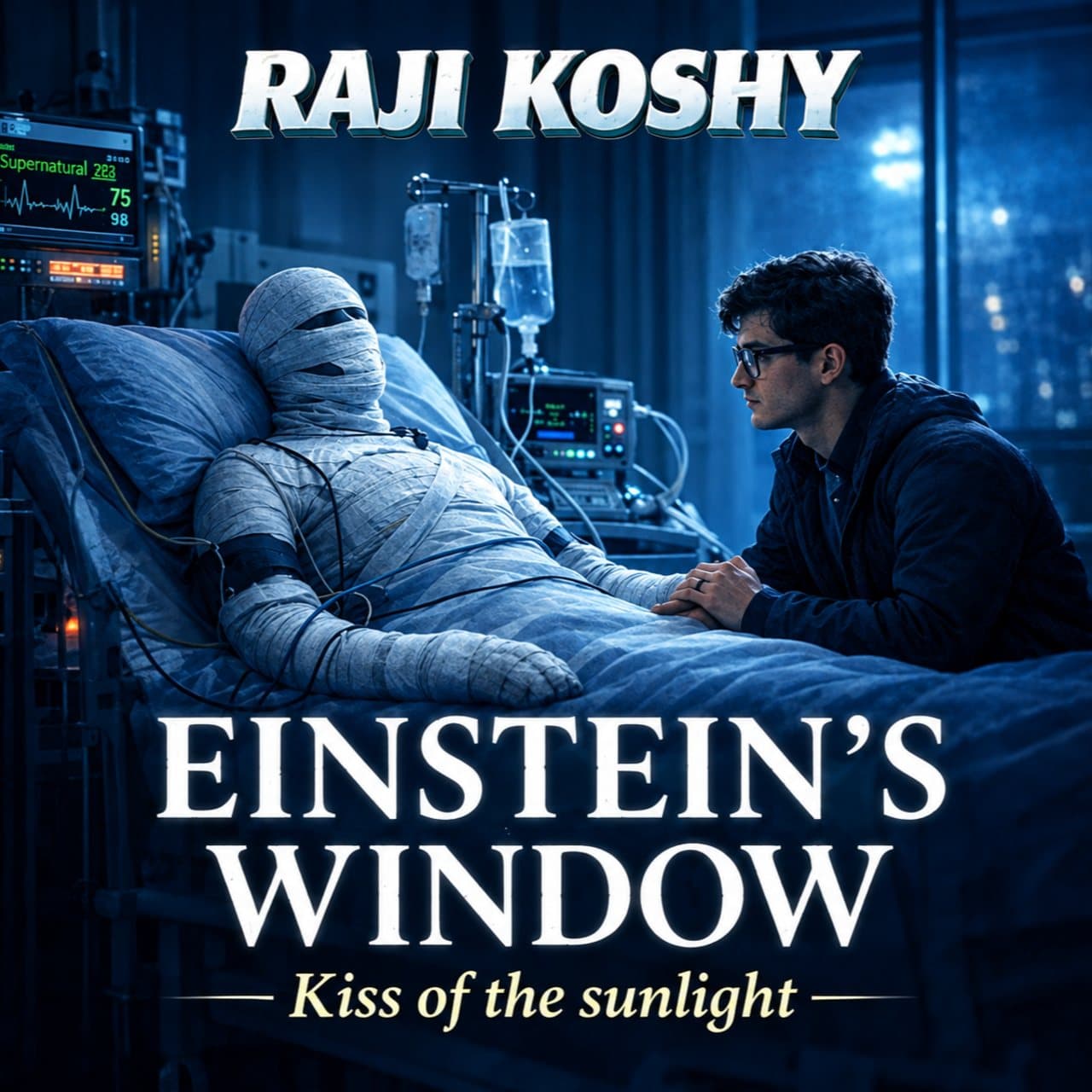

The fluorescent lights of the accounting firm's waiting room hummed a sterile, mournful tune. I sat stiffly in my new, ill-fitting suit, tracing the embossed golden letters on my Commerce degree folder. It felt less like an achievement and more like a tombstone—proof of a dream I never had the courage to chase.
Inside me, my heart refused to obey the rules of debit and credit. It throbbed with the restless beat of unsolved mysteries; a rebellious physicist trapped in an accountant's body. On my bedroom wall hung a faded poster of Albert Einstein, my role model not merely for his genius, but for his audacity to question reality with childlike wonder. And yet, here I was, having chosen the safer fabric: balance sheets, ledgers, and tax tables—orderly, predictable, suffocating.
This purgatory of job interviews was my life just after graduation. Each rejection letter felt like a verdict on my worth. My solace came from an unexpected quarter: my closest friends from college, young doctors serving as junior interns in government hospitals across Bangalore. Overworked and underpaid, they were my anchor to something real. In their presence, my worries about interviews shrank into perspective.
Their curse was the night shift. "The city sleeps, but the ER never does," my friend Mani would say with a weary half-smile. The government hospitals—Bowring, Victoria—became different creatures after sunset. From the city's restless arteries came the nightly harvest of misfortune: mangled bodies from road accidents, drunken brawlers, old men clutching their chests. Sirens sliced through the darkness, ambulances arriving like grim messengers.
Too restless to sit in my quiet, disappointed home, I began to spend my nights with them. At first, I was nothing more than a bystander, a ghost in the corridor carrying a dented thermos of cheap coffee. But nights have a way of breaking us in gently. Gradually, the shock of blood and the raw cries of the injured faded into something disturbingly normal.
Seeing my friends drowning in the bureaucratic tide of paperwork, I slid into usefulness almost by accident. Patient admittance forms, injury charts, consent slips—to them, this was the worst part; to me, it was familiar territory. Ledgers had trained my hands to write neatly, to organize. Soon, I was filling out forms before being asked, guiding bewildered relatives to sign where needed, translating panic into legible handwriting.
From there, the boundaries kept moving. I learned to hand them instruments during frantic first aid, to hold a lamp steady over a bleeding wound, to change IV bags. No one formally trained me; the ER itself was my tutor. Before long, I became a peculiar fixture of the night shift: the commerce graduate who could tie a decent bandage, calm a panicked relative, and quote Einstein while mopping up a spill. In that strange, sleepless world of pain and healing, I had stumbled into something I hadn't found in interview rooms—usefulness, urgency, and the faint, stubborn feeling that I mattered.
Within two or three months, I had learned far more than I had ever expected about their medical procedures. Triage charts, vital signs, suturing, dosage calculations—I began to see patterns, logic, and an almost mathematical elegance in it all. Concepts that would have terrified me in textbooks made sense when attached to faces, pulses, and trembling hands. I realized that interest is the real teacher; the rest is just routine.
One such night, the rain lashed against Bowring's windows with particular fury. The radio crackled with a report of a major bus accident on Mysore Road—multiple casualties. The ER shifted gears. Soon afterward, the doors burst open and the promised wave arrived—broken bodies and shocked faces, soaked clothes plastered to skin, the unmistakable smell of rain, diesel, and blood.
Among them was a man assigned to a corner bed. He was neither screaming nor unconscious, simply terribly still. His clothes were muddy and torn, his hair matted with rainwater. No one knew his name. He looked to be in his thirties, powerfully built, with the rugged shoulders of a man who had spent his life wrestling with stone and sun. But consciousness had utterly forsaken him.
His body was a canvas of deep, ugly cuts. The worst injury was a jagged piece of metal rod lodged in his abdomen—a grotesque souvenir torn from the wreckage of the bus. The surgical team descended upon him with quiet urgency. They worked for hours, extracting the rod with heartbreaking care, repairing what they could. His heart, stubborn and strong, kept beating—sometimes faltering, then rallying, as if unsure whether to stay.
I helped where I could, caught between horror and reverent awe. I fetched suture kits, held basins as crimson water swirled inside them, passed instruments when summoned. I filled out his documentation, writing down the cold facts: "unknown male," estimated age, time of arrival. On paper he became lines and boxes, but on the bed, he was painfully, undeniably human.
By the time the surgical team stepped back, the sky beyond the windows was shifting from ink-black to weary grey. It was nearly 7 a.m. The man lay like a fallen warrior wrapped for burial—a mummy of white bandages, tubes snaking from his arms and nose, machines blinking with clinical indifference. The green pulse on the monitor was the only proof that life still fought inside him.
Around us, the chaos of the night had burned itself out. My friends had collapsed into chairs, grabbing stolen minutes of sleep. I realized I was the lone sentinel, standing guard over a life that did not even know I existed.
And then, without warning, the sun rose.
The first ray of morning light cut through the grimy hospital window like a sharp, golden blade and landed directly on the man's face. Something happened. It was not the clumsy stirring of a sedated patient. This was immediate, precise—almost deliberate. As the sunlight touched his skin, the ashen pallor of near-death receded, replaced by a faint, living glow. It was as though the light recognized him—or he recognized the light.
His eyelids fluttered, then opened. The bandages covered most of his face, but the eyes were free. They were startlingly clear—alert, searching—not the eyes of someone waking from trauma. They arrived fully aware. For a moment, they stared straight ahead, unfocused, as if looking through the ceiling into something far beyond.
Then his eyes found me.
The connection was instantaneous. He looked at me not as a stranger, but as though he had been expecting me. His gaze locked onto mine with unnerving steadiness. His lips parted beneath the oxygen mask. No sound came out—only the faintest movement, the ghost of a word shaping itself without breath.
My breath hitched. He's awake, I thought, relief washing over me. But the relief curdled into something colder. He wasn't disoriented, wasn't grappling for memory. Instead, he looked around the ward with calm, assessing clarity, cataloguing every detail.
Then he moved.
With disturbing, unhurried grace, he pushed himself upright. Tubes tugged at his arms, dressings pulled against stitched flesh, but he showed no sign of discomfort. Hours earlier, his abdomen had been home to a jagged metal rod. Now he sat like a man rising from a short nap.
I tried to shout for Mani, but my voice shrank into something small and helpless. My limbs felt heavy—not with terror, but with a deep, instinctual awe that commanded silence, as though speaking would violate a ritual older than language.
He swung his legs over the side of the bed. I heard the faint slap of bare feet against cold tile. He stood, towering above me, wrapped in gauze and silence. Without looking, he disconnected the IV line with casual accuracy. No wince. No faltering. Just intent.
Calmly, with the detached precision of a surgeon, he removed the oxygen mask. One by one, he peeled off the ECG electrodes. The monitor protested for a second before settling into flat silence. He didn't glance at it. Then he slid the IV cannula from his arm. A tiny bead of blood welled up—then stopped. Just stopped. No trickle. No spreading stain. As if his body had decided to obey different rules.
Then he began unwinding his bandages.
He started with the large dressing at his abdomen. Layers of gauze came away slowly, revealing the angry, sutured line that ran across his stomach. The flesh around it should have been swollen, leaking. Instead, it looked wrong. Too clean. Too composed.
He turned his torso, positioning the sutured line directly into the path of the broadening sunbeam. The golden light spilled across his bare skin. The air changed. A pressure gathered above us, around us, inside us. The hairs on my arms lifted.
The sutured skin trembled. Not from his muscles. It trembled the way metal does when it heats. I watched, transfixed, as the tight, puckered edges softened beneath the sun's golden touch. The thread—black, stark, ugly—seemed to loosen, then sink, then vanish into the flesh.
The line began to close. Not gradually, but with shocking intent—edges drawing together like lips forming a word. The angry red faded to pink, then to pale skin, smooth and unblemished, until nothing remained but the faintest whisper of where violence had once been.
He let out a slow breath. Not of pain. Of completion.
I watched, my brain refusing to process the data my eyes were sending. The sunlight seemed to thicken, to gain weight, to become almost liquid gold where it touched his skin. It didn't merely illuminate him—it clung to him.
The wound moved. There is no other word for it. The inflamed edges relaxed. The purplish swelling drained away. I saw the individual stitches shiver, quiver, and then simply dissolve. Not tear. Not break. Dissolve. They faded into the flesh as if they had never truly belonged there.
The raw flesh beneath did something no flesh should do. It knitted. Not the slow, aching crawl of biology. This was deliberate craftsmanship. Seam after seamless seam drew together with eerie precision, until the gaping line closed in a motion so fluid it made my stomach lurch. It was like watching a zipper being pulled from within, as if the body itself had remembered its original blueprint and decided to return to it.
Then it was gone. Not even a scar remained. Just smooth, unbroken flesh, as if nothing had ever been wrong.
I felt the floor sway beneath me. A single absurd thought drifted through my mind: The body keeps the score. But his body refused to keep anything. It had erased the debt, burned the ledger, closed the account with a finality that made my training in commerce feel suddenly ridiculous.
He looked down at himself—not in shock, not in wonder—but with mild acknowledgement, as one might inspect a finished task.
And in that moment, a cold realization slid into me like a blade: He was not healing. He was restoring.
He turned his arm slowly, presenting the deep gash along his forearm to the widening pool of morning light. Tiny filaments—like strands of spun gold—formed across the open cut, weaving themselves from one side to the other. They tightened, drew together, and in a single, graceful motion the wound zipped closed. No scab. No mark. Just perfection where there had been violence.
He moved with clinical precision. A bruise the size of a fist flowered across his ribs. He tilted his chest into the light. The discoloration swirled, broke apart into fading shades, drained inward until the skin returned to its natural tone. The swelling melted like ice surrendering to water.
He raised a hand to his forehead. The jagged laceration that had required careful suturing now looked as though it had never belonged to him. The sunlight pooled over it, and the torn flesh rippled—literally rippled—like disturbed water returning to stillness. The edges met, kissed, fused. The skin was whole. Calm. Unwritten.
He worked across his torso, arms, legs—anywhere violence had left its signature. Every injury obeyed the same law: touch the light, surrender, vanish. Where there had been sutures, they dissolved as if made of mist. Where there had been abrasions, the rawness softened into ordinary flesh. The more he healed, the more the sunlight seemed to respond. It thickened around him, took on a faint hum I could feel vibrating through my bones.
There was no blood. No pain. No hesitation. The body that should have trembled moved with frightening composure. He didn't examine the results; he already knew them. He simply continued, turning himself like a sculptor inspecting a statue, seeking every fault and erasing it.
The final act was almost obscene in its beauty. He stood—on legs that should not have borne weight—and stepped fully into the rectangle of sunlight. The light climbed him like a second skin. Every last hint of trauma faded, as though reality itself was being edited while I watched.
And when it was done, he was not merely healed. He looked finished. Polished. Complete, as though the man who had arrived broken and bloodied had been only a draft, and this glowing, flawless figure before me was the version the world had always meant to make.
My knees nearly buckled. Because whatever he was now, he was not just a patient anymore.
The entire process took less than two minutes. I realized only afterward that I had not taken a single breath during those seconds.
He swung his legs off the bed with casual ease. His bare feet touched the cold floor with certainty. Then he turned his head.
His eyes found mine with unerring accuracy. Not searching. Not confused. Knowing. They held depth, layers, something old enough to make my skin tighten across my bones. I expected pain, fear, delirium. Instead, there was clarity, an unsettling calm, and a faint curiosity directed not at the world, but at me.
Without a word, he walked away. He moved with gentle inevitability toward the side room where spare clothes were kept. He disappeared for less than a minute. When he returned, he was dressed—trousers, shirt, neatly buttoned. Someone else's clothes, clearly, but on him they looked as though they had always been his. There were no traces of tape on his skin, no marks of trauma. He looked complete.
And then he smiled.
Not widely. Not theatrically. A small, controlled turning of lips that somehow carried immeasurable warmth. It was a smile with weight—a smile that felt like standing on a cliff and seeing the entire landscape at once. There was patience in it, the kind worn smooth by centuries. There was gentleness too, a forest quiet after rain, a river that had seen civilizations rise and vanish along its banks.
It was a smile that did not mock my paralysis. It understood it. It told me, without words: Yes. You saw what you think you saw. Yes, it is beyond you. And no—you are not in danger.
My heartbeat, frantic and animal, slowly began to obey. The spell of terror didn't break; it merely changed shape—fear evolving into awe, awe edging toward dread. Because behind that warm smile was a certainty that chilled me: He hadn't just healed himself. He had chosen to show me.
Then he walked.
He passed the first row of beds, patients draped in sleep and sedation. My friends were next—Mani and the others, crumpled into impossible postures on metal chairs, snoring gently. He walked right past them. He could have brushed Mani's shoulder; he didn't. None of them stirred. Not a twitch. They slept on, cocooned in ignorance, while the impossible slid by them unseen.
He didn't glance at them. That chilled me more than if he had. He didn't need to check whether he was noticed. He knew he wouldn't be. He moved like someone who had long ago made peace with gravity, light, and human attention—and learned how to slip between all three.
The swinging double doors of the ward loomed ahead. His hand touched the metal plate. The doors parted with a soft sigh, as though they recognized him. He stepped through.
At the nursing station beyond, the early morning shift was in full handover. A nurse yawned. Another circled a number on a chart. Someone's phone vibrated. Not one of them looked up.
He passed inches from them—and the world refused to see him. No raised eyebrows. No startled gasps. It was as if he wasn't crossing the space but moving along a layer of reality slightly misaligned with theirs—visible only to me because, by some terrible accident or strange design, I had been allowed to notice.
The doors whispered shut behind him.
The moment he disappeared, the paralysis shattered. I dragged in a breath that sounded too loud, my heart slamming against my ribs. I staggered backward and collided with the cold tiled wall.
Then I heard it.
The monitor beside his now empty bed had lost its rhythm. Where once there had been a steady green pulse, it was now a single, unbroken line. A flat, unwavering horizon. The machine screamed its electronic grief—the sound that meant the end, the sound that summoned rushing feet.
But no one came. Not yet.
I stared at the bed. The sheets were smooth—undisturbed, freshly made, tucked with a nurse's precise corners. No creases where a body had lain in agony. No imprint of weight. Just an absence so clean it felt obscene.
Beside the bed, on the small metal stool, lay the bandages. Not soaked, not clotted—but dry. White. Folded. Almost reverently placed one on top of another, like offerings at a silent altar. The same bandages that only minutes earlier had wrapped mangled flesh now looked as though they had been used to bind nothing at all. No blood. No iodine stains. No trace of pain.
For a heartbeat, I wondered if I had imagined him entirely.
But the air betrayed me. There was a smell—subtle, impossible—a warm scent like sunlight on stone after rain, mingled with a faint metallic whisper of ozone. It lingered, delicate but undeniable, as though the room itself remembered what my rational mind was already trying to deny.
My thoughts buckled. Reality, that dependable old bridge, suddenly creaked under the weight of what I had seen. A man shattered by metal and speed, healed by light. A body that rewrote itself at dawn. A life that stepped casually out of a hospital ward as though death were merely a rumour other people believed.
Something inside me shifted, wrenched, rearranged. The silence that followed the monitor's scream was not empty. It was vast. It expanded in my chest, filling me with a cold, star-studded awareness that my world had cracked open—and the universe had quietly looked back through the gap.
There are moments in life when faith is born, and moments when it is burned away. This was neither. This was something far older—an awakening, raw and terrifying, to the realization that the rules I had built my life upon were only suggestions… and that something, somewhere, had just demonstrated how easily they could be rewritten.
I never found a job in commerce. The interviews, the resumes, the endless rotations of panels—all of it became a blur. When I sat in those brightly lit rooms, reciting ratios, explaining balance sheets, I realized I couldn't concentrate. Profit margins, liquidity ratios, asset valuations—they were suddenly so small, so trivial, like grains of sand compared to what I had witnessed.
The memory of that morning consumed me. I saw it everywhere: in the fluorescent glare of interview rooms, in the cold reflection of office glass, in the blank white walls of my apartment. I could not unsee it, could not unfeel the power in the way the light had touched him, stitching flesh together in a rhythm no human hand could match. It was intimate, precise, terrifying, and utterly beautiful.
Some truths cannot be measured in currency or percentages. Some experiences defy logic, defy commerce, defy explanation. That golden light—the thread of something far older, wiser, and infinitely more powerful than any ledger—had rewritten the trajectory of my life.
I graduated in Theoretical Physics. On paper, it looked like an eccentric detour in the life of a commerce student; in truth, it was a homecoming. My thesis explored the strange borderland where light, biological systems, and consciousness intersect—a place where equations blur into philosophy and laboratories begin to look like temples. My advisors called my work "highly speculative." I never argued. Speculation, after all, is simply curiosity with its eyes open.
Later in my career, I worked with ultraviolet light for almost twenty-three years. Day after day, I watched how light—something we treat as ordinary as air—could sterilize, activate, transform, and even awaken dormant biological processes. I wrote papers, delivered talks, earned two international patents. People began to call me an expert. And yet, beneath every calculation, beneath every instrument calibration and every lab coat, hummed the memory of a hospital ward at dawn. There is science beyond all our research and knowledge; we are just miniatures.
Eventually, I retired—not because the questions stopped, but because they had grown too large to remain confined to scientific journals. I needed to write them down. I needed to give shape to the story that began not in a university, but beside a hospital bed where a dying man met the sun.
Einstein once said, "The most beautiful thing we can experience is the mysterious. It is the source of all true art and science." I had quoted those words for years, like a student reciting scripture without ever expecting revelation. But that night—and that morning—the mysterious did not remain an abstract idea. It stepped into the world. It lay bleeding on a hospital bed. It took a breath, rose with the sunrise, and rewrote the rules of flesh before my eyes.
The mysterious didn't just visit me; it acted. It healed a man in front of me, and in doing so, it stitched together something even more damaged—my own life's trajectory. The fracture between who I was expected to be and who I truly was closed with the same seamlessness with which his wounds had vanished. That morning, science stopped being merely a profession and became a pilgrimage.
I no longer search for my role model only in a poster pinned to a bedroom wall. Einstein's wild hair and amused eyes still watch over me, but now I look for him in every ray of sunlight that spills across a floor, every dawn that breaks through dusty glass, every place where light meets living matter and something indescribable stirs.
Because I know—no longer as speculation, but as witness—that miracles do not always announce themselves with thunder. Sometimes they arrive as a quiet sunrise through a grimy hospital window, waiting patiently at the edge of our understanding for someone, anyone, to notice.