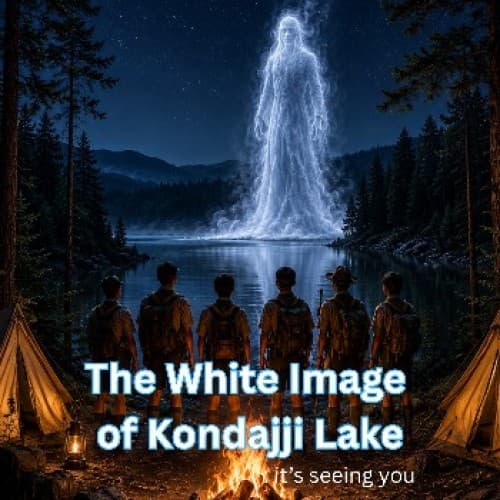

They say Kondajji Lake is serene by day—but by night, the waters remember things no man should. Our scout group, six of us in total, arrived with rolled-up sleeping bags, tents, and hearts full of anticipation. We were all boys—tough in banter, spirited in our drills, and brave enough to camp under a sky smeared with stars.
The village of Kondajji, cradled in the Harihar taluk of Davanagere district, had always been a spot for scout training and nature activities. Our leader, Raju sir, told us the lake was a symbol of calm. “Respect nature,” he’d said, his voice echoing through the trees, “and it will be kind to you.”
We pitched our tents on a small rise overlooking the lake. The water glistened under the afternoon sun, dragonflies skating across its surface. It was everything we imagined—until night fell.
Ho, I forgot to tell you, it's me, Prakash Rai, Diwakar, Prem shake, Sunil and Neela kantta murthyalong with ourScoutmaster we were to be qualified for President scout award had to camp to be certified as camper which is one of the necessities for qualifying as a President Scout which is the highest award in Scouting in India, like The highest achievement in the Boy Scouts of America (BSA) is the Eagle Scout Award.
The evening went smoothly. We cooked simple meals on our portable stove and sang campfire songs with nervous laughter. Around 10 PM, the fire began to die. That's when Prem noticed it first.
“Did anyone see that?” he asked, standing and pointing toward the far bank of the lake.
We all turned. In the darkness, where only shadows danced on the water, we saw it—just for a second. A tall, white figure. Not glowing, not moving, just there. So still, it could have been part of a tree. But no tree stood that tall or that pale.
One of us clicked on a torch.
The beam cut across the water, lit up the trees, the rocks, the edge of the shore—but nothing. The white figure was gone.
“Maybe a bird. Or mist,” someone muttered. Nervous chuckles followed. But none of us laughed from the belly.
Sleep came like a thief—some of us fought it, some surrendered, but all of us woke up just past midnight when we heard the whistle.
It wasn't from any of us.
It was long, shrill, and steady. Not the kind of whistle used by scouts. It seemed to come from within the woods near the lake.
I checked my watch: 12:17 AM.
Raju sir was asleep in his tent, not ten feet away. We huddled in ours, whispering.
“Who’s outside?”
“No one went for a leak?”
“No... I swear I saw something again by the tree line.”
That same white image. But this time, closer.
Sunil grabbed his torch and flicked it on. We peered through the mesh flap of the tent. The torchlight cut through the foliage. Nothing. No image, no figure, no sound. Only the chirr of crickets.
But when he turned off the torch, it was there again—by the lake, standing, watching.
We repeated these three times.
Torch on—nothing. Torch off—there it was.
Something unnatural was happening. The air grew colder. Not breeze-chilly, but icy, biting cold. Condensation collected on the inside of our tent. It shouldn’t have been this cold in April.
Then we heard it: Squelch. Squelch. Like something wet dragging its feet toward us.
No one dared open the flap now.
Suddenly, someone screamed—Koshy. He pointed to the corner of the tent where the canvas was pushing inward, like a hand was pressing from the outside.
Sunil swung the torch. The canvas was still.
"That's it," I said. "We’re waking Raju sir."
But when we unzipped the tent and ran to his, we found it empty.
His sleeping bag was cold. Undisturbed. As if he never came in at all.
Panic set in. We checked the area, calling his name in hushed yells.
No answer.
The white figure was now across the lake again, standing atop the boulder that jutted into the water like a throne. It didn’t move, but its presence felt thick—like a fog that clung to your skin.
We turned the torch on. The figure vanished.
Then, from behind us, we heard the whistle again. Closer. This time, two notes. A beckoning.
We spun around.
There, barely visible, just beyond the trees near the tent, was Raju sir. Or someone who looked like him.
He was standing stiffly, facing the lake, unmoving.
“Sir?” I whispered.
No reply.
We took a step closer. Still nothing. Then he turned—and we froze.
His eyes were wide open, milky white, his mouth hanging slack as if screaming in silence. He raised his hand and pointed—not at us, but at the lake.
Behind him, towering over the trees, the white figure rose.
It wasn’t human.
Too tall. Its limbs too long. Its face blank. It shimmered faintly in the dark, like moonlight on bone.
We ran. Through thorns, over rocks, we ran until our legs gave out. We ended up in the village, half-mad with fear.
A local shepherd saw us and took us in. When we told him what we saw, he didn’t laugh.
“You saw it,” he said simply. “The lake's keeper.”
“What do you mean?”
“They say when the lake dries too much, it hungers. It takes someone—usually a wanderer or a soul who has no anchor. But when too many disturb it, it shows itself.”
“And Raju sir?”
The man didn’t answer, just looked toward the lake.
At dawn, we returned with some villagers. There was no sign of Raju sir. But near the boulder where we had seen the figure, we found his whistle, half-buried in the mud.
And scratched into the rock, in letters long worn by time, were the words: "Do not light the dark. What is seen is not to be seen."
When we reached Bangalore we met our Raju Sir, the scout master- he says he never came with us for the camp !
We never camped again at Kondajji.
Kondajji Lake remains a popular spot by day. Families visit. Children laugh. But come sundown, no one lingers. And no scout has camped there since.
Because when the night is deep and the moon is thin, the white figure still watches. And if you ever point a torch at it—don’t expect to see it. But know this: it’s seeing you.