When Hell Came Hunting
My name’s Elwood. I was the sort of man who never believed in much of anything. Ghost stories? Just the wind in the pipes. Witches? Fairy tales for lonely girls. Hell? A nightmare for the superstitious and the damned. That all changed two years ago, the day my sister Sofia died screaming, torn apart by creatures no one sane would ever believe in.
Sofia was always the wild one. She was the girl who read shadows like tea leaves and laughed at thunderstorms. But after what happened, I can’t hear thunder without thinking about blood, about teeth, about the raw, meat-ripping sound of hellhounds feeding.
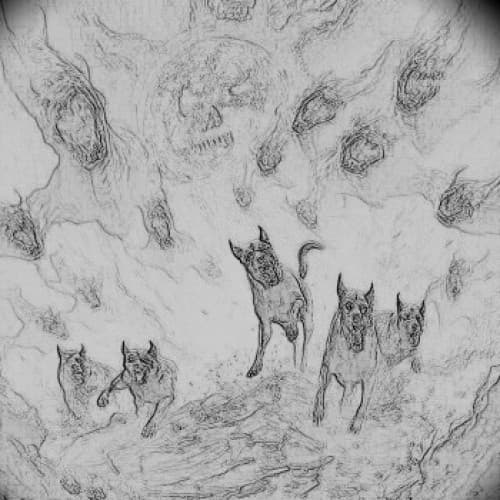
They say hellhounds are just big black dogs, you know, like the ones in old English legends—glowing eyes, foaming jaws, a bit of smoke and brimstone. They lie. The things that killed Sofia weren’t dogs. They were the memory of every nightmare you ever had about what waits in the dark, given flesh and hate. Their fur was blacker than sin, but it moved—crawled, writhed with a thousand tiny things, like maggots in a mass grave. Their eyes were red, yes, but not like rubies or coals—more like wounds, raw and weeping, set deep in skulls that stretched and split and never settled on a single shape. Sometimes they had faces, sometimes only holes, and sometimes I swear I saw Sofia’s own terrified face screaming from their hides.
The night they came was cold as the grave and black as a preacher’s heart. Sofia was in the attic, candles guttering, the thick stink of old wax and iron in the air. I heard her chanting, her voice thin and furious. She’d found out her friend had been hurt—badly hurt—and Sofia wanted revenge. She called them up, the hounds. She thought she could control them. Sofia always thought she was smarter than the darkness. She was wrong.
They tore through the house like a plague. Doors warped and rotted where they passed. The wallpaper peeled. The air thickened until it hurt to breathe. I tried to get to her, but there was something in the stairway—something heavy and cold and full of claws. When I finally forced my way in, it was over. Sofia was dead, her body barely recognizable, and the only thing left of her soul was a scream that echoed long after the hounds vanished.
The next morning, I found a poem tucked into her old spellbook. At least, I thought it was a poem. Turns out it was a spell—a key to hell, written in Sofia’s careful, looping script. She’d known she’d pay the price. She wrote the spell to free herself, hoping someone would find it. I did. And when I spoke the words, I felt something break. Far away, I heard Sofia’s voice—just for a moment, soft as rain. Then the hounds started hunting me.
I’ve been running ever since. Cities, towns, nameless motels with locks that don’t work. I can’t sleep for long. Every night, I hear them—claws on pavement, breath like burning tar, voices that sound almost human. Every town I leave, I find someone dead the next morning. Torn apart, nothing left but blood and fear.
I’m writing this down because I need someone—anyone—to know what happened. What’s still happening. Maybe you’ll believe me. Maybe not. But if you ever hear claws at your door, or see eyes glowing in the dark—run. Don’t look back. Hell is real, and it’s hungry.
I left the house that night with blood on my shoes and Sofia’s spellbook clutched so tight my knuckles cracked. I wandered for hours, numb, until the sun came up and everything looked wrong, as if the world had been painted by someone who’d never seen morning. The cops came, and I lied. I said I found Sofia that way, and maybe I did, but I saw more than I ever wanted. They called it an animal attack, but I saw the way the coroner’s hands shook, the way he looked at me—like he thought I might be next.
I buried Sofia in the old cemetery just outside of town, the one with the crooked stones and the iron gate that never quite shut. It rained the whole time. I thought maybe the water would wash some of the blood away, or the grief, but it just soaked through and left everything colder.
After the funeral, I tried to forget. I threw away her books, burned her clothes, smashed the old mirrors she used for scrying. It didn't matter. Every time I closed my eyes, I saw them—those hounds, crawling into the world through cracks in the walls, their mouths opening wider than any animal’s shoulder, full of teeth that didn’t belong to anything living. I heard their howls, too—high and sharp, like a child’s scream twisted into something obscene.
I started keeping a journal. Not because I thought I could write away the horror, but because the world was starting to slip. Nights became weeks. I’d wake up in strange places, hands shaking, heart pounding. I saw things in the shadows—shapes that didn’t belong, edges where there shouldn’t be any. I stopped eating. Stopped sleeping. I was haunted, and not just by memories.
It was three months before I found the poem again. I was cleaning out Sofia’s old dresser, about to toss it out with the rest of the junk, when I saw the slip of paper taped to the back of the bottom drawer. Her handwriting, careful as always:
“If you find this, it’s too late for me. But maybe not for you. Say the words. Let me go.”
I didn’t know what I was doing. Grief does things to you—makes you stupid, brave, or both. I lit a candle, because that’s what you do in the movies. I read the words aloud. The air went still and heavy, like the moment before a storm. I felt something move, deep in the floorboards, and for a heartbeat I thought I saw Sofia—whole, beautiful, smiling at me through the tears. Then she was gone.
That night was the first time I saw the hounds since Sofia died.
That night, the air felt wrong. Every sound in my little apartment turned sharp—pipes knocking, the refrigerator humming, the wind scraping dry branches against the window like bony fingers. I tried to tell myself it was just nerves, that I hadn’t actually seen anything when I spoke Sofia’s spell. But that’s the problem with lies—you have to keep telling them, and they never get any easier to believe.
It was past midnight when I heard the first growl. Not from outside, but in the hallway, muffled by the cheap door. It was low, guttural, and it vibrated in my chest like a warning drum. I froze, every instinct screaming at me to run, but my legs felt full of sand. The growl came again, closer, and then a scratch—no, a gouge, something dragging claws down the wood with slow, deliberate malice.
I backed away, hands shaking so badly I dropped Sofia’s spellbook. The pages fanned out on the floor, and for a moment I thought I saw shadows moving between the lines—like something alive, writhing beneath the ink.
The door started to bulge inward, just a little, as if something very large and very heavy was pressing its snout against it. The wood splintered. A wet, sucking sound filled the room, and I smelled burning hair and rot—like a slaughterhouse left to fester in the sun.
Then I saw one of them.
It was massive, bigger than any dog I’d ever seen. Its fur was a shifting, oily black, crawling with things that might have been insects or might have been just the twitching of flesh. Its body was wrong—too many legs, the spine arching and snapping like a whip, and its eyes…God, its eyes. They glowed not with fire, but with pain—deep, ancient pain, the kind that makes you want to tear your own skin off just to escape it.
It bared its teeth. They were jagged, yellow, and far too many for its mouth. I heard a sound then—something between a laugh and a howl, all hunger and mockery. The smell grew stronger, choking me, thick as syrup and twice as foul.
I staggered back, tripping over the edge of the bed. The thing pressed its face to the broken wood, and suddenly, impossibly, it spoke. Its voice was Sofia’s, twisted and raw and echoing with agony.
“Elwood,” it whispered, “you let me go, but you can’t save yourself.”
I ran. I don’t remember grabbing my jacket or my keys. I just remember the door exploding inward, splinters flying, claws raking the walls as I bolted down the stairs. The lights flickered. The air grew colder with every step, and behind me, the hound howled—a sound that made every muscle in my body seize with terror.
I hit the street and didn’t stop, not until my lungs burned and my legs gave out. I hid behind a dumpster, knees pressed to my chest, gasping for air and praying the thing wouldn’t find me. I heard footsteps—heavy, pounding, impossibly fast—circling, searching. The shadow of the hound passed over me, blotting out the streetlights for a moment that felt like eternity.
Then, as suddenly as it came, it was gone. The silence left behind was worse than the noise.
That was the first night. The first hunt. The beginning of the long chase.
I left that town before dawn, my breath still fogging in the cold. I didn’t pack. I didn’t say goodbye. I just drove, hands white-knuckled on the steering wheel, eyes flicking to the rearview mirror every few seconds, searching for shapes that shouldn’t be there.
The world looked different after that night—emptier, as if the hellhounds had chewed holes in reality itself. Every highway was endless and gray, every gas station a flickering oasis of nervous faces and cheap coffee. I tried to act normal. I stopped at diners, bought packs of cigarettes I didn’t smoke, pretended I wasn’t haunted. But the fear bled through. People stared at me like I was contagious.
The hounds never let me rest. Wherever I went, they followed. Sometimes I’d catch a whiff of their rot-smoke stink drifting in through a cracked window. Sometimes, late at night, I’d see their shadows flickering in the glass, jaws snapping at nothing. Once, in a motel outside Joliet, I woke to a sound like claws on linoleum. The next morning, the front desk clerk was dead—ripped open, her face frozen in a scream so wide it looked inhuman.
It wasn’t just death they brought. With them came a darkness that clung to walls and crept under doors. Plants wilted. Birds fell silent. Dogs barked themselves hoarse and then cowered, shaking, when the hounds passed. I tried to warn people, but who would believe a man raving about hellhounds?
I kept moving, always west, as if I could outrun them. I slept in my car, in abandoned barns, once even in a church, pressed against the altar as if the stone itself could protect me. The hounds circled outside, growling, their shapes melting and reforming in the stained-glass light. I prayed, not because I believed, but because I was desperate. It didn’t help. The only answer was that same ragged howl, echoing through the empty pews.
Sometimes, I thought about Sofia’s last moments—how she must have felt when she realized what she’d done, how the hounds turned on her the instant their work was done. I wondered if she’d been afraid, or if she’d fought, or if she’d just accepted it—the price for her vengeance. Her soul was supposed to be free now, but I couldn’t shake the feeling she was still out there, trapped in some place darker than death.
I kept Sofia’s spellbook with me, tucked under the seat. I read it every night, searching for something—anything—that might help. Most of it was nonsense. Lists of herbs, moon phases, sketches of things with too many eyes. But one page stood out. It was a map. Not of any place I recognized, but of somewhere deeper, colder, marked only with a single word: Hollows.
I didn’t know it then, but that was where the hounds wanted to take me. Where they dragged everyone they caught. Not Hell, not exactly—not the fiery pit from Sunday school—but somewhere worse. Somewhere made of memory and hunger, where the only law was pain.
I drove on, the road unraveling behind me, the hounds always a breath away.
The first time I truly saw the Hollows was in a dream—or maybe it wasn’t a dream at all. I’d been on the run for weeks by then, my body hollowed out by lack of sleep, my mind scraping against the edges of sanity. I fell asleep in a rest stop bathroom, locked in a stall with my back to the wall, clutching Sofia’s spellbook like a talisman.
I woke up somewhere else.
The light was wrong, heavy and red, like a sunset seen through blood. The ground was cracked and blackened, littered with bones—some small, some impossibly large. The air stank of sulfur and spoiled meat. Above me, the sky twisted, a patchwork of storm clouds pierced by jagged lightning that never made a sound.
All around, I heard the hounds. Not barking, but whispering—voices slithering through the shadows, hissing secrets I couldn’t understand. I tried to run, but the ground sucked at my feet, slowing me, dragging me down. Hands—gray and thin, with claws like broken glass—reached up from the cracks, clutching at my legs, scratching words into my skin in a language only the damned could read.
Shapes moved in the gloom. The hellhounds, but changed—bigger, more monstrous. Their fur writhed with the faces of the dead, mouths open in endless, silent screams. I saw Sofia’s face again, her eyes wide with terror, her mouth moving silently, begging for mercy she’d never receive.
Then I saw what the hounds did to the souls they caught.
They didn’t just kill. They devoured. They tore at their victims, not just flesh but memory—ripping away every happy thought, every bit of hope or love, leaving nothing but pain and terror. The souls they caught became part of them, fused into their bodies, their faces appearing in the mass of writhing fur, their voices added to the endless chorus of howls and whispers. The hounds grew with every soul they consumed, swelling with agony, becoming more and more monstrous.
The Hollows wasn’t a place of fire. It was a place of hunger—a world of emptiness and torment, where nothing ever healed and every wound bled forever.
I woke up screaming, sweat-soaked and shaking. My arms were covered in fresh scratches, the words from the dream still bleeding, as if the hands from the Hollows had followed me back. The spellbook was open to a new page, one I didn’t remember seeing before.
“The only way out is through,” Sofia’s handwriting said. “You must face them, or be taken.”
I knew then that running was pointless. The hounds would find me, sooner or later. And if they dragged me down to the Hollows, there would be no escape—not for me, not for Sofia, not for anyone.
But maybe, just maybe, if I could find a way to fight them, I could end this. For both of us.
I couldn’t run anymore. My body was too worn, my mind too frayed. The hellhounds were closing in—every night their shadows grew thicker, every dream darker. I caught glimpses of them in store windows, saw their eyes in puddles, heard their claws scraping just behind every closed door.
Sofia’s message haunted me: “You must face them, or be taken.” It was a warning, but maybe also a promise. I started to wonder if this was what she’d felt—trapped, desperate, clinging to hope even as the darkness pressed in. I spent long hours with her spellbook, searching for anything that might give me a fighting chance.
There was a ritual on the last page—a way to summon the hounds, not as prey, but as a challenger. It was madness, but then, so was everything else in my life now. I gathered what I needed: iron nails, salt, a candle soaked in my own blood, and a single lock of Sofia’s hair, which I’d kept all this time, knotted in a ring she’d worn as a girl.
I drove to the place where Sofia died, the house long abandoned and half-collapsed, windows black and empty. The wind howled through broken eaves. The air felt thick, charged with old pain. I set up the ritual in the attic, tracing the circle with salt and nails, lighting the candle, whispering the words I barely understood.
The temperature dropped. My breath came in clouds. The shadows grew teeth.
They came through the walls, through the floor, through the darkness itself. Three of them, bigger than ever, their bodies rippling with the faces of the dead—the clerk from the motel, a boy I’d seen on the news, a dozen others, all fused into their shifting, monstrous forms. Sofia’s face hovered at the center of the largest hound, her eyes pleading, her mouth twisted in silent agony.
I forced myself not to look away. “You want me?” I shouted, my voice shaking. “Then come and take me!”
The hounds circled the salt, snapping at the barrier, smoke pouring from their mouths. The air buzzed with their hatred. They spoke—not with words, but with memories, flooding my mind with every horror they had ever wrought, every soul they had ever consumed. I saw Sofia’s death a thousand times, felt her pain, her terror, her regret.
But I also saw something else—a flicker of hope, buried deep in her eyes.
I remembered the last line of her spell: “Light the candle, face the dark, and let love be your shield.”
I stepped into the circle, holding the ring tight in my fist, and called out to Sofia—not the witch, but my sister. The girl who’d believed in magic, who’d laughed in thunderstorms, who’d tried, in her broken way, to protect the people she loved.
The largest hound lunged, teeth flashing, jaws wide enough to swallow me whole. I braced myself, expecting pain. Instead, the world exploded in light.
The light wasn’t blinding, but it was absolute. It poured from the candle, from the ring in my hand, from somewhere inside me I’d never known existed. It was warm, fierce, and impossibly sad. For a moment, the hellhounds recoiled, their shadows peeling back, their mouths snapping in silence as if the light was burning them from the inside out.
I saw Sofia—her true self—standing beside me in the circle, her hand in mine, her eyes shining with tears. She wasn’t the screaming face in the hound’s fur anymore. She was my sister again, flesh and blood and spirit. She smiled at me, a tiny, broken smile, and squeezed my hand.
The hounds circled, howling. Their bodies shivered and flickered, the faces of their victims flickering in and out of existence, mouths opening in silent screams. The largest hound lunged again, smashing against the circle, claws scraping sparks from the floor. Its eyes locked on mine, and I felt its hunger—a bottomless, endless need, the hunger of Hell itself.
I remembered what Sofia wrote: “Let love be your shield.” It sounded foolish, childish, but in that moment, it was all I had left.
I spoke to the hounds—not as monsters, but as the lost souls they were. I told them I forgave them, even as my voice shook and my heart hammered against my ribs. I forgave them for Sofia, for myself, for every person they’d dragged into darkness. The words hurt, tearing out of me like thorns, but they were true.
The largest hound screamed—a sound that split the walls, rattled the windows, made the house tremble. Its body twisted, swelling and shrinking, the faces inside writhing in pain and longing. Sofia squeezed my hand harder, tears streaming down her face.
A crack appeared on the floor, black and endless. The hounds shrieked and clawed at the edge, trying to escape, but the light pressed them down. One by one, they broke apart—first the smallest, then the middle, their bodies unraveling into smoke and bone, their faces fading into shadows. Only the largest remained, fighting, screaming, Sofia’s face pulsing at its core.
“Sofia,” I whispered, “it’s time.”
She nodded, her eyes full of sorrow and gratitude. She let go of my hand, stepped toward the hound, and pressed her palm to its chest. The light flared, brighter than ever, and the hound howled one last time—a sound of pain, yes, but also of release.
The creature collapsed into ash, and Sofia’s spirit rose, shining and new, free at last.
The house fell silent. The air cleared. The darkness lifted.
I was alone, kneeling in the ruin of the attic, the candle burned to nothing, the ring cold in my hand.
But for the first time since Sofia died, I felt something close to peace.
The sun was rising when I stumbled out of the house, clothes torn, skin marked with salt and blood. The street was empty, washed pale and cold, the world feeling fragile as glass after a storm. I looked back at the ruin—the attic window shattered, the roof caved in—wondering if anyone would ever believe what happened here. I barely believed it myself.
For days, I wandered the old town, dazed, waiting for the hounds to return. But they never did. Their rot-smoke stench was gone, the shadows lighter, the air no longer charged with dread. People went about their lives again. The birds came back. The world, somehow, began to heal.
But I didn’t—not completely. There are wounds you carry forever. I missed Sofia in every way a person can be missed. I missed her laughter, her stubbornness, her way of seeing beauty in the dark. I mourned the things I never said, the fights we never finished, the years lost to secrets and silence.
But I also felt her peace. Sometimes, in the quiet, I’d hear her voice—soft as wind in leaves, thanking me, forgiving me, loving me from wherever she’d gone. I kept her ring, the spellbook, the scars. They were proof that she mattered, that I mattered, that even in the deepest dark, there can be light.
I left town eventually, starting over somewhere no one knew my name. I didn’t run anymore. I told Sofia’s story to the people who would listen. Most of them thought I was crazy, but a few heard the truth in my voice.
Sometimes, late at night, I still hear howling on the wind. It doesn’t scare me now. I know what it means to be hunted by hell and to survive.
And I know the price of love, and the cost of letting go.