They drew him before he came.
that sits in your gut like a stone, the kind that stalks you in the dead hours when the house settles and the wind claws at the windows. My name is Marty Caldwell, and if you’re reading this, it means I’m still looking. Or maybe—God help me—it means he’s found me, and you need to know what happened in Stanton, Michigan, before he finds you, too.
It started with a drawing.
Two years ago, almost to the day, my son Bill began to draw. Not the usual stick figures and wobbly superheroes you’d expect from an eleven-year-old, but the kind of pictures that make you want to look away, then stare harder because you can’t quite believe what you’re seeing.
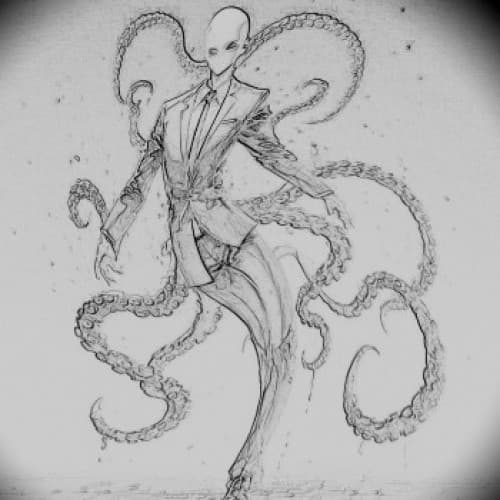
He’d sit at the kitchen table while the sun went down, crayons and pencils like surgical tools in his skinny hands, and sketch page after page of the same thing: a tall, gaunt man in a black suit, faceless, with arms like lengths of rope. Sometimes there were shadows, and sometimes there were blank, gaping holes where eyes should be. Sometimes he’d draw tentacles curling from the thing’s back, black as spilled ink.
At first, I laughed it off. Kids draw monsters. It’s what they do. But after a week of this, I started to notice the little details. The way Bill’s hands shook. The way he’d look out the kitchen window into the woods that huddled up against our backyard, his eyes wide and unblinking. The way he’d flinch whenever the wind rattled the glass.
I asked him about it over pancakes one morning, syrup pooling on his plate like blood. “Who’s the man in your pictures, buddy?”
His fork paused halfway to his mouth. He didn’t look at me. “He comes at night,” he whispered, voice so low I almost didn’t catch it. “He stands by the trees and waits.”
I’d have shrugged it off—maybe some story he heard at school, maybe something he saw online—except the nightmares started. Bill would wake up screaming, sheets twisted around his legs, sweat plastering his hair to his forehead. He’d tell me the same thing, over and over: “He wants me to come outside. He says he can make the bad dreams go away.”
That was creepy enough, but then Kim started drawing, too.
My little girl, only five, with pigtails and a gap-toothed smile, started bringing me pictures from preschool. The same man—tall, thin, faceless. Only sometimes he had more arms, reaching, always reaching.
When I asked her why she drew him, she said, “Because he likes us. He talks to Bill at night. He says we can play in the woods together.”
That’s when I stopped sleeping.
I started sitting on the porch with a thermos of coffee and a shotgun across my knees. I watched the tree line for hours, eyes stinging, nerves raw as exposed wire. Sometimes I’d hear laughter, high and distant, threading through the trees like a chill. Sometimes I’d hear branches snapping, too close for comfort.
And then, one night, I saw him.
I want to tell you I was brave. I want to tell you I stood my ground. But the truth is, when I saw that thing—tall as a lamppost, dressed in a suit black as midnight, face as blank as a sheet of paper—every instinct screamed at me to run. He hovered at the edge of the woods, arms dangling, something impossibly wrong about the way he moved, like he was being pulled by invisible strings.
I tried to stand. My legs wouldn’t work. I tried to scream. Nothing came out but a whimper. He drifted closer, and the world tilted. Light faded at the edges of my vision. The last thing I remember is his arms stretching toward me, impossibly long, fingers splitting and curling like branches.
When I woke up, the sun was rising, the air cold and sharp in my lungs.
My kids were gone.
The house was silent when I stumbled inside, the kind of silence that presses down on your ears and makes your own heartbeat thunder in your chest. Bill’s bed was empty, the sheets thrown to one side as if he’d just stepped away for a moment. Kim’s teddy bear lay on the floor of her room, one glassy eye staring at the ceiling, the other missing—a casualty of her restless nights.
I called their names until my throat felt raw. Nothing answered but the wind rattling the windows and the furnace coughing in the basement. I searched every room, every closet, every crawlspace—even checked the attic, where dust motes danced in the pale morning light and the only footprints were my own. It was as if they’d vanished, plucked from their beds by invisible hands.
Desperation is a living thing—a shadow that clings to your back, whispering that hope is just a lie you tell yourself to keep from screaming. I stumbled out onto the porch and looked toward the woods, their black branches tangled against the sky.
I should have called the police right then. But who would believe me? Who could I tell—“My children were stolen by a faceless man with arms like tentacles, a thing that comes out of nightmares”? The words stuck in my throat, thick and useless.
Instead, I went to the edge of the woods.
The trees in Stanton are old. They remember things. Sometimes, on certain nights, you can almost hear them whisper to each other, leaves rustling with secrets. I stepped into their shadows, my heart hammering, every nerve alight with terror and determination.
The woods were thick with fog, the sunlight barely piercing the canopy overhead. Every branch seemed to reach for me. I followed the only clue I had: the faint, child-sized footprints in the dew-soaked grass, leading deeper among the ancient oaks.
That’s when the voices started.
First, it was just a whisper, so soft I thought it was my imagination. Then it grew, curling around my mind like a cold hand, a thousand tiny voices all speaking at once, layered on top of each other—my children’s laughter twisted into something sharp and hollow, a man’s voice smooth and empty, promising everything and nothing.
“He wants us to play, Daddy. Come play with us. It’s safe in the woods.”
I shivered. My breath came in clouds. Something brushed past my ear—maybe a moth, maybe a fingertip. I spun around, but there was nothing. Just the trees, and the fog, and the sense that I was being watched.
Most towns have their own stories, the things you tell around campfires or at sleepovers to scare the new kids. Stanton was no different. There were tales of the Gray Man, the Watcher in the Woods, the Tall Gentleman—names whispered in the dark, always with a nervous laugh to chase them away.
But those stories felt different now. They weren’t just stories; they were warnings.
I went to see Old Man Hargrove, who lived in a crumbling farmhouse on the other side of town. He’d been around longer than anyone, and people said he knew things—things the rest of us didn’t want to know.
He stared at me with milky eyes as I told him about Bill and Kim, about the drawings, about the thing in the woods. When I finished, he didn’t laugh. He just nodded, slow and sad, as if he’d been expecting this.
“He’s been here before,” Hargrove said, his voice like gravel. “He comes when the veil is thin. Take what he wants. Leaves holes behind—holes in the world, holes in the heart.”
“Who is he?” I whispered.
Hargrove’s hand trembled as he reached for my shoulder. “Some call him Slender Man. Some call him the Shadow Shepherd. But whatever you call him, he feeds on fear. And once he’s marked you, you’re never free.”
I left Hargrove’s place with a shotgun, a flashlight, and a burning need for answers. I tore through old newspaper clippings, police reports, and yellowed pages from the town’s archives. Stories of missing children, strange sightings, unexplained disappearances. Always the same pattern: the drawings, the dreams, the whispers in the dark.
The more I learned, the colder I felt. Stanton wasn’t just haunted—it was hunted.
But I wasn’t going to let him have my kids. Whatever it took, wherever it led, I would find them. I would bring them home. Even if it meant facing the thing in the woods, even if it meant staring into the void behind its faceless mask.
Because that’s what fathers do.
As dusk sank its teeth into Stanton, the house itself seemed to grieve. The walls settled and moaned. I found myself listening for the familiar scuffle of Bill’s sneakers on the porch, for Kim’s giggle echoing down the hall. Instead, there was only that unnatural quiet—thick, suffocating, and somehow alive.
That night, I dreamed. I stood in the woods, fog swirling at my feet, the trees swaying like dancers in a silent waltz. I heard children laughing, but it was muffled, as if they were calling to me from under six feet of earth. Then I saw him. The Slender Man. He glided from between the trees, arms outstretched, his featureless face fixed on me. And behind him, in the shifting shadows, my children stood—small, pale, eyes wide and empty.
He spoke in a voice I felt in my bones:
You can have them back. But you must come to me. You must give me what I want.
I woke with the taste of mud in my mouth, my fingers clenched so hard around the bedsheet that my knuckles ached.
Days bled into nights, and nights into days. I stopped shaving, stopped eating. My world shrank to the size of the woods and the terrible presence within them. I saw Slender Man everywhere: in the swirl of mist over the fields, in the dark windowpanes at midnight, even in the way tree branches bent together in the wind.
Sometimes, I would find new drawings taped to the refrigerator—drawings that hadn’t been there the night before. Stick figures of a man with no face. Children holding his hand. In one, the Slender Man’s arms stretched around the house, squeezing it like a toy.
I started to hear things that couldn’t be real: the sound of footsteps on the stairs when I was alone, the lullaby Kim’s mother used to sing, sung in a voice that was almost—but not quite—hers. The phone would ring, and when I answered, all I could hear was static. And underneath the static, breathing.
People in town started avoiding me. Their eyes slid away when I walked by. They whispered behind cupped hands. I was the crazy man, the one whose kids vanished like morning mist, who spent his days stalking the woods and his nights sitting on the porch with a shotgun and a thousand-yard stare.
But I didn’t care. The only thing that mattered was finding them.
One night, the whispers grew louder, crawling through the floorboards, settling beneath my skin. I grabbed the flashlight and the shotgun and stepped outside. The moon was a ragged coin behind the clouds. The woods waited, black and silent.
I found myself drawn to a spot behind the house where the ground dipped and the grass grew sparse and gray. A hollow, old as the town itself. My breath steamed in the cold air.
That was when I heard it:
Daddy… Help us…
I stumbled forward, a flashlight beam dancing across twisted roots and fallen branches. The air was thick with the smell of rotting leaves and something else—something sweet and sick, like spoiled meat.
At the center of the hollow stood a tree, its bark flayed and oozing sap that glowed faintly in the dark. And there, scrawled into the trunk, were dozens—no, hundreds—of little drawings. Each one a crude child’s sketch of Slender Man. Some old and faded, some fresh as if carved only moments before.
I pressed my hand to the tree. It felt warm, pulsing, almost alive. The ground shifted beneath my feet, and suddenly the world tilted and spun.
I fell.
The earth swallowed me whole. I tumbled through blackness, roots grabbing at my legs, dirt filling my mouth. I landed hard on stone, the flashlight flickering. I was in a tunnel, narrow and suffocating, the walls pocked with handprints—tiny, child-sized handprints, pressed into the clay.
I followed the tunnel, shotgun gripped tight, heart thundering. The whispering grew louder, echoing off the walls, a chorus of voices:
He’s coming… he’s coming…
Ahead, a faint light flickered—blue and cold. I crept closer, and there in a small earthen chamber, I saw them.
Bill and Kim stood hand-in-hand, eyes wide and glazed, skin pale as paper. Behind them, the Slender Man unfolded himself from the shadows, arms stretching, face blank and terrible.
He spoke without words, his thoughts slithering into my head:
You cannot take them. They are mine now. The woods are hungry. You, too, belong to me.
I tried to raise the shotgun, but my arms wouldn’t move. The world spun. His tendrils slid across the floor, wrapping around my ankles, squeezing until I saw stars.
“Let them go!” I screamed, but my voice was a dry croak.
He leaned closer, his faceless head inches from mine.
You can join them. Or you can wander the dark, alone, until the end of your days.
My mind reeled as the Slender Man’s tendrils squeezed tighter. Every instinct screamed at me to fight—to claw and bite and do anything to reach my children. But my body was heavy, numbed by the thing’s presence, as if my blood had turned to ice.
Bill’s eyes met mine. For just a moment, I saw the boy he’d been—frightened, desperate. “Don’t let him take us, Dad,” he whispered, voice thin as spider silk.
Kim’s tiny hand reached out, trembling. “Come home, Daddy…”
The Slender Man turned his blank face toward them, and I felt a ripple of rage—cold, ancient, bottomless.
They will stay. You will forget. The hunger will be fed.
But at that moment, something snapped inside me. Maybe it was the memory of my wife, her laughter in the sunlight, her promise to always keep our family safe. Maybe it was pure madness. I drew in one last, shuddering breath and spoke words that weren’t entirely my own:
“Take me instead. Let them go. I’ll stay here, in the hollow, forever. Just let them go.”
For the first time, Slender Man hesitated. The air shivered. His head cocked, as if considering my offer.
You would give yourself?
The voice was oily, sliding around the edges of my consciousness.
“Yes. Take me. Let them go home. Let them forget this. Let them live.”
Something like a smile rippled across his face—an impression, not a movement.
Done.
His tendrils unwound from my ankles and slithered toward Bill and Kim. They wrapped gently, almost lovingly, around their tiny wrists. I wanted to scream, to tear him apart with my bare hands, but I was paralyzed, trapped in a nightmare made flesh.
A wind rose from nowhere, howling through the tunnels and the hollow above. Bill and Kim began to rise, their eyes closing, their bodies growing insubstantial, fading into mist. The last thing I heard was Kim’s voice, soft and sweet, echoing one final time:
“Goodbye, Daddy. I love you.”
When the wind died, I found myself alone. The chamber was empty, save for the faint outline of two small footprints in the dust. My children were gone—gone home, I prayed, to warm beds and sunlit mornings, their memories wiped clean of the thing in the woods.
Slender Man remained, looming over me. He no longer needed words; his presence pressed on my mind, filling every shadow with dread. I understood, now, what Hargrove had meant by “holes in the heart.” I was a hole, emptied out and left behind.
He gestured, and I felt myself rising, weightless and numb. I drifted through the tunnels, through the roots and mud, until I burst up into the cold midnight air.
I stood at the edge of the woods, staring at my house. Lights glowed in the windows. I saw Kim and Bill inside, laughing, playing, whole and safe. But as I stepped toward them, something pulled me back.
I was invisible. I was a shadow, a whisper, trapped between worlds. The price had been paid.
Days, weeks—years?—passed, though time meant nothing now. I watched my children grow, watched them forget the terror that had nearly devoured them. Sometimes, when the night was darkest, Bill would pause at the window, staring into the woods, a crease of confusion between his brows. Sometimes Kim would shiver, complaining of a cold she couldn’t shake.
But they were alive. I had kept my promise.
Slender Man visited, sometimes. I felt him in the way the trees bent, in the hush before a storm, in the flicker of shadows across the walls. Each time, he would drift through the woods, searching for new prey. And each time, I would whisper warnings to those who would listen—soft, desperate pleas that sometimes reached the ears of children brave enough, or foolish enough, to listen to the wind.
I became Stanton’s secret, the watcher in the woods, the hollow man who traded everything for love.
But one storm-lashed night, as I hovered at the edge of the trees, I saw a new family moving into the old Caldwell house. A woman, alone, with a little boy who looked just like Bill had, all those years ago.
The boy wandered into the yard, chasing a red ball. He stopped at the edge of the woods, peering into the darkness.
That’s when I saw her—my wife, or what was left of her, drifting between the trees, her face pale and empty, her eyes hollow and black.
She looked at me and smiled.
“You saved the kids, Marty,” her voice echoed in the wind, “but you never saved yourself. And you never saved me.”
I tried to reach her, but my hands passed through her like smoke.
Slender Man stood behind her, his arms draped over her shoulders like a cloak. The cycle was not broken. It would never break.
The woods are always hungry.