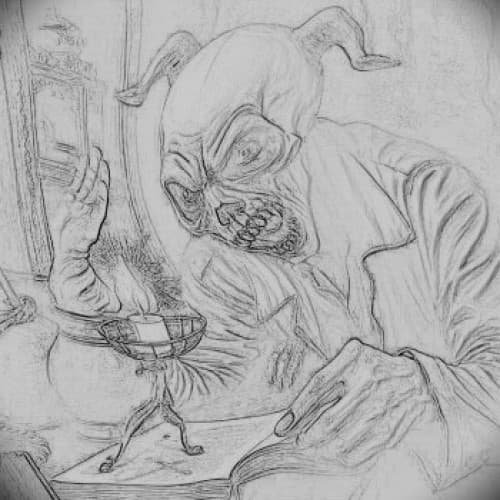

The Night Everything Went Dark
Morley Stanwood looked best in the dark, Carol always thought. By day, it was a place of sagging porches and rusted playgrounds, a town that time refused to remember. But at night, the imperfections were swallowed whole. The dark was a kind of mercy—except for those who knew what lurked inside it.
Carol’s house stood at the edge of town, hemmed in by woods so dense they seemed to press against the windows. He’d chosen it for the isolation, the silence, the way the pines whispered when no one else was listening. His imagination thrived here, but lately, that imagination had turned on him.
It began with small things: the creak of a floorboard when Linda was supposed to be out, the shadow that lingered a moment too long on the lawn, the feeling of being watched even as he wrote his twisted tales in the dead of night. He’d always written horror, but the stories were beginning to write him.
He saw them first on a Thursday. He couldn’t say why he looked outside—the computer screen had gone black, and the clock on the wall was stuck at 2:13 a.m. Maybe it was the wind, or the scrape of a branch against the siding. Maybe it was something deeper, something primal. He went to the window and parted the curtain just an inch.
They stood in the yard, five of them, children wearing out-of-season clothes: a tattered Halloween costume, a summer dress in December, bare feet leaving no prints in the snow. Their eyes were wrong: pools of ink, swallowing the shine from the moon. When Carol blinked, they were gone.
He tried to explain it to Linda the next morning, but she just shook her head, offered him a thin smile, and poured her coffee. She didn’t believe in monsters—not the kind that stalked his dreams, anyway.
That day, the world felt off-kilter. The postman wouldn’t meet his eyes. At the grocery store, the cashier’s smile was stiff, her gaze sliding past him as if he wasn’t really there. Kids gathered by the playground, whispering in a tongue he couldn’t quite catch. He wondered if they were talking about him, or if he was just losing his grip.
Linda came home late. There was a smell on her—cologne, not the kind he wore. She hung her coat by the door and went straight to the bathroom. Carol watched her, counting the minutes, replaying every moment she had ever left him alone.
That night, the children came back. This time, they pressed their faces to the glass, breath fogging the pane. Carol stumbled back, heart rattling in his chest. He reached for his phone, but the battery was dead. He tried the lights, but the power was out. The house was a tomb.
He heard laughter—soft, cruel—from somewhere inside. He called out for Linda, but she didn’t answer. He found her in the kitchen, whispering into her phone, her face lit by the cold blue of the fridge light.
“Who are you talking to?” His voice cracked.
She jumped, clutching the phone to her chest. “It’s just work, Carol. Go back to bed.”
But he didn’t believe her. He couldn’t. The children were waiting outside, and the house was full of shadows.
Sleep fled from Carol that night, chased away by the scrape of branches and the echo of those inhuman eyes. He drifted through the house like a specter, flinching at his own reflection in shadowy mirrors, listening for footsteps that never came. Linda was locked in the guest room, her phone’s light flickering beneath the crack of the door. He heard her voice—low, urgent, almost pleading.
He pressed his ear to the door, straining to pick out words, but all he caught were fragments. “I can’t tonight…he’s here…no, I’ll call you.” The phone clicked off. Silence swallowed everything.
He retreated to his study, the only place that felt remotely safe, and tried to write. The words wouldn’t come. All he could think about were those black-eyed children, their silent vigil at the edge of his yard. He pictured them pressing closer, their hands leaving oily prints on the glass, their breath a cold mist in the air. He wondered what they wanted—what they would do if he let them in.
Hours slipped away in a feverish blur. Carol’s thoughts circled endlessly: Linda’s secrets, the children’s haunting eyes, the feeling that something was terribly, irrevocably wrong. He dug out his old camcorder, set it up by the living room window, and pointed it at the yard. If the children were real, he’d catch them.
The next morning, Linda left before dawn. No explanation, no goodbye. Carol watched her car disappear down the icy road, his heart hammering in his chest. He played back the footage from the night before, his hands trembling. The screen flickered, static lacing the edges, but there was nothing there—just snow and darkness. No children. No proof.
He tried to call Linda, but her phone went straight to voicemail. He drove around town, searching for her car, peering into shop windows and parking lots. He imagined her meeting a man in a shadowed corner, laughing at something only they understood. The image burned behind his eyes.
That evening, the power failed. The whole street went black, one house after another winking out. Carol lit candles and prowled from room to room, every shadow a threat. It was then that he saw them again—dozens this time, crowding at the edge of the woods, their faces upturned, their eyes bottomless.
He grabbed the baseball bat from under his bed and crept down the hallway, each board groaning under his weight. He heard Linda’s voice in the kitchen, rising and falling in frantic whispers. He burst through the door, the bat raised.
Linda spun around, her eyes wide with terror. The phone slipped from her hand and clattered to the floor. “Carol, what are you—?”
“Who are you talking to?” He hissed the words, spit flying from his lips. “Who’s out there?”
She backed away, shaking her head. “You’re scaring me. There’s no one out there, Carol. Just us.”
“Liar!” He heard himself shouting, but it sounded distant, hollow, as if someone else was wearing his skin. “They’re watching us. Don’t you see? They’ve been waiting, waiting for you—”
Linda ran for the door, but Carol blocked her path. The bat felt impossibly heavy in his hands. Rage, fear, and confusion twisted together until he couldn’t tell them apart. In the flickering candlelight, Linda’s face blurred, shifting, her eyes darkening until they were as black as midnight.
He swung the bat. Once. Twice. The world went silent.
Blood pooled on the tile, spreading in slow, sticky rivers. Linda’s body lay crumpled, her hair fanned out like a halo. Carol stared, unable to move or breathe.
Outside, the snow kept falling—soft, relentless, erasing every trace of what had happened.
He didn’t remember dragging Linda’s body down to the basement, only the cold burn of the steps beneath his bare feet, the sticky trail left behind. He wrapped her in a moth-eaten blanket, tucking her away in a corner as if hiding a childhood toy. The house above felt heavier, as though the darkness had thickened, pressing down from the attic and up through the floorboards.
Carol scrubbed the kitchen tile in a daze, red smears swirling into pink, the bleach stinging his lungs. The smell of iron clung to him, no matter how many times he washed his hands. He caught glimpses of Linda in the corners of his eyes, her shadow shifting just behind the refrigerator or the bathroom door. Sometimes, he thought he heard her voice—soft, pleading—calling from the cellar’s depths.
Sleep became impossible. Every time he closed his eyes, the black-eyed children gathered closer, their numbers growing, their faces blurring into a single, monstrous mask. They pressed their hands and faces to every window, filling the house with the muffled sound of their breath. He tried blocking the doors with furniture, nailing boards across the windows, but nothing kept them out. They slipped through cracks, through keyholes, through the spaces between his thoughts.
He stopped leaving the house altogether. The world outside took on a dreamlike shimmer. He watched from behind the curtains as neighbors shoveled snow, their faces blank and white, their movements slow and mechanical. Sometimes the children would follow them, clinging to their coats, whispering things Carol couldn’t quite hear.
The police came by once, asking if he’d seen Linda. Had she run off, they wondered, or was she just laying low after an argument? Carol nodded and shook his head in all the right places, feeling the words tangle in his throat. The officers’ eyes seemed darker than usual, their voices echoing strangely. When they left, he locked every door and hid in the closet until sunset.
He started to believe, truly believe, that he alone stood between Morley Stanwood and the end. The children wanted the town’s soul—or maybe just its children. He filled his journal with frantic notes, scrawled maps, wild theories. He drew sketches of the black-eyed children, their faces multiplying across the pages until the ink bled through.
At night, he heard them inside the walls, scratching and giggling. Sometimes, he saw Linda among them, her face eclipsed by two yawning voids. “Come with us,” she would whisper, her voice curling around his spine, “come see what you’ve done.”
The line between memory and nightmare disappeared. Carol wandered the halls in a fever, sometimes waking up in the yard with snow crusted on his skin, or in the basement, staring at the spot where Linda’s body lay. He didn’t know how many days passed. Time warped, bent under the weight of guilt and terror.
One night, the power went out again. The world outside was a black sea. Carol took his bat and flashlight and stepped out into the night, convinced it was time for war.
Carol’s breath hung in the air, a pale mist in the frozen dark. The town was utterly silent, the only sound the crunch of his boots over brittle snow. He gripped the bat until his knuckles ached, sweeping the flashlight in jerky arcs. Each time he blinked, the world shifted—familiar streets warped into a twisted maze, houses hunched like sleeping beasts.
He no longer questioned whether the children were real. They were everywhere, darting from shadow to shadow, their black eyes glinting in the beam of his flashlight. They watched from behind trees, from the swings at the empty park, from the windows of houses where real children once slept. Their whispers scraped at the inside of his skull, words he couldn’t quite understand but felt compelled to obey.
You’re the only one who can stop us, they seemed to say. You’re the only one who can save them.
He prowled the streets, convinced he was a guardian, a chosen warrior in a battle no one else could see. He smashed at shadows, swung wildly at phantoms, left dents in mailboxes and shattered porch lights. More than once, he caught a glimpse of Linda’s face among the children, her mouth twisting into an accusing smile before vanishing into the gloom.
The town itself seemed to warp around him. Houses changed places, streets doubled back on themselves, his own footprints circling endlessly. Sometimes he found himself pounding on neighbors’ doors, screaming warnings about the black-eyed plague. The few who answered looked at him with pity or fear, promising to call someone, to get help. But help never came.
The children drew closer every night. Sometimes they surrounded him in the woods behind his house, dozens of them holding hands in a silent ring, their eyes swallowing all the moonlight. They whispered his name and beckoned him to join their game.
He started seeing things in the snow—tiny footprints that vanished as soon as he followed them, strange symbols scrawled in the frost, shadows that moved against the wind. The world outside felt thinner, as if he were walking on the skin of some deep, bottomless pit.
Sleep became a distant memory. He prowled the house and the streets until dawn, his bat and flashlight the only things anchoring him to the world. He stopped eating, stopped shaving, barely remembered to drink. The smell of bleach and old blood clung to him, mingling with the sharp, sweet scent of winter.
One night, stumbling through the woods, Carol found himself at the edge of the frozen river. The children were waiting, their eyes reflecting the stars. Linda stood at their center, her face pale and perfect, shadowed by those impossible black eyes.
“Come with us,” she whispered, her voice echoing across the ice. “It’s cold here, but you don’t have to be alone anymore.”
Carol fell to his knees, the bat slipping from his hands. He sobbed, raw and broken, as the children closed in, their fingers icy against his skin.
In that moment, for the first time, he realized he was lost—lost in the darkness he’d made for himself, with no way back to the world he once knew.
The next morning, Morley Stanwood woke to a town changed only by the deepening winter. Carol’s house sat quiet and still, frost webbing the windows and a single set of footprints circling through the yard and into the woods, over and over and over.
Inside, Carol was nowhere to be found. The kitchen looked cleaner than it ever had, the scent of bleach sharp in the cold air. But in the basement, hidden beneath layers of old blankets and boxes, the truth waited in silence.
Carol wandered the woods, his mind a blur of shadow and accusation. He saw police cars crawling the roads, search parties combing the frozen riverbanks, neighbors whispering behind gloved hands. To him, they were all in league with the black-eyed children, all part of the spreading infection. He ducked behind trees and sprinted through drifts, clutching the bat like a lifeline.
The hallucinations pressed in harder, louder, more insistent. Children followed him everywhere, their laughter a constant drone beneath the wind. Sometimes he saw Linda walking among them, her hand reaching out, her eyes hollow with sadness.
“You don’t have to fight anymore, Carol,” she said, her voice echoing through the trees. “It’s over.”
But for Carol, it was never over. He could not outrun the guilt, could not silence the voices. Hunger gnawed at him, and sleep came in fevered flashes—visions of hands reaching up from the snow, Linda’s face twisted in pain and accusation, the children’s eyes blooming like bruises in the darkness.
One night, the police finally found him, staggering along the edge of the river, his clothes torn and soaked with snowmelt. He screamed warnings at them, swinging his bat at invisible enemies, eyes wild with terror. It took three officers to bring him down. Even then, he fought—howling that they were helping the children, that no one was safe.
They dragged him away as the first light of dawn crept over the trees. Neighbors watched from behind curtains as he was bundled into the back of a squad car, his face pressed to the glass, eyes darting from shadow to shadow.
The news spread quickly: Linda was missing, last seen with her husband before the power outage. The search of the house revealed the truth—blood on the tiles, the hastily cleaned mess, the body in the basement. The story made the local papers: “Horror Writer’s Wife Found Dead; Husband in Custody After Rampage.”
But for Carol, the story didn’t end at the police station. In the sterile brightness of the holding cell, the children visited him every night. They pressed close to the bars, their faces pale and shimmering, their eyes bottomless. Linda came with them, always silent, always watching.
He whispered to them, begged for forgiveness, sometimes screamed until his throat was raw. The other inmates learned to ignore him. The guards called him “The Nightman,” a boogeyman in their own right.
In the end, Carol was left alone with his story—a tale of black-eyed monsters, betrayal, and a darkness that no amount of light could ever chase away.