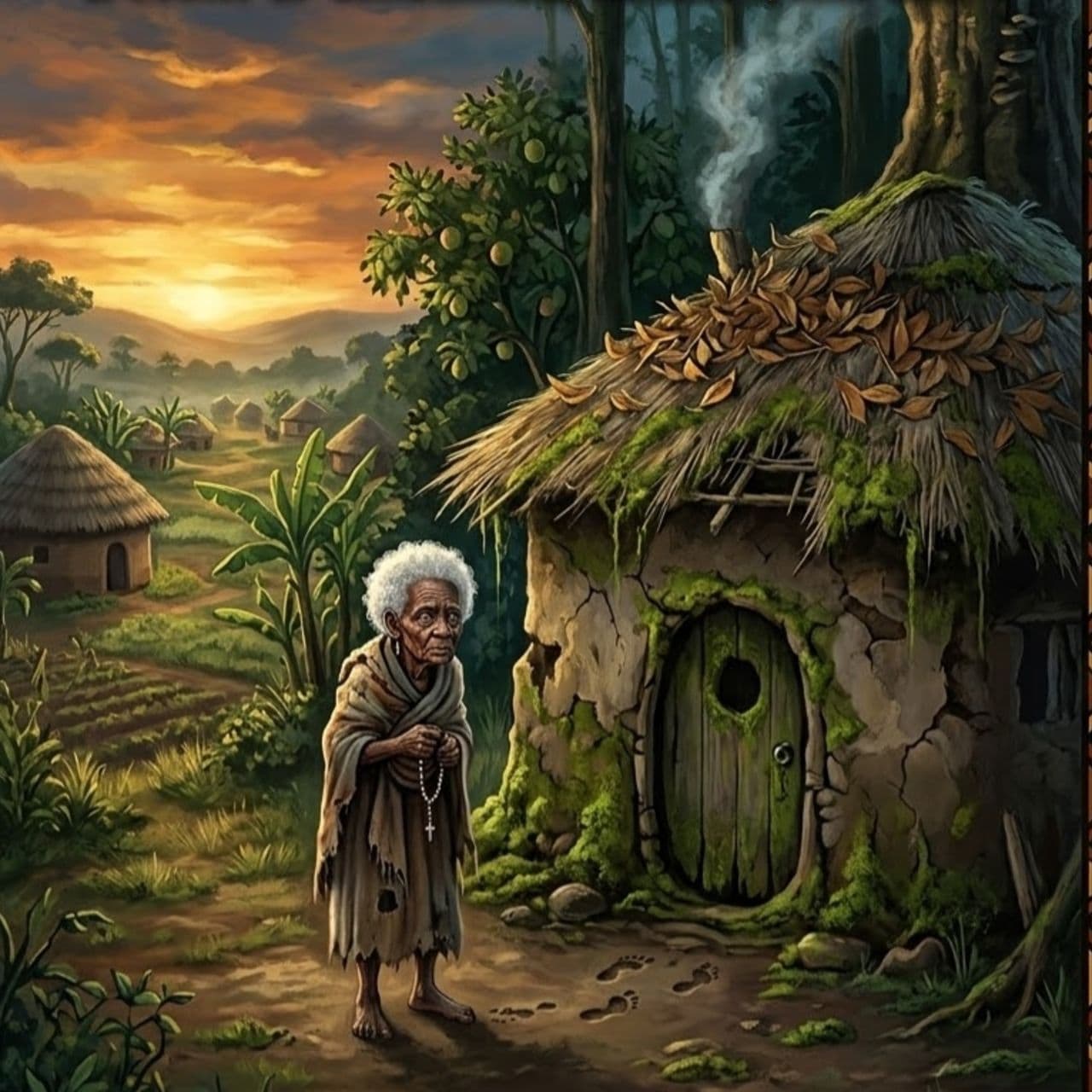

The Lonely, Elderly Woman
When we were young, growing up in the rolling hills of Ngaa, there sat a lonely little crumbling, mud baked and grass thatched hut by the edge of Thagara Forest. There, in the solitude of the forest, it sat like a timid, drenched bird.
My eldest sibling claimed to have strayed around. He told us the hut had a dirt, and green moss clung to its ruby walls. In place of the door, a bloom of moss overhung. This lumpy den of thin mud clay walls, with an unusual small door barely large enough for a thin lad like me to crawl through, was topped with dry and yellowing leaves that would fall from a towering, ancient Mugumo tree.
He told us that a family of birds had ornately woven nests by its dark rear. He claimed to have heard some mumbling human sounds at one time. Occasionally, thin blue scrolls of smoke would curl up through the grass thatching, then slowly dance into the canopy of boughs as if unwilling to leave the hut.
Our elders had warned us against going near the lonely, crumbling hut at the edge of the forest. We were afraid and curious.
One day, I asked M’Mutua, our immediate neighbour, why nobody dared to go near the lonely hut.
“M’Mutua, who lives inside the hut by the edge of the forest?”
“A bad woman lives there. Don’t dare to go there, child. Don’t. A bad omen lives in the little hut,” he answered with a furrowed face.
Curiosity getting the better part of us, Kirimi, Mwiti and I sneaked to the forest edge one early evening. Without a thought about who lived inside, we tucked our chins to our chests, tiptoed against coarse walls and gently thumped.
Nobody answered.
This went on for several days, and each time we were greeted by silence. Some residual smoke smell hung in the air. It had a blend of dry heated cow dung and an aroma of roasted potatoes.
One day, after the previous night’s downpour, we went to the forest edge to pick guavas that were in season. That day, the hut was in a worse shape. Its collapse was imminent. The usual tendrils of smoke wafted about, and I had a lung full of it. It smelled rich.
Mwiti saw tiny human footsteps on the mud leading to the moss door.
We could hear coughing and wheezing from the hut. After a moment, she slowly stepped from the dark, mossy ‘door’.
Her frame was frail. Age had drawn many rows of wrinkles all over her dark face. A lifeless mop of cotton white hair had cropped on her tiny head. Her eyes were pale and deeply buried into their sockets. Her entire face seemed drained of any signs of joy and amusement. Instead, her frumpy cheeks told a tale of loneliness, thirst and hunger.
Upon seeing us, she managed a toothless smile. In a quivering voice, she greeted us:
“Muugenitwana.” (Hello children).
We chorused, “Muga mono juju.” (Hello to you too, grandma).
“Bwejagutuampera?” (Coming to look for guavas?) she asked.
“Iiii, juju.” (Yes, grandma), we said in unison.
“Njuunitujujubutuempera.” (Come, my grandkids, have as many as you want), the old woman said as she pointed to the ripened guava trees all around the small compound.
Two days later, my friend Kirimi went down with fever, chills, headache, sweats, nausea, vomiting and diarrhoea. For three days, Kirimi lay on his rickety bed. For three days, we dared not go out, even to forage for guavas or play with the frogs at the green, murky ponds, ponds that swarmed with armies of mosquitoes.
Kirimi’s parents sent for M’Muna, a feared witchdoctor from Mujwa.
For three more days, M’Muna camped around the compound, sprinkling herbal waters around the house, uttering abracadabra and talking to some invisible being. Sometimes, he would be heard saying,
“Riiiiiiishwaaaaas, katagrivelia, pandamukima, riiiiishswaaaa!”
All the while, Kirimi weakened. His cheeks burned with the flush of fever. On the seventh day, my best friend passed on.
Finally, the witchdoctor declared that he had been bewitched by the lone, elderly woman who lived at the edge of the forest.
Like wildfire, word spread throughout the village that the ‘old hag’ had plucked out yet another flower from Ngaa village. In their droves, the villagers poured into M’Mugambi’s compound to comfort the family for the loss of their beloved son.
“Death! She must die!” Meme shouted.
“Death! The witch must die!” the voices groaned.
Seething with anger like a volcano, the villagers collected sticks and stones. Soon, a procession led by Meme snaked through the banana farms. Soon, the crowd surrounded the strange little hut and forcefully pulled out the elderly woman from the ramshackle.
“She is the witch of Ngaa. Look at her eyes. Look, they are red. Look how wizened she is, and why does she live in solitude?” Meme quizzed.
“Oh, why?” they all replied.
“The witch must die!” Meme shouted.
“She must!” they all groaned.
“Suffer not a witch to live!” Meme shouted.
“We shan’t suffer for a witch to live!” they groaned.
Meme slapped her. Brawny men rained on her with blows and kicks. A hail of stones rained on her from all directions.
Her scream was the kind of a strangled cry that belongs to those not long in this world. A scream of one in mortal terror, rooted to the spot and too afraid to run.
There was no more strength in her voice, just inaudible movement of her blood soaked lips. Her breath quivered in short, quick gasps every time she inhaled, her lungs having no choice but to painfully choke on her own blood. She couldn’t stop shaking either.
Her tiny body finally lay motionless on the grit and blood soaked grass.
Rummaging through the skeletal hut, they found a few utensils, a few old and torn clothes, a portrait of her long dead husband, a Bible, a rosary and a prayer mat.
The lone elderly woman I was taught to despise, hate and fear was only a pious hermit who lived alone for many years, dedicating her life to prayer and meditation after the death of her husband.
She caused no one pain. She was not greedy. She was not evil. She was not rude or rough. She was only lonely, poor and elderly.
Ciombura was murdered by the hatred of the living world.