


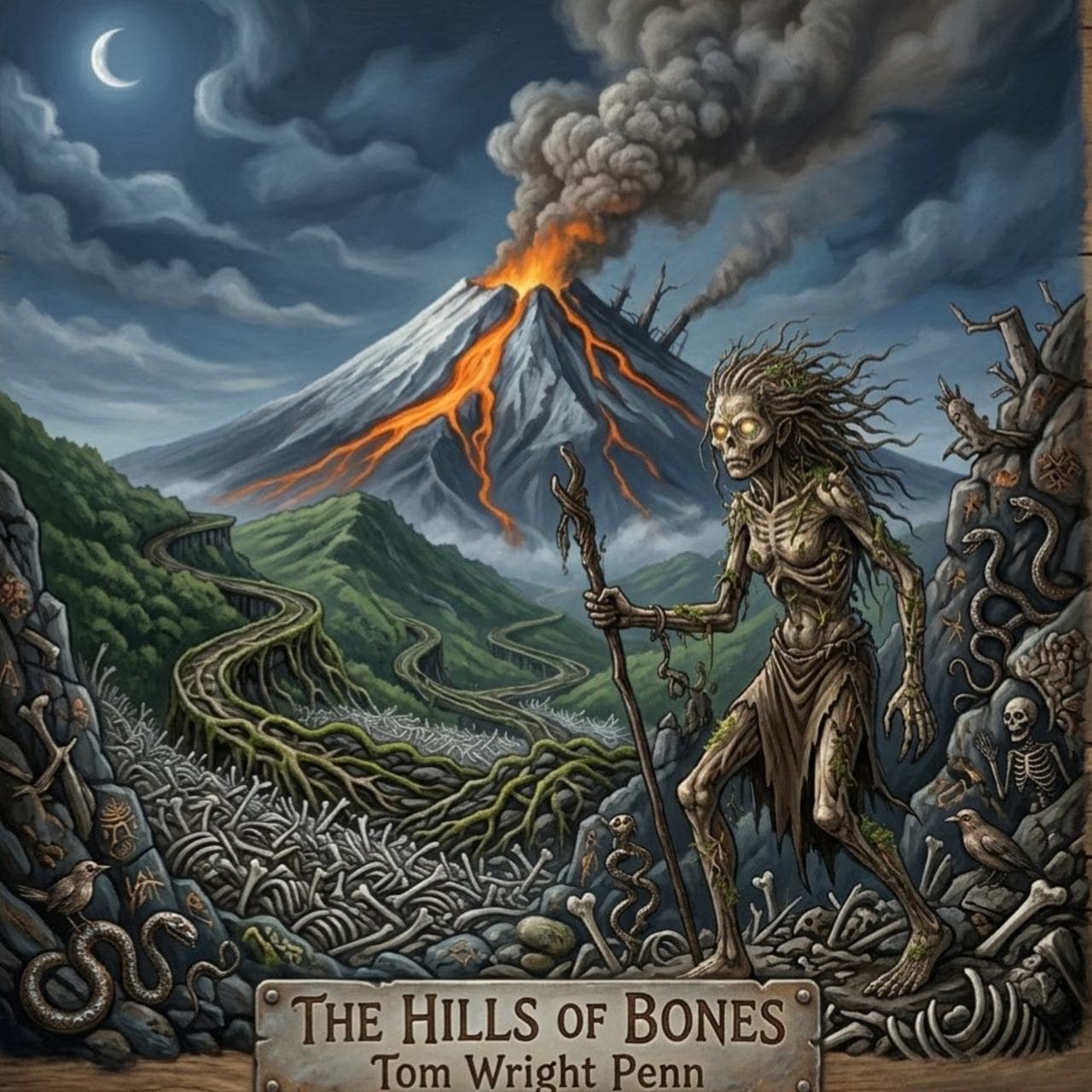

THE HILLS OF BONES
Not even M’Ciatene, the wrinkliest man, nor Ciokaraja, the eldest woman in the Ngaa land, knew the age of the snowy giant cone that rose to the blue. The mountain had remained nameless until Mugwe, the founding father of Ngaa, named it Kirimara. It was a revered cathedral of my ancestors, whom Grandpa always faced West to honour by pouring libations on red earth, and thereafter he would spit tobacco-spiced spittle on my chest and ask Kinii Kiiru (God) to bless me with dozens upon dozens of children.
“Oh Kinii Kiiru, I spit on Son of Ngaa. Bless his groin with children as many as the seeds of Mugumo tree. May they grow and multiply.”
I would answer, “Thaai Thaai Kinii Kiiru” (Yes, yes Kinii Kiiru, yes).
Kirimara towered above an unfathomable green canopy. My drunken uncle used to tell us children that only the men with extra ‘jingle bells’ could venture into where the extensive canopy and thick undergrowth sprawled.
“The forest was ancient too. Boughs were thick and old and only an occasional streak of sunlight could touch the forest floor,” grandfather told us.
“It hosted horned slitherers, fiery eyes, teeth in the dark, bushy-haired crawlers, and a three-eyed creature. A man-like beast of wondrous size, taller, more muscular, and eviler than any man in the history of evil doing. A creature not conceived of a woman’s womb and whose origin is shrouded with mystery, just like the age of Kirimara,” Grandfather added.
Pastor Nebuchadnezzar told his flock that the creature was a cursed descendant of Cain. The Ngaa people named the hideous beast Kirimarimu. They talked about Kirimarimu in hushed tones. Legends say the hellish demon had slain a hundred able-bodied Ngaa warriors; men at the epitome of manhood.
Except for the singular malevolent dweller of the land, everything was unstained.
The Ngaa hills were richly verdant. Nothing toxic flowed in the innumerable pristine rivers that drooled from Kirimara and laughed as they slipped over cascades and danced through twin valleys of Thagara that forever stared at each other. On a hot day, you could cup your hands and scoop immaculate water that would anoint your mouth, edify your body, and freshen your soul. The banks had been alive with nesting ducks. Children spent time by the banks playing with tadpoles. The guava and other trees that would bountifully ripen in season and drop their branches offered enough festivities to the teeming squirrels, vervet monkeys, apes, Inkalimevas, and hosts of other creatures.
Wells spouted in the valley of daisies and wild roses. Wells that maintained their virginity. For many moons, they remained untasted. In those days, Lake Nkunga (the lake of the giant spider) served as the mirror of the Ngaa people. Grandpa said that as a young man, he loved dating his girlfriend Cionthongi (my grandmother) by Lake Nkunga, and he would always see a coronet of stars above her head. The sky was a chaste lavender roof, and the sun smiled mildly on the rolling, green hills of Ngaa and beyond. The pearly moon had shone undimmed by clouds, and forever it gleamed sweetly.
Days went by, and a woman was born in the middle ages of Ngaa. She astonished many with her rare ability to see the wind, smell the sound, taste the light, and hear the colours. Her frame resembled a monument of bones, lightly wrapped with a coarse, clay-coloured parch of membrane. Her eyes were fiery, and her fangs were long like Kayaba thorns, dark and yellow from smoke that came out of her mouth whenever she spoke. Her voice made sparks like fierce fire licking up dry twigs. Her vocal cords were like a clan of squirrels escaping from their hideout. Her hair was the colour of wilting grass. She had twin withering breasts. Her feet resembled dry roots of an emaciated tree. Her name was Cionyange, and she lived alone at the outskirts of Laing’o hills. No one in the land of Ngaa claimed that Cionyange was a girlfriend.
One evening, Cionyange was musing over Kirimara when she saw a wonder that this writer dares not speak its name. Though elderly, she picked up her creaking bones and ran to the Laing’o hill where the Chief elder resided. She was throwing ear-splitting tantrums that rang across the nine hills of Ngaa. Cionyange could not be comforted.
She had seen a shocking vision through her seer eyes. When she was brought to the Chief elder by Nthaka (warriors), she said it all. Utterly shocked and disturbed, the elder asked that the horn be blown so that Cionyange could tell the dwellers of Ngaa what she had seen.
So, the horn was blown. From the nine hills, it sounded ominously. The curious dwellers of Ngaa spilled to the foot of the Laing’o hill.
“Is the chief dead?” they choired inquiringly.
“It’s not that!” Cionyange cried, rolling on the ground.
“Has Kirimarimu been spotted?” they quivered in fear.
“Noooo, oh mayooo!” she screamed.
“Is it Nturubus (Bushmen)? Have they declared war upon our land?” they asked the Chief, who gave them a blank, forlorn look.
When her tears dried up and her bosom ceased quivering, Cionyange gathered her frail, elderly limbs and cleared her throat. You could almost cut the dense, palpable, tense silence with a knife.
“Tell my people, Cionyange. Tell them,” the Chief snorted.
“My people, my very dear sons and daughters of Ngaa,” Cionyange started amid sobs. “A shadow lies upon us. Mayooo! Not long ago, I saw a malevolent cloud hanging over the nine hills of Ngaa. Through the mist, I saw another evil rear its head. I saw a fire-spitting snake made of Chuma (Metal), a diabolic worm of wondrous proportion. The worm was wriggling its way to our land. I tell no lies, my people. I once told you of Kirimarimu's visitation, the demon that hates our joy, the fiend that lurks in Kirimara, saddened by our peace. Now listen, children of Ngaa: a greater evil is about to befall us! Mayooo! Mayoo! Oh Mayoo! Kinii Kiiru, oh Kinii Kiiru!”
They mourned—runny-nosed children, breast-wearing women, and bearded men—they mourned, oh they mourned! Oh mayooo!
Cionyange continued:
“From the snake’s womb, there shall emerge strange men holding fire in their hands. Those are the Jorocheres, and they will subdue us by the might of their ‘witchcraft’. Among us, there will be traitors to our sanctity who will unite with the Jorocheres against us. They will build smoke-billowing plumes that will blasphemously tower heavenwards. Our old mountain will thaw from the great heat and become a desolate rock. The fiercely billowing fumes will turn the sky ashen cold, and several moons later, the sky will turn dark grey.
Ngaa land will be ravaged with non-decaying rubble. The pristine rivers will turn into a black, molten poison that will creep through rocky cubes, stinking from here to Naari hills.
The forests will be cut down to pave way for metallic-clad cubes and more plumes of poison. They will lay twisty, ascending and descending paths of black through which their metallic, legged snakes will scream in speed as they move across the hills.
The forests will be absolutely ravaged, and the creatures that dwell amongst us will lose their homes and completely disappear from the face of Ngaa. The Kirimarimu will change form and hide in the souls of men. Your sons and daughters will throw away loincloths and wear what they will call Suti (suit). Beneath those sutis will be disguised reptilians with the spirit of Kirimarimu, but grinning like men, walking like men, talking like men, but deep inside are spirits from Vaitu Po—the river of darkness.
They will become brutal vultures, thieves, destroyers. For quick, short profits, they will destroy Ngaa as we know it—the home of man, animals of their kind, and birds of wondrous beauty. Oh birds, bless their souls: Pelicans, Doves, hummingbirds, Eagles, and all the numberless kinds of birds will fall from the air. Poor fishes, whom we all adoringly call Samakis of Lake Nkunga—Samakis, the dwellers of our now innumerable streams, will be poisoned and many of their kind will forever disappear from Ngaa streams.
The abundance of flying insects which bless our flowers so that flowers can bear fruits and grain will disappear. Butterflies, bees, and other flying insects will disappear, never to be seen again, nevermore, and plants will cease. Hunger will ravage Ngaa. They will try to create food in their domed, lighted houses, but the fake food will ravage them with diseases. Oh dear trees, hug them while they last. They will cease to exist.
The seven seas of Ngaa will rise and spill over Ngaa valleys; the scourge will claim a multitude of the evil humanity.
The Ngaa air will be filled with an acrid smell which they will call Kaboni Monokisaidi. It will be their death. The heat on this land of Ngaa will burgeon terrifically, and the horn-shaped witchcraft they designed to measure the heat and patterns of weather will lose its potency.
Man will finally fall into ethereal silence. Heap upon heap of bones will gleam from the scorching sun on the desolate valleys of Ngaa. It will no longer be Ngaa. It will be the Land of Bones.”