


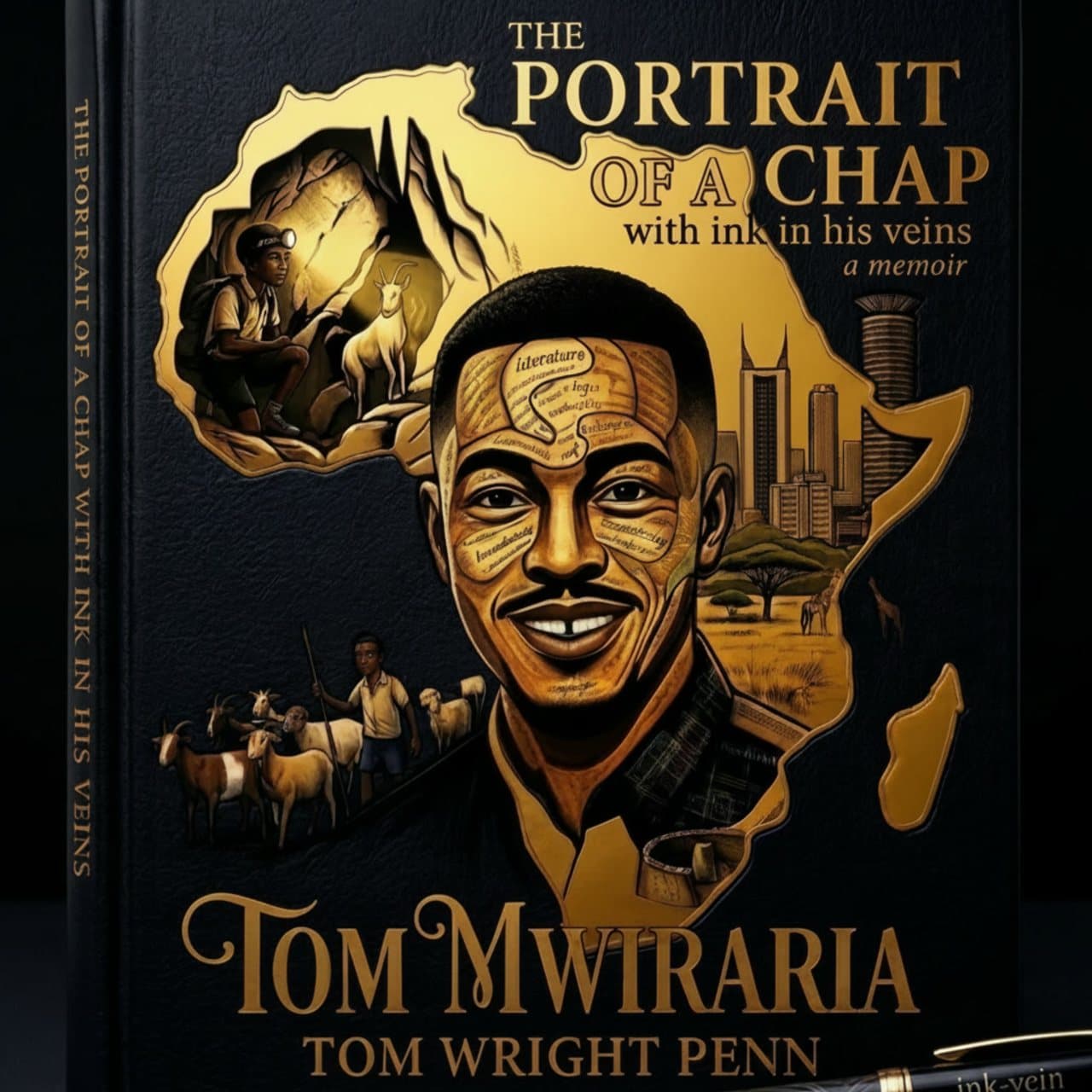

THE PORTRAIT OF A CHAP WITH INSIDE HIS VEINS: A MEMOIR
PROLOGUE: The Hearth and the Herd
Stories were the engine of our identity. They transported cultures. They made us human. My mother told them by the fire. She shared joys and ideas and truths and hopes and triumphs and pains. She spoke of biblical worlds and ancestry and the history of this land. I depended on those narratives for my compass. I depended on her food for sustenance.
My father was a historian. He left this world a decade ago. Yet I still hear the echo of his hummings and his laughter. I still see him writing at his desk. He perused old smelling journals on a familiar shelf. He graced my mother with stories. He was a former seminarian. He conversed with his herd in Latin. He named his favorite goats Aequitas and Veritas. When his health failed, he spoke in a weak voice.
You are a blacksmith of your destiny. You are a lion cub. Wherever you go roar. Operate alone even if everyone quits.
I grew up an ascetic shy lad. I lived on the incline of lone hills below the great blazing blue misty mountain. People call it Mount Kenya. That is a Briton pronunciation and spelling goof. The authentic name is Kiinyaa. That is originally Kamba. John Krapf spotted the peak while traveling with a Kamba caravan. Chief Kivoi led that caravan. Krapf asked what the peak was called. The chief told him Kiinyaa.
I was named Mwiraria after my ascetic uncle Mwaja. Mwiraria is one without a bed fellow. Uncle never remarried after death claimed his wife in forgotten years. He faced terrible nightly solitude for years on end.
I arrived at the age of reason. I acquired for myself the title Son of Ngaa. He is a fictional character. He is a lad carved out of myself. He stems from my imaginations and idiosyncrasies. A story tells us the ancestor of Son of Ngaa once milked a lioness. He sat naked on a porcupine while doing so.
I hail from the Ngaa or Amiiru people. The matriarch of the Ameru was called Ngaa. Son of Ngaa is the son of that founding mother. Our lineage traces back to when my ancestors arrived in the hills. They came from captivity on an island called Mbwaa. We began in Mbwaa. That is what the legends declare. Mbwaa was a peaceful and prosperous island. A veritable water body circled it. We traded with Mukuna ruku back then. The men of Ntangi were warriors. We lived at the very mouth of a large river. That river ran into a great sea. Then we were invaded by Nguu ntune. Those were the brown people. We fled from captivity led by Mugwe and Koomenjue. We arrived in the hills beneath the imposing snowing giant cone.
My father built a big stone dome. It was an eerie monster with one tiny window. That window resembled a hippopotamus ear. It ever listened to strange sounds from the deep valley when nights hushed. The edifice sat isolated from the rest of the village since its heyday. It hosted a clan of bats and birds that never stopped singing. Long tailed lizards with coffin like heads lived there too. We never disturbed them. The edifice is now an architectural throwback. It almost heeds the beckoning call of gravity.
One yellow afternoon during childhood I scribbled on the ground in our compound. Construction activity was underway. Among the tools the builders used was an A shaped ladder. I tried to draw that ladder. All kids at a certain age draw things inspired by objects in their environment.
I drew the ladder. One of my elder siblings came around. He nosed into what I was doing. With one glance he took off. He cried out excitedly. The child wrote the letter A. He ran to tell our mother. She was sweating in the kitchen preparing mokimo for the fundis. Mom left the mokimo burning in the pot. She came to see a miracle. Her jaw dropped. The next day I was taken to school. They determined I was now old enough for kindergarten.
Few of my childhood peers related to my interests. I loved chasing grasshoppers and dragonflies. I loved herding chicken. Nothing felt better in my ears than the meek bleat of lambs. I learned to castrate bulls at a tender age. My nose loved the evocative smell of red dust when goats pissed. I loved to nurse injured goats. I fed orphaned hatchlings. I forgave snakes. If that counts towards maturity I felt as mature as Methuselah at a tender age.
My quest for human rights and animals starts here. I think that is why a squirrel once offered me a nut. I think that is why bats escorted me home at night whenever I crossed a spooky forest. My mother sent me to fetch milk from Tata place. I think that is why someday in the woods a bushy haired creature wearing a tail brazenly came to me. It gave me a firm handshake.
I wondered what I would do when I was not herding. Take a sleep of the blessed under an oak tree. Careful Son of Ngaa. Sleep with your mouth shut tight lest a homeless gecko slithers in.
Gatwiri was a lass my age mate. She was made of honey and sugar and stardust. She often appeared. She smiled and teased me. I chased her. I gained her in the sorghum plantation. Maybe we played show me yours and I show you mine. Maybe we did not. But I confessed to breaking the bread. That confession felt like death. She is the bronze girl of teenage memoirs. She is Kendi in some.
Time rolled. I remember the day we woke up to carcasses of my father flock strewn all over. Life was sucked out of my friends. We trailed the blood down the valley. An unknown predator was responsible for the massacre. Fear gripped the nine hills. Still I had to do my chores. I went down the valley to fetch water to fill a drum. I saw strange footprints. I was scared stiff. My heart galloped in my throat. A liquid raced down my legs. I am sure that was not water. Fear became dilute. A hot flush of blood swam in my veins like ruffled rivers. It was a scarlet cocktail of the blood of my ancestors. Warriors and seers and healers and blacksmiths from lone years spoke. Courage was forged in the heart of a puny lad.
Then there was my neighbor. He was the ruins of a man with an acre of shiny bald head. He was lonely. He was never laid or so rumor whispered. He was a kind man with a permanent glint in his eyes. The people he helped scorned him. They called him a fool when he was not around. I loathed the philistine swine. I pitied their iguana souls. I liked him like a saint equal to the twelve. He died a few years ago. He was swindled off his land. He had no known relatives. A lump formed in my throat when I received the news. Greed is one of the most horrible snakes of this world. I grew up amidst many such stories. Often the village reeked with homicide tales. Their stories have never been told.
A great deal of time passed. Son of Ngaa became a teen. I was an ascetic shy lad. I spent bogs of time in the town library. There I encountered William Wordsworth. I read his dust covered poems. They spoke tongues of words to my heart. His lines had a mighty effect on me. I loved those age old smelling books. I wrote cadences and recited them from heart.
Nothing made my ego soar towards the skies quite like receiving cute letters. These were from someone daughter. She was a girl from Kaaga Girls whom I had fancied. Kaaga Girls were the Acrossians. I was in Meru School. Our motto was and still is In understanding be men. It was derived from the scriptures.
The teacher on duty held a batch of letters during the morning assembly. Names were called. Loved lads stepped forward to receive their mail. Amongst those boys was that lad Son of Ngaa. He was loved and missed by a dainty brilliant girl from the very quaint hills. My name was called. I marched forward with solid feet. I whistled internally. I wore a big grin a Cheshire cat cannot match. I received my letter. Then I momentarily paused. I scanned the faces of the boys. I made a point. I went back to my row. The boys were green with envy. I particularly liked how my girl addressed the letter. It came in a perfectly clean white envelope. That was very good Marietta.
Boys surrounded me in the classroom. I carefully opened the letter. We called it a missive. A delicate straight from heaven scent blessed your nostrils at once brethren. I loved how she carefully chose a writing pad dotted with many little hearts. It made my loins sing. It made my heart overdo itself. I read the letter aloud. We all did that. We read aloud. We were teen boys proud as hell. We were discovering the matters of the heart. Here Marietta had chezad kama yeye. The grammar was manicured. The content was a garden of roses. She began with My darling Tom. Of all the boys me? Someone darling? I stopped at that. I took in deep lungfuls of sighs.
The song dedication was Westlife My Love. It made me weep with both eyes. Aki wewe Marietta you pretty one. I loved you very much.
I was respected and admired and celebrated. Why? A girl loved me. She missed me. She wrote cute letters. Not once. Not twice. To the umpteenth degree. The world was beautiful. Fishes flew in golden ponds. Love is a good thing.
Then I grew up through the horrible school factory. I manufactured good grades. I loved numbers and theories. I dreamed exquisite dreams of a pink future and certain refinement. I saw myself as a great physicist. I wore a dignified beard and honorable gait. I was wise in speech. I was repulsed by the foolhardy. I planned on aging gracefully. I would walk with a cane and spit wisdom to fill empty vessels. I would reduce the number of absolute sheep in this world. I would thwart the idiocy apocalypse by teaching philosophy as a visiting professor. Now I walk with a backpack and a pen and a camera and a big smile. Courage is forged in my heart. I am a wayfaring stranger across the length of life and spaces.
Mama used to look at me. Muthoni wakwa ogres can be slain.
I carried those voices into the concrete jungle like a talisman. I would need them.
CHAPTER I: The Ambush of the Concrete Giants
My first encounter with Nairobi was an ambush.
I came from a world where the only monoliths were the eternal hills of Meru. The skyscrapers of the capital hit me with visceral terror. Chief among them was the convention center. I walked beneath its looming shadow. I felt microscopic. I was certain the concrete giant would topple over. It would crush me along with all my sins before the day the trumpet sounds. I gripped my collar. I began reciting Psalm 23 in the secret chamber of my heart.
I breathed only through my lips. I tiptoed past the beast. Then I ran. There were many such monsters wherever I turned.
To walk these streets looking like an evolution throwback is an unpardonable aesthetic blunder. I am a man of delicate taste. I wrapped myself in my late grandfather long yellow coat. It was a glorious ancient mantle seasoned with tobacco. I evicted a modest colony of spiders whose lease had regrettably expired.
One must always dress like a gentleman even when descending into the gutter.
CHAPTER II: The Bell Jar and the Trades
Life at the university in Kakamega was a mix of quiet academic solitude. We stayed beneath the forest canopy. We engaged in sharp undergraduate lessons.
The student council organized a dance night during those sophomore days. The unspoken slogan was the fresha gold rush. I looked forward to securing a girlfriend. I hoped to share quiet literary conversations with her. I marched to the dance court to show my talent. I realized every single fresha had been thoroughly swept up by local boda boda guys from the gate. They masqueraded as senior students. They completely outdanced and outmaneuvered the academic men. They executed low rider maneuvers while we stood by the perimeter wall. I retired back to my desk. I left the gold rush to the riders.
Then came the true emotional crucible. I had transitioned from high school. I entered into a long distance relationship. I saved her for marriage. I sent money from afar. I was a victim of my own illusions. The illusion shattered. Grief hollowed out my chest.
True to my father command I did not break. I bled ink. I compiled three hundred poems in the quiet Kakamega nights. That marked the death of youthful illusion. It marked the birth of a serious writer. Writing was work. I learned to sit at the desk through gray mornings. I believed that through pain and pleasure the craft is the thing that keeps us going. Perfectionism was a trap. It only caused creative stagnation. Nothing living can be entirely faultless.
I kept my journals. The pages filled with impressions and sentiments and sensibilities and meanings and philosophies. I knew those pellets would always be useful for the autobiographical record.
I also have so many juvenile scraps and musings from that age of estrogen. I will never publish them. I cringe at how much unformed boy is in them. As you evolve into the age of philosophy you inevitably become critical of your younger ancestors. Let this be a lesson to those piling up manuscripts. If you do not release your work when the boy is still breathing in it the philosopher you become will execute him without trial.
As I navigated these shifting professional horizons I moved from one enterprise to another. I worked as a laborer in my father quarry. I served as a boy herder of my father flock during holidays. I farmed on virgin parcels given by my father and grandmother. I tilled hard. I reaped bumper harvests of maize and beans. I kept Kienyeji chickens. I stopped because my parents thought I was losing concentration in school. I tested nearly every trade under the sun. I have been an untrained high school teacher. I have been a preacher. I have been an insurance seller and a marketer and a bank clerk and a corporate trainer. I have been an essayist and a diarist and a memoirist. I served as a programs coordinator for a nonprofit organization. I worked as a grant writer and fundraiser. I worked as a journalist across every medium including video journalism and podcasting and features writing and TV hosting. I worked as a gossip writer for a tabloid and as a science writer. Now I am an aspiring university don and communications director.
Eliud Kipchoge the Goat says no human is limited. I also believe no cat is limited. I am a cat that wants to be a hippopotamus.
Yet this dizzying abundance of paths brought me squarely face to face with the Plathian dilemma.
"I saw my life branching out before me like the green fig tree in the story. From the tip of every branch like a fat purple fig a wonderful future beckoned and winked. One fig was a husband and a happy home and children. Another fig was a famous poet. Another fig was a brilliant professor. Another fig was Ee Gee the amazing editor. Another fig was Europe and Africa and South America. Another fig was Constantin and Socrates and Attila and a pack of other lovers with queer names and offbeat professions. Another fig was an Olympic lady crew champion. Beyond and above these figs were many more figs I could not quite make out. I saw myself sitting in the crotch of this fig tree starving to death just because I could not make up my mind which of the figs I would choose. I wanted each and every one of them. But choosing one meant losing all the rest. As I sat there unable to decide the figs began to wrinkle and go black. One by one they plopped to the ground at my feet."
— Sylvia Plath, The Bell Jar
Starving in the crotch of that tree while every option withered forced my hand. I had to choose. I had to anchor my mind. I turned to Taoism and Stoicism. Taoism taught me not to constantly fight myself. It taught me to work with reality rather than exhausting myself trying to force everything. Stoicism taught me to distinguish between what is within my control and what is not. It taught me to return my attention to deliberate action rather than allowing every passing emotion to become a command.
Later I took a job in an executive office working with a group CEO. It takes peak levels of strategic clarity to survive and prosper at the right hand of a Group CEO. Mastering the art of becoming ultra-effective achieved by combining an unorthodox trifecta of philosophy, focus, and tactical audacity was my greatest test in this high-stakes environment.
I deployed the idea of definiteness of purpose as a committed student of Napoleon Hill's Outwitting the Devil, turning it into a laser-like focus that cut through corporate politics and matched every action with perfect intent. My long-term relationship with Taoism, which gave me a deep, stillness-centered clarity, exquisitely counterbalanced this cerebral armor. I watched the commotion with a serene, effortless accuracy, completely unaffected by the mindless static that raged around me in the executive suite.
To navigate the complex chessboard of corporate politics, I drew inspiration from the biography of Field Marshal Erwin Rommel, The Trail of the Fox, absorbing his intuitive, infectiously confident tactical brilliance while remaining deeply cognizant of how the looming specter of defeat can ultimately stay a leader's hand. Guided by his cold maxim that history judges only by success or failure, I adopted Rudolf Spielmann's ruthlessly elegant philosophy of execution, learning to play the opening like a book, the middle game like a magician, and the endgame like a machine. By blending this calculated methodology with a sharp, self-aware pragmatism, I mastered the ultimate corporate survival strategy, ensuring I won enough to live exceptionally well, lost little enough to sleep peacefully, and always possessed the acute foresight to exit the room before the institution ever mistook me for the furniture.
Another transformation happened. The environment forced me to become extremely intentional. I learned to prioritize and execute and follow through and finish things. I did not become superhuman. I simply learned how to put rails on the train. I have since executed hundreds of projects and strategic tasks with success.
CHAPTER III: Mud and Bammuriat Squeaks
Fresh from graduation I landed a job. It was at a college occupying the fourth floor of a building in the business district. We taught computer packages dubbed a diploma in IT. I wore a massive tent like yellow black coat. It made me look like a tortoise in matatu bumps. Pay was a myth for two months. My single pair of shoes started grinning like a crocodile. The sole peeled off completely right before a lecture.
My mother wanted me to return home like a prodigal son. I refused. I asked only for prayers. I bought gigantic heavy duty Bammuriat shoes. They squeaked like trapped mice with every step. The college vanished into thin air a few days later.
Survival pushed me into strange corners. I went to Rongai bordering the national park. I was offered a job slitting chicken throats and plucking feathers. The compensation was lucrative. I could eat the severed legs and heads with the eyes still staring. The delicate taste inherited from my father made me turn it down even in my starvation. I chose hunger over a macabre banquet of staring poultry eyes.
Colossal Goliaths devoured the offal of unidentified beasts in Mabatini. They showed the ferocious dedication of true carnivores. A rogue on River Road sold me a smartphone for two hundred shillings. It proved to be a lump of hardened mud wrapped in plastic. I nursed my single beer at Sikai Sana Pub through wide eyes. I realized that if a writer does not occasionally wallow in the mud how on earth is he to acquire the authority to sneer at it?
CHAPTER IV: The Furnace of Nairobi
After a stint in an oppressive women microfinance institution I quit my first mule job. I arrived here in this huge machine Nairobi with whirlwind plans in my head. I walked out with solid feet and heart afire. I wrote a multitude of notes. I kissed them. Then I loathed them and discarded them. I cussed loud and lethal. I snapped my fingers in disgust. I was sad with life at this point. I felt like an imposter in writing. Then I picked myself up. I wandered these streets looking for a job. I got jobs and quit after a short stint. Pockets said no. Passion said yes. I got wise with the ways of life. I stayed alive by odds and ends. Sometimes I went through sterile periods. Many times I was on the other side of Lazarus. Once I hit rock bottom like Jonah. I had a complete circle in absolute hell like Dante Alighieri. I have had countless moments of elevation and wins and miracles and awe like Elijah. I thrived like a plant by wells with roots established deep. My leaves did not wither. I yielded in drought. All through I remained faithful to the pen in a lonely planet. I received no scant advice to quit. I remained stubbornly focused and ruthlessly hopeful. I gave them an internal middle finger and countless non verbalized swear words. Mother offered her liquid voice praying for a lost sheep. Her tongue rolled out blessings. Dear mother you will be proud. I smell a huge break. I am a species born of hope like you mom. I am fearless because I am insured by your prayers. I inherit the double incentive of your stoic strength and the great erudite man you married my father. As if this was not enough an angel watches over me. It trusts solely the mysterious one who feeds pink bellied frogs in the swamps. I am thankful for many heavenly moments.
When the city became too heavy I took a job in a dusty town called Wote. I endured a toxic administrative bog for eleven months. Then I quit. I mastered the ropes entirely on my own through relentless self teaching.
A book about outwitting the devil changed things for me during this autodidact awakening. Ideas about definiteness of purpose and drifting and repeated mental patterns affected me deeply. I realized intelligence and curiosity and enthusiasm are wonderful servants but terrible masters. If every new interest grabs you by the collar and drags you somewhere new you can spend your life beginning magnificent journeys and never reaching the destination.
That was a turning point. I became very definite about what I wanted. I deliberately practiced focus. I learned the difference between what is exciting and what is important. The first can change every Tuesday. The second gives you somewhere to stand when excitement disappears.
This focus allowed me to contribute to the anthology Broken Rhythm. Rehema and Eric Rugara and Odhiambo Kaumah and Sharon Odongo and Imani and Debrah Mullemia contributed too.
CHAPTER V: Shape Shifters and Street Editions
A story trail led me to the south coast in 2017. A traditional medicine man told me he traveled oceans by shape shifting into a tilapia.
The claim sparked an obsession back in Nairobi. I penned a dark speculative fiction about an entity possessing university students and priests. I encountered human centered design when I later joined a regional leadership center. Empathy was the foundational pillar.
It was a revelation. I inverted shape shifting into an ethical framework for storytelling. Step into the shoes of the vulnerable. Bleed with emotion. Give eighty percent weight to victims. Investigate problems from the subject perspective to surface tangible solutions.
That commitment to unvarnished truth found its earliest literary compass in the dark, brilliant corridors of school set books. I studied Ken Saro-Wiwa in high school from an anthology of short stories entitled Encounters from Africa. Saro-Wiwa convict story Africa Kills Her Sun remained etched in my mind for a loop of years. The story gave me emotional outbursts. I remember analyzing it with teary emotions during my Kenya Certificate of Secondary Education English paper two exam. It remains one of the best reads my fast aging eyes have ever grazed over.
He was rudely aroused from sleep on his ghastly cold prison floor on a Friday dawn in 1995. They blindfolded him, frog-marched him to a Black Maria, and led him to his earthly end. As he was led to the gallows, he lacked nothing in courage. He had rotted in jail. While in his dungeon, he had scribbled volumes of letters that have endeared literary circles and continue to inspire social justice enthusiasts across the globe. His final protest short story, Africa Kills Her Sun, is among the most bold and heartrending tales to come out of Africa. It was a foreshadow of his death at the hands of an oppressive and corrupt regime led by Sani Abacha, a stone age dictator addicted to blood. Ken had deconstructed runway corruption and led the Ogoni people in protests against Shell because of mindless environmental degradation. The man with a titanium heart and nerves as strong as an underground power cable had expected to pay the ultimate price rather than sit on the fence or keep quiet like the cowards of the country.
It took five attempts to hang Ken Saro-Wiwa before the writer spoke his last words and his body went limp. "Lord take my soul, but the struggle continues," were the anti-government activist's final words before he died on a Friday morning, blindfolded and dangling from a rope.
The Nigerian writer, environmental activist, and winner of the Right Livelihood Award and the Goldman Environmental Prize was a true son of the soil whose voice the hangman noose could not silence. Ken speaks from the grave, and his works are etched in the hearts of many who are lovers of social justice. His shadow taught me that writing is not a passive pastime; it is an act of war against tyranny.
My idols were and are men of action: Che Guevara, Field Marshal Musa Mwariama, General Baimungi, His Mau Mau Grandpa, Prof. Katana Mkangi, Ken Saro-Wiwa, Thomas Sankara, Bobi Wine, Field Marshal Rommel the Fox, Socrates, Napoleon, Hannibal, The Last Samurai, and the ilk.
My literary philosophy has been shaped by activist writers who got their hands dirty in pursuit of social justice and paid a price when they stood up against African homegrown tyrants. Closer home, Ken Saro-Wiwa, Professor Katana Mkangi, and Koigi wa Wamwere stand as towering figures, the latter two being heroes of our second liberation.
While I admire Ngugi wa Thiong'o's literary prowess, I am not apologetic about my critique of his ideologies, for the good Professor still battles vague colonial phantoms. Ngugi does not, for instance, talk of the ontological reality of African colonization: that the real, the most stubborn and obnoxious colonizers of Africa are Africans themselves. Ngugi has unnecessarily been tucked away in supposed exile for too long—too scared, perhaps traumatized by "his Africa," deeply immersed in Western culture, teaching in English, eating English food, dancing to English music, and lecturing Africa about the need to go slow on English ways and preserve African culture and language. It is the height of double standards.
That said, I further think the good old Professor's idea on African culture and languages is an archaic notion he has held over the years, informed by gut feelings and sentiments rather than by sensibility, scientific realities, and the natural nature of man. All languages and cultures are dynamic, cyclical, and obey a natural fate; they obey the Darwinian evolution thesis. In Darwinian terms, the phrase is best understood as "survival of the fittest." As Alfred Russel Wallace wrote to Charles Darwin on July 2, 1866, regarding natural selection, “This survival of the fittest, which I have here sought to express in mechanical terms, is that which Mr. Darwin has called 'natural selection', or the preservation of favoured races in the struggle for life.”
Africa can only avoid language colonization not by writing vernacular books, but solely through economic liberation and competitiveness. Superior economies will continue to colonise African culture digitally and outside digital space simply because the West and Asia possess massive economic muscle.
Scanning through the Threatened Scholars Fund one afternoon, I paused to ponder and wept with both eyes. Save for David Ndii and Miguna Miguna, is there any other threatened scholar in Kenya? I was met with such awful silence. Either we have made gains in democracy or this generation has bred perfect cowards and poltroons.
Courage is the bone and spine of revolutionary scholars, but it has become unnaturally rare among modern authors and scholars, especially in Kenya. In the first and second struggle for emancipation, great writers and revolutionaries emerged: Tom Mboya, Ngugi wa Thiong'o, Katana Mkangi, Koigi wa Wamwere, Wangari Maathai, and Gitobu Imanyara, to mention just a few. Every generation produces stubborn revolutionaries and holders of a terrifying pen. Oddly, we have none today, even as the moral integrity of the nation goes to the dogs and social injustices become the order of the day.
The absence of brazen writers is astounding and actually quite scary. The decline of courage, moral integrity, and intellectualism is quite spectacular. What caused the extinction of scholars in this our land of Kenya? Perhaps great scholars are just not born anymore as courageous genes become recessive and poltroonry dominates. It is possible.
A scholar is made of two substances: a spine of courage, the stature of moral integrity, empathy, an unwavering and incorruptible passion for social justice and democracy, and an insatiable thirst for knowledge and wisdom—a gift from the designer of the universe. Anyone who understands evolution will realize that humanity has been on a steep decline. The most abundant attribute amongst Kenyans today is fear, even as academic factories produce mental mannequins, such that if you have met one graduate you have met all of them.
Many forces in modern Kenya favor mediocrity. In the evenings, citizens gather to watch pigs muddle. Children look up to socialites, sushulites, and cats as the intellectuals. There are budding intellectuals, but they are so underrated and marginalized by mainstream publications and are obscuring away in vermin-infested sixth-floor bedsitters as they grapple with keeping body and soul together. Let me quietly walk away to the desert wearing a sack, put dust in my head, wriggle in dust, pull my hairs, and cry with both eyes and my heart out.
I have been terribly limited hitherto by story arcs which cause premature literary menopause and creative impotence. Blessed be ancestors of Avant-Gardeism philosophy. Blessed be Saint-Simonian Olinde Rodrigues, the father of Avant-Gardeism in his essay "L'artiste, le savant et l'industriel" ("The Artist, the Scientist and the Industrialist"). Blessed be the Italian essayist Renato Poggioli in his 1962 book Teoria dell'arte d'avanguardia (The Theory of the Avant-Garde). Blessed Virginia Woolf—the matriarch of the stream of consciousness. Blessed be James Joyce. Blessed be St. Oscar Wilde. Blessed be Sylvia Plath for calling out the devastating critics who sneer at art as if it were their Aunt's petticoat. Blessed be the radical ones. The unorthodox. The round pegs in square holes. Those who were rejected by the dogma and gatekeepers of the status quo. Blessed be the vanguards of this day. Hail all the rebels of a worthy cause. Hail Miguna! Hail street artists! Hail composers, writers, and thinkers whose work is opposed by the mainstream. The stream of consciousness is enabling me and all the students of free expression to overflow. Hail Avant-Gardeism! Hail Avant-Gardeism!
I carry Letters Home by Sylvia Plath everywhere. I must have read it well over fifty times trying to understand what made Sylvia so fine, how she thought—the workings of her mental universe, what she ate, how she slept, whom did she read, who were her friends, what really inspired her such that she combusted with such flames?
So I am reading this book to extinction. It's really not just a book but my drug. Each day it chips off, bit by bit. Someday I won't have any of it. But by that time I will have grown wittier because my literary godmother 'Sylvia Plath' was a stroke of genius and it always feels like hanging out with her, and she was published by the world's most erudite publications and went to Ivy League, definitely a writer you would want to look up to.
Even if Sylvia is no longer of this Earth (she took her own life), I can't stop the spell she has had over me. The girl wrote with whirling tongues of words. With wit and charm. With salt and juice and flowers. With fire and fierce flames.
Oh and the girl was bodacious She married Ted Hughes, a hulking Adam and definitely her masculine version, himself a gifted and prestigiously published writer and university don. Writing to her mom, Sylvia described Ted as "writer, world wanderer who won't stop, and lion with voice like the thunder of God."
Sylvia is a mighty inspiration for my aspirations because she was a learned writer of many charms like Oscar Wilde whom I have talked about in the By the Book interview.
Two years ago on this day I was conferred an Eco-warrior award by Ecotourism Kenya for promoting people, culture, and writing through storytelling.
I had for two years traversed Kenya writing human stories. I used my own savings to cover for basic expenses, and most times I slept in seedy lodges. Some looked like a morgue with two rusty nails hanging and quite looked like a vampire was hiding somewhere baring an ugly gum with two venomous teeth. Such horrors partly inspired the fiction story Chronicles of Sigi the Sigisi.
Some days were sunny. I was from bara and basking in the sand, caressed and loved by velvety tendrils of breeze.
Some days I cried with both eyes at my miserable self. Like the proverbial gecko who fell from a very tall Iroko tree, landing flat on his belly and surviving the fall, with none around to pat his back, he tapped his head against a rock and said, "You survived this chap, you can triumph." Amid my pains with none in the scene, I was proud as hell.
Some days, and those days were many, I was prosperous and the world was wonderful.
Some days I sat on a rock out there in the sticks to recite cadences from heart. Some days I stopped to read the trial of Socrates. Some days I read Dante Alighieri's Divine Comedy, James Allen's As a Man Thinketh, all the works of C.S. Lewis, The Ballad of Reading Gaol, and The Picture of Dorian Grey by Oscar Wilde.
I worshipped alone in the lone hills in communion of trees and birds, where there are no smilers and talkers; hills are sacred, hills are my cathedrals in the footsteps of my ancestors, my glorious dead.
Thus, I travelled alone because it was a journey of discovery and pursuit of purpose. I had finally found my greatest epiphany; this was a bliss that would never fade, this was finally my obedience to the great commission. See, as a child I had wanted to be a voluntary eunuch and an apostle, but the gorgeous ones happened. Gorgeous ones happened. Hilda, a song of a woman, a melody. This was me repairing myself from beer and passions of Solomon and living for a purpose greater than self. And so, my passion for human-centred storytelling has since not abated.
This award boosted my morale and gave me confidence, but it was not time to relax. I was squarely focused, and I forged forth with belly-aching will.
A great deal of time has passed, and I am still a wayfaring stranger, walking with a pen, a camera, and a map, faithful to the cause.
At the moment of victory, tighten your helmet. #SamuraiCode.
Fight a good fight, keep the faith, finish the race.
Someone once asked me whom I look up to as a literary mentor. While I have been immensely inspired by literary legends of now and yore, it would be politically correct—like others do—to pick a dead writer or an aged author and declare them mentor. When my drunk uncle is not staggering home drunk, he is incoherently quoting Shakespeare. Yet it surprises many when I tell them that my literary mentors are children. Yes, children. They tell stories with authenticity and the whole truth. Let truth be my mentor. Children are authentic creatives who do not shy from traveling the worlds and realms that spread in their imagination.
There are some folks who want to play children's games, enter into the #10yearchallenge, but they won't because they fear being suspected as childish. I submit that being an adult is not about having traveled around the sun many times. It is not about having cells that have divided many times. It is not growing beards, wearing breasts, marrying, and starting a family. Being an adult is being a child; it is not about watching things from a distance, looking "all mature." Being an adult is forgiving like a child, caring like a child, being authentic, full of life, and seeing things without masks and filters like a child. There is a child in every adult—a child that wants to romp around after a good meal, a child that can drop a spoon while eating, a child that makes mistakes and deserves second chances.
You are likely to be a better human if you are childish. You are going to be more creative if you are a child who has not been arrested by adulthood, a child that imagines and trusts its own thoughts, unfettered in the enormity of space and time. You are going to reclaim freedom and happiness by being a child. Let children teach us what we forgot.
Self-indoctrination is way more powerful than socialization, but it depends on one's temperament. I derive strength in solitude, and happiness in silence, and I often fear that by socializing my energy would start leaking—and it does. I am always looking for a way to escape gatherings, feeling invaded. Others get ideas and encouragement from communities, and that is perfectly okay. They get power from hugs, beer, selfies, welfies, kakamunjis—the wows, the ooohs, aaahs, the hahas and hehehs, and that is perfectly okay and healthy. It is a matter of understanding the conditions under which one thrives best. I know I said that I am a hermit, but I like communities. I know the power of networks and therapy in communities, but only when the said community is of refined quality. If the community is not quality, depending on how you define quality, you are likely to catch vanities like pessimism, vulgarity, gossip, hate, complacency, and doubts, and your energy will start leaking.
I am mostly to be found in the communities of the glorious dead and the living. I read a lot of Einstein, Ralph Waldo Emerson, C.S. Lewis, Wolfgang Amadeus Mozart, Friedrich Nietzsche, René Descartes, Blaise Pascal, Thomas Aquinas, Prof. Katana Mkangi, Alex La Guma, Chinua Achebe, Socrates, the Gospel of Christ, James Allen, Plato, and as many philosophers, philosophies, and scientific works as I can lay my hands on. Surrounded by these glorious and intelligent ones all year round, day in and day out, I believe their influence on the quality of my thoughts is profound.
A man is oftentimes a victim of his own thinking. Therefore a man must first save himself before he is capable of saving anyone and anything around him. A man must first educate himself before educating those around him. Thus said, I have been carrying out little experiments to see the outcome of my work by application of different work approaches, and realised results vary when I change my thinking design. Having realised that, at the end of every week I have started to audit my mind, and my approaches to work, and wellness, as I aim for the hills am yet to conquer and those immovable doors of erudite publications, with their hard to impress editors. I am on the lookout for dark spots, and weak points, and general mental climate, and processes that got me good results, and which failed me. I am also on the lookout for habits, weeding out bad ones and reinforcing the great ones. If you don't realise the moment habits are being formed in your mind, it might be too late to change the habits once they are reinforced in your mind by the power of 'hypnotic rhythm'. This hypnotic rhythm will best be understood by the reader in my story titled 'Hypnotic Spell'.
Over time, through trials, errors, and quiet reckonings in the margins of life, I codified the architecture of personal sovereignty. To gain and protect one's power requires a cold, deliberate discipline: one must study avariciously, relentlessly, and constantly to master their field, harnessing expert power as a foundational shield. You must maximize your natural talents and gifts while acquiring unique advantages through disciplined scenario building and lean execution. Power is exercised by making things happen with intentionality, anchored in a definiteness of purpose that cuts through static. Associate exclusively with the powerful, deliberately avoiding the toxic congregations and ranks of the weak and unhappy, yet master mindfulness and stoic philosophy to remain unshakeable. Reformulate your mindset to become an incurable optimist and problem solver, abandoning permanent dogma to flow with the fluid adaptability of water, following the footsteps of Socrates and Emerson.
Like the dark side of the moon, remain profoundly mysterious, utilizing smoke screens and decoys to protect your real strength from adversities while always keeping a hidden card up your sleeve. Appear weak when you are strong, and strong when you are weak, letting trust be earned rather than freely given. Stay calm even in the midst of a raging storm through the quiet acceptance of Taoism, and disarm your adversaries with disarming humor. By all means possible, acquire emotional intelligence, master negotiation skills, and express yourself with wit and charm, knowing that you can negotiate anything. Win always through your actions rather than empty arguments, remembering Henry Miller’s timeless conviction that a book lying idle on a shelf is wasted ammunition. Hide your sources of power and remain fiercely frugal with it, reserving your energy for the moments when it is needed most.
I once knew a man who drank nothing but rainwater; he died sober, suspicious, and entirely without stories.
Look, I have seen men ruin themselves with whiskey, and I have seen men ruin themselves perfectly sober; stupidity needs no bottle.
I have nothing against a few fingers of whiskey; a man should occasionally oil the hinges of his soul. What I am against is drinking like a fool or drinking with idiots—they do it like religion. Whiskey, like wisdom, is best taken slowly, preferably by someone who has already survived his own foolishness. The young drink to forget tomorrow; the old drink to remember yesterday without suing themselves for damages.
Also, some respectable whiskey is good for the heart—perhaps not the heart in the doctor’s textbook, but certainly the heart that has been broken by women and landlords.
You have to know how to hold your whiskey. The latter-day self holds with moderation, unlike my younger self. Moderation is the art of knowing when the glass is half full and the wife is already half annoyed.
A wise man drinks whiskey, a wiser man knows when to put the bottle down. An idiot drinks until his knees go weak and start offering furniture political advice.
I should mention I keep it strictly diplomatic and often symbolic. I drink more often than not when I am eyeing a deal or celebrating a win, small and big.
Crusaders against whiskey argue that whiskey never solved a problem, but neither has staring at the ceiling with a cup of cold milk.
Whiskey teaches patience: pour too quickly and you miss the pleasure, drink too quickly and you miss the next morning entirely. An idiot may drink to the point of requiring an ambulance.
Let the younger men chase skirts. Let me chase wisdom, peace, laughter, and reminiscences. There is poetry in a whiskey glass, though usually it appears after the second pour and disappears before breakfast.
And like I said, drink slowly because haste is for idiots, horses, and men trying to impress women who have already made up their minds.
So, by the fireside pour me a little, not a flood—Noah built an ark for rain, and I have no intention of building one for whiskey.
I wrote The Land of Bones during my agonies. The great thing with writing is that if you hit rock bottom you can write about rock bottom. If you find yourself on the other side of Jairus daughter you can write about it. Should the authorities throw you into prison like Ngugi you can write on tissue paper. If they sentence you to a pack of hyenas you will come back leading the pack. If your life turns out to be one enormous miracle like Elijah you will with such excited zeal spill yourself all over. Even if they train a gun on your head you will not beg for life. It is dishonorable to beg for life from a mortal. You will instead beg a cigarette if you are a smoker. You will beg them to let you finish the sentence. There is immense power in writing. Writing is more powerful than death. It comes only second to life.
Mainstream publishers were a band of thieves. I remembered my father command to operate alone even if everyone quits. I bypassed them entirely. I self published my debut collection of short stories titled The Land of Bones in 2018. Through pure grit I sold roughly twenty five hundred copies. My commitment to culture was honored with an eco warrior award that same year.
Sometimes, the echoes of those stories produce the most amusing collisions with reality. A reader once stumbled on my maiden book, The Land of Bones, flipped through, and found the story "Interview with a Ghost." He paused, stared at me with eyes widened, and said, "I fear you now." He applied more saliva on his flipping finger, went on flipping, and came upon the story "The Evening I Died," whereupon he screamed, "You died!" He dropped the book on the table and ran out screaming. No human is limited in ignorance.
CHAPTER VI: The Asymmetric Silences of Global Strategy
My transition into global journalism and communications and narrative strategy expanded across the screen and the continent. I operate professionally as a Communications and Narrative Specialist and Polymathic Writer. My background spans digital journalism and strunications and narrative development. I help individuals and organizations turn complex ideas into sharp persuasive communication. I build compelling professional identities. I craft winning proposals. I refine organizational messaging. I deliver clear content for practical results.
My academic foundation includes an MA in Digital Journalism and Communications and a Bachelor of Business Management. I hold professional membership in the Public Relations Society.
In November 2019, my relentless pursuit of the craft reached a pivotal milestone when I entered the innovative competition organized by the Thomson Foundation. Competing against hundreds of journalists worldwide, I immersed myself in the rigorous five-week Journalism Now Scholar programme, completing seven advanced courses spanning mobile journalism, social media newsgathering, data journalism, and cross-platform storytelling. As Ewen MacAskill announced when naming me the 2019 Journalism Now Scholar winner:
“An innovative journalism competition organised by Thomson Foundation has been won by Kenya-based journalist, Thomas Mwiraria, who wrote a graphic piece about a poverty-related plague in sub-Saharan Africa. The Journalism Now Scholar programme, which is constantly-evolving and is at the forefront of online learning, attracted hundreds of entries from around the world. The final shortlist was made up of strong stories told through lively mixes of text, video and graphics.”
For my final submission, I wrote about the destructive impact of a plague of jiggers, humanizing the crisis by concentrating on the terrible condition of one sufferer. Surviving the fierce competition alongside an elite shortlist—including Kavina Ragoo on Mauritius, Bashir Alshria on Libya, Lucia Posteraro on Georgia, Elena Cobilean on Moldova, Patrick Obumselu, Fathia Eldakhakhny on Egypt, and Sarah Marcellino on Brazil—validated my unwavering dedication to human-centered reportage.
As I noted to the Foundation's director of innovation and learning, Hosam El Nagar, during the program: “Journalism Now offered me an unprecedented opportunity to continue learning other aspects of journalism, to interact with instructors and other experts and with journalists from all over the world. As I am a night owl and a traveller, I took some modules while perched on a recess at the mystical Komarock on the outskirts of Nairobi and, on some dull days, in a café over shots of espresso. After completing seven Thomson Foundation Journalism Now Scholar courses, I am now confidently equipped to produce more engaging and important human stories.”
That victory secured an all-expenses-paid trip to London to attend a five-week journalism summer course packed with masterclasses, workshops, practical training, and a week’s placement at a leading UK media organization—adding another heavy brick to the foundation of my continental and global narrative work.
That same year, my dedication to grassroots mobilization and leadership earned me recognition as a Young African Leaders Initiative Fellow. My reporting footprint expanded significantly into 2021 through a constellation of intense fellowships and awards. I served as a National Association of Science Writers Alumnus, navigated complex datasets as a SciDev Data Science Fellow, and explored human impact through visual storytelling as a Facebook and Aga Khan University Video Journalism Fellow. I tackled illicit wildlife networks as an InfoNile EJN Wildlife Trafficking Reporting Awardee, championed children rights as an Isu Elihle Child Reporting Fellow, and joined the prestigious ranks of continental change makers as an Archbishop Tutu Leadership Fellow.
In 2023, the National Press Foundation gave me a fellowship as a National Press Foundation Rare Diseases Reporting Fellow to tell the story of Michelle Nekesa, a young Kenyan girl whose bone marrow suddenly stopped producing red blood cells. It was a stark reminder. The Global North celebrates multi million dollar gene editing breakthroughs like CRISPR. Meanwhile a mother in Bungoma still walks thirteen kilometers on rutted dirt roads every two weeks. She does that just to keep her daughter alive on someone else donated blood.
That brutal irony is why I write. The human body does not exist in a vacuum. A rare blood disorder such as Pure Red Cell Aplasia sits squarely at the bruised intersection. Climate induced hardship and fragile health infrastructure and indifferent public policy collide there. As a factual and truthful writer my job is to keep pulling on those fine threads. I show how environmental changes and systemic neglect intersect on the most vulnerable bodies of the world. I write about the absurd heartbreaking cost of survival on a warming planet with unvarnished honesty.
My body too carries its own quiet indelible record. I am a person living with disability. I was officially registered under the National Council for Persons with Disabilities in March 2025. My disability is hearing loss. It is a permanent sensory classification under the primary category of Hearing Impairment. Audiometric evaluations at Kenyatta National Hospital and the National Hospital for Spinal Injury trace the underlying cause. Early childhood ear disease and a congenital onset occurring at just one year of age are responsible. Clinical testing reveals bilateral Sensorineural Hearing Loss. It is marked by a distinct asymmetry between ears. My right ear presents with mild SNHL. It registers a Pure Tone Average of 33\text{ dB}. That corresponds to a monaural disability rating of 2\%. Conversely my left ear is classified with severe SNHL. It records a Pure Tone Average of 77\text{ dB}. It carries a monaural disability rating of 70\%. These audiometric figures combine to calculate an overall binaural disability level of 13.39\%. The National Council for Persons with Disabilities officially registers this under Grade 3 Severe impairment. Hearing the world through asymmetric silences has only deepened my capacity to listen to the unheard.
That remote recognition and field reporting opened doors to continental leadership. My journey of systemic governance and international advocacy culminated in being named a One Humanity Fellow in 2026, anchoring my life work in the relentless pursuit of global human dignity.
CHAPTER VII: Hills of Bones
Not even M’Ciatene, the wrinkliest man or Ciokaraja the eldest woman in the Ngaa land knew the age of the snowy giant cone that rose to the blue. The mountain had remained nameless until Mugwe, the founding father of Ngaa, named it Kirimara. It was a revered cathedral of my ancestors whom Grandpa always faced West and honoured by pouring libations on red earth, and thereafter he would spit tobacco-spiced spittle on my chest and ask KiniiKiiru (God) to bless me with dozens upon dozens of children. "Oh KiniiKiiru, I spit on Son of Ngaa. Bless his loins with children as many as the seeds of Mugumo tree. May they grow and multiply." I would answer "ThaaiThaaiKiniiKiiru (Yes, yes KiniiKiiru yes)."
Kirimara towered above unfathomable green canopy. My drunken uncle used to tell us children that only the men with extra "jingle bells" could venture into the extensive canopy and thick undergrowth sprawled. The forest was ancient too. Boughs were thick and old and only occasional streaks of sunlight could touch the forest floor, grandfather told us. "It hosted horned slithers, fiery eyes, teeth in the dark, bushy haired crawlers and a three-eyed creature. A man-like beast of wondrous size, taller, muscular and more evil than any man in the history of evil doing. A creature not conceived of a woman’s womb and whose origin is shrouded with mystery just like the age of Kirimara," Grandfather added.
Pastor Nebuchadnezzar told his flock that the creature was a cursed descendant of Cain. The Ngaa people named the hideous beast Kirimarimu. They talked about Kirimarimu in hushed tones. Legends say the hellish demon had slain a hundred able-bodied Ngaa warriors; men at the epitome of manhood. Except for the singular malevolent dweller of the land, everything was unstained.
The Ngaa hills were richly verdant. Nothing toxic flowed in the innumerable pristine rivers that drooled from Kirimara and laughed as they slipped over cascades and danced through twin valleys of Thagara that forever stared at each other. On a hot day you could cup your hands and scoop immaculate water that would anoint your mouth, edify your body and freshen your soul. The banks had been alive with nesting ducks. Children spent times by the banks playing with tadpoles. The guava and other trees that would bountifully ripen in season and branches fall offered enough festivities to the teeming squirrels, vervet monkeys, apes, Inkalimevas and hosts of other creatures.
Wells spouted in the valley of daisies and wild roses. Wells that maintained their virginity. For many moons they remained untasted. In those days, Lake Nkunga (the lake of giant spider) served as the mirror of the Ngaa people. Grandpa said that as a young man, he loved dating his girlfriend Cionthongi (my grandmother) by Lake Nkunga and he would always see a coronet of stars above her head. The sky was a chaste lavender roof and sun smiled mildly on the rolling, green hills of Ngaa and beyond. The pearly moon had shone undimmed by clouds and forever it gleamed sweetly.
Days went by and a woman was born in the middle ages of Ngaa. She astonished many with her rare ability to see the wind, smell the sound, taste the light and hear the colours. Her frame resembled a monument of bones, lightly wrapped with a coarse clay colour parch of membrane. Her eyes were fiery and her fangs were long like Kayaba thorns, dark and yellow from smoke that came out of her mouth whenever she spoke. Her voice made sparks like fierce fire leaking up dry twigs. Her vocal chords were like a clan of squirrels escaping from their hideout. Her hair was the colour of wilting grass. She had twin withering breasts. Her feet resembled dry roots of an emaciated tree. Her name was Cionyange and she lived alone at the outskirts of Laing’o hills. No one in the land of Ngaa claimed that Cionyange was a girlfriend.
One evening Cionyange was musing over Kirimara when she saw a wonder that this writer dare not speak its name. Though elderly, she picked her creaking bones and ran to the Laing’o hill where the Chief elder resided. She was throwing ear-splitting tantrums that rang across the nine hills of Ngaa. Cionyange could not be comforted. She had seen a shocking vision through her seer eyes. When she was brought to the Chief elder by Nthaka (warriors), she said it all. Utterly shocked and disturbed, the elder asked the horn be blown so that Cionyange could tell the dwellers of Ngaa what she had seen. So the horn was blown. From the nine hills it sounded ominously, the curious dwellers of Ngaa spilled to the foot of the Laing’o hill. "Is the chief dead?" They choired inquiringly. "It’s not that," Cionyange cried, rolling on the ground. "Has Kirimarimu been spotted?" they asked, quivering in fear. "Noooo oh maaayo." She screamed. "Is it Nturubus (Bushmen)? Have they declared war upon our land?" They asked the Chief, who gave them a blank forlorn look. When her tears dried up and her bosom ceased quivering, Cionyange gathered her frail, elderly limbs and cleared her throat. You could almost cut the dense, palpably tense silence with a knife. "Tell my people, Cionyange, tell them." The Chief snorted. "My people, my very dear sons and daughters of Ngaa," Cionyange started amid sobs. "A shadow lies upon us. Mayooo! Not long ago I saw a malevolent cloud hanging over the nine hills of Ngaa. Through the mist I saw another evil rear its head. I saw fire spitting snake made of Chuma (Metal), a diabolic worm of wondrous proportion. The worm was wriggling its way to our land. I tell no lies my people. I once told you of Kirimarimu visitation, the demon that hates our joy, the fiend that lurks in Kirimara saddened by our peace. Now listen children of Ngaa, a greater evil is about to befall us! "Mayooo!Mayoo! Oh Mayoo!" "KinniiKiiru, ohKiniiKiiru!" They mourned, runny-nosed children, breast-bearing women and bearded men, they mourned, oh they mourned! "Oh mayooo!" Cionyange continued: "From the snake’s womb there shall emerge strange men holding fire in their hands. Those are the Jorocheres and they will subdue us by the mighty of their ‘witchcraft’. Among us there will be traitors to our sanctity who will unite with Jorocheres against us. They will build smoke billowing plumes that will blasphemingly tower heavenwards. Our mountain old will thaw from great the heat and become a desolate rock. The fiercely billowing fumes will turn the sky ashen cold and several moons later, the sky will turn dark grey. Ngaa land will be ravaged with non-decaying rubble. The pristine rivers will turn into a black, molten poison that will creep through rocky cubes stinking from here to Naari hills. The forests will be cut down to pave way to metallic clad cubes and more plumes of poison. They will lay twisty, ascending descending paths of black through which their metallic, legged snakes will scream in speed as they move across the hills. The forests will be absolutely ravaged and the creatures that dwell amongst us will lose their homes and completely disappear from the face of Ngaa. The Kirimarimu will change form and hide in the souls of men. Your sons and daughters will throw away loin clothes and wear what they will call Suti (suit). Beneath those sutis will be disguised reptilians with the spirit of Kirimarimu but grinning like men, walking like men, talking like men but deep inside are spirits from Vaitu Po - the river of darkness. They will become brutal vultures, thieves, destroyers. For quick, short profits they will destroy the Ngaa as we know it, the home of man, animals of their kind and birds of wondrous beauty. Oh birds, bless their souls: Pelicans, Doves, humming birds, Eagles and all the numberless kind of birds will fall from the air. Poor fishes whom we all adoringly call Samakis of Lake Nkunga. Samakis, the dwellers of our now innumerable streams will be poisoned and many of their kind will forever disappear from Ngaa streams. The abundance of flying insects which bless our flowers, so that flowers can bear fruits and grain, will disappear. Butterflies, bees and other flying insects will disappear, never to be seen again, nevermore, and plants will cease. Hunger will ravage Ngaa. They will try to create food in their dome, lighted houses but the fake food will ravage them with diseases. Oh dear trees. Hug them while they last. They will cease to exist. The seven seas of Ngaa will rise and spill over Ngaa valleys, the scourge will claim a multitude of the evil humanity. The Ngaa air will be filled with acrid smell which they will call KaboniMonokisaidi. It will be their death. The heat on this land of Ngaa will burgeon terrifically and the horn-shaped witchcraft they designed to measure the heat and patterns of weather will lose its potency. Man will finally fall into ethereal silence. Heap upon heaps of bones will gleam from the scorching sun on the desolate valleys of Ngaa. It will no longer be Ngaa. It will be the Land of Bones."
As I chronicled these prophecies from the after-shocks of my own heart, I understood that it is each person's responsibility to conserve other species and serve as an environmental custodian against the coming of such desolation.
CHAPTER VIII: The Ghost of Christmas Eve
Dusk fell last evening. I was walking down the streets of my mountain town with my sister Naito. Dearly beloved Naito.
She told me stories of old wives and their panic when bones are mentioned in a proverb. She shared tales of certain folks and foxes. Those characters possessed hearts the size of a full stop.
Really sis? And then? I asked her. She told me but I will not tell you.
Boy. We laughed about random things and random people. We laughed till tears came. We were off base. We were extra. Me especially. But we laughed still. We had such belly laughs.
Naito is a melting pot of stories. Her heart is full of stories. Her pocket is full of stories. Her handbag and her purse are full of stories. She is a story untold. If wit be the food of love she overfeeds. If sarcasm be a language Naito is fluent. She makes such mimicry of her characters. It leaves me in stitches half the time. Before you recover she says something witty. The aching it does on your ribs is profound.
She is generous to a fault. Violets sprout from her soul. She is a medical nurse by profession. Her selfless nature is the Pelican piety. If you are her young brother Naito will spoil you till you beg her to stop.
She is worse with street food when you hang out with her. She does not like seeing your mouth idle.
It is Christmas Eve. She is spoiling me her kid brother with street food. Ice cream here. Some smokies there. She will not eat smokies though. She says they look like giant worms or something. I will eat hers. Dental mechanics get down to work at once. This body of mine is not built of jokes. You have to be intentional about eating. Eat my friend eat.
Ah sis angalie mtu wa mahindi choma. I am pointing with my mouth. Sis says I look like a duck billed platypus.
Mpatie ya twenty bob. Ile imeiva vizuri. Sis tells the roasting maize vendor. She hands him twenty bob. We keep walking down.
Ka bro unajiskia mutura?
I nod. Surely I do not know limits because my sister will not judge me.
Tushiriki she says.
Tukatie ya thirty na kafilifili.
Hey we did not get popcorns. Will you hurry back at the store entrance kwa yule msichana and get some? Basi kimbia you snail!
We keep walking down. We are happy and laughing and eating stories and binging on street food.
Then the unexpected happens.
A black Maria parks by the busy street. It stops hapo kwa soko as we are fondling avocados and mangoes.
Grim looking cops in heavy boots and metallic caps and long navy blue trench coats jump out of the van. People scamper in all directions. They grab my sister and throw her into the back. One cop holds me by the scruff. He tries to pull me in. I tell him no. I want to see your boss. You must let my sister go too. What have we done? All the while my sister is screaming for them to let me go. Her voice fades away as the cop tightens his grip on my arm like a vice. He frog marches me to his boss hoping for my sister release. I meet the boss cop. He is an old lanky fellow with a mottled scalp. Few hairs remain on his arid head. They fall off one by one. He has a permanent sinister grin. He snarls when he sees this puny lad with solid courage.
I explain to him that my sister was wrongly arrested. I must see her at once. They need to release her immediately.
Before the cop replies I wake up from the dream.
It has been fifteen years now since the morning she departed. She crossed that bridge. That bridge of no return. She crossed and she never came back. We laid her to rest beneath a slab. I buried her in my heart.
Whenever I walked those mountain paths afterward Wordsworth lines came back to me. When my sister departed I felt I was alone in the world for many years. I was lonely as a cloud. I would go to her grave. I would recite I Wandered Lonely as a Cloud from heart to her memory.
Mola mbona alienda? Bado nampenda Nitamuona Mungu akipenda
Nonini.
CHAPTER IX: The Confessional Blade and the Unwritten Book
On January the first 2025 I committed myself to writing a memoir about my childhood.
Every single day for six months I wrote my story stitch at a time everyday and in retrospect. Memoir writing is more than simply accessing the file cabinet of memories. It is making impressions and sentiments and sensibilities and meanings and philosophies out of it. It represents an extrapolation of events and observations and the absurdities of growing up in rural Africa.
Truth is the bone and spine when writing personal stories. When you write truth you do not have to struggle with imagination. You will have no need for purple language and bling bling words. You will not skirt around your honest truths by means of ambiguity. Once you decide to narrate bold personal stories you will let readers inside your mind and soul. You will expose the actions triggered by thoughts and emotions.
When you write honestly and boldly relatives will gasp. Oh great ancestors we thought it is a lamb we raised. Oh spirits of our dead it is a skunk! Once you write bold truths your potential in laws will not allow a swine to betroth their daughter. The duchess of the nine hills will cancel betrothal plans. If your personal stories are dark one should be ready to be crucified in the public gallows. One is not ready to write great personal stories if they are not truthful to a fault and bold. Writing a personal story is removing a mask. It is a middle finger to your fears.
Why then should one write personal stories? Personal stories heal our traumas. They are fragments of humanity in us. They are our tickets to freedom. Dangerously free species write personal stories. I hail Sylvia Plath. She is the mother of confessional writing. She is the bold and beautiful Sylvia with a pen like a spear.
My thoughts go to those who cannot publish their memoirs now. It can break hearts and families. It could cause them a job loss and public infamy. They hope to publish someday in the future. It term it historical fiction. Even in the future they won't be bold. Many actually may never publish because the world and its people is not a safe place.
Now the pages have piled up into a book length manuscript. This journey stretched my imagination far beyond the ordinary. It allowed me to forge meaningful sentiments and sensibilities. It helped me create ideas by theorizing and philosophizing. I hope to send the manuscript to an offshore publisher as my debut work written entirely through the stream of consciousness.
I feel more confident in this than in anything I have ever written before. I hope it will go far places.
CHAPTER X: The Weekly Audit of the Mind
A man is oftentimes a victim of his own thinking. Therefore a man must first save himself before he is capable of saving anyone and anything around him. A man must first educate himself before educating those around him.
Thus said I have been carrying out little experiments to see the outcome of my work. I apply different work approaches. I realize results vary when I change my thinking design. Having realized that at the end of every week I have started to audit my mind. I audit my approaches to work and my wellness. I aim for the hills I am yet to conquer. I target those immovable doors of erudite publications with their hard to impress editors.
I am on the lookout for dark spots and weak points and the general mental climate. I examine processes that got me good results versus those that failed me. I look out for habits. I weed out bad ones. I reinforce great ones. If you cannot explain your thoughts on paper do not blame the listener. Often the confusion began in the mind. If you do not realize the moment habits are being formed in your mind it might be too late to change them once they are reinforced by the power of hypnotic rhythm. This hypnotic rhythm will best be understood by the reader in my story titled Hypnotic Spell. It comes soon in an anthology I co authored with writers Eric Rugara and Odhiambo Kaumah and Debrah Mullemiah and Imani Wambui and Sharon Atieno. That collection is dubbed Broken Rhythm. My story Hypnotic Spell in this co authored collection is an epitaph of fire in memory of the death of love.
CHAPTER XI: Swimming in Pink Mist
Finally I found my pathway. It centers on the power of bold and human centered storytelling for change based on the train of events and many untold happenings. It is the most utterly divine thing that happened to me. I feel like I am swimming in pink mist. On my birthday on December 14 I know my purpose on earth. My purpose on earth is to be a vessel. I give voice to the voiceless and the faint and the trampled and the marginalized at the outskirts of humanity. I am sent by a sense of right and truth and social justice. My mind and heart and pockets are filled with so many stories untold. Sometimes I write to spill myself. I believe I am a full vessel. My cup runneth over. I hope you find particles of yourself in my stories. I hope the expression will be handsome to pair with your cultivated taste.
Goals? With the invincible goodness blessing me I hope to produce a lot of cultivated work. That includes literary prophecies.
CHAPTER XII: Whispering Rivers and Legacies of Love
A sparkling new anthology of short stories! Broken Rhythm is its name.
Eight authors contributed. Debrah Mulemiah and Eric Rugara and Imani Wambui and Rehema Zuberi and Odhiambo Kaumah and Gathoni Kinuthia and Vivian Sharon and myself Tom Mwiraria.
It is a revealing and sizzling and powerful collection of stories. They are written with blazing innate gifts and remarkable grace and a rolling exuberance of style. They are unflinchingly honest and deeply affecting and relentlessly witty.
I wanted to write something magnificent and win the Caine Prize for African Literature or something. Then I figured out that instead of writing about a fictional character I could simply be that character. My audience wonders where I fewer. I have been doing an experiment of transmuting my fiction to physical reality. I have been living the life of my protagonist in Hypnotic Spell and other short stories. In extension I am creating something magnificent in the Ngaa hills. In days not far I will be able to announce the Mwiraria Prize for African Writing. I will host you in the hills for a writers residency at Whispering Rivers Resort. That is a dream like place.
To craft a legacy of love while one still breathes is not merely parental duty. It is the ultimate aesthetic triumph over mortality. Money is that dreadfully vulgar utility designed solely for the settlement of accounts with tailors and butchers. It pales into absolute insignificance beside a letter penned with deliberate devotion. Such a letter is an heirloom of the spirit. It is a talisman of the soul.
Do not stop at the written word. Entrust your voice to a recording. Capture the frivolous scandal of your laugh. Record your absurdly fierce opinions on entirely trivial matters. Preserve the exquisite cadence of your child name. In the fullness of time these fleeting echoes will become her most sacred treasures. Gather photographs too. Clothe them in the brilliant stories they deserve. By all means arrange the tedious trivialities of education insurance. Appoint a respectable firm of solicitors to manage the estate. Above all refuse to be frightened.
To be alive at all is an outrageously dangerous affair. We are all every one of us candidates for the final curtain. We are surrounded by a thousand invisible perilously mundane ways to perish. Yet here we sit. We smile. We partake in the humblest local fare. We carry on with immaculate nonchalance. We are merely passing through this delightfully absurd little theatre of a world. When the time comes for the final bow let us take it without the slightest trace of panic. I have survived my own share of ghastly catastrophes. I find that when the heavy velvet drapes finally descend I intend to carry myself out with an unshakeable flawless elegance.
I wish you a long and extravagantly happy life. Eat grandly. Love fiercely. Laugh without apology. Take to the open road with your favorite melodies playing on endless loop.
CHAPTER XIII: Return to the Hearth
The city in twenty twenty six remained a splendidly staged tragedy. But a man cannot truly understand the noise of the metropolis until he returns to the silence from which he came.
I packed my bags and made the pilgrimage back to the slopes of Meru when the executive calendars cleared and the manuscripts were bound.
The air here was crisp. It was laden with the damp scent of eucalyptus and red earth. It carried the brooding shadow of the mountain. The nine hills stood sentinel against the horizon. They remained unbothered by the frantic politics of the capital.
I walked the familiar paths down to the Mau Mau caves. I touched the ancient dripping stone where resistance was once whispered in the dark.
Twilight painted the sky in amber and violet that evening. I sat beside the crackling embers of my mother hearth. Old smoke rose toward the thatch. It carried with it the invisible ghosts of my father Latin named goats Aequitas and Veritas. It carried the quiet cadence of his dying command.
My mother sat across from me. Her eyes were bright with the wisdom of a matriarch. On the wooden stool beside me rested the heavy artifacts of my journey. A printed copy of The Land of Bones sat there. Fellowship certificates rested near. Growing stacks of memoir pages waited. Steel nibbed pens that survived the fourth floor college and the dusty exile of Wote and the remote digital dispatches completed the scene.
She looked at the books. Then she looked into my eyes. She smiled.
Muthoni wakwa she whispered softly. Her voice blended with the crackle of the wood. The ogres were slain after all.
I smiled back. I listened to the wind sighing through the canopy of the hills. The scared boy who once tiptoed past the monolith reciting Psalm 23 was gone. In his place sat Tom Wright Penn. He was the lion cub who had walked through the fire. He had mastered the shape shift. He returned home to the hearth with his soul entirely intact.
POST SCRIPT: The Technology of the Cave
Writing was invented in the caves of Lascaux about 17,000 years ago. Writing is not a natural human instinct. Rather it is a technology. Humans are visual creatures. They easily unpack images far better than text. Visuals are processed 60,000 times faster than text by the human brain.
Writing was all too strange to me when I was taken to school. It was merely the result of a misinterpretation. I was only visualizing the ladder.
THE PLOT TWIST: The Council of the Still and Silent
For a man who has faced down the concrete giants of Nairobi, survived the toxic bogs of Wote, and squared off against the ghosts of lost sisters and broken illusions, one might assume terror had long since retired from my vocabulary. I have walked through fire and bled ink. I have stared down tyrants and dissected the machinery of human cruelty.
Yet, there is a singular, quiet horror that undoes me entirely—a vulnerability I have guarded with all the fierce, stoic pride of my ancestors.
I harbor an absolute, paralyzing dread of puppets, baby dollies, and mannequins.
Put me in a room alone with a collection of lifeless, staring effigies, and the iron armor of my philosophy instantly dissolves into dust. It is not merely discomfort; it is a primal, marrow-chilling panic. I cannot bear to be alone in a room full of them. In the dead stillness of isolation, my mind—usually so fortified by Descartes, Emerson, and the stoic masters—betrays me completely. I am haunted by the harrowing conviction that they are only pretending to be inanimate. I fear them going mad, rising from their pedestals, and chasing me down empty corridors with stiff, unnatural jerks.
I live in terror that a glassy-eyed baby dolly might slowly wink at me when I am alone in the dark. I dread looking away for a single second and turning back to find it has shifted—did it move by itself? The cold sweat breaks across my brow as I stare at an empty spot where a mannequin stood just moments ago. Who would even believe me if I told them? If I ran out into the Nairobi night screaming that I had been hunted and attacked by a syndicate of plastic dolls and storefront mannequins, what would the world say? The polymathic writer, the award-winning journalist, the fierce advocate for human dignity—frightened to his core by a child’s toy?
I can’t deal with it. I simply fear. For all my tactical audacity and strategic bravado, I remain utterly defenseless against the silent rebellion of things that look like us, but possess no soul.
And perhaps this profound, visceral terror of the uncanny is why the city’s asphalt corridors can spring traps so grotesque they rival my darkest nightmares.
It happened during one of those desperate seasons in Nairobi when I was pounding the pavement with a crumpled brown envelope of CVs and cover letters clutched in my fist. A mysterious laugh was rumbling in my stomach—not of joy, but that hollow, frantic churn as if a colony of squabbling pigs had taken up residence in my gut. Right there on Kimathi Street, I bumped into an old acquaintance. Seeing my gaunt frame and the tired determination in my eyes, he offered to buy me lunch. I accepted without hesitation.
Though Kimathi Street is lined with respectable eateries, my companion suggested we descend toward Kirinyaga Road, promising something "nice and rare" for midday. We plunged into the suffocating human tide, fighting through sweating crowds that trampled our toes, while run-down matatus belched thick, sulfurous clouds of black exhaust straight into our faces, devouring our noses with deafening noise.
We reached Kirinyaga Road and ducked into a dimly lit establishment. Yellow, flaky paint chipped like scabs from the damp walls, and not a single other customer sat at the bare tables. A waiter materialized from the gloom. He held a blunt, rusty knife in his right hand. He was a gaunt man whose hollow cheeks resembled a wooden flute, his eyes buried deep within dark sockets like sunken pods, his upper gum missing several teeth. He wore a once-upon-a-time white apron that bore the brownish maps of forgotten meals.
My acquaintance and the waiter exchanged a long, chillingly familiar look. Without blinking, my "friend" placed an order for ile kitu yangu—my special thing.
In less time than it takes to draw a breath, the waiter emerged from the shadows carrying a heavy metal platter. Resting upon it, stark and unmistakable, was the freshly severed, grinning head of an unknown creature, its teeth bared in a macabre welcome.
The sophisticated stoic, the disciple of Marcus Aurelius, the intellectual survivor of the executive suite vanished in a microsecond. Panic seized my marrow. I flew backward over chairs, crashed onto all fours, scrambled like a cornered animal, and bolted out the door, limping frantically back into the merciful anonymity of the Nairobi sea of humanity.
THE MULTITUDE: The Many Faces in the Glass
You are multiple versions, hundreds and thousands versions of yourself out there. To some you are a hero, and to others a grim horrible villain. Many are who deem you the most blithering fool to ever walk on the face of the Earth, yet others think of you as a wisdom-spitting sage of mankind. Some think of you as a sweet lovely saint equal to the twelve while others think that no prayers can absolve a rotter as you. Even the closest of people have different versions of you in their mind. Some relatives think you are a beautiful pigeon; others say in their secret heart that it is a lowbrow swine we raised. Some think of you as an expert while others deem you an imposter. Some see you and their hearts throb and stomachs flutter; others feel a pinch. To some you are the fragrance of lilacs, and roses, and jasmine; to others you are a donkey fart. To some you belong to the waste basket, yet others think you are the best news Africa has been waiting for. Your dimples are a beauty that dare not speak its name; others see defects. Your laughter is music to some ears; to others it sounds like falling plates and objects. You walk like a dancer treading on the skies, yet others see it quite a scare.
You are strangely happy; someone thinks you do substances. You are polite to a fault; others think you are flirtatious. It is a comradely greeting to some; to others—ouch! You squeezed my hand. You call this stuff 'a piece'; someone calls it a toad's croak. You are a love feast to Iguanas, while someone sees a likely soul mate. Your scars are battle trophies; others see a pitiable failure.
Despite the many versions of yourself out there, do not be a traitor to your soul—the real version. Walk tall and solid and work on yourself, play your sanguine tune as if no one is watching because only you have to live with yourself when everybody leaves, and soon the curtains fall.