


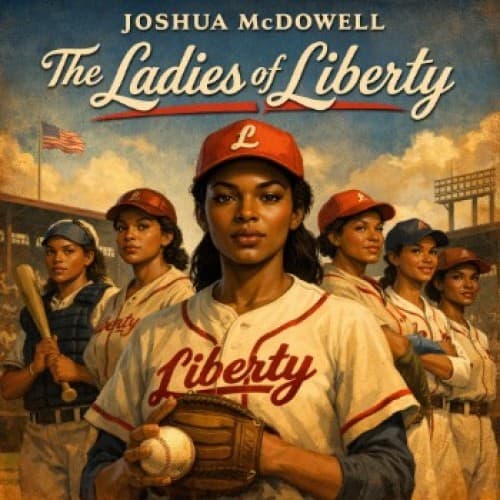

Philadelphia, 1924.
The city hummed like a machine that never slept—steel clanging, trains shrieking, men shouting over the grind of labor. And tucked inside that rhythm was Ella Carpenter, her hands stained with factory grease, her mind somewhere else entirely.
Always somewhere else.
A baseball diamond.
Every evening, after the whistle blew and the factory doors spilled bodies into the street, Ella would walk—not home, not right away—but to the edge of a field where men played under fading sunlight. The Philadelphia Colored Giants. She knew every player. Every stance. Every swing.
She knew she could do it better than some of them.
But knowing and being allowed were two very different things.
“Tryouts?” The man at the gate laughed so hard he had to wipe his eyes. “Girl, this ain’t no carnival.”
Ella didn’t laugh.
She stood there, shoulders squared, jaw set.
“I just want a chance.”
“You got one,” he said, still smirking. “Go on home.”
The gate shut in her face.
And something in her—something that had been quietly waiting—rose up like a storm.
The next morning, the factory felt smaller. The machines louder. The walls tighter. By lunchtime, Ella had made a decision that didn’t ask permission. If they wouldn’t let her play…
She’d build something they couldn’t ignore.
It started with a whisper. Lou Jackson was the first to say yes. She leaned against a brick wall, wiping sweat from her brow, eyes sharp and curious.
“You serious?” Lou asked.
Ella nodded. “Dead serious.”
Lou grinned, slow and dangerous.
“Then I’m in.”
After Lou came Dot—young, fiery, with a pitch that cracked the air like thunder. Then Effie, who moved like lightning across dirt. Then Anita, quiet but steady, and Mamie, who swung like she had something to prove to the whole world.
Each woman brought more than skill.
They brought hunger.
They practiced in empty lots, dodging broken glass and judgment alike. Men laughed when they passed. Women shook their heads.
“You gonna hurt yourself.”
“Ain’t no place for that.”
“Act like a lady.”
Ella heard it all.
And kept going.
Coach Andrew “Sweet Knuckles” Foster found them one afternoon. He stood at the edge of the field, arms crossed, watching in silence as Dot fired a pitch that snapped into Lou’s glove.
“Y’all serious about this?” he finally asked.
Ella stepped forward. “We are.”
He studied them. Really studied them. Not like a joke. Not like a spectacle. Like players.
“You’re gonna need more than heart,” he said. “You’re gonna need discipline.”
Ella didn’t flinch.
“Then teach us.”
He exhaled, slow… then nodded.
“Alright. Let’s see what you got.”
They became something real after that. Uniforms stitched together by Clara Wells, who believed in business and in bold ideas. A name chosen with pride:
The Philadelphia Liberty Belles.
They played wherever they could—empty fields, borrowed diamonds, anywhere someone would let them stand.
And slowly…
The laughter faded.
The exhibition game changed everything.
A real field.
A real crowd.
And a rival team that didn’t come to play nice.
Frank Washington stood at first base, smirking like the whole thing was a joke written just for him.
“Y’all should be home,” he called out, loud enough for everyone to hear. “Not out here embarrassing yourselves.”
Effie adjusted her grip on the bat.
“Guess you gon’ have to live with that,” she said.
The game was brutal. Every pitch carried doubt. Every swing carried defiance. Lou turned impossible plays into routine magic. Dot struck men out who had never been struck out by anyone. Mamie held first base like it belonged to her bloodline. And Ella…
Ella watched it all unfold, heart pounding like a drum. This wasn’t just a game. This was proof.
Final inning.
Score tied.
Ella stepped up to the plate.
The world narrowed.
No factory.
No laughter.
No closed gates.
Just the ball.
It came fast.
She swung.
CRACK.
The sound cut through the air like a declaration.
The ball soared—past Frank’s reach, past doubt, past everything that had ever tried to hold them back.
By the time Ella hit first base, the crowd was already rising.
By the time she reached home…
History had shifted.
They won.
But the world didn’t change overnight. Newspapers wrote about the game—but not about them. The league refused to recognize them. Ella lost her job. Progress, it seemed, had a cost.
Later, as the field emptied and the sky softened into evening, the Liberty Belles walked off together. Not defeated. Not forgotten. Just… not fully seen. Yet.
Ella lingered.
She turned back one last time--
--and saw them.
Little Black girls at the edge of the field, clutching gloves too big for their hands, eyes shining like they’d just witnessed something sacred.
“Mama,” one whispered, tugging at her mother’s sleeve.
“I wanna play like them.”
Ella felt it then.
Not victory.
Something deeper.
A seed.
Years later, another girl would pick up a bat. Then another. And another. And somewhere in the echo of every swing…
The Liberty Belles would still be there.
Unwritten. Uncredited. Unstoppable.
Because they didn’t just play the game.
They changed who it belonged to.
The End