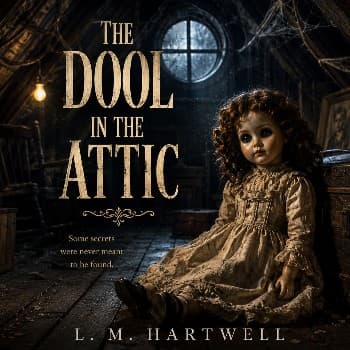

On a bleak, stormy evening, Emma arrived at her grandmother’s decrepit house nestled at the edge of town. The house had always been a place of uneasy memories for her—creaking floorboards, faded wallpaper, and shadows that clung to every corner. Her grandmother had recently passed away, leaving Emma with the responsibility of sorting through the old belongings. The house felt colder, emptier, yet somehow alive with silent whispers.
As rain pounded against the windows, Emma decided to explore the attic, hoping to find some keepsakes or clues about her grandmother’s past. The attic was cluttered with forgotten relics covered in thick layers of dust and cobwebs. Amid the clutter, Emma spotted an old, cracked wooden chest tucked into a dark corner. The latch was rusted, but with some effort, she pried it open.
Inside the chest lay an antique doll, its porcelain face cracked and stained with age. The doll wore a faded, tattered dress that looked as though it belonged to another century. But what unsettled Emma most were the doll’s eyes—they seemed unnervingly lifelike, glistening as if reflecting the dim attic light. Almost instinctively, Emma felt a chill crawl down her spine.
She carried the doll downstairs and placed it on the mantelpiece in the living room, hoping to clean it the next day. But that night, strange things began to happen.
At first, it was subtle—a soft creaking from the hallway, shadows shifting in the corners of her vision. Then, Emma heard faint footsteps echoing through the empty house. She told herself it was just the wind or her imagination. But when she woke in the middle of the night, she found the doll sitting at the foot of her bed, its glassy eyes glowing faintly in the darkness.
Heart pounding, Emma picked up the doll and put it back on the mantelpiece. But each morning, she found it in a different place: on the kitchen table, the staircase railing, even in her closet. No matter how many times she locked the doll away, it always returned.
The atmosphere in the house grew heavier. The air felt thick with cold, and Emma could sense unseen eyes watching her. Whispers echoed faintly in the walls, and shadows seemed to coil and stretch unnaturally.
Desperate for answers, Emma searched through her grandmother’s belongings and discovered a dusty, leather-bound diary hidden beneath a loose floorboard. The diary belonged to a little girl named Annabelle who had lived in the house nearly a century ago.
The diary revealed a haunting tale. Annabelle was a lonely child, often left alone while her parents argued downstairs. She had found comfort only in her beloved doll, which she named Lilith. But one tragic night, Annabelle disappeared without a trace, and the townsfolk whispered that her spirit had been trapped inside the doll, cursed to wander the house forever.
Emma realized that the doll she had found was Lilith—the very same doll from the diary. With a mixture of dread and determination, she read through the diary’s final pages, which contained a ritual to free Annabelle’s trapped soul.
On the stroke of midnight, Emma gathered the candles, herbs, and the doll in the center of the living room. She recited the ancient incantation with trembling lips as the storm raged outside. The doll’s eyes flickered wildly, emitting an eerie glow that filled the room. Suddenly, a soft sigh filled the air, and the doll’s porcelain face softened into a faint, peaceful smile.
Then, as if made of dust and shadow, the doll crumbled in Emma’s hands, dissolving into nothingness. The oppressive weight lifted from the house. The shadows retreated, the cold vanished, and a warm light seemed to fill every corner.
Emma knew that Annabelle’s spirit was finally free.
And though the house was silent once more, Emma never forgot the haunting lesson she had learned: some toys are never just toys, and some secrets are best left buried in the past.