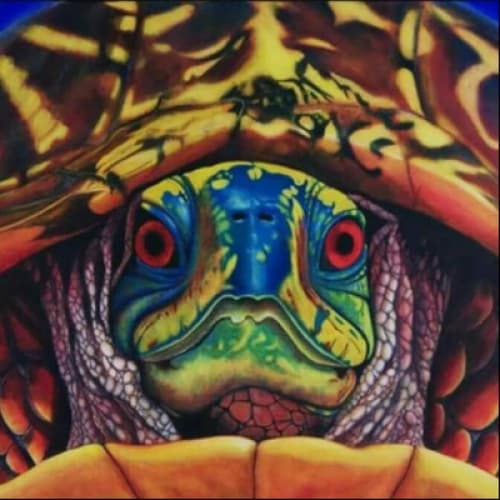

She called him Booger-Head for good reasons. He lurked in the water around the island, and he was a troublemaker. He was at least 400 pounds, maybe more. He was at least 50 years old as people who lived on the island could testify to his age. He always acted like he was harmless, but he was a menace to everyone. End to end of his shell, he was five feet long. Booger-Head was a loggerhead sea turtle. He was one of the largest ever known in the Florida Keys. He was legendary for the things he did to commercial fisherman and divers.
People on the island tried to ignore him. He could often be seen at the island fish house where lobsterman and fisherman sold their daily catches of lobster and fish. The only good part of a Florida lobster to eat is the tail. The rest of the lobster bodies were discarded daily in the water off the dock at the fish house.
During lobster season, thousands of lobsters went thru the fish house every day. The majority of the lobsters were sold to wholesalers out of Miami who arrived daily in refrigerated box trucks and the wholesalers bought the whole lobster, bodies and tails. What was sold to tourists and locals were wrung lobster tails. Workers at the fish house did what is called "wringing tails." With one hand they would hold the body of the lobster and with the other hand they would give the tail a quick twist, separating the body from the tail. The motion is just like wringing a washcloth. The tails were sold for five dollars a pound the rest of the lobster went into the water at the fish house.
Discarded in the water as well, everyday there were the heads and left over body parts of fish that had been fileted. Most of these fish were ten-to-twenty-pound groupers, or a virtual royal feast for scavengers like crabs and sharks. Every day the water around the fish house was a graveyard buffet but by the next morning, everything was devoured and gone.
Booger-head could sometimes be seen at the fish house during the day, but he preferred to go at night to avoid the boat traffic. If he got in the way of boats trying to get to the dock, he was often poked and prodded with long wooden poles to get his big, slow, lazy butt out of the way.
The water around the fish house was very clear but shallow. It was only about six feet deep in most areas but on low tide it could be as shallow as four feet deep. It was not a big boat basin, and it wasn't possible for fisherman to dock their boats if Booger-head was in the way. In the water he appeared to be the size of a small truck. He was like a small truck stuck in mud when it came to trying to make him move. He was never scared of people or boats. He would never do what anyone wanted him to do but for the most part, everyone tried to ignore him.
At night with a flashlight, Irena often walked down the short street from her house to the fish house. Irena's house was on the peninsula of the island and the fish house was next to the lagoon and not far from highway US 1. She sat on the fish house dock and with the flashlight, she watched Booger-head eat hundreds of lobster bodies like a bulldozer plowing through the bottom of the boat basin. He never left anything behind for sharks or crabs. He was an enormous pig and kept growing in size year after year.
The lobster in the Florida Bay and the Atlantic Ocean were extremely plentiful. It wasn't like the old days the old timers still talked about. How on low tide, on the flats around the islands, thousands of lobsters would suddenly be left out of the water, high and dry. Scurrying like crazy and climbing over each other to get back in the water when the tide went out. The days of millions and millions of lobsters were long gone, but they were still very plentiful.
There were 42 houses on the island and 42 lobster fishermen. Everyone who lived on the island put out lobster traps, stone crab traps, and fished with hand lines for grouper and snapper at night on the reef.
Most of the lobsterman had one thousand lobster traps. They put the traps out in the water in the Florida Bay and on the reef in long lines. Every trap was marked by a painted Styrofoam buoy. Each trap line had anywhere from 50 to 100 traps and each lobsterman had to mark down and memorize where they put their traps as many of the traps were a long way offshore.
Everyone on the island knew where everyone else's lines were located as each lobsterman had their own unique buoys painted in either a solid color or a combination of colors. Mark's buoys were light pink. Toby's buoys were half black and half white. The fish house buoys were half red and half white. Al's buoys were half blue and half yellow.
It was useful and a legally regulated practice so no one else could pull the traps of another lobsterman. People on the island didn't steal from other lobstermen. It was often boats that came all the way from Cuba or Miami. They would moor their boats on tiny mangrove islands out in the Florida Bay during the day then rob everyone's traps at night. Tourist divers would also try and rob the lobster traps on a regular basis. It was illegal to touch a lobster trap that was not yours or to have the lobster buoy that was not yours in your boat or attached to it. If caught by the marine patrol, it was a one-way ticket to jail. It was a constant, never-ending issue. Marine patrol officers spent countless days and nights on the water arresting people by the hundreds every year.
During lobster season the lobstermen had to pull their traps every day. There was an unwritten rule on the island that no one started their diesel boats up before 7 am. To a fisherman, 7 am might sound a little late but most of the lobsterman also went out on the reef and fished for fish until late at night.
It was common to see and hear boats coming in from the reef well after midnight. If they landed on a big school of snapper, you would know they caught a lot of fish as they didn't come back until two or three in the morning. Everyone on the island knew who was returning and when just by the sound of their engines. Lying in bed at night, Irena was often awakened by Chuck's boat. She didn't have to get out of bed to know he was home. She knew it was him by the distinct sound of his engines. She also knew it was him because every time he docked his boat, the dock squeaked in certain spots.
Lobstermen had to pull traps every day because they could only physically pull two or three hundred a day even with a motor assisted pulley. It takes time to pull one hundred feet of rope through the pulley, get the big lobster trap on the trap table, take off the barnacle encrusted lid, and then grab and measure each lobster. All of the small illegal size lobster stayed in the trap to attract more lobsters.
The trap ropes were often covered in sea grass and sargassum weeds and the lines had to be cleared before the line could go through the big stainless-steel pulley. Inside the traps was also a wide range of tropical fish and invertebrates that had to be returned to the water. Once a trap and the rope were clear and tossed back overboard, the other person driving the boat was already at the next buoy of the next trap to be pulled. However, most of the lobstermen in smaller boats pulled traps alone and had tillers or steering wheels at the stern so they could pull traps and drive at the same time.
Slow workers can take up to 5 minutes to clear a trap. The fast-working younger guys could clear a trap in two minutes or less. Even at 2 minutes a trap, that's only the ability to clear 30 traps and hour. Pulling 300 traps a day was a ten-hour day on the water no matter what the weather conditions were.
Not only were the lobstermen beaten by the wind, the sun, and the waves, but they were also covered in sticky salt residue from the water and slime from things that were dead in the trap. They always stunk to high heaven by the end of the day.
You could always tell the fast workers from the slow ones. Not by how many lobsters they caught, but by their scarred up bloody arms. Even though they all wore heavy full-length socks, and thick rubber gloves up to their elbows, the lobster spines could pierce through anything. It often led to serious infections and every lobsterman had to get a tetanus shot once a year.
The traps had to be pulled in rotation. By the time one full rotation was done, the first traps that were pulled would be full of lobster again. It was not uncommon for most lobsterman to catch a thousand pounds of lobster a day by only pulling two or three hundred traps. If they didn't stay on top of the rotation, the lobster would die in the traps and a dead lobster could not be sold.
Other boats and divers that pouched lobster traps were one thing, but Booger-head and his friends was a different story. With their enormous beaks, loggerhead turtles have no mercy on a wooden lobster trap. They would crush and destroy the whole trap to get to the lobster. Their beaks are like steel traps that can easily turn a lobster trap into a pile of splintered wood. Every day when the lobstermen returned to their docks, they would yell to each other about how many traps Booger-head and his friends pulverized and destroyed that day. On their docks they would throw down the evidence of twenty or thirty ropes with buoys attached to only a splinter of wood, or the remnants of what was left of the trap.
For this reason, even during lobster season when lobstermen were supposed to be pulling traps and not building them, the cha-choo, cha-choo, cha-choo of pneumatic nail guns was still often heard echoing around the island. They were often forced to build new traps to replace the traps Booger-head and his friends demolished without mercy.
During the off season, the cha-choo, cha-choo of pneumatic nail guns rang out all day long from every house. The ocean breeze carried the sound through the swaying palm trees and the noise ricocheted and bounced off the houses.
You cannot see where or who was building traps. You can only hear it. When traps were out of the water, every house was surrounded with lobster traps stacked ten feet high. All sides of every house were walled in by stacks of lobster traps. There was only a narrow path to get to the house from the street and a narrow path to get to their boat at their dock. You never saw anyone working but the cha-choo, cha-choo of the twenty or thirty nail guns firing at a rapid pace was proof everyone was hard at work.
Even when you tried to sleep, you could still hear that sound ringing in your head.
When the nail guns stopped firing, it was a clue that the trap pours were about to begin. Every trap had to have between four and six large coffee cans of concrete poured into the bottom of the trap. With hundreds of traps, mixing and pouring concrete was too much work for one person to do alone. The most efficient method was a tradition on the island that was practiced for the past 40 years.
When a lobsterman was ready for concrete, a concrete truck would come from Marathon early in the morning. The night before, each lobsterman would stack their traps on a hand truck and wheel them out into the street. The traps were lined up in singled rows down both sides of the street leaving just enough room for the concrete truck to drive between them.
No one on the island had to be informed that there was a trap pour in the morning. There was no notice, and no one was told. Everyone could see the traps lined up down the street as the island was very small. The road on the island was a small circle. If you drove around the circle six times, you would only cover the distance of one mile.
The lobsterman who needed his traps poured was responsible for providing breakfast for everyone on the island. Some served only coffee and donuts while others put out an entire breakfast buffet. All other lobsterman showed up with heavy duty work gloves, rubber boots, and a wheelbarrow. It was one of the few times when everyone on the island came together so there was no surprise at the endless sea stories and jokes that were told over a few cups of coffee.
When the concrete truck arrived at 7 am, the chatter stopped. Everyone lined up behind the truck with wheelbarrows. The concrete truck driver was also given coffee and a breakfast sandwich. He would eat and drink with one hand while pulling the lever to dispense half a wheelbarrow full of concrete to everyone in line. In less than one hour, all two or three hundred traps lines up on the street would be poured. A full concrete truck was only enough concrete for 300 traps. It was over and done with before the day began. As fast as everyone showed up was the same speed they left and went back to work, and the cha-choo, cha-choo of the nail guns started back up again.
The traps had to sit on the street until the next morning for the concrete to set. As soon as they were ready to be moved, whoever the traps belonged to had to wheel them back into their yard and stack them around their house. It was very hard work as with the concrete, each trap now weighed about sixty to seventy pounds. When the traps pulled out of the water at the end of the season, the traps were easily one hundred pounds or more when they were soaking wet. The end of the season was a time when everyone watched out for each other as well. It was not uncommon for a lobsterman to put too many traps in their boat. The whole boat could easily sink or the boat could split right down the center of the keel and literally split in half and sink. Just by loading 20 soaking wet lobster traps in the boat was a two-thousand-pound load.
There were also quiet days on the island in June and July during the off season when the nail guns stopped, and just before lobster season opened in August. During the quiet times the whole island was redecorated with round balls of colorful, fresh painted buoys.
In every yard, Styrofoam buoys were strung horizontally on long ropes from one coconut tree to the next. Every trap had to have a pointed buoy, and each lobsterman had their own license number. The license number was stamped into the Styrofoam with a hot branding iron. You could always tell who had been a lobsterman the longest by their number. Most everyone had only two digits. The older men had the lowest numbers like 13, 33, or 42. The younger lobsterman had numbers like 68, 80, and 95.
The most efficient way to paint lobster buoys is with a paint gun and beer and margaritas. The buoys are strung on heavy duty rope, zigzagging across the yards in a maze from tree to tree. It is really boring to stand and paint the buoys, and one can easily get dizzy. One hand holds the paint gun, and the other hand spins the buoy around so the whole surface gets covered in paint. Spinning the Styrofoam balls and painting them makes you dizzy from both the paint fumes and the spinning motion.
The best way to do it was to turn the music up loud and have a few pitchers of margaritas and a case of beer in the frig. When anyone on the island saw someone painting buoys, people would drop by to help paint knowing there were free beers or margaritas to be had. Free food or free drinks on the island was never really free. Only if you helped do the work was there a reward.
On the opening day of lobster season, every boat was loaded with traps the night before. Some of the smaller boats could only carry 30 or 40 traps while the bigger boats could carry 80 or more. All day long for an entire week or two, no one did anything else except load traps in boats and run them offshore.
It was a race to get to the best spots before your own neighbors got there. It sometimes resulted in heated verbal battles if one lobsterman setting a line of traps too close to another lobsterman. It was taboo. It was another unwritten rule that was sometimes broken by some who were just trying to cause trouble. It was an unwritten law on the island to never set your line immediately next to another line of traps. It wasn't about who was going to catch the most lobster. It was about not getting ropes and buoys wrapped up on your prop or drive shaft. Too close was just a boating hazard.
Commercial lobster season for scuba divers also opens the same day as commercial lobster season for lobster traps. Regular divers with only recreational licenses are limited to a small number of lobsters per day. Commercial divers like Irena paid a much higher license fee and reported their catches to the state every month but were licensed to take unlimited lobster. During the first two weeks of lobster season while traps were going out, this was the best time for seasoned divers like Irena to get a lot of lobster. Once traps were in the water, the lobster would go into the traps and there were no longer be hiding in their natural habitats. Divers had to hit the water early and dive hard to stock up.
Irena did not put out lobster traps. She was not a commercial lobsterwoman. She was a professional scuba diver. As a seasoned diver, she could dive in areas where novice or tourist divers couldn't go. These areas were the most dangerous areas where there was very swift current and things on the bottom that make it impossible for other divers to go there.
Irena could go out as early as midnight on the first day of dive season but diving the best areas in the dark posed one serious problem. The areas under the bridges were notorious for very large hammerhead sharks and at night. It was never a good idea for any diver to take that risk of diving at night with sharks. At daybreak, she was always anchored on the Three Mile Bridge with dive gear on and ready to hit the water.
The current at the bridge is always too strong for all divers to swim against. Because of the swift current, the bottom or sea floor is covered with large stances of fire coral. Fire coral grows unlike any other coral. It grows at the speed of light in strong current. It grows over everything in its' path. It forms a hard-shell encasement so matter what a diver touches like a rock or a concrete bridge piling, the deadly sting from the coral would send every diver out of the water screaming in pain.
A diver only has to get caught in fire coral once and they will swear to never go near it again. The only way to be protected is to be covered head to toe in a thick neoprene wetsuit including a hood that wraps around the neck. Rubber boots are worn inside of diving fins to protect exposed ankles. Long, thick rubber gloves are worn to protect the hands and wrists.
The sharks, the swift current, and the fire coral are not the only dangers. There are several more. Divers have to be keenly aware of other boats as lobsterman are running traps to the ocean and other divers are headed to the reef as well. As long as you stayed behind the bridge columns and stayed down on the bottom, you could hear boats approaching and watch the props of boats go past you in the water. If you didn't stay on the bottom and keep your head down, catching lobster would be the last thing you'd be doing that day.
Under the bridges are one hundred years of trash. It's just one bridge but two bridges. The old Henry Flagler railroad bridge and the new bridge built in the early 1908s are side by side. Everything from miles of monofilament fishing line that is the very worst to bottles, cans, tires, metal objects, and even old bicycles. It was very important for Irena to keep her body at least one foot from the bottom at all times in order to not get tangled up or cut. There is nothing more terrifying to a diver than to be tangled up in foreign objects that prevent the diver from being able to get back to the surface. Novice divers can panic and drown this way.
There is also a creature that lives under the bridge Irena was very familiar with. Most divers are completely unaware this creature even exists. They live under the bridges in large numbers. They live under rocks and will attack if disturbed. If Irena had to flip over a rock or other debris, she was always careful to be on the up current side before moving anything on the bottom. She learned that if she was down current and flipped something over, the creature would flip up in the water column and the current would plaster it right to her face. Her face was the only part of her body that was not fully protected.
These creatures are unmistakable once seen. They are bright neon orange with long white prickly hairs sticking out from all sides. They look soft and fluffy, but they are deadly. They're called orange bristle worms. Their sting is so deadly it can cause a diver to go into shock, have a heart attack, and drown within a minute. Irena knew from experience that largest ones she'd ever seen anywhere in the ocean lived under these bridges. Some of them were a foot long. To Irena, the orange bristle worms were much more terrifying than the fire coral or the sharks.
These were all of the hazards Irena knew about when diving lobster on the bridges. She knew if she went from piling to piling swiftly, she could catch about 500 lobsters and be back at her dock by noon.
She had several very large lobster collection bags that were custom made. They were made of heavy-duty tarp like material with only a few holes in the bottom to let water pass through. The interlocking handles were custom made of stainless steel with a locking clasp. The handles had to be strong for when she pulled the bags into the boat. The handles could easily break as each bag had around 25 lobsters or about 50 pounds of lobster.
Crawling across the bottom with a giant bag of two dozen lobster most men cannot do. Irena clipped two bags to her belt, one on each side. When she crawled back to the boat, she was dragging 100 pounds of lobster with her. The whole trick was to crawl across the bottom. Not to even try to swim with all that weight and fighting the strong current. It was simply something novice divers could not do at all.
The first day of commercial lobster season, Irena already had about 200 lobsters in the boat before 8 am. She had done two dives, returning each time with two full bags. The current was getting stronger, but she was ready to get back in the water for the next dive. Little did she know there was another hazard in the water Irena never had an encountered but was about to experience.
Going from one bridge piling to another, she reached up into the rocky holes around the pilings and grabbed large lobsters left and right. She stuffed them into her bags one by one, careful to latch the clasp on the handle each time she opened and shut the bag. One bag was almost stuffed full and as usual, the lobster in the bag were making a raucous to get out.
She was shoving the fighting critters down into the bag when she was suddenly and crushed to the bottom. It happened really fast and without warning. It felt as if the entire bridge had collapsed down onto her and she could not move.
She was plastered to the fire coral on the bottom and the lobster bag was underneath of her. She could feel the sharp spines of the lobster digging onto her chest fighting to break free but she could not move. She could feel the fire coral burning her face but could not move away from it. Her arms were pinned to her chest. She began to fight against whatever was on top of her. She was able to get one arm slightly free. She grabbed the scuba tank regulator with her hand and held it tight to her mouth so it couldn't fall out for she feared she was about to drown.
Suddenly, she felt the heavy mass on top of her move. It freed her up a little bit. Just as she tried to move, it smashed her body and head back down onto the bottom with great force. She felt her lungs and rib cage collapse. She stayed frozen not trying to fight or move. She had no idea what was on top of her, but she knew the worst thing she could do was panic. She focused on her breathing and tried hard to get air into her lungs.
Suddenly, something had ahold of the lobster bag and was trying to rip it out from under her. She still couldn't move but now she could turn her head a little.
Looking to her left, there he was. Booger-Head. She was face to face with him as he ripped at the lobster bag with big dirty claws. He put his eyeball right up to Irenas face mask and pressed his head against hers. Irena tried hard to not scream and not look back into his eyeball.
Irena could not believe the size of his beak. It was the size of her own head. With one bite he could tear her whole face off. He could have easily clamped his huge beak around her neck and taken her whole head off. He was pushing her head with his beak and staring at her while trying to take the lobster bag.
Irena suddenly realized she had to roll over and let him take the bag. She put her face down into the fire coral and screamed in pain as the coral stung her. She rolled over and hurriedly unclipped the bag from her waist. Booger-Head grabbed the bag with both front fins and his beak and swam off with it.
Irena swam to the next piling and hid behind it from the current and Booger-Head. She was hyperventilating and was in no shape to crawl back to the boat. Her face was on fire from the stinging coral. She was choking and gagging and in shock. She had never been mugged by a turtle and could not believe what the turtle had done. She kept screaming out loud, "There was no way that just happened!".
She knew she was injured as his body weight had crushed her for several minutes. She didn't know if she could get back to the boat at all, but she had to try.
After she caught her breath, she kicked away from the piling and frantically grabbed at anything solidly attached to the bottom to pull her way back to the boat. In her state of panic, she accidentally flipped up two rocks and both of them sent orange bristle worms up into the current. She ducked out of the way as they flipped up with the current and she watched them float right past her face, just barely missing her.
When she got to the boat, she threw herself over the gunnel headfirst onto the deck. She laid on the deck for a long time gasping for air trying to catch her breath. She began thinking about what she was going to tell people because no one was going to believe she was mugged by Booger-Head. When he was on top of her, he felt like he weighed a thousand pounds.
How rude, she thought. He eats every lobster carcass around the whole island but went to the extreme of holding a person underwater in order to steal more. Staring me down. Right in my face. He was dangerous and psychotic! He was a filthy, greedy pig! He acted with malice in order to get food. Irena had never witnessed that in any other creature in the ocean. She had never witnessed any other creature in the ocean in twenty years act with malice.
Sure, sharks and barracuda will steal your fish right off the shaft of the spear gun, but that was different. How did this turtle learn to use his body weight to subdue a diver while stealing the lobster? Only Booger-head could think of such a thing. He was old and mean and needed to eat more than any other turtle.
On the boat ride back to her dock, Irena decided to not tell anyone. No one was going to believe her anyhow. Everyone would think it was just as excuse as to why she only got 200 lobsters for the day. It was better, if asked, to blame it on the current and the visibility or say there wasn't a lot of lobster to be found. She would go back and dive on the bridge again but not to collect lobster as long as Booger-head was alive. She never told anyone about how mean he really was.
More than a full year passed, and it was the beginning of a new lobster season. Irena went diving on the bridge many times over the past year to collect invertebrates, but not lobster. She had not seen Booger-Head on all of those bridge dives at all. She had seen him around the island and at the fish house, but not while diving on the bridge.
Early one morning Irena walked to the front of the island to the marina and store. On the rack in the store was the local newspaper that had just been delivered from Marathon. There were several residents of the island in the store talking about the newspaper headline that read:
Diver Reports To Marine Patrol He Was Sexually Molested By A Turtle.
Irena immediately thought it was Booger-Head. As she read the article, she realized the diver was seriously confused. He was a novice diver in the Florida Keys on vacation. He was out on the reef about three miles offshore and alleged that a large turtle tried to get on his back and mate with him.
It was buried way down in the article that he was actually collecting lobster when it happened. It was Booger-head. He was only trying to steal the lobster, but this diver was totally unaware. He accused the turtle of something a turtle would never think to do to anything or anyone that wasn't a turtle. It was projection. This man had obviously been sexually molested and related that event to this one. Poor guy. He sounded really terrified, but he was not injured.
People in the store were laughing and making jokes saying things like,
"I bet he doesn't come back to The Keys to dive anymore!"
"I guess the turtle gave him a sore butt!"
"I guess he'll have nightmares about turtles for the rest of his life!"
Not only did the diver report it to the marine patrol but he also went to the sheriff's office to report the incident as turtle molestation. He then went to the local newspaper to report the turtle for the crime. He was hysterical and truly believed he was sexually assaulted by a turtle.
A few months later Irena was watching The Late Show on TV and there he was. The publicity of the incident had landed the diver a spot on the show. The diver was still hysterical about the incident and insisting the turtle was trying to mate with him. No one could believe the story, but many thought his account was true.
Irena laughed out loud and fell off the couch. She could have run to the press with her story too. She could have been on The Late Show too. She saw how crazy the diver appeared to others, but she also knew it was not what really happened.
In her twenty years of diving and reading on the internet beginning in 1985, there were several accounts from around the world when divers thought they were being sexually molested by turtles. She couldn't figure out why male divers thought that. She had been pinned down and pounced on by Booger-Head, but she never even for a second thought it was a sexual act.
In every case, what each diver overlooked is they were all taking food such as lobster or fish and the turtle was only mugging them, not raping them. Men somehow confused the two very different acts as the same thing. To Irena, it said a lot more about the men than the turtles.
Pulling traps on the water every day, lobstermen often come across dead turtles floating on the surface of the water. Many would bring them in and try to procure the shells usings old techniques only fishermen know about. Most of the time, a lobsterman or a fisherman will only attempt to do it once in their life.
A rotting turtle is unlike any other smell on earth. It is so strong and offensive it will immediately make every person vomit. Just one dead turtle on the island can be smelled all over the entire island. There was one old fisherman on the island who taught everyone else how to cure a turtle shell the right way.
Doug often did it in his back yard, hidden amongst all the coconut tree debris in his yard. First thing was to have a large stainless steel or cast-iron cauldron full of fresh water and over an open fire. The shell and all of the mucous membranes and rotting meat had to be boiled for several days. When anyone boiled a turtle shell on the island, no one could open their windows. It smelled as if a thousand dead pigs were rotting in a pile and no amount of wind could carry the smell away.
After the shell was boiled and there was nothing left but the shell, the shell was put on the ground and salted with a large bag of salt. More salt had to be added every day and it would take at least 50 pounds of salt to cure a large turtle shell. It had to sit in the yard covered in salt for several months. After that, it was cleaned and polished and hung on porches where it would stay forever. The final resting places of many turtles was one the homes of the fisherman and lobsterman on the island who had the stomach and the patience to preserve them.
No one knows what happened to Booger-head. His five-foot-long shell, his giant head and beak, and his enormous claws, disappeared. He stopped coming around the fish house. He vanished from the waters around the island. There are no turtle shells on anyone's house as big as he was. Irena often wondered if his voracious appetite was the very thing that killed him. She thought maybe he starved to death not being able to eat enough to sustain his life.
At one time Booger-Head wasn't bothered by anything when he ate the leftovers at the fish house. He was always there and had plenty of food. Later on, he was willing to attack and kill to get food. As he got old. He didn't have to get mean. He just did.