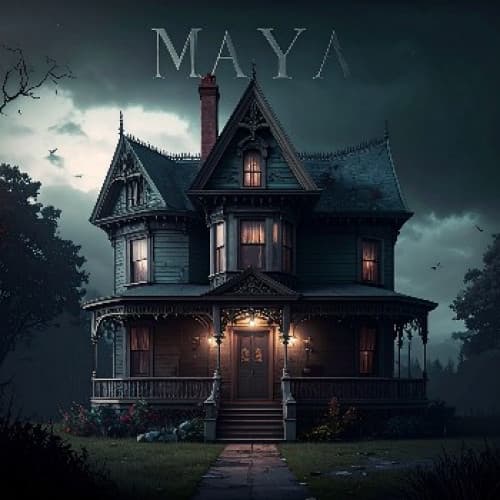

Maya had lived in the old Victorian terrace for three weeks when she first noticed it. The narrow landing at the top of the stairs had four doors, three she’d open countless of times, leading to bedrooms and a small bathroom. But the fourth, tucked in the far corner behind a tattered velvet curtain, she’d somehow missed until now.
The wood was dark oak, worn smooth by time, with an iron handle shaped like a twisted hand. When she tried to turn it that first night. It wouldn’t budge, as if something was pressing against it from the other side.
‘’Just stuck,’’ she told herself, even as the handle felt warm beneath her fingers, like it had been held moments before.
Over the next few days, strange things began to happen. Her tea would go cold in seconds, even on the hottest afternoons. Shadows moved across the walls, when all the lights were off, not just shifting shapes, but distinct figures that seemed to be walking towards the hidden door. And every night at exactly 3.17am, she’d hear soft scratching from behind it, slow, deliberate, like someone was drawing letters in dust.
One morning, she found marks etched into the floorboards outside the curtain: three small circles, connected by crooked lines that looked like tears. She ran her finger over them, and the wood was still warm. That same day the estate agent who’d sold her the house called out of the blue.
‘’Did you… did you find any doors you weren’t expecting?’’ his voice cracked over the line. ‘’The previous owner, a girl your age, same name even, she vanished twenty years ago today. Last thing anyone saw was her standing at the top of the stairs, staring at a corner that didn’t have a door.’’
Maya’s blood ran cold. She hung up and pulled back the curtain. The door was still there, but now there were faint scratches on its surface too, what looked like a name, half erased: Maya.
That evening, she searched every inch of the house. In the attic, under a pile of yellowed newspapers, she found a leather-bound journal. The first page was dated exactly twenty years before she’d moved in. The handwriting was neat at first, then grew frantic:
‘’The door appeared yesterday. It calls my name. I’ve tried to lock it, but the key won’t turn from this side. It says I must go in, that I’ve been waiting for myself all this time.’’
She flipped to the last entry, written the night the girl disappeared:
‘’3.16 AM. The handle is warm again. I can feel my own breath coming from behind the wood. I know now, it’s not a door to somewhere else. It’s a door to when.’’
At the bottom of the page was a small drawing of an iron key, with the same shifting symbols she’d seen earlier. And tucked into the spine of the journal was the key itself, heavy, cold as ice, and impossible to let go of once her fingers closed around it.
The night, she waited by the door. The house fell silent at exactly 3.00 AM. The floorboards beneath her feet began to hum. At 3.17, the handle twisted on its own, then stilled.
Her hands shook as she inserted the key into the lock. The click that echoed through the silent house was louder than a gunshot, and the air grew thick with the smell of damp earth, rotting flowers, and honey mixed with blood.
‘’Come in,’’ a voice whispered, thin as cobwebs. It sounded like her own, but younger, and full of a pain she’d never known, a pain she now felt spreading through her chest, as if memories she’d never lived were forcing their way into her mind.
Maya stepped forward, drawn by a force she couldn’t resist. As she pushed the door fully open, the hallway lights flickered out. Behind her, she heard the unmistakable sound of a key turning in a lock.
When she spun around, the door to the landing was closed. The twisted iron handle now faced inside.
The room beyond was her bedroom, but not as she knew it. The walls were covered in newspaper clippings about a young woman named Maya who’d vanished from this house twenty years ago. On the bed lay a leather-bound journal, it’s pages blank except for the first line, already being written by an invisible hand:
‘’The door appeared yesterday. It calls my name…’’
Through the window, she could see herself standing on the street below, carrying moving boxes up to the front door. She tried to scream, but her voice came out as a whisper that drifted towards the landing, slow deliberate, like someone drawing letters in dust.
In the mirror on the wall, she saw two reflections: her own face, and the face of the girl from twenty years ago, both staring back with the same terrified eyes. And in the corner of the room, behind a tattered velvet curtain she was sure she hadn’t been there a moment before, a dark oak door was beginning to take shape.
The door in the corner of the room solidified within minutes, dark oak, twisted iron handle warm to the touch. Maya watched in horror as her reflection in the mirror walked towards it, her hand outstretched.
‘’It’s not a trap,’’ the other her said, turning to face her. The pain in her eyes had softened into something like resignation. ‘’It’s a loop. We’ve been waiting for each other to break it.’’
The journal on the bed flipped open to a new page, and words began to appear in Maya’s own handwriting: ‘’I see now. The door doesn’t take us away, it keeps us here, holding the place open for the next me to arrive. But we can change it. We must choose together.’’
Twenty years ago, the first Maya had gone through alone. This time, as the handle twisted at 3.17 AM, both figures reached for it, one from the past and one from the present. When their hands touched, the symbols on the key blazed with warm light, and the door swung inwards not to another room, but to the landing she’d left behind.
The house was quiet. The curtain hung empty in the corner, no door in sight. On the floorboards, the marks of circles and tears had faded to nothing.
Maya stepped back into her own time, the journal tucked under her arm. Outside, the sun was rising over Cheltenham, painting the sky soft pink and gold. But as she walked downstairs to make tea, she noticed something new: a small brass plaque by the front door, engraved with words she’d never seen before: ‘’For Maya, may all doors lead home.’’
She opened the journal one last time. The final page was filled with writing from every Maya who’d ever stood at that landing, each entry ending the same way: ‘’We’re free now.’’
A month after breaking the loop, Maya still couldn’t shake the feeling that the house had more secrets to tell. The brass plaque by the door had led her to the local archives in Cheltenham, where she spent every free afternoon digging through old records.
The house on Chapel Street had been built in 1897 by a carpenter named David Thorne. According to the files, he’d lost his daughter, also named Maya, to a fever when she was just seven years old. Grief-stricken, he’d carved a door in the landing, claiming it would let him ‘’bring her back to when she was whole.’’ He vanished the night it was finished, and the door was walled up… only to reappear every twenty years, calling to a woman named Maya who’d be drawn to the house without knowing why.
‘’He didn’t mean to trap anyone,’’ Maya murmured, tracing her finger over a faded photograph of David and his daughter. ‘’He just wanted to fix something he couldn’t change.’’
She decided to find his grave. The records led her to a small churchyard on the edge of town, where weathered headstones leaned against each other like old friends. His was easy to spot, at the foot of it stood a tiny wooden door, no bigger than her hand, with an iron handle shaped like a twisted hand.
As she approached, the handle grew warm. A soft voice, like a child’s laugh carried on wind, whispered: ‘’He made it for me. But he never knew I was already here.’’
Maya knelt down and gently touched the little door. It swung open, revealing not darkness, but a sunlit garden she’d never seen before. In the centre stood a girl with braided hair and eyes that matched hers exactly, holding a small leather journal, the same one Maya had found in the attic, but new and unwritten.
‘’I’ve been waiting for you too.’’ The girl said, smiling. ‘’Every time the big door called a Maya, I’d watch from here. You’re the first one who didn’t go through alone. Now we can help him.’’
Together, they walked through the small door into the garden. At its far end stood David Thorne, young again, staring at a wooden door he was in the middle of carving. When he saw them, his tools fell from his hands.
‘’My Maya,’’ he breathed. ‘’I thought I’d lost you forever.’’
‘’You never did,’’ the girl said, taking his hand. ‘’But we can’t stay in the past. Let’s go home, all of us.’’
The garden began to glow, and when the light faded, Maya was back in the churchyard. The small door was gone, replaced by a new plaque that read: ‘’David and Maya Thorne – Together always.’’
Back at the house on Chapel Street, she found a letter tucked under the doormat, written in elegant handwriting she’d recognize anywhere:
‘’Thank you. We’re finally where we belong. The house is yours now, keep it safe for anyone who needs a place to find their way home.’’
Maya decides to turn the house into a safe haven for people who feel lost or disconnected from their lives, just as she once was. She fixes up the empty rooms, painting walls warm colours and filling them with comfortable furniture, books, and plants. Above the front door, she hangs a sign: ‘’Chapel Street House – Where Doors Lead Home.’’
She keeps the journal David and little Maya left her, adding her own entries about the people who come to stay. There’s an artist struggling to find her voice after a loss, a student far from home who feels like she doesn’t belong, and an elderly man searching for the neighbourhood he grew up in decades ago. For each of them, Maya shares the story of the door, not to scare them, but to show that sometimes the things that haunt us can become the very things that set us free.
She also works with local historians to document the house’s full history, ensuring David and his daughter are remembered not as figures of mystery, but as a father and child whose love transcended time. Every year on the anniversary of when she broke the loop, she places fresh flowers in the corner where the door once stood and lights a candle in the window to guide anyone who might need the house as much as she did.
One rainy afternoon, a young woman knocks on the door, her name is Maya too, and she says she felt an impossible pull to this street as soon as she moved to Cheltenham. Instead of fear, though, she feels a sense of peace. Maya welcomes her in, hands her the journal and tells her: ‘’Sometimes we think we’re looking for a place to stay. But really, we’re looking for somewhere we’ve always been.’’
The first guest to stay at Chapel Street House was Nina, a painter in her late twenties who hadn’t picked up a brush in two years. She’d lost her partner Ben in a car crash, and with him, her ability to see colour, everything looked washed out, like an old photograph.
Maya found her sitting on the doorstep one grey morning, staring at the sign above the door with red-rimmed eyes.
‘’I don’t know why I came here,’’ Nina whispered. ‘’I just got on a bus and told the driver to take me somewhere I could breathe.’’
Maya gave her room three, the one that had once faced the hidden door. The walls were painted soft blue and the sunlight streamed through the window onto a small easel that had been left by a previous owner. Nina looked at it, then turned away.
For the first week, she barely spoke, spending her days walking the quiet streets of Cheltenham or sitting in the garden, staring at the flowers without seeming to truly see them. But Maya noticed small changes: Nina would pause by the journal on the hall table, running her fingers over its cover, she’d linger in the corner where the door once stood, as if feeling the warmth that used to live there.
One evening Maya shared the story of David and the Mayas. When she finished, Nina looked up, her eyes wide.
‘’I keep dreaming about a door,’’ she said quietly. ‘’It’s not scary, its just… waiting. And on the other side, I can see colours I can’t name.’’
The next morning, Maya found Nina in room three, brush in hand. She was painting a garden filled with flowers that glowed with impossible hues, blues like midnight sky, reds like warm embers, yellows like sunlight through honey.
‘’I can see them again,’’ Nina said, tears streaming down her face. ‘’I think Ben was on the other side of that door in my dreams, not to bring me back to him, but to show me I could still see the world the way we used to together.’’
She finished the painting and hung it in the hall, right where the hidden door had been. It became a symbol for everyone who stayed at the house, a reminder that even when things seem colourless, beauty is waiting to be found again.
Nina stayed for three months, teaching art classes to other guests who needed a way to express what they couldn’t say. Before she left to move into a studio nearby, she painted one more piece, a portrait of Maya, surrounded by doors leading in every direction, all of them open.