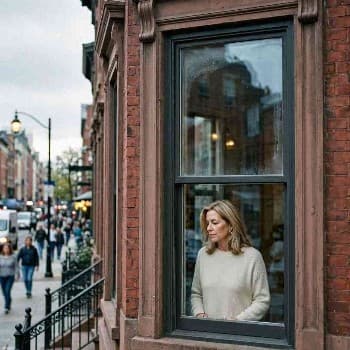
The Window
Anna Davis had memorized every crack in the sidewalk from her third-floor window. Five summers of watching had taught her the patterns: the way the concrete buckled near the fire hydrant, how water pooled by the storm drain after rain, the dark stain—gum or oil, she'd never know—that marked the spot where the bakery's awning ended.
She knew the rhythms too. Morning joggers at 6:15, the ones who ran like their lives depended on it, faces grim with determination. The dog walkers came next, a parade of leashes and plastic bags and animals that sniffed the same spots day after day. By eight, the professionals emerged—suits and briefcases, coffee cups clutched like talismans against the day ahead. She'd named some of them. Red Tie Guy. Headphone Woman. The Couple Who Never Spoke.
It was July, and the window was open as wide as it would go. The brownstone held heat like a brick oven, and even at nine in the morning, Anna could feel sweat gathering at her hairline. She sat in her usual spot, the wingback chair she'd dragged from the living room three years ago, its burgundy fabric faded to rust on the side that faced the sun. A cup of coffee cooled on the sill beside her, next to yesterday's cup, which she'd forgotten to bring to the kitchen.
This was her world. Twelve hundred square feet of pre-war architecture, high ceilings and crown molding and hardwood floors that creaked in the same places every time. She knew every sound the building made—the groan of pipes, the rattle of the radiator in winter, the way the front door stuck in humid weather. She knew which floorboards to avoid if she wanted to move quietly, though there was no one to disturb. She'd lived alone since her mother died seven years ago, and alone in a different way for the last five.
Five years since she'd felt sunlight directly on her face. Five years since she'd smelled anything but the filtered air of her apartment—coffee, toast, the lavender detergent she ordered online, the faint mustiness that crept in no matter how much she cleaned. Five years since she'd touched another human being.
The last time had been Dr. Reeves, her therapist, gripping her elbow as Anna hyperventilated on the sidewalk halfway to the corner bakery. "You're doing great," Dr. Reeves had said, which was a lie. Anna's vision had tunneled to a pinpoint, her lungs refusing to expand, her heart hammering so hard she thought her ribs might crack. The buildings had been leaning in, the sky pressing down, the sidewalk tilting beneath her feet. Too many people. Too much space. Too much everything.
She'd made it back inside and never tried again.
Dr. Reeves still called once a month. They did sessions over video chat now, Anna sitting at her kitchen table, the therapist's face pixelated and concerned on her laptop screen. "Have you thought about trying again?" Dr. Reeves would ask, and Anna would say, "Maybe next month," and they both knew she was lying.
The agoraphobia had started small. A tightness in her chest on the subway. An urge to leave crowded restaurants. Then came the panic attacks—sudden, vicious things that felt like dying. Her heart would race, her skin would prickle with sweat, and her throat would close as if invisible hands were squeezing. The world would become too bright, too loud, too much. She'd started avoiding triggers. Crowds first, then enclosed spaces, then anywhere that wasn't home.
The psychologist had explained it once: her amygdala misfiring, her fight-or-flight response stuck in the on position, her brain convinced that the outside world was a mortal threat. Understanding it didn't help. Knowing the fear was irrational didn't make it less real.
So she'd retreated. Slowly at first, then completely. Grocery delivery. Online shopping. Bills paid automatically. Her freelance work—copyediting for a publishing house—could be done entirely from her laptop. She had everything she needed. She was fine.
Except she wasn't, not really. She knew that. There was a difference between surviving and living, and Anna had been doing only the former for a long time.
Below her window, a taxi honked. A woman in a yellow dress jaywalked, phone pressed to her ear. A teenager on a skateboard rattled past. Anna watched them all with the detached fascination of an anthropologist studying a foreign species. These people who moved through the world so easily, who stepped outside without thinking, who breathed open air and felt sun on their skin and never once considered it a miracle.
She envied them. God, how she envied them.
Sometimes, late at night when she couldn't sleep, Anna would stand at the window and imagine it. Walking down those steps. Feeling the concrete under her shoes. Turning left toward the bodega or right toward the park. Just walking, like it was nothing. Like she was normal.
But morning always came, and with it the familiar weight of impossibility. The outside world wasn't for her anymore. She'd made her peace with that. Mostly.
Her coffee had gone cold. Anna picked up the cup, then set it down again. She'd get it later. Right now, a delivery truck was double-parked, and the driver was arguing with someone in a BMW. She settled deeper into her chair, watching the drama unfold.
This was enough. It had to be.
The morning stretched ahead, identical to yesterday and the day before and all the days that would follow. Anna Davis, forty-three years old, watching life happen to other people. Safe in her brownstone. Alone in her window.
The summer heat pressed against the glass, and somewhere in the distance, a siren wailed.
The woman appeared at the corner just after ten.
Anna noticed her immediately—not because she was remarkable, but because her pace was wrong. Everyone on this street moved with purpose, even the tourists. This woman moved like she was walking through water, each step deliberate and effortful. She wore a loose cotton dress, pale blue, and even from three floors up, Anna could see the pronounced curve of her belly.
Very pregnant. Eight months, maybe more.
The woman stopped at the bodega, one hand pressed to the small of her back. She stood there for a long moment, swaying slightly, then continued down the block. Toward Anna's building.
Anna watched her progress. The woman's face was flushed, her dark hair pulled back in a ponytail that had come half undone. She kept stopping, starting, stopping again. Her free hand clutched a small purse, knuckles white against the strap.
Something was wrong.
Anna leaned forward, her breath fogging the glass. The woman had reached the building next door now, moving slower with each step. She paused at the railing, gripping it hard enough that Anna could see her shoulders tense.
Keep walking, Anna thought. Whatever's wrong, keep walking. Get to a hospital. Call someone.
But the woman didn't keep walking. She took two more steps and stopped directly in front of Anna's stoop. Her hand went to her stomach, pressing hard, and her face contorted. Pain. Definitely pain.
Anna's heart began to accelerate, that familiar flutter that preceded panic. She gripped the arms of her chair. This wasn't her problem. The woman would move on. Someone else would help. There were people everywhere—the joggers, the dog walkers, someone would see.
But the street was empty. The morning rush had passed, and the lunch crowd hadn't emerged yet. Just Anna and the pregnant woman and the summer heat shimmering off the pavement.
The woman's legs buckled.
She caught herself on the railing, barely, her body folding forward. A sound escaped her—Anna couldn't hear it through the glass, but she saw the woman's mouth open, saw the desperation in the movement. The woman tried to straighten, took one step toward the stoop, and collapsed.
She went down hard, crumpling onto the bottom step, her body twisted at an angle that made Anna's stomach lurch. The woman's purse fell, contents scattering across the sidewalk. Her hand reached out, grasping at nothing, and then went still.
"No," Anna whispered. "No, no, no."
Her heart was hammering now, a violent percussion against her ribs. Sweat broke out across her forehead, down her spine. Her hands were shaking. The familiar tightness wrapped around her chest, squeezing, and her breath came in short, inadequate gasps.
Not now. Please, not now.
But her body didn't care about timing. The panic was rising, that black wave that would pull her under if she let it. The room tilted. The walls pressed in. Her vision narrowed to a tunnel, and at the end of that tunnel was the woman on her stoop, not moving.
Anna forced herself to breathe. In through the nose, out through the mouth. Dr. Reeves's voice in her head: Ground yourself. Five things you can see.
The woman on the stoop. The scattered contents of her purse. A phone. A wallet. Keys.
Four things you can touch.
The chair beneath her. The windowsill. The cool glass. Her own trembling hands.
It wasn't working. The panic was too strong, fed by something more powerful than her usual triggers. This wasn't about crowds or enclosed spaces. This was about a woman—a pregnant woman—lying motionless on her stoop, and Anna was the only one who knew.
She had to call 911. That was simple. She could do that from here, from safety. She didn't have to go outside. She just had to make the call.
Anna pushed herself up from the chair, her legs unsteady. She made it three steps toward the kitchen, where her phone was charging, before she stopped.
What would she tell them? A woman collapsed on her stoop. Which stoop? What's the address? Is she breathing? Is she conscious? They would ask questions Anna couldn't answer from three floors up.
They would tell her to go check on the woman. To stay with her until the ambulance arrived.
They would tell her to go outside.
Anna's throat closed. She couldn't breathe. Couldn't think. The walls were too close, the ceiling too low, and the woman on her stoop might be dying while Anna stood frozen in her apartment, prisoner to her own broken brain.
Choose, she told herself. Choose right now.
Call 911 and hope it was enough. Hope they could find the right building, hope someone else would appear to help, hope the woman would be okay without Anna doing anything more than making a phone call.
Or go outside.
Five years. Five years of safety, of routine, of carefully constructed walls between herself and the world. Five years of telling herself she was fine, she was managing, she had everything under control.
And now a stranger was lying on her stoop, and Anna had to decide who she was going to be.
Her phone was in the kitchen. The door was twenty feet away.
Anna stood between them, shaking, sweating, her heart trying to break through her chest.
And made her choice.
She grabbed her phone from the kitchen counter and moved toward the door before she could think about it. Thinking would stop her. Thinking would remind her of every reason this was impossible, every time she'd tried and failed, every humiliation and defeat that had led to five years of self-imposed exile.
The hallway stretched before her like a tunnel. Her apartment door—solid, painted white, with three locks she'd installed herself—stood at the end. She'd looked at that door thousands of times. She'd touched it, leaned against it, pressed her ear to it to hear the sounds of her neighbors coming and going.
Her hand reached for the top lock. Her fingers were trembling so badly she could barely grip the deadbolt. It stuck, resisting, and for one wild moment she thought maybe this was a sign, maybe she should stop, go back to the window, call 911 and let them handle it.
The lock turned with a click that sounded like a gunshot.
The second lock. The third. Each one a small death, a small resurrection. Her heart was a drum, a hammer, a thing trying to escape her chest. Sweat ran down her spine, soaked through her shirt. The hallway tilted and she put her hand against the wall to steady herself.
Breathe. Just breathe.
But breathing was impossible. Her lungs had forgotten how.
She turned the doorknob. Pulled.
The door opened six inches and the world rushed in.
Heat. Immediate and oppressive, the thick August heat that turned the city into a furnace. It hit her face like a physical blow, carrying with it the smell of hot asphalt and exhaust fumes and garbage and something sweet—flowers, maybe, from someone's window box. The sounds came next: a car horn several blocks away, the rumble of traffic on the avenue, voices she couldn't distinguish, the mechanical hum of air conditioning units, a dog barking, music from an open window, the city's endless symphony that she'd heard muffled through glass for five years but never like this, never this immediate and overwhelming and loud.
Anna's vision grayed at the edges. Her knees buckled and she caught herself on the doorframe, her phone clattering to the floor. She was going to pass out. She was going to die right here in her own doorway, and the woman on the stoop would die too, and it would be Anna's fault for being too broken to function like a normal human being.
No.
She picked up her phone. Forced her legs to move. One step into the hallway, then another. The stairwell door was ten feet away. She could see it through the tunnel of her vision, could see the red EXIT sign above it like a beacon.
Or a warning.
She pushed through the door and the stairwell swallowed her. Three flights down. Forty-two steps—she knew because she'd counted them once, years ago, when she could still navigate them. The walls pressed in, closer than her apartment walls, closer than anything. The air was stale and hot and tasted like dust. Her footsteps echoed, multiplying, until it sounded like a crowd was following her down.
She gripped the railing so hard her hand ached. One step. Another. Her legs were shaking, threatening to give out. Halfway down the first flight, she had to stop, pressing her forehead against the cool concrete wall, gasping for air that wouldn't come.
The woman. Think about the woman.
Anna pushed off the wall and kept going. Down and down and down, an endless descent into hell, except hell was just the outside world that everyone else navigated without thought. The ground floor door appeared and she hit it with her shoulder, stumbling out into the small vestibule.
The front door was glass. She could see through it to the stoop, to the woman's body still crumpled on the bottom step, one arm flung out, her blue dress twisted around her legs.
Anna's hand was on the door handle. This was it. The final barrier. Once she crossed this threshold, she would be outside. Exposed. Vulnerable. Every instinct screamed at her to turn around, run back upstairs, lock herself in where it was safe.
She pushed the door open.
The heat was worse out here, radiating up from the pavement in visible waves. The noise crashed over her—so much louder without even glass between her and it. A bus rumbled past and she flinched, her whole body jerking. The sky was too big, too bright, pressing down on her. The buildings leaned in from both sides. The sidewalk stretched away in both directions, endless, and there were people—she could see them now, walking, moving, coming closer—
Anna dropped to her knees beside the woman.
Up close, she looked younger than Anna had thought. Mid-twenties, maybe. Her face was pale beneath brown skin, her lips slightly parted. Anna reached out with a shaking hand and touched the woman's neck, feeling for a pulse. There—faint but steady, a flutter beneath her fingertips.
"Hey," Anna said, her voice cracking. "Can you hear me?"
Nothing. The woman's eyes stayed closed, her body limp.
Anna pulled out her phone and dialed 911. Her fingers slipped on the screen twice before she got it right. The ringing seemed to last forever.
"911, what's your emergency?"
"There's a woman—she collapsed—she's pregnant—" The words tumbled out, barely coherent. Anna forced herself to slow down. "A pregnant woman collapsed on my front steps. She's unconscious but breathing. I think—I think she might be in labor."
"What's your location?"
Anna gave the address, her eyes fixed on the woman's face. The dispatcher was asking more questions—how far along was the pregnancy, was there any bleeding, was the woman responsive to stimuli—and Anna answered as best she could while her heart tried to explode and her vision kept narrowing and the world spun around her.
A man walked past, glanced at them, kept walking. Anna wanted to scream at him to help, but her throat was too tight.
"The ambulance is three minutes away," the dispatcher said. "Stay with her. Keep monitoring her breathing. You're doing great."
Anna wasn't doing great. She was dying. Her body was shutting down, her brain misfiring, every system in revolt against this exposure. But she stayed on her knees beside the woman, one hand on her shoulder, feeling the rise and fall of her breathing.
The ambulance arrived with sirens that made Anna's teeth ache. Two paramedics jumped out, moving with practiced efficiency. They asked Anna questions—what had she seen, how long had the woman been unconscious—while they checked vital signs and loaded the woman onto a stretcher.
"You family?" one of them asked.
"No, I just—I saw her fall."
"We're taking her to Mount Sinai. You can follow if you want."
They were loading the stretcher into the ambulance. The woman—this stranger whose name Anna didn't even know—was being taken away, and Anna would go back inside, back upstairs, back to her window. She'd done enough. More than enough. She'd gone outside, she'd called for help, she'd stayed until the professionals arrived. No one could ask for more than that.
Anna looked at the open door of her building. At the safety waiting inside.
Then at the ambulance, its back doors still open.
"Can I ride with her?" The words came out before she'd decided to say them.
The paramedic looked surprised. "Sure. Come on."
Anna climbed into the ambulance on legs that didn't feel like her own. The doors slammed shut behind her, sealing her in with the woman and the paramedics and the smell of antiseptic and the beeping of monitors. Through the back windows, she watched her building recede as the ambulance pulled away from the curb.
She was outside. Moving through the city. The world she'd hidden from for five years was rushing past, and Anna was in it, part of it, no longer watching from behind glass.
Her hands were still shaking. Her heart was still racing. The panic hadn't left—it coiled in her chest like a living thing, ready to strike.
But she was here. And for now, that was enough.
The emergency room at Mount Sinai was a circle of hell Anna hadn't known existed.
The ambulance bay doors opened and sound crashed over her like a physical wave. Beeping—so much beeping, from every direction, different pitches and rhythms creating a discordant symphony that made her teeth ache. Overhead speakers crackled with pages: "Dr. Martinez to Trauma 2, Dr. Martinez to Trauma 2." Voices overlapped—nurses calling out vitals, doctors giving orders, patients moaning or crying or shouting. Somewhere a child was screaming. The fluorescent lights were too bright, buzzing with a frequency that burrowed into Anna's skull.
The paramedics wheeled Bonnie's stretcher through automatic doors that whooshed open, and Anna followed because she didn't know what else to do. The hallway was narrow, crowded with gurneys and equipment and people in scrubs moving with urgent purpose. Anna pressed herself against the wall as a trauma team rushed past, their voices sharp and clipped. The air smelled like disinfectant and something underneath it—blood, maybe, or fear, or sickness. All of it.
Her vision was tunneling again. The walls were closing in. She couldn't breathe, couldn't think, couldn't—
"Ma'am? Ma'am, are you with the patient?"
A nurse stood in front of her, clipboard in hand, expression professionally neutral. Behind her, two doctors were examining Bonnie, who was conscious now and making small sounds of pain.
"I—yes. I mean, I came with her. In the ambulance."
"Are you family?"
"No. I'm—she collapsed on my stoop. I called 911."
The nurse's expression shifted slightly. "So you're not related? Do you know her name?"
Anna's mind went blank. She'd ridden in an ambulance with this woman, had broken five years of isolation to help her, and she didn't even know her name.
"I don't—she was unconscious when I found her. I don't know anything about her."
One of the doctors looked up. "Does she have ID? Insurance card?"
The paramedic who'd brought them in shook his head. "No purse, no wallet. Just the clothes she was wearing."
Anna remembered gathering the young woman's purse and scattered items and placing them in a corner of the steps to keep them safe.
"I have her ids at home."
"Okay." The nurse made a note. "We'll register her as Jane Doe for now. Ma'am, you can wait in—"
"No." The word came out sharper than Anna intended. She forced herself to breathe, to focus. "I mean—can I stay? She's alone. She doesn't have anyone."
The nurse studied her for a moment, then nodded. "You can stay until we move her upstairs. But you'll need to step back while we examine her."
Anna moved to the corner of the small bay, pressing her back against the wall. The room was maybe ten feet by ten feet, curtained off from the chaos of the ER but not soundproofed. Every beep, every page, every cry filtered through. The walls were too close. The ceiling too low. There were too many people—the two doctors, three nurses, the paramedics still lingering to give their report. Too many bodies in too small a space.
Five things you can see.
The heart monitor. The IV pole. Bonnie's blue dress, now pushed up to expose her swollen belly. A blood pressure cuff. The clock on the wall showing 3:47 PM.
Four things you can touch.
The wall behind her. The edge of her shirt. Her phone in her pocket. Her own racing pulse at her wrist.
"Contractions are three minutes apart," one of the doctors said. "Cervix is dilated to seven centimeters. We need to get her to L&D now."
"Blood pressure's elevated," a nurse added. "160 over 95."
"Any medical history? Prenatal records?"
"Nothing. We don't even have a name."
Bonnie made a sound—a low moan that built into something sharper. Her hands gripped the sides of the gurney, knuckles white. One of the nurses moved to her side, speaking in a low, soothing voice, but Bonnie's eyes were wide and frightened, darting around the room until they landed on Anna.
Their eyes met. In that moment, Anna saw her own terror reflected back—the fear of being trapped, of being overwhelmed, of facing something impossible alone.
Anna pushed off the wall and moved to the other side of the gurney. Her legs were shaking but they held. She reached out and took Bonnie's hand.
"It's okay," Anna said, her voice steadier than she felt. "You're okay. They're going to help you."
Bonnie's grip was crushing. "I don't—I can't—"
"You can. You're doing it right now." Anna had no idea if that was true, had no idea what she was doing or why she was still here when every cell in her body was screaming at her to run. But Bonnie's hand was in hers, and the woman was terrified, and Anna knew what it felt like to be that afraid.
"What's your name?" Anna asked.
"Bonnie." It came out as a gasp. "Bonnie Alvarez."
"I'm Anna. Anna Davis. You collapsed on my stoop."
"I'm sorry—I didn't mean to—" Another contraction hit and Bonnie's words dissolved into a cry.
"We need to move," the doctor said. "L&D is ready for her."
They were already releasing the brake on the gurney, already pushing toward the door. Anna started to let go of Bonnie's hand but Bonnie held on, her grip desperate.
"Please," Bonnie said. "Please don't leave me."
Anna looked at the nurse, who shrugged. "You can come up to Labor and Delivery. But once she's in active labor, only family can stay in the room."
"She doesn't have family," Anna said. "She doesn't have anyone."
The nurse's expression softened slightly. "We'll figure it out. Come on."
They moved through the ER, the gurney rolling fast, Anna half-jogging to keep up while still holding Bonnie's hand. Through double doors, into an elevator that was too small and too crowded. Anna's vision grayed at the edges but she focused on Bonnie's face, on the fear there that was bigger than Anna's own.
The elevator doors opened on the third floor. Labor and Delivery. A nurse's station, more hallways, more doors. They wheeled Bonnie into a room that was quieter than the ER but still too bright, too full of equipment, too much.
"Okay, Bonnie," one of the nurses said, helping her shift from the gurney to the bed. "Let's get you comfortable. You're doing great. Baby's going to be here soon."
Bonnie's eyes found Anna's again. "You'll stay?"
Anna thought about her apartment. About her window. About five years of safety and routine and carefully constructed walls. She thought about the panic still coiling in her chest, about how every instinct was telling her to run, to get out, to go back to where it was safe.
She thought about Bonnie's hand in hers. About being alone when you needed someone most.
"I'll stay," Anna said.
And meant it.
Four hours later, Anna held a baby for the first time in her life.
He was impossibly small, wrapped in the standard-issue hospital blanket with its pink and blue stripes, his face scrunched and red, his tiny fists curled against his chest. The nurse had placed him in Anna's arms while Bonnie was being cleaned up, and Anna had frozen, terrified she would drop him or hold him wrong or somehow break this fragile new person.
"Support his head," the nurse had said, adjusting Anna's arm. "There you go. You're a natural."
Anna wasn't a natural at anything involving other humans, but she looked down at the baby's face and felt something crack open in her chest. Something that had been sealed shut for a very long time.
Now, two days later, they sat in a hospital room that smelled like antiseptic and the peculiar sweetness of newborn baby. Bonnie was in the bed, looking pale and exhausted, dark circles under her eyes. The baby—still unnamed—slept in a plastic bassinet beside her. A nurse stood at the foot of the bed with a clipboard, going through discharge instructions.
"You'll want to feed him every two to three hours," the nurse was saying. "He should have six to eight wet diapers a day. If he develops a fever over 100.4, you need to call the pediatrician immediately. Any questions?"
Bonnie shook her head mutely. She looked overwhelmed, like the information was washing over her without landing anywhere she could hold onto it.
"Your follow-up appointment is in two weeks," the nurse continued. "The pediatrician will want to see him in three days. Make sure you—"
"Excuse me." A woman in business casual appeared in the doorway. "Ms. Alvarez? I'm Sandra Chen from social services. Do you have a few minutes?"
Anna watched Bonnie's face go even paler. "I—yes. Okay."
The social worker pulled up a chair, her expression professionally kind. She had a folder in her lap, papers visible inside. "I wanted to talk to you about your discharge plan. The hospital needs to know where you'll be going, who your support system is. Do you have family in the area? Friends who can help?"
"No." Bonnie's voice was barely audible. "No family. No friends. I just—I moved here six months ago. For a job that didn't work out."
"I see." Sandra made a note. "And the baby's father?"
"Not in the picture."
"Okay." More notes. "We have resources that can help. There are shelters that take mothers with newborns. I can also connect you with housing assistance programs, though there's usually a waiting list. WIC can help with formula and food. Medicaid should cover—"
"A shelter?" Bonnie's voice cracked. "I can't—with a baby—"
"It's temporary," Sandra said gently. "Just until we can find you something more permanent. The shelter I'm thinking of is clean, safe. They have cribs, supplies. You wouldn't be on the street."
Anna watched Bonnie's hands twist in the blanket. Watched her look at her sleeping baby, then at the window, then down at her hands. Watched her try to hold herself together and fail, tears spilling down her cheeks.
"I don't know how this happened," Bonnie whispered. "I had a plan. I had money saved. And then everything just—fell apart. I lost my apartment last month. I've been staying with people, couch surfing, but nobody wants a pregnant woman around. Nobody wants a baby crying all night. I thought I had more time. I thought I could figure it out before he came."
Sandra's expression remained kind but Anna could see the calculation behind it. Another case. Another woman with no resources and a newborn. Another problem to be processed and filed and moved through the system.
"The shelter can take you today," Sandra said. "I can have a van here in an hour."
Anna heard herself speak before she'd decided to. "She's not going to a shelter."
Both women turned to look at her. Anna had been so quiet for the past two days, sitting in the corner of the room, that they'd almost forgotten she was there.
"I'm sorry?" Sandra said.
"She's coming home with me." Anna's heart was hammering but her voice was steady. "She and the baby. They're coming to my apartment."
Bonnie stared at her. "Anna, you don't have to—"
"I know I don't have to." Anna stood up, her legs shaking but holding. "I'm offering. You need a place to stay. I have space."
"But you don't even know me." Bonnie's voice was thick with tears. "I'm a complete stranger. You can't just—"
"You collapsed on my stoop," Anna said. "I rode in an ambulance with you. I held your hand while you gave birth. I don't think we're strangers anymore."
Sandra was frowning slightly, her professional instincts clearly warring with the practical solution in front of her. "Ms. Davis, that's very generous, but I need to make sure this is a stable situation. How long have you known Ms. Alvarez?"
"Two days."
"And you're offering to house her and a newborn indefinitely?"
Anna thought about her apartment. Her carefully controlled environment. Her routines and rituals and the walls she'd built to keep the world out. She thought about what it would mean to let someone in—not just for a visit, but to live there, to fill the space with noise and mess and need.
She thought about Bonnie's face when the social worker said the word "shelter."
"Yes," Anna said. "Indefinitely."
The Uber driver helped them load the car seat—provided by the hospital—into the back. Anna sat beside it, watching the baby sleep while Bonnie sat in front, still moving gingerly from the birth. The driver pulled away from the hospital and Anna's chest tightened immediately.
Outside. She was outside again. In a car, moving through traffic, surrounded by the city on all sides. Through the windows she could see people on sidewalks, other cars, buildings rising up, the sky pressing down. Too much. Too big. Too exposed.
She focused on the baby. On his tiny sleeping face, his miniature fingers curled against the blanket. She counted his breaths. Matched her own breathing to his.
The drive took fifteen minutes but felt like hours. When the car pulled up in front of her brownstone, Anna's hands were shaking so badly she could barely unbuckle the car seat. Bonnie got out slowly, wincing, and Anna saw her look up at the building—at Anna's building, which would now be Bonnie's building too.
"third floor," Anna said. "There's no elevator. Can you manage the stairs?"
"I'll manage."
They did it in stages. Anna carried the car seat with the baby while Bonnie followed, one hand on the railing, stopping every few steps to catch her breath. The hospital had sent them home with a bag of supplies—diapers, formula, a few changes of clothes in newborn size. Bonnie carried that, though Anna could see it was almost too much for her.
At the apartment door, Anna hesitated. Her hand on the key. Her sanctuary on the other side. Once she opened this door, once she let them in, everything would change. There would be no going back to the quiet, the solitude, the carefully maintained isolation.
She unlocked the door and pushed it open.
Bonnie stepped inside and stopped, looking around. Anna tried to see it through her eyes: the living room with its worn couch and overflowing bookshelves, the kitchen visible beyond, the window—her window—with its view of the street. It was clean but cluttered, lived-in but lonely, the home of someone who'd had nothing but time to fill.
"It's not much," Anna said.
"It's perfect." Bonnie's voice broke. "Anna, I don't know how to thank you. I don't know how I'll ever—"
"You don't have to thank me. Just—let's get you settled."
Anna set the car seat down carefully and looked around her apartment with new eyes. Where would a baby sleep? Where would Bonnie sleep? She had a bedroom, a bathroom, this living room, a tiny kitchen. No nursery. No crib. No preparation for this at all.
"You can have the bedroom," Anna said. "I'll sleep on the couch. And the baby—we can put him in the bedroom with you, or—"
"The couch is fine for me," Bonnie said quickly. "I don't want to take your bed."
"You just gave birth two days ago. You're taking the bed."
They compromised: Bonnie would take the bed, the baby would sleep in the living room in a makeshift bassinet Anna created from a laundry basket lined with blankets. It wasn't ideal but it would work until they could get something better. Anna found herself making mental lists—things they would need, things she would have to buy, which meant going out or ordering online, which meant engaging with the world in ways she hadn't for five years.
By the time they had everything arranged, it was evening. Bonnie fed the baby, changed him, settled him in his basket-bassinet. She was moving like a sleepwalker, exhaustion written in every line of her body.
"Go to bed," Anna said. "I'll watch him."
"Are you sure? You've already done so much—"
"I'm sure. Go."
Bonnie disappeared into the bedroom and Anna heard the creak of the mattress, then silence. She was probably asleep before her head hit the pillow.
Anna stood in her living room—her transformed living room, now containing a sleeping baby and a stranger in her bedroom—and felt the walls of her carefully constructed world dissolving around her. The apartment didn't feel like a fortress anymore. It felt like a home.
She walked to the window. Her window. The place where she'd spent five years watching life happen to other people. The street below was darkening, streetlights coming on, people walking home from work or out to dinner or wherever people went when they weren't trapped by their own minds.
Behind her, the baby made a small sound in his sleep. A sigh, or maybe a dream. Anna turned to look at him, this tiny person who had somehow become her responsibility, and then at the closed bedroom door where Bonnie slept.
Life wasn't happening out there anymore. It was happening here. Inside her apartment. Inside her carefully guarded sanctuary that was no longer quite so carefully guarded.
Anna pressed her forehead against the cool glass of the window and felt something she hadn't felt in five years: not panic, not fear, but something else. Something that felt almost like hope.
Outside, the city moved on. Inside, a baby slept, and a young mother rested, and Anna Davis stood at her window and watched the reflection of her new life in the glass.
The first week was chaos.
The baby—whom Bonnie finally named Leo, after her grandfather—cried every two hours through the night. Anna would wake on the couch to the sound of his wails, her heart pounding, and hear Bonnie stumbling out of the bedroom, murmuring soft reassurances. Sometimes Anna would get up too, heat a bottle while Bonnie changed him, hand it over and watch Bonnie sink into the armchair with Leo cradled against her chest.
"You don't have to get up," Bonnie would whisper. "Go back to sleep."
But Anna never did. She would sit on the couch in the dark apartment, listening to Leo's hungry gulps, watching the streetlight through the window cast shadows across the walls. The apartment had never felt so alive. So full.
By the second week, they'd developed a rhythm. Anna would wake first—she'd always been an early riser—and make coffee. Bonnie would emerge with Leo, both of them rumpled and exhausted, and they'd sit at the small kitchen table while Leo dozed in Bonnie's arms. They talked about small things: what they needed from the store, whether Leo seemed warmer than usual, the weather. Safe topics. Surface topics.
But gradually, as the days accumulated, the conversations deepened.
Bonnie told her about growing up in Arizona, about her mother who'd died when she was sixteen, her father who'd followed two years later. About moving to New York with dreams of working in publishing, about the job that had evaporated, the apartment she'd lost, the slow slide into desperation.
"I met Marcus at a bar," Bonnie said one morning, staring into her coffee cup. "I was lonely. He was charming. I thought—" She stopped, shook her head. "It doesn't matter what I thought. I was wrong about him."
Anna didn't push. She'd learned that Bonnie would talk when she was ready, and that some stories needed time to emerge.
Anna told her own story in pieces too. About the panic attacks that had started in her thirties, the way the world had gradually become too much—too loud, too crowded, too overwhelming. About the therapist who'd tried to help, the medications that hadn't worked, the final attempt to walk to the bakery that had ended with her on her hands and knees on the sidewalk, hyperventilating, certain she was dying.
"I gave up after that," Anna said. "It was easier to just... stop trying."
"But you came outside for me," Bonnie said softly. "You got in an ambulance. You went to a hospital."
"I don't know how I did that."
"I do." Bonnie shifted Leo to her other arm. "You did it because someone needed you. Because it mattered."
By the third week, Anna had ventured outside twice more. Once to the bodega on the corner—just three buildings down—to buy diapers and formula. Her hands had shaken so badly she'd dropped her credit card twice, but she'd done it. The bodega owner, Mr. Kim, had looked at her with surprise and something like pride.
"Miss Anna! Long time! You have baby now?"
"Helping a friend," Anna had managed, and Mr. Kim had loaded her bags with extra care, as if he understood what the trip had cost her.
The second time was harder: a walk around the block with Bonnie and Leo. Just one block. Four right turns that brought them back to the brownstone's stoop. But it was a block Anna hadn't walked in five years, and every step felt like pushing through water. Bonnie had held her arm, Leo strapped to her chest in a carrier Anna had ordered online, and they'd moved slowly, stopping whenever Anna needed to breathe.
"You're doing it," Bonnie kept saying. "Anna, you're doing it."
When they made it back to the stoop, Anna had sat down hard on the steps—the same steps where Bonnie had collapsed—and cried. Not from panic, but from something else. Relief, maybe. Or disbelief that she'd actually done it.
Bonnie had sat beside her, Leo between them, and taken her hand. They'd stayed there for twenty minutes, watching people pass, watching the city move around them.
By the second month, the apartment had transformed completely. There were baby things everywhere: a proper crib that Anna had assembled with shaking hands, a changing table, toys scattered across the living room floor. The bathroom counter held bottles and pacifiers and baby soap. The kitchen cabinets contained formula and baby food alongside Anna's carefully organized groceries.
It should have felt invasive. It should have triggered every anxiety Anna had about losing control of her space. Instead, it felt right. Like the apartment had been waiting all along to be filled with life.
Bonnie had started looking for work—remote positions she could do from the apartment, customer service jobs that didn't require her to leave Leo. Anna had insisted she didn't need to rush, that they had time, but Bonnie was determined to contribute.
"You've given us everything," Bonnie said one evening while Leo played on a blanket on the floor, reaching for a stuffed elephant. "I can't just take and take and never give back."
"You're giving back every day," Anna said. "You're here. That's enough."
But she understood Bonnie's need for independence, for dignity. So she helped her update her resume, sat with her during video interviews, watched Leo when Bonnie needed to focus.
When Bonnie landed a remote customer service position—flexible hours, decent pay—they celebrated with takeout Chinese food and ice cream. Leo, now three months old, watched them from his bouncer with wide, curious eyes, and Anna felt something she'd thought she'd lost forever: joy. Pure, uncomplicated joy.
The friendship that developed between them was unlike anything Anna had experienced. It was born of necessity but had grown into something deeper—a bond forged in crisis and strengthened by proximity and need and genuine affection.
They developed their own language, their own jokes. Bonnie would catch Anna's eye when Leo did something particularly adorable and they'd both dissolve into laughter. Anna would make coffee exactly how Bonnie liked it without asking. Bonnie would know when Anna was having a bad day—when the walls were closing in, when the panic was rising—and would talk her through it, or sometimes just sit with her in silence.
They watched movies together after Leo went to sleep, sharing the couch and a blanket, commenting on the plot or the actors or just sitting in comfortable quiet. They cooked together, Bonnie teaching Anna recipes her mother had taught her, Anna sharing the simple meals she'd perfected over years of cooking for one.
"I never had a sister," Bonnie said one night, washing dishes while Anna dried. "But I think this is what it would feel like."
Anna felt her throat tighten. "I never had anyone," she said quietly. "Not like this."
Bonnie turned off the water and dried her hands, then pulled Anna into a hug. It was the kind of casual affection Anna had forgotten existed—the kind that didn't require explanation or justification, that just was.
By the third month, Anna was leaving the apartment three times a week. Short trips, always with Bonnie and Leo, but trips nonetheless. To the park two blocks away, where they'd sit on a bench and watch Leo discover grass and sky and birds. To the pediatrician's office for Leo's checkups. To the grocery store, where Anna would push the cart while Bonnie wore Leo in the carrier, and they'd debate whether to buy the organic apples or save money on the regular ones.
The panic was still there. It probably always would be. But it was manageable now. Bearable. Anna had learned to recognize the signs—the tightness in her chest, the racing heart, the feeling that the world was tilting—and she had tools to fight back. Breathing exercises. Grounding techniques. And Bonnie, always Bonnie, who would touch her arm or take her hand and remind her that she was safe.
"You're not the same person you were three months ago," Bonnie said one afternoon. They were at the park, Leo asleep in his stroller, the autumn sun warm on their faces. "You know that, right?"
"I'm still afraid," Anna said.
"Being afraid and being paralyzed aren't the same thing. You're afraid, but you're living anyway. That's brave, Anna. That's so brave."
Anna looked at Leo, at his perfect sleeping face, his tiny chest rising and falling. She looked at Bonnie, at this woman who had literally collapsed into her life and changed everything. She looked at the park around them, at the other people living their lives, and felt connected to it all in a way she hadn't in years.
"I think he saved me," Anna said quietly. "Both of you. I think you saved my life."
Bonnie's eyes filled with tears. "You saved ours first."
Three months and two weeks after Leo was born, Anna stood at her window—her window, where this had all begun—and watched the street below. It was late afternoon, the October light golden and slanting. Bonnie was giving Leo a bath, their laughter floating from the bathroom. Anna could hear Leo's delighted squeals, Bonnie's voice singing something soft and silly.
This was happiness, Anna thought. This ordinary moment. This life they'd built together from nothing but need and chance and choice.
She was about to turn away from the window, to go help Bonnie with Leo, when she saw him.
A man on the sidewalk across the street. Tall, broad-shouldered, wearing a leather jacket despite the mild weather. He was standing still in the flow of pedestrian traffic, looking up at the building. Looking up at Anna's window.
Anna's first thought was that he was lost, or waiting for someone. Her second thought, the one that made her stomach drop, was that he looked familiar. Not to her—she'd never seen him before. But there was something about his posture, his build, that triggered a memory of Bonnie's descriptions.
He was charming at first. Then he wasn't. Then he was terrifying.
The man started walking toward the building. Toward Anna's building.
"Bonnie?" Anna called, her voice tight. "Bonnie, can you come here?"
"Just a second! Leo's all soapy—"
"Now. Please."
Something in Anna's tone must have registered because Bonnie appeared in the living room doorway seconds later, Leo wrapped in a towel against her chest, both of them damp. "What's wrong?"
Anna pointed at the window. "Is that him?"
Bonnie moved to the window, looked down at the street, and went absolutely white. The color drained from her face so fast Anna thought she might faint. Leo, sensing his mother's tension, started to whimper.
"Oh God," Bonnie whispered. "Oh God, oh God, that's Marcus. That's him. How did he find us? How did he—"
The buzzer rang.
They both froze. The sound echoed through the apartment, harsh and demanding. It rang again. And again.
Then Marcus's voice came through the intercom, distorted but unmistakable. "Bonnie. I know you're in there. Let me up. I want to see my son."
Bonnie was shaking so hard her teeth were chattering. Leo had started crying in earnest now, picking up on his mother's fear. Anna felt her own panic rising—not the familiar agoraphobic panic, but something sharper, more immediate. Danger. Real danger.
"We don't have to let him in," Anna said, trying to keep her voice steady. "We can call the police. We can—"
The buzzer rang again, longer this time. Insistent.
"Bonnie. Open the fucking door. I'm not leaving until I see my son. You can't keep him from me. I have rights."
"He'll break in," Bonnie whispered. "Anna, you don't know him. If we don't let him up, he'll find a way. He'll break a window or force the door or—he doesn't give up. He never gives up."
"Then we call 911 right now—"
"And tell them what? That my ex-boyfriend is buzzing the apartment? They won't come for that. Not in time. Not before he—" Bonnie's voice broke. "I should leave. I should take Leo and go. I can't let him hurt you. This is my problem, not yours—"
"You're not going anywhere." Anna surprised herself with the firmness in her voice. "This is your home. Both of you. We'll handle this together."
The buzzer rang again. And again. And again.
Then it stopped.
For a moment, there was silence. Anna and Bonnie looked at each other, both holding their breath. Maybe he'd given up. Maybe he'd—
The sound of breaking glass came from the back of the building. From the fire escape window in Anna's bedroom.
"He's coming in," Bonnie said, her voice flat with terror. "He's coming in and there's nowhere to go."
Anna's mind raced. They were on the third floor. No way down except the stairs, which meant going past the bedroom, past wherever Marcus was breaking in. Her phone was in the kitchen. Bonnie's was—where? The bedroom? The bathroom?
Leo was screaming now, his cries filling the apartment.
They heard footsteps. Heavy boots on the hardwood floor of the bedroom. Moving toward them.
Marcus appeared in the bedroom doorway.
He was exactly as Anna had imagined from Bonnie's descriptions: tall, muscular, handsome in a hard way. Dark hair, dark eyes, a smile that didn't reach those eyes. He looked at Bonnie, at Leo, at Anna. Taking inventory. Assessing the situation.
"There you are," he said, his voice almost gentle. Almost. "I've been looking everywhere for you, baby. You didn't make it easy."
"Get out," Bonnie said, but her voice shook. "You can't be here. You need to leave."
"Leave?" Marcus laughed. "I just got here. And I came all this way to meet my son. You're not going to introduce us?" He took a step into the living room. "He's gotten big. Three months old now, right? You didn't think I'd want to know? Didn't think I deserved to meet him?"
"You don't deserve anything," Bonnie said, and Anna heard the anger beneath the fear. "You hit me, Marcus. You put me in the hospital. You think I'd let you near my baby after that?"
"Our baby." Marcus's voice hardened. "He's mine too. And you can't keep him from me. That's parental alienation. That's illegal."
"So is breaking and entering," Anna said. Her voice came out steadier than she felt. "So is assault. I've already called the police. They're on their way."
It was a lie, but Marcus didn't know that.
He looked at Anna properly for the first time, his eyes narrowing. "Who the fuck are you?"
"I'm the person who lives here. And you need to leave. Now."
Marcus smiled. It was the most frightening thing Anna had ever seen. "I'm not going anywhere. Not until I get what I came for." He moved further into the room, and Anna saw Bonnie step back, clutching Leo tighter. "We're going to sit down, the three of us—the four of us—and we're going to talk about how this is going to work. How I'm going to be part of my son's life. And nobody's going to call the police, and nobody's going to make this difficult. Right?"
He pulled something from his jacket pocket. A knife. Not large, but large enough. The blade caught the light from the window.
"Right?" he said again.
Anna felt the world tilt. This was happening. This was really happening. In her apartment. In her sanctuary. The place where she'd felt safe for the first time in months.
Bonnie was crying silently, tears streaming down her face, Leo wailing against her chest.
Marcus gestured with the knife toward the couch. "Sit down. Both of you. We're going to have a nice, long talk about the future."
And Anna realized, with a clarity that cut through her panic like ice water: there was no escape. No way out. The man with the knife stood between them and the door. Between them and freedom. Between them and any hope of help.
They were trapped.
Day One
Marcus made them sit on the couch for four hours while he paced and talked. About his rights. About how Bonnie had stolen his son. About how he'd searched for months, hired a private investigator, finally tracked them down through hospital records and a bribed clerk. About how he was going to be a father whether they liked it or not.
The knife stayed in his hand the entire time. Sometimes he gestured with it, making his points. Sometimes he just held it, turning it over and over, the blade catching the light.
Leo cried himself hoarse. Bonnie tried to feed him, but Marcus wouldn't let her move from the couch at first. "He can wait," Marcus said. "This is more important. He needs to learn patience."
"He's three months old," Bonnie whispered. "Please. He's hungry."
"I said he can wait."
Anna watched Leo's face turn red, watched his tiny fists clench, watched Bonnie's arms shake as she held him. The sound of his crying filled the apartment, bouncing off the walls, drilling into Anna's skull. She wanted to scream. She wanted to launch herself at Marcus, knife or no knife. But she sat frozen, her hands gripping the couch cushions so hard her knuckles went white.
Finally, after what felt like hours, Marcus waved the knife toward the kitchen. "Fine. Go make a bottle. But leave the baby here."
"I can't—"
"Leave. The baby. Here."
Bonnie looked at Anna, her eyes wild with panic. Anna nodded slightly. I'll watch him. I won't let anything happen.
Bonnie laid Leo on the couch between them and stood on shaking legs. She walked to the kitchen, Marcus following close behind, the knife still in his hand. Anna heard drawers opening, the sound of formula being prepared, Bonnie's quiet sobs.
Leo's cries had subsided to exhausted whimpers. Anna touched his tiny hand, and his fingers wrapped around her thumb. So small. So helpless. So completely dependent on them to keep him safe.
And they couldn't. They couldn't keep him safe because there was a man with a knife in the kitchen, and he wasn't leaving.
When Bonnie came back with the bottle, Marcus made her feed Leo on the couch while he sat in the armchair across from them, watching. "That's my son," he said. "Look at him. He's got my eyes. My chin. You can't deny he's mine."
"I never denied it," Bonnie said quietly, not looking at him.
"But you tried to keep him from me. You disappeared. You thought you could just erase me from his life."
"You put me in the hospital, Marcus. You broke my ribs. You—"
"That was an accident. I told you that was an accident. You made me angry. You know how you get."
Anna felt something cold settle in her chest. The casual way he said it. The way he blamed Bonnie for his violence. She'd heard about men like this, read about them, but she'd never been in a room with one. Never felt the particular kind of evil that could look at a woman holding a baby and feel entitled to hurt her.
"I'm staying," Marcus announced. "Here. In this apartment. Until we figure out custody arrangements. Until I'm sure you're not going to run again."
"You can't—" Anna started.
"I can do whatever the fuck I want. This is about my son. My rights. You think the police are going to side with you? Two women playing house with a baby that's not even yours?" He looked at Anna with contempt. "What are you, anyway? Her girlfriend? Her sugar mama? You think that gives you any claim to my kid?"
"I'm her friend."
"You're nobody. You're nothing. And if you call the cops, I'll tell them you kidnapped my son. That Bonnie's unstable. That she's an unfit mother. I'll take him, and you'll never see him again."
The threat hung in the air. Anna knew, with sickening certainty, that he could do it. That the system would believe him—the biological father, concerned and persistent—over two women with no legal standing. That he could take Leo and disappear, and there would be nothing they could do.
"So here's how this is going to work," Marcus continued. "You're going to make me dinner. You're going to give me a place to sleep. And we're going to be a family. All of us. Until I decide what happens next."
That night, Marcus slept in Anna's bedroom. He made Anna and Bonnie sleep on the living room floor with Leo between them. He kept the knife on the nightstand, the bedroom door open so he could hear if they tried to leave.
Anna lay awake in the darkness, listening to Bonnie's quiet crying, to Leo's restless sleep sounds, to Marcus's snoring from the bedroom. Her bedroom. Her sanctuary. Violated.
She thought about the window. Her window. The one she'd sat at for five years, watching the world go by. It was fifteen feet away, but it might as well have been on another planet. Even if she could get to it, even if she could open it and scream for help, Marcus would be on them before anyone responded.
They were trapped. Truly, completely trapped.
Day Two
Marcus woke them at six in the morning by kicking Anna's leg. "Make breakfast. I want eggs. Bacon. Coffee."
Anna stumbled to the kitchen, her body aching from sleeping on the floor. She made breakfast while Marcus sat at the table, watching her. Bonnie fed Leo in the corner, trying to be invisible.
"You know what I think?" Marcus said, sipping the coffee Anna had made. "I think this could work. The three of us raising Leo together. You've got this nice place, plenty of room. Bonnie needs someone to keep her in line. And Leo needs his father."
"We don't need you," Bonnie said quietly.
The change in Marcus was instantaneous. He stood up so fast his chair fell backward, crossed the room in three strides, and grabbed Bonnie by the hair. Leo, in her arms, started screaming.
"What did you say?"
"Nothing. I didn't—"
He yanked her head back. "You don't get to tell me what my son needs. You don't get to make decisions about him. Not anymore. I'm here now. I'm in charge."
"Let her go," Anna said. Her voice shook, but she said it anyway. "You're scaring the baby."
Marcus looked at her, still holding Bonnie's hair. Then he smiled and released her, shoving her backward. Bonnie stumbled, clutching Leo, and sank to the floor.
"See? That's all it takes. A little respect. A little acknowledgment of who's in charge." He picked up his chair, sat back down, and resumed eating his eggs as if nothing had happened.
Anna helped Bonnie up. There were tears streaming down Bonnie's face, but she wasn't making a sound. Leo was still crying, his face red and contorted. Anna took him from Bonnie's arms and carried him to the living room, bouncing him gently, whispering meaningless comfort.
Over Leo's head, she caught Bonnie's eye. And she saw it there: the same realization that was forming in her own mind. This wasn't going to end. Marcus wasn't going to leave. He was going to stay here, in this apartment, terrorizing them, hurting them, controlling them, until—
Until what? Until they broke completely? Until he decided to take Leo and disappear? Until he killed one of them in a rage?
There was no good ending to this. No scenario where they all walked away intact.
Day Three
Marcus found Anna's laptop. He'd been going through her things—her drawers, her closet, her personal papers—looking for what, Anna didn't know. Control, maybe. Or just asserting his dominance over every inch of the space.
He set up the laptop at the kitchen table and started researching custody laws. Parental rights. How to establish paternity. How to file for emergency custody.
"This is good," he said, scrolling through legal websites. "This is really good. I've got rights. Lots of rights. And you know what you've got?" He looked at Bonnie. "Nothing. You're nobody. A homeless woman who gave birth in a hospital and then moved in with a stranger. What judge is going to give you custody over the biological father?"
"I'm his mother," Bonnie said.
"You're an incubator. I'm his father. That's what matters."
Anna was in the kitchen, making lunch because Marcus had demanded it. Her hands moved automatically—bread, cheese, mustard—while her mind raced. He was right. Legally, he had all the power. Bonnie had no resources, no family, no permanent address. Anna had no legal connection to Leo at all. If Marcus wanted to take him, if he filed the right paperwork, got the right lawyer—
He could do it. He could take Leo, and it would be legal.
The knife was on the counter next to the cutting board. Anna looked at it. Just looked at it. The blade was sharp. She'd used it yesterday to cut vegetables for dinner. It would be so easy to pick it up, to walk up behind Marcus while he was absorbed in his research, to—
No. She couldn't. She wasn't that person. She wasn't capable of—
Marcus slammed the laptop shut and stood up. "I'm going out. Need to make some calls, get some things. You two are going to stay here. If you try to leave, if you call anyone, I'll know. And when I come back, I'll make you regret it. Understand?"
They both nodded.
"Say it."
"We understand," Anna whispered.
"Good." He grabbed his jacket, checked that his knife was in his pocket, and walked to the door. Then he stopped and turned back. "Actually, no. I don't trust you."
He walked to the bedroom and came back with Anna's phone and Bonnie's phone. He'd found them both. He held them up, then dropped them on the floor and stomped on them, grinding them under his heel until the screens shattered and the cases cracked.
"Now I trust you," he said, and left.
The moment the door closed, Anna and Bonnie looked at each other. They had maybe an hour. Maybe two. They could run. They could grab Leo and run and—
And go where? They had no phones. No way to call for help. Anna hadn't been outside alone in months. Except that one short trip to the bodega. The panic would hit her before she made it to the corner. And Marcus would find them. He'd found them once; he'd find them again.
"We can't run," Bonnie said, reading Anna's thoughts. "He'll catch us. And then it'll be worse."
"Then what do we do?"
Bonnie looked at Leo, sleeping in his bouncer, oblivious to the nightmare surrounding him. "I don't know. I don't know."
They spent the next hour in silence, waiting for Marcus to return. When he did, he was drunk. Not falling-down drunk, but mean drunk. The kind of drunk that made his eyes flat and his movements unpredictable.
He'd brought beer. A case of it. He put it in the refrigerator and cracked one open, drinking it while he stared at them.
"You know what I realized?" he said. "I don't need to go through the courts. I don't need lawyers and judges and all that bullshit. I've got everything I need right here. My son. His mother. A place to live. Why would I leave?"
"You can't stay here forever," Anna said.
"Why not? You going to make me leave? You going to call the cops with your broken phone?" He laughed. "This is my home now. Our home. And you're going to accept that, or things are going to get very bad for you."
He drank four more beers that evening. With each one, he got louder, meaner. He made Bonnie sit next to him on the couch while he held Leo, his big hands clumsy around the baby's small body. Leo cried, sensing the wrongness, and Marcus got angry.
"Shut him up," he told Bonnie. "Make him stop crying."
"He doesn't know you. He's scared."
"He's my son. He should know me. He should—" Marcus stood up abruptly, still holding Leo, and the baby's cries intensified. "Why won't he stop? What's wrong with him?"
"Give him to me," Bonnie said, standing. "Please, Marcus. Just give him to me."
"No. He needs to get used to me. He needs to—"
Leo's cries became screams. Marcus's face darkened. He looked at the baby in his arms with something like hatred, and Anna felt her heart stop.
"Marcus," she said carefully. "Let Bonnie take him. He's hungry. He needs to eat."
For a long moment, Marcus just stood there, holding the screaming baby, his jaw clenched. Then he thrust Leo at Bonnie so roughly she almost dropped him.
"Take him. Take him before I—" He didn't finish the sentence. He grabbed another beer and went to the bedroom, slamming the door.
Bonnie sank onto the couch, clutching Leo, her whole body shaking. Anna sat next to her and put her arm around both of them.
"He almost hurt him," Bonnie whispered. "Did you see? He almost—"
"I know."
"He's going to kill us. Maybe not today, maybe not tomorrow, but eventually. He's going to kill us, or he's going to take Leo, or—" Her voice broke. "Anna, I can't. I can't do this. I can't watch him hurt my baby."
"He won't. We won't let him."
"How? How do we stop him?"
Anna didn't have an answer. Not yet.
Day Four
urMarcus didn't come out of the bedroom until noon. When he did, he looked worse—hungover, unshaven, his eyes bloodshot. He went straight to the refrigerator and got another beer.
"Make me something to eat," he told Anna.
She made him eggs again. Scrambled, the way he'd said he liked them. She put the plate in front of him and stepped back quickly, out of reach.
He ate in silence, drinking his beer, not looking at either of them. Leo was in his bouncer, awake but quiet, his eyes tracking movement. Bonnie sat on the couch, her arms wrapped around herself.
The apartment felt smaller every day. The walls were closing in. The air was thick and hard to breathe. Anna kept thinking about her window, about the years she'd spent looking out at the world, afraid to join it. Now she was trapped inside with something far more terrifying than crowds or open spaces.
She was trapped with a man who could hurt them whenever he wanted. Who would hurt them. It was just a matter of time.
"I've been thinking," Marcus said, pushing his empty plate away. "About how this is going to work long-term. I need money. Can't live here for free. So you—" He pointed at Anna. "You're going to support us. All of us. You've got money, right? This place, it's not cheap. So you can afford to take care of your new family."
"I'm not—"
"You're not what? Not going to help support my son? That's what I thought." He stood up, walked over to where Bonnie sat, and grabbed her chin, forcing her to look at him. "And you. You're going to be a good mother. A good partner. You're going to do what I say, when I say it. No more running. No more hiding. You understand?"
Bonnie nodded, tears spilling down her cheeks.
"I can't hear you."
"I understand."
"Good." He released her and turned to Anna. "And you. You're going to keep your mouth shut and your head down. You're going to pretend this is all normal. That we're all one big happy family. Because if you don't—" He pulled the knife from his pocket, held it up so the light caught the blade. "If you don't, I'll use this. On her first. Then on you. And then I'll take my son and disappear, and nobody will ever find us. Got it?"
Anna nodded. She didn't trust her voice.
"Say it."
"I've got it."
"Good."
He went back to the bedroom. They heard the door lock. Heard the bed creak as he lay down.
Anna and Bonnie sat in silence for a long time. Leo had fallen asleep in his bouncer, his tiny chest rising and falling. The apartment was quiet except for the distant sounds of the city outside—sounds that used to comfort Anna, that used to remind her the world was still there. Now they just reminded her how far away help was. How alone they were.
"Anna," Bonnie whispered finally. "We have to do something."
"I know."
"He's going to kill us. Or take Leo. Or both."
"I know."
"The police won't help. Even if we could call them. He's the father. He has rights. They'll believe him over us."
"I know."
Bonnie turned to look at her. Her face was bruised—Marcus had hit her that morning, a casual backhand when she'd taken too long making his coffee. Her lip was split. Her eyes were hollow.
"There's only one way out of this," Bonnie said.
Anna felt something shift inside her. A door opening. A line being crossed.
"I know," she said again.
They looked at each other. Really looked at each other. And in that look, they understood. They both understood.
Marcus had to die.
The Decision
It was three in the morning when they finally had their chance to talk. Marcus had drunk himself into a stupor, passed out on Anna's bed with the door half-open. They could hear his snoring, deep and rhythmic. He'd been asleep for two hours. Maybe they had another hour before he woke up. Maybe less.
Anna and Bonnie sat on the floor in the corner of the living room, as far from the bedroom as possible. Leo slept between them, finally peaceful after a day of crying. They spoke in whispers, their heads close together.
"We can't keep living like this," Bonnie said. Her voice was flat, emotionless. She'd cried herself out days ago. Now there was just exhaustion and a terrible, cold clarity. "He's not going to leave. He's not going to get better. He's going to keep hurting us until—"
"Until he kills us," Anna finished. "Or takes Leo."
"Yes."
They were quiet for a moment. From the bedroom, Marcus's snoring continued, oblivious.
"If we call the police," Anna said slowly, "he'll tell them Leo is his son. That he has every right to be here. That we're keeping him from his child."
"They'll believe him."
"Yes."
"And even if they don't, even if they arrest him, he'll get out. He'll come back. He'll—" Bonnie's voice cracked. "He'll take Leo. Legally. Through the courts. And I'll never see him again."
Anna knew she was right. She'd been thinking about it for days, turning it over and over in her mind. Marcus had all the power. All the legal standing. He was the biological father. Bonnie was a woman with no resources, no family, no permanent address. Anna was a stranger with no claim to the child at all.
The system wouldn't save them. The system would give Marcus exactly what he wanted.
"There's only one way," Bonnie whispered. "You know there is."
Anna did know. She'd known since yesterday, maybe since the day before. The knowledge had been growing inside her like a tumor, dark and terrible and undeniable.
"We'd have to—" She couldn't say it. Couldn't make the words real.
"Kill him," Bonnie said. "We'd have to kill him."
The word hung in the air between them. Kill. Murder. Take a human life.
Anna felt sick. She felt like she was falling. This wasn't who she was. She was a woman who'd spent five years hiding from the world, afraid of crowds and open spaces. She wasn't a killer. She wasn't capable of—
But she looked at Leo, sleeping peacefully between them. She looked at Bonnie's bruised face, her split lip, the hollow fear in her eyes. She thought about the last four days—the terror, the helplessness, the certainty that it would only get worse.
And she realized: she was capable. When it came down to survival, when it came down to protecting the people she loved, she was capable of anything.
"How?" she whispered.
Bonnie's eyes met hers. "He drinks. Every night, he drinks until he passes out."
"We could—" Anna's mind was racing now, cold and calculating. "We could put something in his beer. Something to make sure he doesn't wake up."
"I don't have anything like that. Do you?"
Anna thought about her medicine cabinet. Sleeping pills, prescribed years ago when the panic attacks were at their worst. She'd never taken them—they'd made her feel disconnected, floating, worse than the anxiety itself. But she still had the bottle. Nearly full.
"I have sleeping pills," she said. "A lot of them."
"Would that be enough?"
"I don't know. Maybe. If we crushed them up, put them in his beer—"
"He'd taste it."
"Not if he's already drunk. Not if we put them in the last beer, when he's barely conscious."
They were planning it. They were actually planning it. Anna felt like she was watching herself from outside her body, watching this woman who looked like her but couldn't possibly be her, calmly discussing how to murder a man.
"What if it doesn't work?" Bonnie asked. "What if he wakes up? What if—"
"Then we use something else." Anna's voice was steady now. Certain. "The knife. A pillow. Whatever we have to do."
Bonnie was crying silently, tears streaming down her face. "I never thought—I never imagined I'd be capable of—"
"Neither did I." Anna took Bonnie's hand. "But he's going to kill us. Or take Leo. We don't have a choice."
"There's always a choice."
"No. Not anymore. He took our choices away when he broke into my home. When he threatened us. When he hurt you. When he scared Leo." Anna's grip tightened. "This isn't murder, Bonnie. This is survival. This is self-defense."
"The law won't see it that way."
"Then we make sure the law never finds out."
They looked at each other in the darkness. Two women who'd been strangers four months ago. Two women who'd built a life together, a family, a home. Two women who were about to become something else entirely.
"Tomorrow night," Anna said. "When he drinks himself unconscious again. We'll do it tomorrow night."
"Are you sure?"
Anna thought about her window. About the five years she'd spent watching life happen to other people, too afraid to live her own. About the day Bonnie had collapsed on her stoop and changed everything. About the three months of joy and healing and hope.
About the four days of hell that had destroyed it all.
"I'm sure," she said.
Bonnie nodded slowly. "Okay. Tomorrow night."
They sat in silence, holding hands, listening to Marcus snore in the other room. Leo stirred between them, made a small sound, settled back into sleep.
Tomorrow night, they would kill him.
Tomorrow night, they would take back their lives.
Tomorrow night, they would become murderers.
But tonight, they were still just two women trying to survive. Two women who'd run out of options. Two women who'd been pushed so far past fear and desperation that murder felt like the only rational choice left.
Anna looked at the bedroom door, at the man sleeping beyond it. The man who'd terrorized them. The man who'd threatened to take everything.
She felt no guilt. No hesitation. Just a cold, clear certainty.
He had to die.
And they were going to kill him.
The Act
The next night unfolded exactly as they'd predicted. Marcus drank steadily from six o'clock onward, beer after beer, his mood cycling from mean to maudlin to mean again. He made them watch him hold Leo, made them sit through another rambling speech about his rights, his son, his future plans. By ten o'clock, he was slurring. By eleven, he could barely keep his eyes open.
Anna had crushed the sleeping pills that afternoon while Marcus was in the bathroom. Twenty of them, ground to powder with the back of a spoon, hidden in a folded piece of paper towel in her pocket. Her hands had been steady. That had surprised her—how steady her hands were.
At eleven-thirty, Marcus opened what would be his last beer. He was sitting in the armchair, his head lolling, the knife on the side table next to him. Always the knife. Even drunk, even half-conscious, he kept it close.
"Get me another," he mumbled when the bottle was half-empty.
Anna stood. Walked to the kitchen. Opened the refrigerator. Her heart was pounding so hard she could feel it in her throat, but her hands didn't shake. She opened the beer, pulled the paper towel from her pocket, and tipped the powder into the bottle. It dissolved almost instantly in the amber liquid. She swirled it gently, watching the last white specks disappear.
This was it. The point of no return.
She carried the beer back to Marcus. He took it without looking at her, drank half of it in one long swallow. Anna sat back down next to Bonnie on the couch. They waited.
Fifteen minutes. Twenty. Marcus's eyes closed. His head dropped forward. The beer bottle slipped from his hand and rolled across the floor, spilling the last few ounces onto the hardwood.
They waited longer. Watching his chest rise and fall. Listening to his breathing deepen, slow, become the heavy rhythm of unconsciousness.
"Is he—" Bonnie whispered.
"Not yet. We have to be sure."
They waited another ten minutes. Anna's whole body was vibrating with tension, with fear, with the terrible knowledge of what they were about to do. Beside her, Bonnie was crying silently, tears streaming down her face.
Finally, Anna stood. Walked slowly to the armchair. Marcus didn't move. She reached out and touched his shoulder. Nothing. She shook him, gently at first, then harder. His head lolled to the side, but he didn't wake.
She picked up the knife from the side table. The blade caught the lamplight. It was heavier than she'd expected.
"Anna." Bonnie's voice was barely audible. "Are we really—"
"Yes." Anna's voice was steady. Cold. "We are."
She looked at Marcus's face. Even in sleep, even drugged and unconscious, there was something cruel about it. The set of his jaw. The lines around his mouth. This was the face that had terrorized them. The hands that had hurt Bonnie. The voice that had threatened to take Leo.
Anna raised the knife.
For one moment, she hesitated. One moment where she was still Anna Davis, the woman who'd spent five years hiding from the world, the woman who'd never hurt anyone, the woman who believed in goodness and safety and the possibility of peace.
Then she thought of Leo. Of Bonnie. Of the life they'd built together. Of everything Marcus would destroy if they let him live.
The moment passed.
She brought the knife down.
The blade sank into Marcus's chest with less resistance than she'd imagined. There was a sound—wet, terrible—and Marcus's eyes flew open. He looked at her, confused, his mouth opening. No sound came out. Just a gurgling, choking noise.
Anna pulled the knife out. Blood came with it, dark and hot, soaking Marcus's shirt. He tried to move, tried to raise his hands, but the drugs and the wound had stolen his strength. His eyes were wide, panicked, understanding finally what was happening.
"For Leo," Anna said quietly. "For Bonnie. For us."
She stabbed him again. And again. She didn't stop until his eyes went empty and his body went still.
The silence that followed was absolute.
Anna stood over Marcus's body, the knife still in her hand, blood dripping onto the floor. Her breathing was ragged. Her whole body was shaking now, the adrenaline finally hitting her system.
Bonnie was on the couch, her hands over her mouth, her eyes huge. "Oh God. Oh God. Anna. You—we—"
"It's done." Anna's voice sounded strange to her own ears. Distant. Like it belonged to someone else. "He's dead. It's done."
She looked down at Marcus. At the blood spreading across his chest, pooling in the chair, dripping onto the floor. At his face, frozen in that final moment of understanding. At the hands that would never hurt them again.
She'd killed him. She'd actually killed him.
The knife slipped from her fingers and clattered to the floor.
"Anna." Bonnie was standing now, moving toward her. "Anna, look at me."
Anna looked up. Bonnie's face was pale, streaked with tears, but her eyes were clear. Determined.
"We did what we had to do," Bonnie said. "He would have killed us. Or taken Leo. We didn't have a choice."
"I know."
"We're going to be okay. We're going to figure this out. We're going to—"
"I killed him." Anna's voice broke. "I killed a man. I'm a murderer."
"You're a survivor." Bonnie took Anna's hands. They were covered in blood. "We both are. And we're going to survive this too."
They stood there, hands clasped, Marcus's body between them and the rest of their lives. The apartment was silent except for Leo's soft breathing from his crib in the corner. He'd slept through it all. He'd never know what they'd done to keep him safe.
Anna looked at the window. Her window. The one she'd sat at for five years, watching the world go by, too afraid to join it.
She'd been so afraid of the world outside. Of crowds and open spaces and all the things that could hurt her.
She'd never imagined the real danger would come inside. That she'd have to become something terrible to survive it.
But she had survived. They both had.
And Marcus was dead.
Three Weeks Later
The October afternoon was perfect—cool enough for sweaters, warm enough that the sun felt good on Anna's face. She walked down her street with Bonnie beside her, Leo strapped to Bonnie's chest in the carrier they'd bought at the secondhand shop on Amsterdam Avenue. The baby was awake, his dark eyes taking in the world, one tiny fist waving at nothing in particular.
Anna didn't count her steps anymore. Didn't catalog her symptoms or practice her breathing exercises. She just walked.
They'd been out for an hour already. Coffee at the corner café, a stop at the bodega for milk and bread, a slow stroll through the neighborhood that had once been Anna's entire universe viewed through glass. Now it was just her street. Her city. Her life.
"He's getting heavy," Bonnie said, adjusting the carrier. "Growing like crazy."
"He's perfect," Anna said, and meant it.
A woman passed them with a golden retriever, and the dog stopped to sniff at Leo's dangling foot. The baby made a sound—not quite a laugh, but close. Bonnie smiled. Anna smiled. They were just two women with a baby, enjoying an autumn afternoon. No one looked at them twice.
They turned the corner onto West 82nd Street. The brownstones here were identical to Anna's—tall, elegant, their stoops lined with potted mums and pumpkins. Someone was playing piano in one of the apartments, the notes drifting through an open window. Chopin, Anna thought. Nocturne in E-flat major.
Three doors down, another window was open. Not music this time, but voices. The sharp, urgent cadence of a news broadcast.
"—body recovered from the East River early this morning," the anchor was saying. "Police have identified the victim as a Hispanic male in his early thirties. The cause of death has not been released, but sources say—"
Anna's step didn't falter. Bonnie's hand found hers, squeezed once, then let go. They kept walking. Leo made another small sound, content and oblivious.
Behind them, the news continued. Something about an investigation. Something about no suspects at this time. The words faded as they moved down the block, replaced by the ordinary sounds of the city—traffic, voices, a siren in the distance.
"Farmers market tomorrow?" Bonnie asked, her voice steady. Normal.
"Sure. We need apples. I want to try making that pie."
"The one from your mom's recipe?"
"Yeah. That one."
They reached the end of the block and turned back toward home. The sun was lower now, casting long shadows across the sidewalk. Leo had fallen asleep against Bonnie's chest, his small body rising and falling with her breath.
Anna looked at them—this woman and this child who had changed everything. Who had pulled her out of her prison and then survived a different kind of prison together. Who knew what she was capable of, what they were both capable of, and loved her anyway.
She thought about Marcus. About the weight of the knife in her hand. About the moment his eyes went empty. She thought about it every day, would probably think about it every day for the rest of her life.
But she also thought about this: the three of them walking down a sunlit street. Leo's small hand curled against Bonnie's collarbone. The smell of coffee and fallen leaves. The piano music still playing somewhere behind them. The ordinary, beautiful, impossible fact of their freedom.
They climbed the steps to Anna's brownstone—their brownstone now. Anna unlocked the door. They went inside together.
The window was open, letting in the October air. Anna walked over and looked out at her street, at the world she'd been so afraid of for so long.
She wasn't afraid anymore.
She closed the window gently and turned back to her family.