Sadie stood in front of her bedroom mirror—or rather, in front of the elaborate arrangement of black velvet and silver filigree that pretended to be a mirror, since actual mirrors were, understandably, a bit of a design flaw for their family—and turned the little clip-on bat pin over in her fingers.
"Too much?" she called.
"Nothing is too much for the Midnight Ball," her mother said from the doorway, and Sadie turned to find her already dressed, a vision in deep burgundy silk that moved like it remembered being something else. Something with wings. "Though I'd lose the pin. We're going for elegant, not Party City."
"It's ironic."
"It's derivative." Her mother swept into the room, moving with that particular grace that no amount of practice ever quite let Sadie replicate herself, the kind of walk that suggested gravity was more of a friendly suggestion than a rule. "Now come. Your father's pacing downstairs. He gets nervous before the Ball. Always has."
"Dad gets nervous about everything. Yesterday he got nervous about the mailman."
"The mailman was new. New mailmen ask questions." Her mother pulled a brush through Sadie's hair with quick, efficient strokes, humming something under her breath that might have been a lullaby in a language dead longer than most stars. "Questions are how people end up as party favors."
Sadie laughed, because it was funny, and also didn't quite laugh, because it wasn't only a joke.
Down in the kitchen, her father was indeed pacing—six steps to the refrigerator, pivot, six steps back to the sink, like a man walking off a bad meal, except her father hadn't eaten a bad meal in three hundred years and wasn't likely to start tonight. He'd loosened his tie, which meant he was Truly Stressed, and he kept glancing at the microwave clock like it might announce something terrible if he stared at it hard enough.
"Sadie. Sweetheart. You look lovely." He said it the way he said most things lately, a beat too fast, like he was checking it off a list. "Your mother has the— the thing? The bag?"
"I have the thing," her mother said, not looking up from the hallway mirror—the real one, the one that only worked because it was aimed at the front window's reflection off the porch light, a trick Sadie had asked about once and then deeply regretted asking about. "Relax. It's the Ball, not an audit."
"Every year you say that."
"Every year it's true."
In the den, Sadie's little brother Milo was upside down on the couch, feet hooked over the back cushions, watching cartoons with the sound off because their neighbor Mrs. Halloran could apparently hear a pin drop through drywall and had Opinions about "that family's noise levels."
"You're not coming?" Sadie asked.
"I'm eleven. It's a mother-daughter thing. Dad's staying home too. We're gonna order a pizza and not think about the smell of the crypt level." He said it with the easy nonchalance of someone discussing a mildly annoying chore, and went back to his cartoons.
"There's a smell?"
"There's always a smell."
Her mother appeared in the doorway, keys in hand, though the car keys were, Sadie knew, entirely for show—the car was for driving to the Ball's parking structure, a perfectly normal three-story concrete affair attached to what appeared, from the outside, to be a defunct textile mill. "We're leaving. Your father will lock up. Milo, bed by ten."
"Bed by ten," Milo repeated, in the tone of someone agreeing to a lie they both understood.
The drive was fifteen minutes, past the Hendersons' lit-up porch and the cul-de-sac where the Chen twins were riding bikes in the last violet light of evening, past all the small, warm, entirely mortal windows glowing gold up and down the street, oblivious. Sadie watched them go by and felt the familiar little twist in her chest—not guilt, exactly. Something adjacent to it. The particular ache of loving a normal you were only ever borrowing.
"You're quiet," her mother said, eyes on the road, though "the road" was generous; she was driving mostly by feel and a confidence Sadie found both comforting and alarming.
"Just thinking."
"About Lisa?"
"Maybe." Sadie had texted her friend twice today about the pre-calc homework and gotten back two responses so aggressively normal—ugh math, kill me—that she'd almost laughed out loud in the hallway. If Lisa only knew what "kill me" sounded like when Sadie's family said it.
The old textile mill rose up ahead, brick and dark windows, exactly as unremarkable as it had been every year of Sadie's life. Her mother parked in a spot marked RESERVED that hadn't been reserved for anyone specific in decades, and they walked toward a door that looked, to any passerby, like a maintenance entrance, rusted and unlovely.
It was not, on the inside, a maintenance entrance.
The stairwell went down, and down, and further down than the building's modest three stories had any right to allow, the walls sweating with a damp gray light that came from candles too numerous and too still to be candles at all. Music drifted up to meet them—something with cellos in it, mournful and grand, the kind of music that made you want to either weep or set something on fire.
"Ready?" her mother asked, at the final door, hand already on the great iron ring of a handle.
"Always," Sadie said, and meant it, mostly.
The door opened onto the Ball.
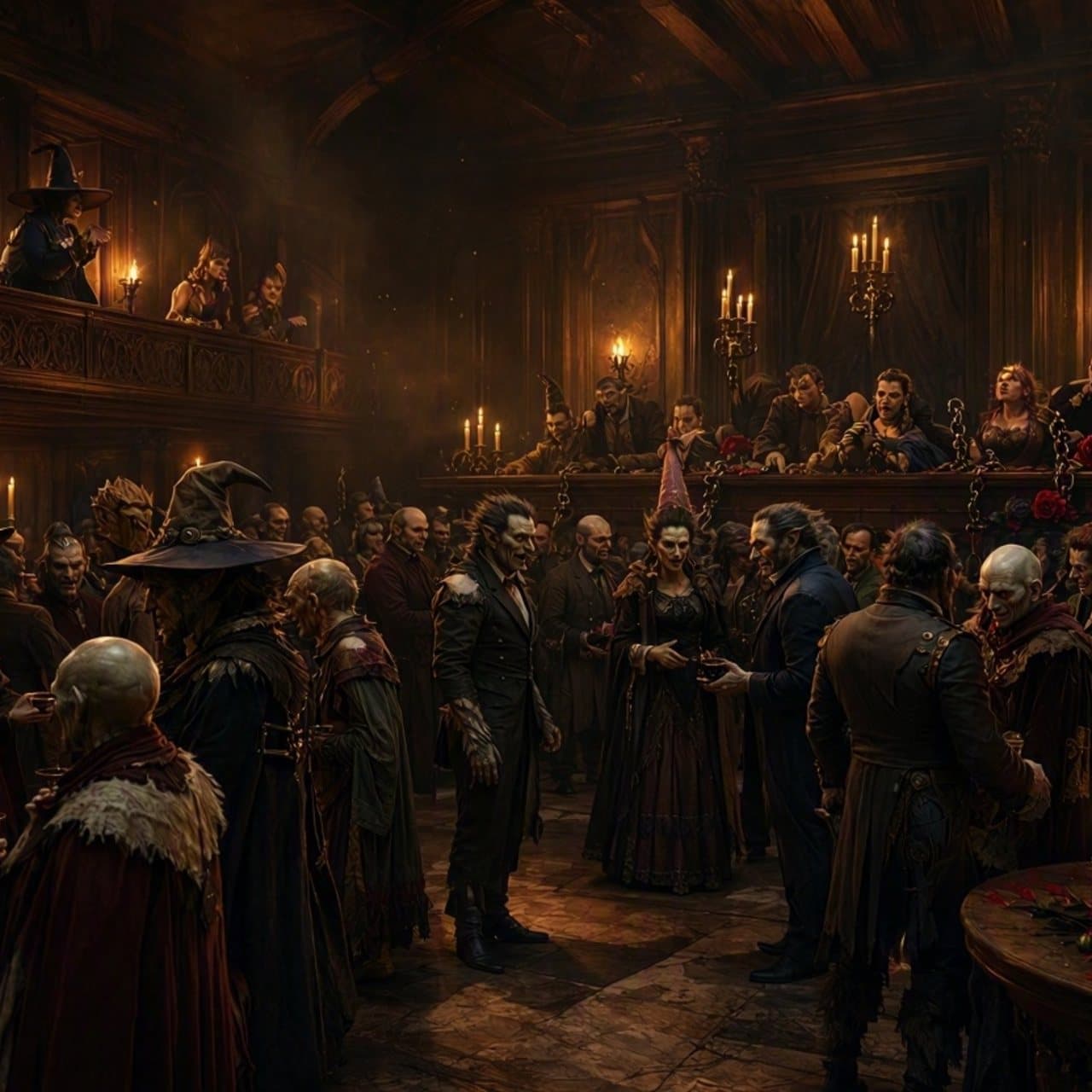
The ballroom sprawled beneath a ceiling of black stone and chandeliers dripping with candles that burned an unnatural shade of violet, throwing long dancing shadows across a crowd unlike any Sadie had ever gathered the nerve to look at for too long. Witches in tattered finery laughed in circles that spun the wrong direction. Something with too many joints in its limbs bowed low over a woman's offered hand. Near the far wall, chained in silver-threaded rope to an ornate iron rack dressed up like a buffet table, a dozen humans stood dazed and glassy-eyed among trays of fruit and wine, presented like the evening's main course, because they were.
And past them all, curled at the foot of a dais draped in black roses, three heads lifted in unison to track Sadie's arrival, six burning eyes fixing on her with lazy, ancient interest, while a triple set of jaws parted just enough to show teeth the length of kitchen knives.
Sadie's mother squeezed her hand once, warm and human-seeming and entirely a lie, and smiled.
"Welcome back," she said, "to the Ball."
Sadie made herself walk instead of freeze, which was harder than it sounded, given that one of the three heads had just yawned in her direction and the yawn had lasted considerably longer than a yawn had any business lasting.
"Don't stare at the dog," her mother murmured, steering her by the elbow toward the refreshment table that was not, strictly, a refreshment table for people like them. "He knows he's the centerpiece. Feeding his ego just makes him beg for scraps later."
"Does he actually beg?"
"Sits, too. It's very undignified for something with three heads." Her mother plucked a wine glass from a passing tray held aloft by a ghoul in a very good tuxedo, the kind of tuxedo that made Sadie wonder exactly how long that ghoul had been dead and whether the suit had died with him. "Smile, sweetheart. You look like you've seen a monster."
"I've seen several."
"Well, stop counting. It's rude."
They drifted past a knot of witches whose laughter spiraled up into something with too many extra notes in it, like a chord played by someone with six more fingers than a person ought to have, and Sadie recognized one of them—Ms. Okafor, who ran the flower shop on Elm and always gave Sadie a free carnation on her birthday, currently deep in conversation with something that might have been a shadow if shadows had opinions and also teeth.
"Sadie! Look how you've grown," Ms. Okafor called, in the exact tone she used at the shop, like nothing whatsoever about this basement ballroom of horrors was unusual, which, for her, it clearly wasn't.
"Hi, Ms. Okafor," Sadie said, and gave a little wave, because apparently that was just what you did.
"She does the flowers for the buffet table too," her mother said under her breath, once they'd passed. "The roses. Very fresh. Fed personally, if you catch my meaning."
"I did not want to catch that meaning."
"Too late. You caught it."
Something skittered along the ceiling overhead on legs that bent the wrong way at the knee, and Sadie decided, firmly, not to look up. A skinwalker in a suit two sizes too sharp was holding court near the dais, mid-transformation between a man and something with antlers, switching faces every few sentences like he couldn't quite commit to a bit. Near the buffet, the chained humans swayed gently to the cello music, eyes glassy, smiles fixed, utterly unaware that they were, tonight, less "guests" and more "hors d'oeuvres," and Sadie made herself look away from that too, because some things even a fifteen-year-old vampire wasn't quite ready to make peace with on an empty stomach.
"You're doing very well," her mother said approvingly, sipping her wine, which Sadie was fairly sure was not, technically, wine. "Last year you nearly threw up on the hors d'oeuvres. Which would have been ironic, since they were—"
"I remember, Mom."
"I'm just saying, growth."
It was near the dais, past a cluster of vampires Sadie recognized dimly as second cousins from her father's side—the kind you saw once a year and never quite remembered the names of, though you always remembered the fangs—that Sadie's gaze snagged on a familiar face across the room and simply stopped working.
It couldn't be.
The girl was wearing a dress that looked like something off the clearance rack at the mall three towns over, cheap black taffeta with a rip already forming at one seam, standing near the punch bowl looking exactly as awkward and out of place as any fifteen-year-old dragged to a formal event by her mother would look. Brown hair pulled back in a messy bun. A phone-shaped bulge suspiciously outlined against the fabric of a small clutch purse, because apparently even at the actual literal Midnight Ball, some things were sacred.
"That can't be Lisa," Sadie said, mostly to herself.
Her mother followed her gaze with polite interest, the way you'd glance at a stranger's dog. "Lisa who?"
"Lisa Marsh. From school. She's in my—she's just a regular girl. She complains about pre-calc. She has a poster of that boy band with the terrible haircuts. She is not—that is not—"
But it was. Because the girl looked up right then, scanning the crowd with the exact bored, faintly nauseated expression she wore during fire drills, and her eyes landed on Sadie, and for one whole second the two of them just stared at each other across a room full of monsters, two ordinary suburban teenagers having profoundly ordinary identical thoughts, which were, roughly: oh no.
Then Lisa's eyes went gold.
Not gradually. Not like a filter warming up. All at once, the warm brown Sadie had spent three years of algebra staring at during boring lectures simply lit up like two struck matches, and her jaw—her whole face, actually—did something Sadie's brain immediately filed under Things I Cannot Unsee, a kind of ripple, bones shifting under skin like something underneath was trying on a new shape for size. Fur, dark and coarse, bristled along her jaw and down the back of her hands where they gripped the punch bowl, claws extending with the kind of casualness most people reserved for cracking their knuckles.
"Oh, thank God," Lisa said, in a voice that dropped half an octave and gained a growl at the edges, "I thought I was the only one."
"You're a werewolf," Sadie hissed, crossing the room fast enough that a passing incubus had to sidestep her.
"You're a vampire." Lisa said it like an accusation, though her claws were already retracting, her jaw sliding back into its regular, punchably normal shape. "You've literally sat next to me in homeroom for a year and a half. You could've said something."
"You could've said something!"
"I didn't want to be that girl." Lisa gestured vaguely at herself, at the ripped taffeta, at the punch bowl, at the entire horrifying tableau of the Ball around them. "The one who's, like, obsessed with being a werewolf. There's a whole clique of them at the Ball every year and they're insufferable, I swear, they only talk about full moons and hiking—"
"Lisa. We go to the same school. Who else—" Sadie's stomach did something complicated. "Who else at school is—"
"Oh, don't even start. Do you know how many of the cheer squad turn furry once a month? It's a lot. Coach knows. Coach is also—" Lisa waved a clawed finger vaguely, indicating something too large to explain in one sentence.
Before Sadie could ask the four hundred follow-up questions currently lining up behind her teeth, a horn sounded from somewhere above the dais—kind of sound that vibrated in your molars—and the three-headed dog at the foot of the roses rose up all at once on legs like tree trunks, all three heads swiveling toward the low, brassy, the crowd, and let out a growl that rattled the chandeliers and silenced the cellos mid-note.
"Guests," boomed a voice from the dais, rich and delighted, "the Feast is served."
The room exhaled.
That was the only way Sadie could describe it—one long collective breath, a hundred monstrous shoulders dropping in relief, as if the whole Ball had been holding its polite, formal posture purely for the sake of small talk and was thrilled to finally get down to business. The witches abandoned their conversation about someone's disastrous garden gnome curse mid-sentence. The skinwalker near the dais settled, at last, on the antlered face, apparently deciding that horns were the appropriate accessory for dinner. Even the cellist set down her bow with the brisk satisfaction of someone clocking out early.
And the crowd began to drift, unhurried, gracious, toward the roses.
"Oh, lovely, they're doing the string quartet arrangement this year," Sadie's mother said, tucking her arm through Sadie's and steering her forward with the gentle, unstoppable momentum of a woman who had attended forty-some of these and intended to enjoy every one. "Your father will be so sorry he missed it. Come on, sweetheart, best to get a good spot before the Okonkwo-Reyes clan cleans out all the ones with any spice to them."
"Spice," Sadie repeated, throat doing something unpleasant.
"Seasoned. Marinated in fear for at least a week, it makes such a difference, you can really taste the difference between someone who's been mildly stressed about a car payment and someone who's been properly, existentially terrified." Her mother said this the way other mothers discussed which brand of pasta held sauce best. "Don't slouch. You'll want to look interested even if you're not hungry yet, it's simply good manners."
The chained humans swayed on their tethers, gauzy-eyed, smiling the soft unfocused smiles of people dreaming a dream someone else was having for them. A ghoul in the excellent tuxedo was already circling one—a heavyset man in a golf polo, blissfully unaware that his retirement plans had just become extremely short-term—sniffing delicately near his collar the way a sommelier might swirl a glass. Nearby, a witch was feeding little bites of something dark and glistening to two more, cooing at them like they were prize poodles at a ribbon ceremony. And through it all wound six spidery legs on the ceiling, some ghoulish thing pausing directly overhead to watch the proceedings with an expression Sadie chose, again, not to examine.
"I don't feel hungry," Sadie said, which was true, and also the least of her problems.
"You never do until you start," her mother said breezily. "It's like the ocean. Nobody wants to get in, and then—"
"Mom."
"I'm just saying, dip a toe."
Beside her, Lisa had gone very quiet, standing close enough that her shoulder pressed Sadie's, a small furnace of tension in an itchy taffeta dress. Up close, Sadie could see the faint tremor in her jaw, the way her golden eyes kept sliding sideways toward the roses and then away again, fast, like she was trying not to look at roadkill on the highway and failing every third second.
"You okay?" Sadie murmured.
"Fine," Lisa said, in the exact tone she used when she was absolutely, catastrophically not fine, the same tone she'd used the time she broke her wrist in gym class and insisted on finishing the volleyball unit. "Werewolves don't really—we're not big on this part. We prefer things that run first. Makes it sporting." A beat. "This is not sporting. This is just—" She gestured at the swaying, glassy-eyed buffet with a mixture of horror and forced nonchalance. "—brunch."
"You come every year?"
"My mom makes me. Says it's networking." Lisa's claws had crept back out, just slightly, just at the tips, and she was gripping her little clutch purse hard enough that the fabric was starting to give. "I usually just, you know. Graze. Eat a canapé. Pretend to have a big appetite for something small and try to make it to the coat check before anyone notices I skipped the main event."
"That's it," Sadie whispered. "That's the plan. We're doing that plan."
But her mother had other ideas, because her mother was already gesturing them both toward the roses with the pleased, expectant look of a woman introducing her daughter at a debutante ball rather than, technically, a slaughter.
"Go on, then," she said, nudging Sadie's elbow. "Pick one. First-timers usually go for something easy—the man in the golf shirt looks tender, or there's a lovely young jogger near the end, very fit, probably low cholesterol—"
"Mom, I don't want to pick one."
The words came out louder than Sadie meant them to. They landed in the sudden lull between the string quartet's movements, in that particular hush a room gets when several centuries-old monsters have just heard something extremely interesting, and every head within twenty feet turned toward her—vampire, witch, ghoul, and one very startled skinwalker whose antlers actually drooped a little in surprise.
"Darling," her mother said, in the bright, brittle voice of a woman doing damage control, "she's joking. Fifteen-year-olds, you know how they are, so dramatic—"
"I'm not hungry," Sadie said again, quieter this time but no less final, and felt the words drop into the room like a stone into a very deep, very dark well.
Somewhere to her left, a witch tittered. Somewhere behind her, someone murmured how rude in a tone that suggested Sadie had just declined a perfectly nice casserole at a potluck rather than committed some enormous supernatural faux pas. And at the foot of the rose display, all three heads of the hellhound lifted at once, ears swiveling, nostrils flaring, a low interested rumble building in its collective chest like a very large, very patient dog that had just noticed someone hadn't finished their dinner and found that fascinating.
"Sadie." Her mother's smile had not moved, but her grip on Sadie's arm had tightened to something with actual pressure behind it. "This isn't the place—"
"Sadie?"
The voice was small. Human. Cracked at the edges like something breaking through ice, and it came from the roses, from the chained line of glassy-eyed guests swaying gently to music none of them could really hear anymore—except one, apparently, because the golf-shirt man's soft dreaming smile had suddenly gone rigid, his eyes clearing, focusing, fixing on Sadie with a horror that had absolutely nothing dreamlike about it at all.
"Sadie Ashford," he said, "is that you? Oh God, oh God, you're in my daughter's carpool—"
Time did a strange stuttering thing, like a record skipping. Sadie felt the whole room tilt sideways into a place where "Mr. Marsh from the Wednesday carpool" and "chained golf-shirt appetizer number six" were somehow the same person, and her brain simply refused the math for a solid three seconds.
Then Lisa made a sound.
It wasn't a scream. It was smaller than that, and worse—a strangled, breathless little no that came out sounding like something tearing. Sadie had heard Lisa laugh so hard she'd fallen off a bleacher. She had never heard her make a noise like this.
"Dad?" Lisa's voice cracked straight down the middle. "Dad?"
"Lisa, honey, is that—what are you wearing—" Mr. Marsh's eyes were doing something awful, clearing and fogging and clearing again, like a windshield in a fight with its own defroster. "Where's your mother? We were supposed to—we had that thing, the parent-teacher, I had it on the calendar, I never miss the calendar—"
"Oh, for heaven's sake," said a witch nearby, sounding personally inconvenienced, the way someone might sound if their Uber driver started reciting poetry. "Is he lucid? Whose enchantment was that, because it is not holding."
"Mine," said another witch, with the aggrieved dignity of a woman defending a soufflé. "He's been lucid-adjacent all night, it's not my fault, he's got a very stubborn brainstem, some of them do—"
"Well, fix it, Deborah, this is embarrassing—"
Sadie's mother had gone very, very still beside her, which in Sadie's experience was worse than her mother getting loud. Her fingers found Sadie's elbow again, this time with the specific pressure of a woman recalculating a social disaster in real time and hating every number she was getting.
"Sadie," she said, low and pleasant and utterly without warmth, "step back from the display, sweetheart."
"That's Lisa's dad," Sadie hissed back.
"I'm aware."
"You're aware—"
"I am extremely aware, and I would like you to step back from the display before—"
"Carpool," Mr. Marsh said again, gaining traction now, his voice climbing toward something that was going to be a shout if nobody stopped it, chains rattling faintly as he strained forward. "Tuesdays and Thursdays, I drive, Linda does Mondays, we split it because of her shift, Sadie you're always so quiet in the back seat, you never say much, I thought maybe you didn't like the radio station, I switched it to the one with less talking, did that help, was that—Lisa, sweetheart, what is happening, why does everyone have teeth—"
"Oh, now he's chatty," muttered a ghoul, sounding genuinely put out, like a man whose dinner had started giving a TED talk. "This is exactly why I don't like the marinated ones. Too much personality left in them. Give me a nice tranquilized jogger any day, they don't editorialize."
Somewhere overhead, six spider legs shifted, and something with too many eyes made a small clicking sound that might have been laughter or might have been a threat assessment. Sadie didn't look up to find out which.
Lisa had gone rigid beside her, claws fully out now, breath coming in short furious pulls through her nose, and Sadie recognized the particular vibrating stillness of someone about three seconds from doing something extremely unwise in front of several centuries of apex predators.
"Lisa," Sadie whispered, grabbing her wrist. "Lisa, don't—everyone's looking—"
"That's my dad, Sadie, that's my actual—he doesn't even know, we never told him, he thinks Mom and I go to a garden club meeting, he thinks—" Lisa's voice broke again, sharper this time, more animal. "How is he here? How did he even get here, he doesn't know this world exists, someone had to—someone brought him—"
At the foot of the rose display, the three-headed hellhound had gone fully alert, all six ears swiveled forward, three sets of nostrils working the air with the delighted, focused attention of a creature that had just noticed the evening's entertainment had upgraded itself considerably. One head made a low, curious sound almost like a question. Another simply drooled, thoughtfully, onto the marble.
"He is not helping," Sadie's mother said, in the tight, gracious voice she used exclusively for situations she found completely unacceptable, and turned that same gracious smile on the assembled crowd like a woman smoothing over a spilled drink at a dinner party that had briefly threatened to become a crime scene. "Everyone, forgive us, first-timer nerves, you remember how it is—" A ripple of indulgent, unconvinced laughter answered her, the kind reserved for someone clearly, obviously lying. "Deborah, darling, if you wouldn't mind just—resettling him—"
"On it," said the witch, sounding relieved to have a task, raising both hands toward Mr. Marsh with fingers already curling into the shape of something that was going to smooth all of this very inconvenient personhood right back out of him.
"No—wait—" Sadie stepped forward without entirely deciding to, some instinct older than table manners kicking in, and found herself between the witch's hands and Lisa's father, which was, in retrospect, possibly the single worst tactical decision of her short vampiric life.
But Mr. Marsh's eyes had found hers again, sharp now, terrified, holding on to lucidity with everything he had, and his voice dropped to something urgent and low and horribly human, chains rattling as he leaned as far forward as his tether allowed.
"Sadie—Sadie, listen to me, I don't have much time, I can feel it slipping again—someone knew. Whoever took me, whoever brought me here—they said Lisa's name. They knew what she was before I did. They said—" His eyes flicked, wild, toward his daughter, and something like grief cracked through the terror on his face. "They said they already had her mother."
The witch's hands closed the last inch of distance, and Mr. Marsh's eyes went soft and dreaming and empty all over again, mid-sentence, like a light switching off.
Behind Sadie, Lisa made a sound that wasn't human and wasn't quite wolf either, and the whole glittering, monstrous room went very, very quiet.
Lisa's eyes went first—amber bleeding through brown like a stain spreading under water, gold and lit-from-within and utterly wrong in a face Sadie had watched roll its eyes through three years of pre-algebra. Then her knuckles, cracking outward, elongating, dark fur pushing up through skin in patches like something growing in fast-forward. The taffeta of her dress—pale blue, a little too matchy with the tablecloths, the kind of thing a mother picks out for a "special occasion"—strained across her shoulders and gave up with a long, ripping shhhhk that somehow managed to sound both terrifying and deeply embarrassing.
"Oh, this is marvelous," breathed the witch called Deborah, clasping her hands like she'd just been handed a second dessert. "Genuine, unscripted, first-transformation nerves—when's the last time we got one of these at a Ball, Carol?"
"Not since the Whitfield boy," someone answered, delighted, and somewhere behind them a ghoul was already taking bets in a low, businesslike murmur, and someone else applauded, actual polite applause, like Lisa were a magician's assistant who'd just been sawed successfully in half.
Lisa didn't seem to notice any of it. She'd gotten one clawed hand around her father's chain and was hauling at it with the single-minded fury of an animal that had stopped being able to distinguish between rescue and rip apart whatever is in the way, fur sprouting along her forearm in uneven, panicked clumps, one strap of the ruined dress sliding off a shoulder that was no longer entirely shoulder-shaped.
"Lisa." Sadie grabbed for her wrist and got shrugged off so hard she nearly went down. "Lisa, you're going to break his arm, not the chain—"
At the base of the rose display, the three-headed hellhound uncurled itself, unhurried, and ambled directly into the gap between the girls and the nearest set of doors, three sets of eyes tracking them with the calm, professional attention of a bouncer who'd seen this exact scene start a hundred parties and knew precisely how it ended. One head yawned, showing a truly unreasonable number of teeth. Nobody clapped for that, which felt, to Sadie, deeply unfair.
Okay. Okay. Not the doors, then. Not with three heads and God-knew-how-many tons of muscle in the way. Which meant this had to be done the boring way—the polite way, the my-mother-would-be-so-disappointed-in-me way—because the one thing Sadie was absolutely certain of was that snarling at a room full of things older than the concept of dentistry was not going to end with anyone walking out alive.
"Everyone," Sadie said, and was startled by how loud her own voice came out, "I would like to speak to whoever is running this."
The laughter didn't stop so much as reorganize itself, curious now instead of delighted, and the crowd parted—actually parted, like a curtain—for a man who had clearly been enjoying the show from somewhere close the whole time. He was tall in the particular way that made tailoring look like a moral achievement, silver at the temples, a smile that had probably been charming senators to their deaths since before senators existed.
"Mr. Voss," Sadie's mother said faintly, behind her, in a tone Sadie had never heard her use before, which was somehow more alarming than anything else that had happened all night.
"Warden," someone else murmured, with a small, respectful bow that several other guests echoed.
"Sadie, isn't it," Voss said, pleasant as a maître d'. "Your mother's told me so much. First Ball. How exciting for you." His eyes flicked, briefly, appreciatively, to Lisa—half-transformed, snarling, dress in ribbons, one clawed hand still locked around her father's chain—the way a man might admire a particularly aggressive centerpiece. "And this must be the werewolf. Delightful. We so rarely get variety."
"He's her father," Sadie said. "Mr. Marsh. He drives us to school on Tuesdays and Thursdays."
"Yes, I gathered, there was quite a bit of shouting about carpools earlier." Voss's smile didn't move. "Very domestic. Very sweet."
"Then you know the rule."
Something in the room's temperature dropped, a ripple of attention going taut all the way to the chandeliers. Even the hellhound's heads swiveled, interested now, like dogs hearing a specific word they recognized.
"The Doorstep Accord," Sadie said, pushing every ounce of her mother's dinner-party voice into it, chin up, heart absolutely hammering. "Humans who interact daily with our kind in the human world—neighbors, coworkers, carpools—aren't to be harmed, endangered, taken, or served. That's not a house rule. That's not something I made up on the spot because I panicked. That's the rule. The old one. The one that keeps the whole world from finding out about us in the first place."
"She's not wrong," someone murmured, somewhere in the crowd, sounding almost proud, and Sadie could have kissed that stranger.
Voss tilted his head, unbothered, the way you'd look at a child who'd made a decent point in an argument you'd already won weeks ago. "The Accord protects those who interact with us, my dear. Mr. Marsh interacts with your family. Charming as that is, it's hardly the Ball's obligation to extend courtesy to every human who's ever shared a car radio with a vampire. Otherwise we'd never eat anyone. Half this city carpools with something."
"He knows Lisa," Sadie said. "He's known her literally her whole life. That's not some stranger you scraped off a jogging trail. That's an established relationship—"
"An established relationship she concealed from him," Voss said smoothly, gesturing at Lisa with two fingers, almost lazy. "Which one could argue voids the spirit of the arrangement rather elegantly. He didn't know what she was. Ignorance rather undoes the protection, don't you think? The Accord protects informed proximity. Otherwise it's not a relationship, it's a coincidence with a car."
Lisa's snarl deepened at that, a sound that made two nearby ghouls take an appreciative step backward, and behind the gold eyes and the fur Sadie could see something that was still entirely, furiously Lisa. "He's my father," Lisa managed, the words coming out thick and wrong around teeth that weren't built for consonants anymore, but landing anyway.
"He's decoration," Voss said, without malice, which was somehow worse than if there'd been any. "Delicious, well-preserved decoration who happened to raise something interesting."
"And her mother?" Sadie said. "Where's her mother?"
The pause that followed was small, surgical, and told Sadie everything before Voss even opened his mouth to answer it, his smile sharpening at the edges like something catching light.
"Safe," he said. "For now. Held somewhere considerably more comfortable than a rose display, I promise you." He spread his hands, gracious, as though offering a gift. "Here is what I'll do, since you've clearly got your mother's spine and I do so hate a scene. Walk away, Sadie. Take your little transforming friend, take her father, I'll even throw in a car service—and we forget this evening's unpleasantness entirely happened. Or." His smile widened by exactly one degree. "You keep invoking accords at me in front of my own guests, and we find out together whether the Ball's doors lock from the inside."
Behind him, with a soft, deliberate click that seemed to echo far too long in the sudden silence, they did.
Three heads turned as one, unhurried, toward Sadie—and then, after a long, considering moment, the hellhound sat.
Directly between Sadie and the Warden.
Not lunged. Not snarled. Sat, three heads settling into a neat, considering row, the way a judge might arrange three sets of notes before delivering a verdict nobody had asked for.
Voss's smile flickered—just once, just barely, but Sadie caught it, and something about that flicker made her chest unclench half an inch. He hadn't expected that either.
"Cerberus," Voss said, pleasant, patient, the tone of a man addressing a large and expensive houseplant that had suddenly developed opinions. "Move."
The middle head yawned instead, showing every one of its teeth, and did not move.
"He knows the rule too," Sadie said, and she had no idea if that was true, but she said it like it was, the way her mother said because I said so like it was a documented law of physics. "Older than you, probably. Older than this house. Maybe he doesn't love being told to eat someone's carpool."
"He is a dog," Voss said, with the particular condescension of someone who has just realized, in real time, that he might be wrong. "He does not love anything. He follows instructions."
"Then whose instructions is he following right now?" Sadie's mother said, stepping up beside her daughter with the unhurried grace of a woman arriving fashionably late to her own emergency. She'd gone very still and very cold in the way Sadie recognized from exactly two prior occasions—the time a door-to-door vacuum salesman had refused to leave the porch, and the time Sadie's father suggested inviting his mother for the whole month of December. "Because it isn't yours, clearly."
A ripple went through the watching crowd—witches looking at each other, a ghoul actually setting down its little plate of something Sadie chose not to look at, the general electric hush of a room realizing the entertainment had turned into an actual disagreement.
"The Accord doesn't ask the hound's permission, Warden," Sadie's mother continued, voice carrying, pitched for the whole ballroom now, not just for Voss. "It doesn't ask yours, either. It's not a party favor you hand out when you're feeling generous. It predates you. It predates this house. And it exists specifically so that nights like this one don't end with our entire world exposed because some Warden couldn't be bothered to check whether tonight's smorgasbord had a carpool schedule."
"She concealed her nature," Voss said again, sharper now, some of the polish coming off the word. "That's not my failing to check. That's hers."
"No," said a voice from the crowd—Deborah, the witch, arms crossed, looking less delighted now and considerably more like someone doing long division in her head. "That's not how the Accord reads, Reginald. I helped draft the last revision. It protects the relationship, not the paperwork behind it. Doesn't matter if the wolf told her father what she was. Matters that they know each other. Every day. Ordinary life. That's the whole point of the thing—so ordinary life stays ordinary." She looked, with evident distaste, toward the chained humans still swaying gauzy-eyed on their tethers. "You didn't just serve a stranger tonight, Warden. You served somebody's father. That's a violation, plain as anything, and every one of us standing here just watched you do it."
The room's temperature, already cold in the way rooms full of the dead tend to be, dropped further—and this time it wasn't Voss's doing.
"He's my father," Lisa said again, and this time the words came out clearer, less garbled by teeth that had stopped fighting her—because somewhere in the last minute, mid-crisis, mid-public-trial, Lisa had found the eye of her own storm. The fur along her arms had settled into something more controlled, more deliberate, claws retracted just enough to let her keep a careful, human-gentle grip on her father's wrist instead of his chain. Her eyes were still gold, her jaw still wrong in the candlelight, but she'd stopped snarling and started thinking, which Sadie suspected was infinitely more dangerous.
"Please," Mr. Marsh said—hoarse, terrified, swaying on legs that clearly hadn't fully caught up to whatever spell Voss had wrapped him in, but saying it, looking straight at the crowd instead of at the floor. "I don't—I don't understand any of this. I don't know what you people are. But that's my daughter. That's my little girl who I taught to ride a bike in the Kroger parking lot because our driveway's too short. I drive her and Sadie to school Tuesdays and Thursdays. We do carpool. We complain about gas prices. That's—" His voice cracked, but he pushed through it, chin up, the bravest thing Sadie had ever watched an enchanted human do. "That's a relationship. However you people define it. That has to count for something."
The silence that followed had weight to it, the specific silence of a jury deliberating in real time.
"He's very convincing for hors d'oeuvres," murmured a skinwalker near the back, and it wasn't unkind.
"Where's her mother?" Sadie said again, louder this time, turning the question back on Voss before the room's sympathy could cool. "You said safe. You didn't say where. If this is all so above-board, Warden, show us."
Voss's jaw tightened—just barely, just enough—and Sadie understood, with a small thrill of vindication, that she'd found the loose thread.
"Behind the dais," Deborah said helpfully, not looking at Voss at all. "Where else does anyone hide anything at these things. It's practically tradition."
The crowd turned as one, and Voss, visibly calculating the math of fight the room versus lose the room, gave a thin, tight smile and gestured, magnanimous, toward the heavy velvet drape behind the rose display—as if he'd simply been waiting for the correct moment to reveal his generosity all along.
Behind it was a room that had absolutely no business existing behind a curtain: gilt mirrors, a chaise lounge upholstered in what Sadie desperately hoped was velvet and not something worse, a chandelier entirely too large for the space, and Linda Marsh, seated primly in the middle of it all like a woman waiting for a very late dinner reservation, ankles crossed, wrists bound in silk ribbon rather than chain—unharmed, furious, and, Sadie noted with real respect, still wearing lipstick.
"Oh, thank God," Linda said, spotting her husband, and then, spotting her daughter's ears, added without missing a beat, "Lisa, honey, your face."
"Mom—"
"We'll talk about it in the car."
The hellhound stood.
All three heads turned toward the ballroom's enormous double doors, and with the unhurried authority of something that had clearly done this before, planted one enormous paw against them—and the click Sadie had heard earlier reversed itself, the lock disengaging with a soft, resigned little sigh, as though the doors themselves had been waiting for someone to finally make a decision.
Voss looked at his hellhound with the wounded betrayal of a man watching his own dog choose a stranger's lap over his.
"You too?" he said.
The middle head yawned again.
"The Accord existed before your appointment, Warden," Sadie's mother said, taking Sadie's hand, then Lisa's, gathering the room's attention back to herself with the sheer gravity of disappointed mother energy, "and it will exist after it. I'd start thinking very seriously about how you're going to explain tonight's guest list to whoever appointed you to that chair. Because I promise you, several people in this room already intend to mention it."
"Several," Deborah agreed cheerfully, and beside her, several witches nodded, and one ghoul, apparently done with the whole affair, actually applauded again—though this time, Sadie was fairly sure it was aimed at them.
They didn't run. Sadie's mother didn't allow running, ballroom crisis or not, and so they left the way they'd arrived—unhurried, chins level, Linda Marsh's ribbons trailing like she'd simply won a very strange raffle, Mr. Marsh leaning heavily on his daughter's still-not-entirely-human shoulder, Lisa's claws gentle at his elbow, guiding him past a smorgasbord of the merely curious and the visibly disappointed—out through the doors the hellhound had personally, deliberately, unlocked.
Behind them, Voss's voice rose, bright and brittle, already spinning the story into something he could survive: "Well! Quite the eventful evening, everyone, shall we move on to the dancing—"
Nobody clapped for that either.
Mr. Marsh remembered it, in the end, as a bad night at a work function that had gotten out of hand—strange lights, a headache, something about a car service, vague and slippery in the way of dreams you can feel more than recall. He woke up the next morning on his own couch with a crick in his neck and a story he told at the next neighborhood barbecue about "some kind of food poisoning situation, honestly, don't even ask," and everyone nodded sympathetically and passed the potato salad.
Linda remembered everything, because ribbon, it turned out, doesn't come with the same enchantment as chains, and she'd used every long, furious minute of her captivity composing what she planned to say to Reginald Voss the next time she caught him at the grocery store, which—she assured Sadie's mother over decaf the following Tuesday—she absolutely would, because their kind ran into each other eventually, that was simply how neighborhoods worked, supernatural or otherwise.
Lisa and Sadie walked to the bus stop together the following Monday same as always, backpacks, one earbud each, the same argument about whether the cafeteria pizza counted as a food group. Except now, when Lisa complained about the full moon messing with her sleep schedule, Sadie didn't have to pretend she didn't understand exactly what that meant, and when Sadie mentioned—carefully, testing the water—that she'd skipped breakfast on purpose because a substitute teacher had a nosebleed in third period, Lisa just said "gross" and kept walking, which, honestly, was the nicest anyone had ever responded to that particular sentence.
"My mom wants to have your mom over for coffee," Lisa said, at the corner.
"Mine wants to have your mom over for coffee," Sadie said. "She said, and I quote, 'anyone who survives a night in Reginald Voss's dais closet and still remembers to reapply her lipstick deserves a decent cup of coffee.'"
"That does sound like her." Lisa considered this. "Does your mom know my mom knows about, um—everyone?"
"I think that's the whole point of the coffee."
At home that evening, Sadie's father asked, over a pizza that nobody in the family particularly needed to eat but ordered anyway because eleven-year-olds notice things like why does nobody in this house ever order pizza, how the Ball had gone.
"Fine," Sadie said, around a bite she was mostly chewing for show. "Lisa's a werewolf."
Her brother, halfway through unwrapping a breadstick, did not even look up. "Cool. Can she come over."
"Maybe not during a full moon."
"That's fair," he said, and went back to the breadstick, and that, apparently, was the entirety of the household's reaction to their daughter's best friend turning out to be a different apex predator entirely.
Later, much later, long after the pizza box had been folded into the recycling and the porch light clicked off and the ordinary street had gone properly, boringly quiet, Sadie stood at her bedroom window and looked out at the dark, at the shapes the streetlights didn't quite reach, and thought about a locked door that had opened anyway, and a three-headed dog that had chosen, for reasons of its own, to sit exactly where it needed to.
Somewhere out past the edge of the cul-de-sac, where the streetlight gave up and the shadows started, something with too many eyes blinked once, slow, and did not look away.
Sadie closed the curtain, climbed into bed, and set her alarm for carpool.