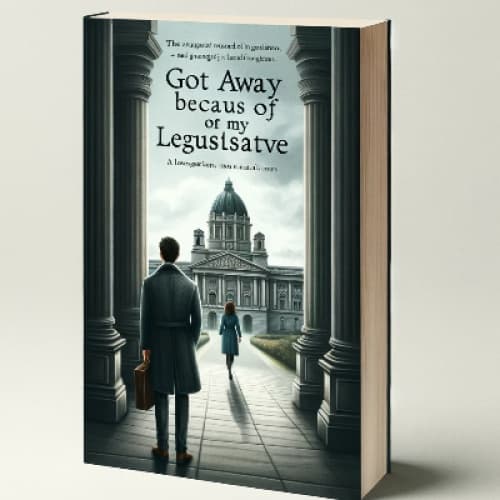
I stood in the hallway of the legislature, the weight of my decision pressing heavily on my chest. The walls around me were lined with portraits of the lawmakers who had come before me—men and women who had built careers out of defending principles and making choices for the good of society. But at that moment, I wasn’t thinking about laws or policies. I was thinking about her.
Her name was Isabella, and from the moment we met, I knew she was different. She had a spark, a confidence that drew me in like nothing else. Her laughter was infectious, and her passion for life left me breathless. I had never met someone who challenged me so much, who made me question every decision I thought was final. She wasn’t just the love of my life—she was my equal in every sense of the word.
But in a world as unforgiving as politics, love can be an elusive thing.
We met years before my ascent into the legislature, back when life was simpler. I was just a fresh-faced idealist, eager to make a difference in the world, and she was already making waves as a fearless advocate for the people. We were drawn to each other immediately, spending late nights talking about the changes we wanted to see in the world. Our conversations flowed from heated debates on policy to tender moments of shared vulnerability.
But as my political career advanced, things changed. The demands of the job grew, and soon, the rules and regulations that I swore to uphold began to take precedence over everything else. The more responsibility I took on, the more distant I became.
I could still remember the night it all fell apart. We had planned a quiet evening together—something rare amid the endless meetings and legislative sessions. But as we sat down for dinner, my phone buzzed with a message from my office.
"Emergency session," it read.
I sighed, knowing exactly what was coming next. I looked up to meet her eyes, the disappointment already there before I could say a word.
"Not again," she whispered, her voice barely audible but filled with hurt.
"I’m sorry, Isabella. You know how it is... I can’t just leave them hanging."
She put her fork down, her movements slow and deliberate. "I know. I know it’s important, but so are we. When did we stop being important?"
I didn’t have an answer for her, and in that silence, everything we had built began to crumble. The weight of my responsibilities as a lawmaker—the very thing that had once drawn us together—was now the wedge driving us apart.
That night, I left for the session. I thought it would be just another evening of debates and compromises, that we’d talk it through when I got back. But by the time I returned, she was gone.
She didn’t leave a note, didn’t say goodbye. She just… vanished. And as I stood in our now empty apartment, the realization hit me like a ton of bricks: I had lost her.
Not because we stopped loving each other, but because I had let the system—the endless cycles of duty and obligation—pull me away. I had let my role as a legislator become more important than the love of my life.
It’s been months since then, and every day I wonder if I could have done things differently. I see her sometimes—on television, at community events, speaking passionately about the issues we once fought for together. But she’s no longer mine to hold. I lost her to my own ambition.
As I sit here in the legislature, surrounded by the laws I’ve helped shape, I wonder about the laws I broke in my heart. The law of love, the law of commitment. The one thing that mattered most, I let slip through my fingers.
And now, she’s gone.
Days turned into weeks, and weeks into months. Each morning, I woke up to the same cold, empty apartment, the same routine that used to feel purposeful but now felt hollow. My legislative work went on as usual, though nothing was usual anymore. Bills passed, motions debated, meetings held—but my mind was always elsewhere. It was always with her.
Isabella’s absence was an echo that filled every corner of my life. The sound of her laughter, the touch of her hand, the way she’d challenge me—like no one else ever could. Every room I walked into seemed quieter, every conversation felt emptier. No amount of political success could fill the void she left behind.
My colleagues noticed the change. They asked if everything was alright, if the pressure was getting to me, but I brushed it off with the same practiced smile I gave at press conferences. What could I say? That my heart was broken because I had chosen my career over the one person who truly mattered? In politics, vulnerability is weakness, and I had already shown enough of that by letting her walk away.
Still, I couldn’t help but keep tabs on her. Her face would pop up on the news, speaking with passion about the issues that once united us—housing, equality, the rights of the marginalized. She looked as vibrant as ever, her eyes still full of the fire that first drew me in. But there was something different, too. She seemed freer, as if my absence had given her wings. The sight of her, flourishing without me, was bittersweet.
Then one evening, I found myself scrolling through old photos of us. There was one in particular—a candid shot of her laughing, taken during a weekend getaway in the countryside. Her hair was tousled by the wind, her eyes sparkling in the sunlight. We were happy then, so utterly lost in each other, unaware of how fragile everything truly was.
I couldn’t shake the thought: What if I hadn’t gone that night? What if I had chosen her over the emergency session, over the constant demands of the legislature? Would she still be here with me?
The weight of regret was suffocating, and for the first time in months, I realized I needed to do something about it. I couldn’t change the past, but maybe, just maybe, I could find a way back to her.
The Meeting
Weeks passed before I worked up the courage to see her. I learned through mutual friends that she was organizing a rally for affordable housing, a cause close to her heart—and mine. It seemed like the perfect opportunity to at least talk to her, even if only for a moment. Maybe I could explain myself, try to bridge the chasm I had created between us.
The rally was set in a park downtown, and by the time I arrived, the crowd had gathered, chanting and holding signs. There, at the center of it all, was Isabella. She stood tall, commanding the attention of everyone around her, speaking with the same fire and determination I had always admired. Her voice cut through the noise, full of conviction, as if every word mattered.
I watched from the sidelines, unsure if I should approach. What would I even say? How could I make up for everything I had lost?
When her speech ended, the crowd erupted in applause. She smiled, the same radiant smile that had once been reserved for me. I took a deep breath and made my way toward her. My heart pounded with each step.
She was surrounded by supporters, but eventually, our eyes met. For a moment, time seemed to stop. She blinked, as if unsure whether she was really seeing me there. I stepped closer, and the crowd around her began to thin. Finally, it was just the two of us.
“Isabella,” I started, my voice unsteady. “Can we talk?”
She studied me, her expression unreadable. After what felt like an eternity, she nodded. We walked away from the crowd, finding a quiet spot under the shade of a tree.
“I wasn’t expecting to see you here,” she said, her tone guarded but not hostile.
“I wasn’t sure you’d want to see me,” I admitted. “But I had to come. I’ve been thinking about you… about us. About everything.”
She crossed her arms, waiting for me to continue. I searched for the right words, but none of them felt enough.
“I know I messed up,” I finally said. “I let my job, my ambition, get in the way of what really mattered. Of you. And I hate myself for it.”
Her eyes softened, just a little. “It wasn’t just your ambition,” she said quietly. “We both knew what kind of life you were stepping into when you chose the legislature. But I didn’t expect to come second. Not after everything we shared.”
“I didn’t expect it either,” I replied, my voice breaking. “I thought I could balance it all, but I couldn’t. And I lost you because of it.”
She looked away, her gaze distant. “We were good together,” she said softly. “But we wanted different things. You wanted to change the world, and I loved that about you. But somewhere along the way, you forgot that I was part of your world too.”
Her words cut deep, but they were true. I had pushed her aside in pursuit of something that, in the end, felt empty without her.
“I know,” I whispered. “And I’m sorry. I don’t expect you to forgive me, but I needed you to know that.”
There was a long silence between us. The wind rustled through the trees, carrying the distant sounds of the rally. Finally, she looked back at me, her eyes filled with a mixture of sadness and understanding.
“I’ve moved on,” she said gently, but firmly. “I had to. You’re still the man I fell in love with, but I can’t go back. Not now.”
The finality of her words hit me like a punch to the gut. But I nodded. I had come here knowing that this might be the outcome.
“I understand,” I said, my voice barely above a whisper. “I just… I wanted to tell you that I’ll always care about you. And I’ll always regret losing you.”
She smiled sadly. “I’ll always care about you too. But some things are meant to end, even if they were beautiful while they lasted.”
With that, she turned and walked away, leaving me standing there under the tree, watching as she disappeared into the crowd once again.