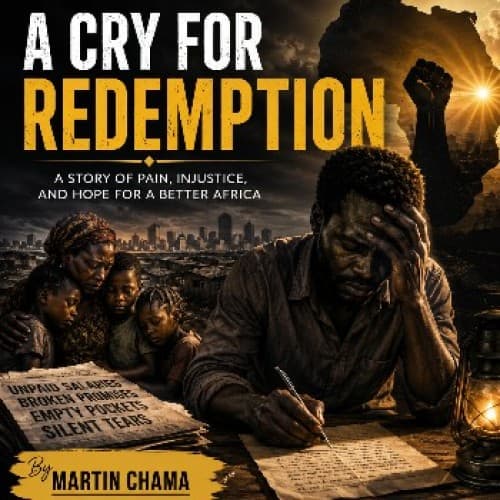

A folded white paper landed on my desk like a bird with a broken wing—silent, fragile, and heavy with foreboding.
I looked up to see Phiri Mutuna, my editor-in-chief, standing before me. His face was tense, carved with worry, and for a moment he said nothing. He simply slid the paper toward me with the careful caution of a man handling something dangerous.
“This contains the last words of a dying man,” he finally said, his voice low and strained. “Craft a story that captures the essence of his struggle. I want it in tomorrow’s paper.”
I unfolded the paper slowly.
The handwriting was hurried and uneven, trembling with emotion. As my eyes moved across the page, the newsroom around me seemed to disappear. In its place rose the voice of a man suspended between despair and hope.
His name was Kelly Walubita.
His story bled through every line.
He wrote of unpaid salaries, of months without income, of debt that clung to his neck like chains. He spoke of waking each morning with a knot in his stomach—not only from hunger, but from the agony of watching his children suffer while he stood helpless before them.
His words carried the weight of a man who had exhausted every ounce of strength and still found himself empty-handed.
“The masters dine in gluttony,” he wrote, “while the servants fight flies over crumbs.”
He described a system so broken it no longer even pretended to care. Across the pages echoed one painful question:
Why must we suffer on a continent of plenty?
Africa, he wrote, was rich in soil, rich in rivers, rich in people—and yet starved of justice.
As I continued reading, I found myself drawn into the painful rhythm of his evenings, a ritual of silent suffering disguised as family life.
Every evening, when he returned home, his children would run toward him with joyful cries.
“Daddy! Daddy! Mum, Dad has come!”
But their innocent excitement only deepened his pain. They did not know their father carried empty pockets, tired shoulders, and a soul crushed beneath the burden of failure.
“You sink deep into the sofa,” he wrote, “while your children search your eyes for hope. That silence—the silence that grips your throat and buries your words—becomes a living thing inside the room.”
Then came the moment he feared most.
All eyes turned toward him.
Waiting.
Hoping.
Trusting.
And he had nothing to offer.
In a whisper meant more for himself than for them, Kelly would say:
“Rise, my seeds. Find your mat and rest.”
The children would walk slowly to their room like little shadows fading into darkness. He described them as “tipsy with the wine of hunger, their eyes wet, their tongues dry, and their bellies empty.”
That night, sleep abandoned him.
He sat watching their tiny chests rise and fall in the darkness. Dried streams of tears stained their cheeks, proof that they had cried themselves to sleep.
“You look at your sleeping children,” he wrote, “and see the dry paths of tears upon their faces. They cried even in their sleep. And I—wept too. Not because I am weak, but because I am human.”
The next morning, Kelly did not wake with renewed strength or determination.
He woke with a decision.
One final act.
One final cry that he hoped the world would hear.
The note ended not with surrender, but with anguish poured heavenward:
“Oh God, who will redeem Africa from these gluttonous leaders? From men who swallow wealth like air while we chew on misery?”
At the bottom of the page was a short handwritten note in different ink.
It was from Phiri.
“The owner of this note, Kelly Walubita, was found dead in his boss’s office. His body was seated in the boss’s chair, the door locked from the inside. Nothing had been disturbed.”
I stared at the paper long after I finished reading.
A heavy lump formed in my throat as the meaning of it all settled upon me. Kelly had chosen not to die at home or in the streets, but in the office of the man who had ignored his suffering.
It was more than a death.
It was a statement.
That night, I worked without rest.
Every paragraph felt like lifting bricks soaked in sorrow, but I kept writing, driven by the urgency in Kelly’s words.
The story appeared on the front page the next morning beneath a headline that seemed to pulse with pain:
THE AGONY OF AFRICA: A CRY FOR REDEMPTION
The reaction was immediate.
Readers were stunned.
The newsroom telephones rang endlessly. Social media erupted with grief, outrage, and debate. Some people wept openly. Others demanded answers. Politicians, as expected, described the tragedy as “regrettable” and “unfortunate.”
But ordinary people—the weary, hungry, forgotten people—recognized Kelly’s voice instantly.
Because it was their voice too.
As I reflected on his final words, I realized this was no longer merely the story of one man. It was the story of countless people across a continent gasping for breath beneath the crushing weight of corruption, greed, and indifference.
Kelly had not simply written his pain.
He had written ours.
The cries of his children echoed far beyond his home. They echoed through crowded markets and dusty villages, through struggling townships and overcrowded cities. From the streets of Lusaka to the alleys of Kibera, from remote villages in Chad to the towering buildings of Johannesburg, his story belonged to millions.
Yet even in the shadow of his death, I saw a flicker of hope.
Stories like Kelly’s must not remain mere memorials.
They must become manifestos.
Declarations that people can no longer accept the unacceptable.
I hope his story reaches not only those who sympathize, but also those who hold power and possess the ability to bring change. I hope it unsettles their conscience the way it unsettles mine. I hope it sparks conversations, reforms, and compassion where silence once lived.
Kelly Walubita may have died unheard in life, but his words will continue to echo long after his voice is gone.
And as long as they echo, the cry for redemption lives on.