
I still remember the dream because it did not fade the way ordinary dreams do. It remained sharp and vivid in my mind, as though it had been placed there deliberately rather than imagined.
In the dream, I was walking alone through a dense forest. Towering trees surrounded me like ancient sentinels, their branches whispering secrets older than time itself. The air felt unnaturally heavy, charged with a presence I could not see but could deeply sense, as though unseen eyes followed my every step.
After a long walk, I came upon a dried-up riverbed. Its cracked earth lay scorched beneath a relentless sun.
“This should have been a mighty river,” I whispered aloud, wondering how something once so powerful could be reduced to lifeless dust.
The moment I stepped into the riverbed, the ground trembled violently.
Without warning, water burst upward around me. The dry river suddenly came alive with terrifying force, roaring like a beast awakened from sleep. Within seconds, I was drowning.
The icy current dragged me beneath the surface. I struggled desperately, gasping for air as panic tightened around my chest. My lungs burned. Darkness closed in.
Then I saw him.
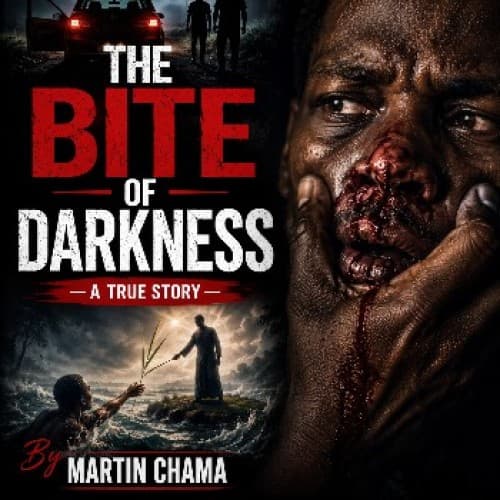
A man stood calmly on a small patch of floating earth above the raging water. In his hand was a single stalk of elephant grass, thin and fragile, swaying gently in the storm.
“Hold it,” he said calmly. “I’ll pull you out.”
“It’s only grass!” I cried. “It will break!”
“It won’t,” he replied. “Trust me.”
There was something in his voice that cut through my terror. I reached out and grasped the stalk.
It held.
With impossible strength, the man pulled me safely from the flood.
I woke suddenly, drenched in sweat, my heart pounding violently against my chest.
For days, the dream haunted me—especially the image of the elephant grass. Something so weak should never have been able to save me. Yet it had.
The dream felt less like imagination and more like a warning.
Two months later, I understood why.
My cousin Puki called and asked me to film his son’s birthday party.
We had not been close for many years. Our family had once been torn apart after Puki was accused of using witchcraft to kill my older brother. Though time had eventually forced reconciliation, trust between us never fully healed.
Later, Puki’s wife visited my studio personally and insisted that I attend the party myself. I tried to decline, claiming I had work to finish, but she would not take no for an answer.
Eventually, I agreed.
The party itself was joyful and ordinary. Children laughed freely. Music filled the air. Families talked and celebrated together. For a few brief hours, it almost felt as though old wounds had finally disappeared.
But as evening approached, something shifted.
I noticed Puki standing beneath a tree with his brother-in-law, Bocha. The two men spoke in hushed voices while repeatedly glancing in my direction.
An uneasy feeling settled inside me.
Eventually, the guests left the school grounds where the celebration had been held. Only the three of us remained.
Puki asked me to wait.
At exactly 8:00 p.m., we entered the car to leave. I sat in the back seat. Bocha joined me there, sitting strangely close despite the empty front seat.
The gate slowly opened.
Then he leaned toward me and whispered:
“I’ll bite you.”
I laughed nervously, thinking it was some kind of joke.
“What?”
Suddenly, he lunged.
The pain was immediate and horrifying.
His teeth sank into my face, tearing flesh and cartilage from the columella between my nostrils. Blood poured down instantly, blurring my vision. I tried to scream, but shock stole my voice.
I turned toward Puki for help.
His eyes were empty.
Both men looked disturbingly vacant, as though something human had left them.
Acting on pure instinct, I threw open the car door and hurled myself from the moving vehicle. I hit the ground hard and ran blindly through the darkness, dizzy from blood loss and fear.
By some miracle, I made it back to the house.
Puki’s younger sister, Cathy, saw me first and screamed in horror.
Moments later, Puki and Bocha appeared again.
They still did not seem like themselves.
Bocha moved toward me aggressively, determined to finish what he had started. For a moment, I considered fighting back. But deep inside, a chilling realization settled over me:
This was not merely physical.
It was spiritual.
No one intervened. Even the security guards stood frozen, as though fear itself had paralyzed them.
Finally, Puki’s wife rushed outside. She rebuked everyone for standing there helplessly. Realizing that both men were no longer in control of themselves, she quickly pushed me into her car and drove me to the hospital.
At the hospital, the doctor examined my injuries silently for several minutes.
Then he looked at me and said quietly:
“This is not a normal bite. You are fortunate to be alive.”
Days later, I called Puki.
“Why did you do this to me?” I asked.
He laughed coldly.
“Why didn’t your God protect you?”
At first, his words disturbed me deeply. If God had protected me, then why had the attack happened at all?
But later, I understood.
Their intention had not been merely to wound me.
It had been to destroy me.
I was supposed to die that night.
But I didn’t.
And then I remembered the dream—the drowning river and the fragile stalk of elephant grass that refused to break.
What seemed weak had proven stronger than death itself.
God had protected me, not by preventing the attack, but by preserving my life through it.
The bite left a permanent scar, but it did not take my life.
I survived when I should not have survived.
Evil does not always announce itself openly. Sometimes it arrives quietly, wearing familiar faces. Sometimes it sits beside you in the back seat of a car.
And sometimes, long before darkness comes, you are warned.
Some dreams do not fade.