
Every morning, Adwoa woke up believing that life was against her.
It was not that her life was perfect—far from it. She had experienced disappointments, setbacks, and moments when things had not gone the way she had hoped. She had applied for opportunities and received no response. She had trusted people who eventually disappointed her. She had watched others move ahead while she felt as though she was standing in the same place.
Over time, these experiences shaped the way she saw the world.
She began to expect disappointment before anything even happened.
When her phone rang, she wondered what bad news was coming. When someone asked to see her, she became suspicious. When an opportunity appeared, she told herself not to get excited because it would probably fail anyway.
She had become convinced that life was difficult, people could not be trusted, and good things simply did not happen to people like her.
And because that was what she believed, that was what she constantly looked for.
If ten people praised her and one person criticised her, Adwoa thought about the criticism for days. If she succeeded in something, she told herself it was luck. But when she failed, she considered it proof that she was not good enough.
She could stand in a room full of possibilities and see only the closed doors.
She could receive a blessing and focus on what was still missing.
She could have a peaceful day and allow one unpleasant moment to convince her that the entire day had been terrible.
Slowly, without realizing it, Adwoa's life began to follow her perception.
She believed she was unlucky, so she stopped expecting opportunities.
She believed people did not care about her, so she withdrew from them.
She believed she would fail, so she sometimes gave up before she had even truly begun.
Then, whenever things did not work out, she would shake her head and say, “You see? I knew it.”
One Saturday morning, Adwoa went to visit her auntie, an elderly woman named Maame Efua. The old woman was sitting quietly in front of her house, peeling oranges into a bowl.
Adwoa sat beside her with a heavy sigh.
“What is it this time?” Maame Efua asked gently.
Adwoa looked at her. “Auntie, I don't understand my life. Nothing ever seems to go right for me.”
Maame Efua continued peeling the orange.
“Nothing?” she asked.
Adwoa sighed again. “Almost nothing.”
“You woke up this morning?”
“Yes.”
“You were able to walk here?”
“Yes.”
“You ate?”
“Yes.”
“You can see, speak and think?”
Adwoa looked at her auntie impatiently. “Auntie, you know what I mean. I am talking about the important things.”
Maame Efua stopped peeling.
For a moment, she said nothing.
Then she picked up one of the oranges and placed it in Adwoa's hand.
“What colour is this?”
“Orange,” Adwoa replied.
“Are you sure?”
Adwoa looked confused. “Of course I am sure.”
The old woman smiled. “That is how you see it. But imagine someone had never been taught the name of that colour. They might call it something else. The fruit would still be the same, but their understanding of it would be different.”
Adwoa remained silent.
Maame Efua continued.
“My daughter, many things in life are like this. The situation may be real, but the meaning you give to it can shape what you do next.”
Adwoa frowned. “So you are saying my problems are not real?”
“No,” Maame Efua said firmly. “I am saying your problems are real, but your perception of them may be making them heavier than they need to be.”
Those words stayed with Adwoa.
That evening, she thought about them.
She remembered the job opportunity she had lost years earlier. For a long time, she had called it the worst thing that had ever happened to her. But if she was honest, losing that job had forced her to learn new skills. Those skills later helped her get a better position.
She remembered a friendship that had ended painfully. At the time, she had felt abandoned. But the experience had also taught her boundaries and helped her understand the kind of people she wanted in her life.
She remembered moments she had called failures.
Perhaps they had not all been failures.
Perhaps some had been lessons.
The next morning, Adwoa decided to conduct a small experiment.
For one day, she would stop immediately assuming the worst.
When she woke up, her first thought was, Today will probably be another difficult day.
She caught herself.
Then she said, Today may have difficulties, but perhaps something good will happen too.
It sounded simple, but it felt strange.
On her way to work, heavy traffic delayed her. Normally, she would have become angry and spent the entire journey complaining. Instead, she took a deep breath and used the time to listen to a programme she had been postponing.
At work, a colleague failed to respond to her greeting.
She does not like me, Adwoa immediately thought.
Then she remembered her auntie's words.
Or perhaps she is having a difficult morning.
Later that day, she discovered that the colleague had received upsetting news about a family member.
Adwoa felt ashamed of how quickly she had judged her.
As the days passed, she continued practising.
Not pretending that everything was perfect.
Not lying to herself about her struggles.
But refusing to give every difficult situation the worst possible meaning.
When she received criticism, she asked, Is there something here I can learn?
When she experienced rejection, she asked, What else can I try?
When something took longer than expected, she asked, Could this delay be giving me time to prepare better?
When someone disappointed her, she stopped immediately asking, Why does this always happen to me?
Instead, she began asking, What is this experience teaching me?
The more she changed her questions, the more her answers changed.
And the more her answers changed, the more her actions changed.
She began applying for opportunities she would once have been too afraid to pursue.
She started speaking more confidently about her abilities.
She reached out to people instead of assuming they did not care.
She stopped allowing one failure to convince her that she was a failure.
Months later, one of her friends noticed the difference.
“Adwoa,” her friend said, “your life has really changed.”
Adwoa smiled.
At first, she almost agreed.
But then she thought carefully.
Had her life really changed that much?
She still had problems.
She still experienced disappointment.
Some opportunities still did not work out.
Some people still misunderstood her.
There were still days when she felt tired, frustrated and uncertain about the future.
But something important had changed.
She had changed the way she saw her life.
And because she saw herself differently, she began behaving differently.
Because she behaved differently, she made different choices.
Because she made different choices, she started experiencing different results.
One evening, Adwoa returned to sit with Maame Efua.
The old woman was once again sitting in front of her house.
This time, Adwoa smiled before she even sat down.
Maame Efua looked at her closely.
“What has made you so happy today?” she asked.
Adwoa thought for a moment.
“My life is not perfect,” she said. “I still have problems.”
Maame Efua nodded.
“But I have realized something,” Adwoa continued. “I used to think my life was against me. Now I think perhaps I was against myself because of the way I saw everything.”
Maame Efua smiled.
“And what do you see now?”
Adwoa looked around her.
She saw the setting sun.
She saw children playing nearby.
She heard laughter from a neighbouring house.
She felt the evening breeze against her face.
Then she answered quietly:
“I see that life can be difficult without being hopeless. I see that a closed door does not mean there are no other doors. I see that rejection does not reduce my worth. I see that a delay does not mean a denial. And I see that I have more power over my next step than I once believed.”
Maame Efua nodded slowly.
“That,” she said, “is wisdom.”
Adwoa finally understood.
The world had not suddenly become perfect.
People had not suddenly become kinder.
Every road had not become easier.
But she had stopped allowing her negative perception to become the lens through which she saw everything.
She understood that perception could become a prison.
If you believe you are powerless, you may stop trying.
If you believe nobody cares, you may push away those who do.
If you believe every challenge will destroy you, you may never discover your strength.
If you believe you are destined to fail, you may unconsciously make choices that keep you from succeeding.
But perception can also become a source of freedom.
When you begin to see yourself as capable, you try again.
When you see challenges as temporary, you endure them.
When you see failure as a lesson, you learn.
When you see possibilities, you take chances.
When you believe your next chapter can be better, you begin writing it differently.
Adwoa's greatest transformation did not begin when she got a new job, made more money or solved all her problems.
It began much earlier.
It began the moment she realized that she had a choice about the meaning she gave to her experiences.
She could not always control what happened to her.
But she could control what she allowed those experiences to make her believe.
And that changed everything.
Because your perception influences your thoughts.
Your thoughts influence your decisions.
Your decisions influence your actions.
And your actions shape the direction of your life.
So perhaps your life is not only moving according to what happens around you.
Perhaps, in many ways, it is also following what you believe is possible within you.
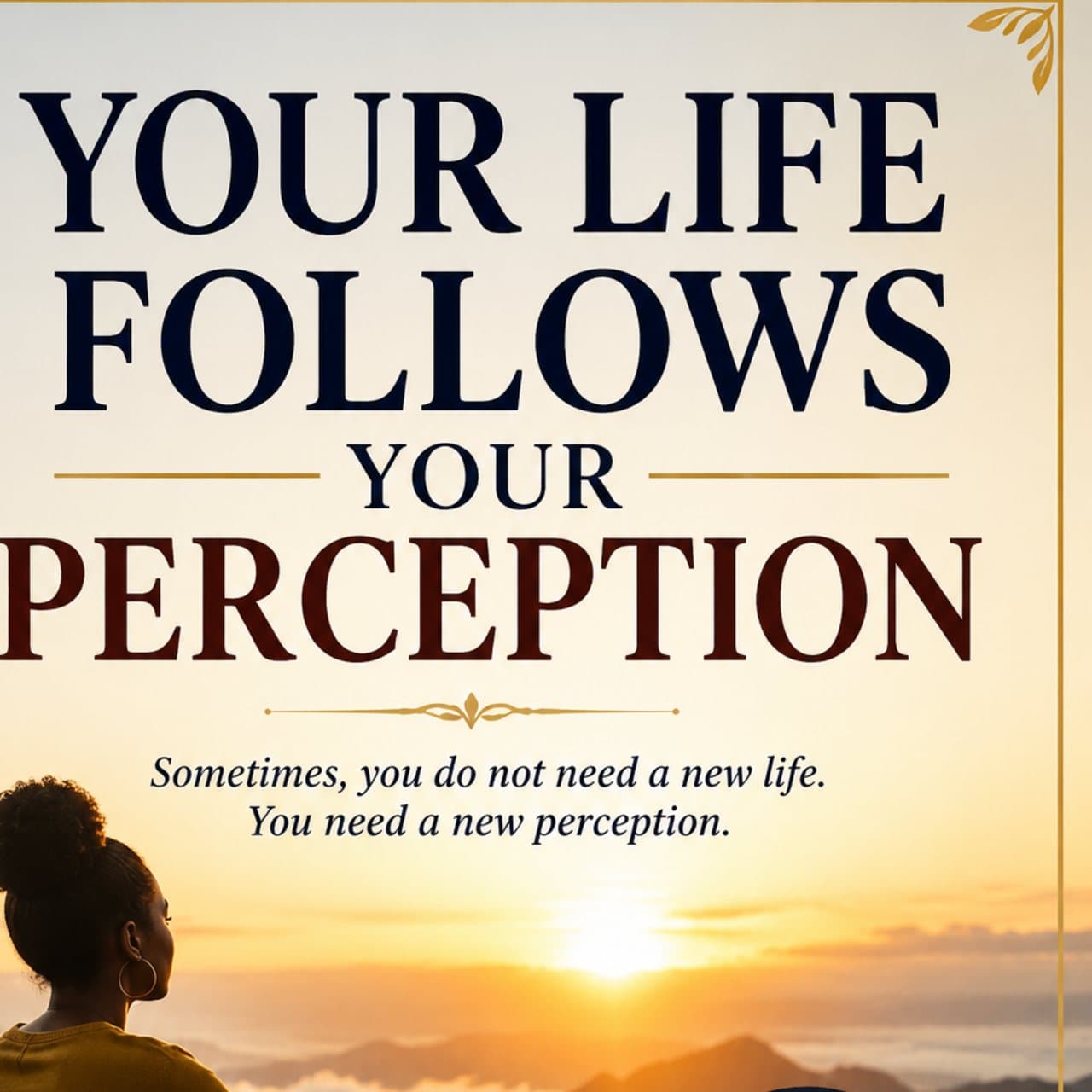
Your life follows your perception.
See yourself as defeated, and you may stop fighting.
See every obstacle as impossible, and you may never try to overcome it.
See rejection as the end, and you may miss the beginning waiting somewhere else.
But see yourself as capable, and you may discover strength you never knew you had.
See challenges as lessons, and you may grow through what was meant to break you.
See possibilities where you once saw only limitations, and your life may begin to move in a direction you never imagined.
The situation may not always change immediately.
But sometimes, the moment you change the way you see it, you change the way you live through it.
And perhaps that is where transformation truly begins.
Sometimes, you do not need a new life.
You need a new perception.