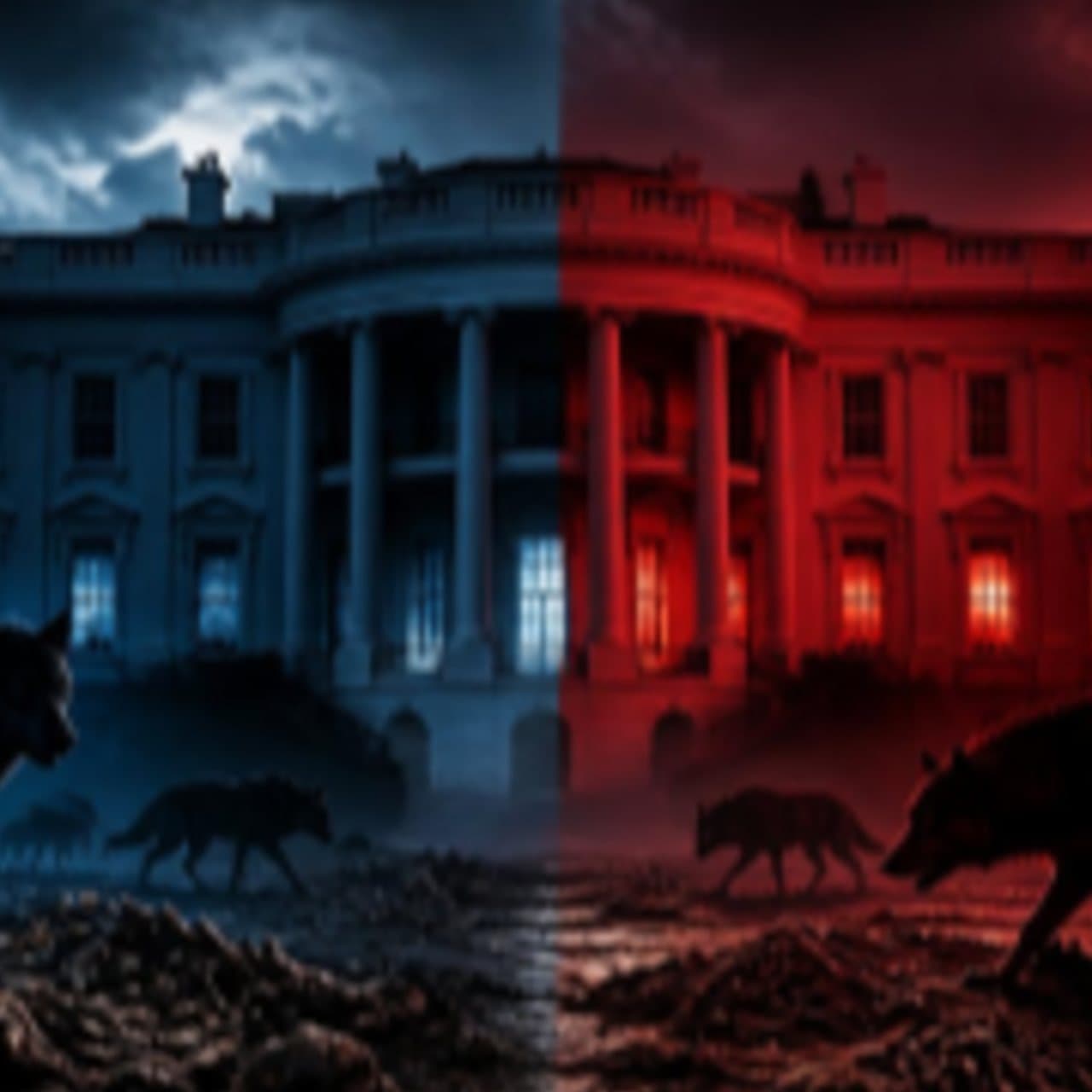

Wolves and Bone Piles: Corruption from the Biden White House to the Trump White House
In 2026, Americans’ perception of corruption in government hit 89%, the highest in 20 years. But the corruption of the two governments is fundamentally different. Procedural cover (code words to cover money flows) covered most of the corruption during the Biden era. Trump’s second term has moved to obvious, systemic self-dealing, from crypto policy to family business, where he no longer hides corruption.
A Poem and a Passage of Scripture
Her officials within her are like wolves tearing their prey;
They shed blood and ruin lives for dishonest gain.
— Ezekiel 22:27
Biden White House corruption was like rats in a dark room, sealing the records with code words. Trump White House corruption is like wolves in the marketplace, tearing at prey in broad daylight. The former at least acknowledged that rules existed; the latter treats rules as a fig leaf.
The Biden White House: Procedural Cover and the "Benghazi" Code Word
Biden-era corruption controversies centered on using bureaucratic procedure to mask money flows. The clearest case was one Senator Ernst exposed: Small Business Administration officials in the Biden administration used the code word "Benghazi" to refer to internal communications involving Planned Parenthood in order to hide $90 million in taxpayer funds from Congress and the public.
The defining feature of this corruption was that it was denial-based—officials wouldn't publicly defend the transfers; instead, they used records-management rules, administrative procedure, and vague eligibility standards to evade scrutiny. HUD audits similarly showed roughly $5.8 billion in "questionable payments" in Biden-era rental assistance, including payments to deceased tenants and non-citizens. The problem stemmed more from regulatory absence and loose management than from deliberate, targeted steering of funds.
At the time, Republicans' perception of corruption was 83%, Democrats' only 57%. In other words, during Biden's term, the corruption narrative never became a cross-party consensus.
Trump's Second Term: Open, Systemic Fusion of Interests
After the 2025 transfer of power, the shape of corruption changed qualitatively. As The Atlantic put it, "The first term at least had nods toward the idea that President Trump and businessman Trump should be separate. That's gone now."
First, crypto went from regulatory target to wealth engine. Trump earned roughly $2.2 billion from crypto trading; crypto assets now make up the bulk of his net worth, while his administration simultaneously made loosening crypto regulation part of its economic agenda.
Second, family businesses are plugging directly into federal contracts. The Trump sons' defense-tech portfolio has drawn more than $3 billion** in direct government business since their investment. Senator Murphy laid it out in March 2025: DOGE head Musk expanded his companies' federal contracts while gaining labor-enforcement data on competitors; the State Department planned a **$400 million purchase of armored Teslas**—against just $483,000 in EV procurement under Biden.
Third, pay-to-play diplomacy and celebrations. Freedom 250 (the Trump-restructured version of the nonpartisan America250 commission) offered private access to the president to donors of $1 million** or more. Prime contractor Event Strategies has received **$38.6 million in federal contracts since early 2025, many of them no-bid.
What stung the public most was the prediction-market insider-trading case: a White House teleprompter operator, using advance access to Trump's speech content, bet on Kalshi and Polymarket and was fined about $172,000 by the CFTC.
The Irony of the Perception Gap
Both parties now broadly agree that corruption is widespread—in 2026, 91% of Democrats, 83% of Republicans, and 90% of independents say government corruption is extensive. But they define what counts as corruption in completely different ways.
Democrats see the Trump family's open monetization; Republicans may see the "deep state" obstructing Trump. Gallup's data reveals a key pattern: Democratic corruption perception swings sharply with which party holds power (57% under Biden → 91% under Trump), while Republican perception stays relatively constant (hovering around 80%). That means Republicans already believed government corruption was severe long before Trump; his presidency didn't change their baseline. Democrats, watching Trump's second term, underwent a sharp upward revision in perception.
Why This Comparison Matters
Biden-era "code-word corruption" presupposed that public knowledge would bring accountability—which is why it needed hiding. Trump's second-term "storefront corruption" presupposes that public knowledge will bring no consequences—which is why it doesn't need hiding. When the G20 is held at the Doral golf club, congressional Republicans' reaction runs from silence to "excitement"; when the president earns billions from crypto trading, Senate Republicans raise almost no structural objection.
It doesn’t happen that overnight corruption is normalized. It occurs at the moment when hiding is no longer necessary. The Biden White House used code words to cover up behavior; the Trump White House turns the behavior itself into a spectacle. It’s not a moral level. It’s an expectation of responsibility. The former still dreads it, the latter no longer simulates.