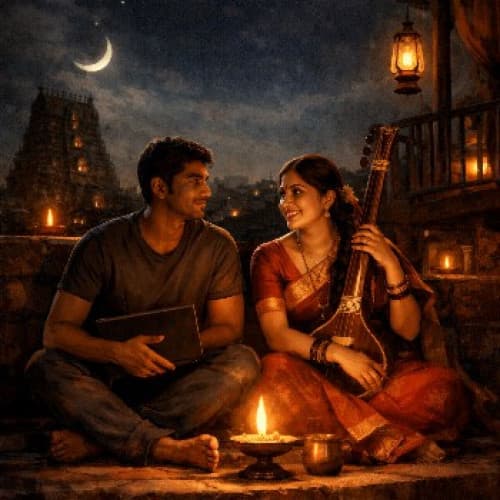

When the power went out in Mylapore, the city did not fall silent—it inhaled.
Ceiling fans slowed into tired sighs, lights blinked their last goodbyes, and the usual hum of generators hesitated, then gave up. The evening air, thick with jasmine and impending rain, crept into homes uninvited.
Arjun noticed the outage only because his laptop died mid-sentence.
One moment he was debugging a stubborn piece of code for a Singapore client, fingers flying, mind half elsewhere. The next, his screen went black, reflecting his own faintly annoyed face back at him. He leaned back in his chair, rubbing his eyes.
“Perfect,” he muttered.
His apartment was too quiet now. No fan. No router. No Slack notifications pretending to be urgent. Just the distant honk of autos and the rhythmic clatter of someone closing windows downstairs.
Then he heard it.
A note—long, deliberate, unmistakably alive.
It drifted in through his open balcony door, unamplified and unhurried, curling around the darkness like it belonged there. A voice followed, steady and precise, tracing a raga Arjun didn’t know the name of but somehow recognized in his chest.
He stood up.
Across the narrow lane, on the terrace of the old agraharam house, a woman sat cross-legged beside an oil lamp. Its flame painted her face in amber and shadow. She wore a simple cotton saree, hair braided loosely, a tanpura resting against her shoulder like an old friend.
She was singing not to an audience, but to the night.
Arjun leaned against his balcony railing, unsure when he’d stopped being annoyed and started being undone.
When her eyes finally opened, they found him there—awkward, barefoot, holding a dead laptop like an apology.
She smiled first.
“Power cut?” she called out, as if Chennai ever needed confirmation.
“Yeah,” he replied, voice louder than intended. “I think the universe wanted me to stop working.”
She laughed softly. “It usually does.”
Her name was Meera. She told him this when he climbed down and crossed the lane, drawn by curiosity he pretended was politeness. She was a Carnatic vocalist, practicing for a concert that now had no microphone, no lights—only the mercy of a willing listener.
He told her about code and deadlines and how his life ran on calendars and caffeine. She told him about ragas meant only for twilight, about how some notes were not meant to be rushed, about silence being as important as sound.
They sat on the terrace steps, sharing candlelight and time neither of them had scheduled.
“Doesn’t it bother you,” Arjun asked, “that your music disappears the moment you stop singing?”
Meera tilted her head. “Doesn’t it bother you that your code will be obsolete in five years?”
He laughed, startled. “Fair point.”
The power did not return quickly. Neither did they want it to.
When the lights finally flickered back to life, the moment shattered politely—fans whirring, TVs blaring, the city reclaiming them. Meera stood, adjusting her saree.
“I should go,” she said.
Arjun nodded, already feeling the shape of missing her. “Yeah. Same. Early call tomorrow.”
They exchanged numbers with the hesitance of people who knew how easily magic could turn practical.
Weeks passed. Messages were sporadic. Calls shorter than either wanted. Arjun traveled. Meera practiced. Life, efficient and relentless, resumed control.
But sometimes—when his office generator failed during a storm, or when Meera sang to a half-empty hall—each of them thought of a night when time slowed, when darkness introduced two worlds that would otherwise have remained parallel.
They never quite collided again.
Yet every power outage in Mylapore still carries a rumor of music.
And somewhere, a techie pauses mid-thought, listening, wondering what might have happened if the lights had stayed out just a little longer.