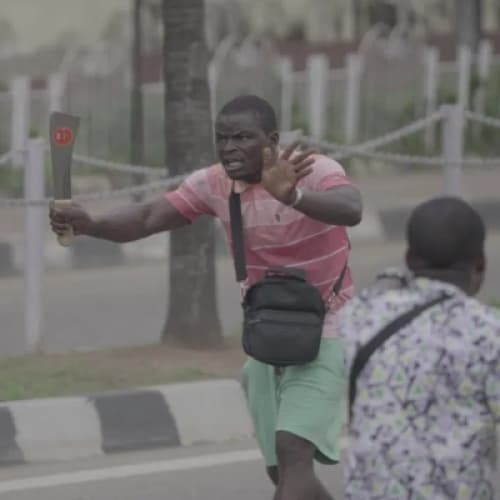

In the dusty heart of West Africa, where motorbikes roared like lions and street vendors sang louder than church choirs, a boy named Sonto was born with fists clenched like a fighter and eyes that stared at the world with suspicion. He was the product of Lagos’s underbelly — born not in a hospital but in the back of a pepper soup shack during a power outage. His mother, Adeola, cried silently that night. She knew the streets would raise him faster than she ever could.
Makoko — a floating slum where homes stood on stilts, children ran barefoot on planks, and danger lurked behind every smile — was Sonto’s home. At ten, he could row a canoe better than he could write his name. At twelve, he was pickpocketing white tourists with the precision of a surgeon. By fourteen, he had his first scar from a machete fight, and by sixteen, he was known as Oga Blak, a name whispered with both fear and respect.
Sonto didn’t choose the streets; the streets chose him. His father, some say, was a gangster killed by rivals. Others say he ran away to Benin after stealing from a corrupt police chief. Whatever the truth was, Sonto never knew him. All he knew was survival.
His initiation into the local gang — The Red Crows — was brutal. They beat him until his lip split, until blood soaked through his shirt, until he could no longer stand. Then they poured cheap gin on his wounds and handed him a machete. "You want respect?" the leader, Papa Kay, growled. "Earn it."
He did.
The first job was a raid on a market stall that refused to pay “protection.” Sonto was told to stand watch. But when the shop owner — an old man with trembling hands — tried to grab his phone and call the police, Sonto panicked. He lunged with the machete. The blade caught the man’s shoulder. Not fatal, but enough. The gang cheered. That night, they gave him his first gun — a rusty Tokarev from the war in Sierra Leone.
From then on, Sonto moved like a shadow through Lagos. Carjacking. Kidnapping. Armed robbery. If it had a price, he could take it. But he wasn’t reckless. Unlike other thugs who craved violence for fame, Sonto studied the streets like a chessboard. Every enemy was a piece to be moved. Every alley was an exit. He became a legend not just for blood, but for brains.
But no thug life lasts forever.
Sonto’s world began to shake the day he met Amara.
She was everything he wasn’t — soft-spoken, educated, and full of faith. She volunteered with a local NGO teaching kids to read. They met when he snatched a man’s phone on Third Mainland Bridge and ducked into the back of a church compound to hide. She found him bleeding from a scratch, clutching the phone like it was gold.
"You should clean that wound," she said, handing him a handkerchief.
"Mind your business," he snapped.
She didn’t flinch. "You think you’re hard, but you’re just scared."
That was the first time someone saw through the mask.
He didn’t return the stolen phone. But he remembered her face. For weeks, he found reasons to pass by the church. Sometimes to smoke. Sometimes just to listen. One day, she handed him a book — Things Fall Apart.
“You might see yourself in it,” she said.
He did. And it disturbed him.
The more Sonto tried to pull away from the streets, the more the streets clutched him. Papa Kay grew suspicious. "You dey go Bible class now?" he mocked. “You dey fall for that fine girl abi?”
But Papa Kay wasn’t just suspicious. He was threatened. Sonto’s influence in the gang had grown too large. Soldiers began to take orders from him. When a South African arms deal came through, and Sonto suggested a more cautious approach, Papa Kay saw it as rebellion.
The night of betrayal came fast.
A setup. An ambush.
They were supposed to raid a warehouse in Ajegunle. Sonto led the crew. But when they entered, there was no loot — just bullets. Police units surrounded them like ants on sugar. It was a massacre. Only Sonto and a boy named Gidi escaped through a hole in the wall.
Bleeding from a shot to his leg, Sonto knew it was over. Not just the job. The life.
He fled Makoko and hid in Badagry, near the border with Benin. Amara helped him — not because she approved of what he’d done, but because she saw the boy behind the scars.
“Don’t you want more than this?” she whispered one night as they listened to gospel songs on a broken radio. “Don’t you want to live without always looking over your shoulder?”
“I don’t know how to be anything else,” he confessed.
“You can learn.”