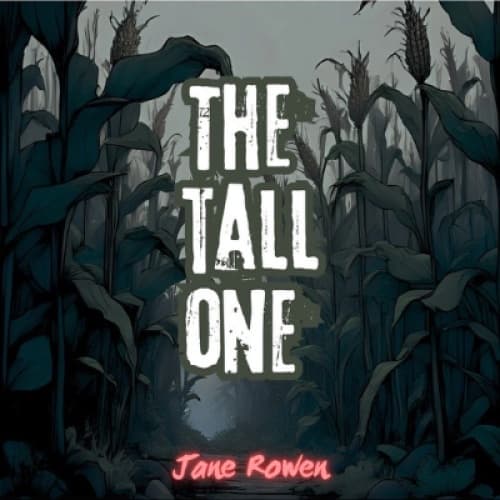

The corn had died in its sleep.
Brown stalks slumped in the July heat, brittle and bowed like mourners. The Dalton farm stretched over eighty acres of this withering crop. Every inch aching from drought and debt.
Mara sat cross-legged in the dirt behind the barn, sketchbook balanced on her knees. Her fingers were stained with graphite. She was drawing again, quiet and intent, her mouth parted slightly as if listening to something just out of reach.
Her pencil moved in looping lines. A cornfield. A sagging house, distant and crooked. Then something else took shape. A figure, tall and thin, rising behind the rows.
She paused.
It was already there. She hadn’t planned it.
She stared for a long moment, then turned the page without a word.
Inside the house, Aaron Dalton scrubbed his hands at the kitchen sink. His shirt clung to his back with sweat. Rachel sat at the table, flipping through a small stack of bills. Her jaw was clenched, her thumb tapping against a calculator that didn’t change the numbers.
“Another calf’s gone,” Aaron said.
Rachel didn’t look up. “Fence?”
“Holding. No tracks. No blood.”
She paused. “Coyotes?”
He didn’t answer.
Outside, the dog barked. One sharp note, then nothing.
Mara looked up from her sketchbook. The corn rustled, soft and slow, as though something were shifting just beneath the dry leaves.
There was no wind.
She stood and closed the sketchbook.
That night, Aaron set up the trail camera.
He mounted it on a fence post near the livestock pen, the lens aimed at the edge of the corn. The soil cracked under his boots. Across the field, the dog barked again, then fell quiet.
The camera blinked red once, then held steady.
By morning, the house was already warming in the sun. Rachel moved through the kitchen with practiced motion, pouring coffee, sorting mail, saying little. Mara came in barefoot, clutching her sketchbook against her chest. She sat at the table and opened to a blank page.
Rachel refilled her glass. As she glanced down, her breath caught.
On the previous page, the figure had returned. Taller now. Its limbs stretched too far, arms like cords. The face was missing. Just an oval where features should be. The corn around it curled inward, drawn toward the thing.
Rachel touched the edge of the sketch. “Did you dream this?”
Mara didn’t look up. “No.”
Aaron came in from the barn, trail camera in hand, sweat lining his brow. He dropped into a chair, plugged the camera into the laptop, and let the footage play.
Windless dark. Insects flitting past the lens. Nothing at first.
Then the corn moved.
At 2:46 a.m., something stepped just into the frame. Tall, too tall for a person. Its arms moved strangely, like joints bending the wrong way. It turned and seemed to face the camera.
Aaron leaned closer.
The figure had no eyes. But it was looking straight at him.
He didn’t hit play again.
Rachel found the sketch again later that day.
Mara had left her sketchbook open on the porch bench, the breeze flipping a few pages before Rachel caught it. She meant to close it, to leave it be, but her eyes lingered.
There were more drawings now. The same figure again and again, always in the corn. It stood at different angles, sometimes distant, sometimes too close. In one, its hand brushed the edge of the page, as if reaching out. In another, it had grown taller, its limbs thinner, stretched until the lines began to break.
Rachel closed the book, slower this time.
That night, Aaron stood alone on the back steps, a beer sweating in his hand. The fields were silent except for the dry rattle of the corn. No crickets. No wind.
Then something moved.
He stepped forward, squinting into the dark.
Between the rows, something stood.
Not walking, not shifting, just standing. Tall and still.
He raised the flashlight, but the beam bounced off the first few stalks and vanished in the distance. When the light found the spot again, it was gone.
Not a sound.
Aaron stayed there a long time, longer than he meant to. His beer warmed in his hand.
The next morning, an old pickup pulled into the drive. The neighbor, Mr. Lunden, stepped out. He was wiry and sun-leathered, his eyes sharp beneath the brim of his hat.
He didn’t say hello. He looked past Rachel to the corn.
“You need to stop looking for it,” he said.
Rachel blinked. “Looking for what?”
Lunden kept his eyes on the field. “Doesn’t matter what you call it. It notices when you notice back.”
Mara began speaking in her sleep.
At first it was just murmurs, soft sounds carried through the thin walls at night. Rachel assumed it was dreaming. But the second time, she stood in the hallway, listening, and realized the cadence was wrong. The words didn’t belong to any language she knew.
Low, rhythmic, almost melodic. Like a lullaby sung through a cracked door.
The next morning, Mara’s eyes looked cloudy. Her fingers were stained darker than before. She had filled four more pages in her sketchbook overnight.
She didn’t remember drawing any of them.
One showed the house from above, as if seen by something high in the sky. Another showed a spiral cut into the earth, with thin figures standing around it like stones. One sketch was just the cornfield, endless, but each row bent toward a center point just off the page.
Rachel stared at them, unsure what frightened her more. The detail, or the fact that
Mara didn’t seem curious about them at all.
Later that afternoon, Aaron went out to check the fence again. The heat wrapped around him like wet cloth. He moved slow, boots kicking dry dust, eyes scanning for signs of breakage.
He didn’t find any tracks. But halfway through the north side, something caught his eye between the stalks.
A symbol, cut crudely into the dirt. Not drawn, but pressed down. Almost seared into the soil. A wide circle with jagged rays around it, like a sun with broken teeth.
That night, Mara drew it perfectly from memory.
She had never seen it.
It was Mara who found the journal.
She had wandered into the barn without saying anything. Rachel noticed her missing just before dusk and followed, barefoot across the yard, brushing through the dry weeds that had grown wild near the fence line.
The barn was still. Dust hung in the shafts of evening light.
Mara sat cross-legged near the back wall, holding something half-buried beneath an old pile of fencing wire and rusted nails. A leather-bound notebook, curled at the edges, the cover blackened as if it had been through a fire.
Rachel crouched beside her. “Where did you find that?”
Mara didn’t answer. She just handed it over.
Most of the pages were too charred to read. The corners crumbled when Rachel touched them. But a few toward the center had survived. The handwriting was jagged, hurried. A farmer’s hand.
“Tall one came again last night. Still afraid. It watches the field like it’s not allowed to look away.”
“There’s two of them. The tall one’s not the worst.”
“We stayed quiet, and it passed. You must stay quiet. You mustn’t look.”
Rachel closed the book with a shiver.
That night, Mara didn’t draw. She sat by the window instead, watching the field with her knees tucked to her chest, her face unreadable in the dim light.
Aaron passed by once and paused. “You okay, kiddo?”
Mara didn’t look at him. “He’s not bad,” she said softly. “He’s hiding like me.”
The calf was missing by morning.
Aaron followed its trail through the pasture, but it ended near the edge of the corn, the ground dry and undisturbed. No blood, no struggle. Just hoofprints that stopped mid-stride.
Rachel insisted on looking herself. Aaron tried to talk her down, said it could be nothing, said it wasn’t worth going in, not alone.
She went anyway.
The air inside the corn was cooler than she expected. Dim, too. The light filtered through in narrow shafts, yellow and still. The silence pressed against her ears.
She called the calf’s name, a soft chant more for herself than the animal.
No answer.
The rows closed around her as she walked. She moved slower now. The corn rustled once, not behind her, but ahead, about twenty feet in.
She stopped.
There, between the rows, something was standing.
It wasn’t hidden. It didn’t move.
It was tall. At least seven feet, and pale, its limbs hanging low, fingertips nearly brushing the ground. Its head tilted slightly, like it was listening. Its shape was human, mostly. But wrong, too. The arms too long. The joints bent the wrong way.
Rachel held her breath.
It didn’t come closer. It didn’t vanish.
It just watched.
She stepped back slowly, hand trembling, and turned without speaking. She didn’t run. She walked until she was out of the corn, heart pounding so loud it hurt.
Mara was waiting near the barn, sketchbook open on her lap.
She was drawing the exact scene. The same rows, the same crooked stance.
Without looking up, she said, “He didn’t want you to see him.”
The trail camera triggered again that night.
Aaron checked it early, before coffee, still in his boots and undershirt. He hadn’t slept much. No one had. Even the wind felt heavier, dragging its feet across the fields.
He plugged the camera into the laptop in the barn office. The software loaded, and the first few clips played normally. Nothing but empty stillness, insects, a light flicker as the moon moved.
Then, 3:12 a.m.
Motion detected.
Aaron leaned forward. At first, just the corn again. Then a figure stepped between the rows.
It was taller than before. Closer. Directly in line with the lens.
The way it moved wasn’t right. Its joints flexed softly, as if it didn’t weigh anything. Arms too long. Shoulders too narrow. A smooth white oval where the face should have been.
It stopped six feet from the camera. Stared into it.
Then, for exactly one second, the image broke.
Aaron blinked. Rewound.
At the moment the figure faced the lens, the footage distorted. Not a glitch. Something worse. The trees behind the corn were gone. The barn, gone. The ground was white. Flat. As if the whole world had been erased except the figure and the lens.
Then it flicked back.
He froze, hand hovering over the keyboard. He didn’t rewind again.
Behind him, the barn creaked. Loud. Sharp. Sudden.
Aaron turned, but nothing was there.
That night, he didn’t tell Rachel what he saw. He shut the barn early. Locked the door. Turned off every light in the house.
But Mara stayed awake.
She sat on the porch until dawn, watching the field.
And smiling.
They called for the dog all morning.
His leash still hung by the back door, untouched. The food bowl sat full. No signs of struggle, no fur, no tracks. Just gone.
Aaron checked the barn, the ditch, even the empty grain silo behind the south field. Rachel walked the edges of the corn three times, her voice going hoarse. Mara didn’t search.
She sat on the swing under the old pecan tree, sketchbook on her lap, bare feet brushing the dirt.
Rachel found her there after the second hour. “Mara. Did you hear him last night?”
Mara nodded.
“Did you see where he went?”
Mara looked down at her sketchbook. She had drawn the porch again, but this time, something tall stood near the steps. The dog was in the drawing too. Facing it.
“He took him,” she said softly.
Rachel crouched in front of her, voice tight. “Who?”
Mara didn’t answer.
“Why?”
Mara blinked, as if the question didn’t make sense.
“Because it barked,” she said. “It was too loud. He didn’t want it to call the other one.”
Rachel stared at her. “The other what?”
Mara tilted her head, thoughtful. “The thing he hides from.”
She turned the page. Another drawing.
Not the Tall One.
Something larger. Only a piece of it visible. It's silhouette too wide for the paper. Horns, or maybe branches, curved up from the edge of the frame. No face. Just a mouth, open far too wide.
Mara traced one line with her fingertip. “He’s still hungry.”
Aaron entered the corn just after sundown.
He told Rachel he was checking fence posts, but he didn’t bring tools. He carried only a flashlight and the worn hunting knife his father had given him, blade dulled from years of not being used.
The rows were quiet. The deeper he went, the more the air changed. Cooler. Stale. Like a basement that had never been aired out.
He moved slowly. The beam of the flashlight cut through the stalks in narrow slashes, dust dancing through the light.
Something whispered.
He stopped. Listened.
Just corn brushing against corn, he told himself. Just leaves shifting against each other.
He turned right at the edge of the west field, following a half-trodden path. Something had moved through here recently. Stalks bent inward. Tips snapped clean.
Then he saw it.
Another symbol.
Not the one from before. A new one. Carved into the dirt in a wide spiral, the size of a truck tire. Around it, tiny stick formations were laid out in a pattern. Bones tucked inside them. Bird bones. Maybe rabbit. Arranged with careful symmetry.
Aaron knelt beside the spiral. The ground smelled burned, though there was no ash.
He looked up and froze.
Mara was standing at the edge of the field.
He hadn’t heard her. She didn’t call his name.
She just watched.
Then she turned and walked back toward the house, her hair catching the last of the sun.
Aaron stayed kneeling a long time. When he finally stood, he looked back once.
The symbol was gone.
Only the dirt remained.
Rachel waited until Mara was asleep to open the journal again.
She had hidden it beneath the kitchen sink, wrapped in a plastic bag between a box of rags and an old flashlight. But it still smelled like smoke when she pulled it out.
Something oily and scorched.
She sat at the kitchen table with only the stove light on.
Most of the pages were ruined. Burnt corners, crumbling ink. But as she turned carefully, one intact section gave way, revealing more than she remembered.
The entries weren’t dated. But the writing changed. It started clean, then turned jagged. By the end, the lines ran crooked, words smashed together like the writer had been rushing, or shaking.
It watches because it’s afraid. That’s the only reason we’re still here.
The tall one doesn’t make noise. The other one does.
It never comes at first. It waits until the tall one is weak.
The mistake is thinking the tall one chooses to be here. It doesn’t. It’s trapped. The corn is the lock. We are the bait.
Rachel turned the page and stopped.
This one had a drawing.
Simple. Charcoal rubbed hard into the paper. A narrow figure, arms hanging low. Then, behind it, something immense. No shape. Just void, drawn in tight spirals until the paper dented.
Beneath the image, the final line was written in larger, broken letters.
It doesn’t want us. It wants through us.
Rachel closed the book. Her hands were shaking.
In the hallway, Mara’s door creaked open slowly.
Then came the sound of footsteps, soft and bare, moving toward the back porch.
Rachel woke to the sound of the screen door opening.
She sat up in bed, heart racing, listening. The house was dark. No footsteps followed. No voices. Just the faint groan of the wind pushing through the old frame.
She crossed the hallway in bare feet, opened Mara’s door.
The bed was empty.
Outside, the night was thick with humidity. A faint mist clung low to the grass. Rachel called her daughter’s name once, then again, louder. No answer. Aaron came out moments later, flashlight in hand. They searched the yard, the barn, the ditch, shouting until their voices cracked. The corn loomed in every direction, unmoving.
Then they saw her.
Halfway into the field, standing still among the stalks. Barefoot. Her nightgown damp
with dew.
Rachel ran to her, pulled her close. Mara didn’t speak.
She was cold.
When they brought her inside, she didn’t remember leaving. She didn’t seem frightened. Just tired.
Rachel wrapped her in a blanket and sat beside her on the couch. Aaron stood behind them, arms crossed tight, jaw working as he stared through the window toward the corn.
After a long silence, Mara spoke.
“It’s not him we should fear,” she whispered.
Rachel turned. “What do you mean?”
Mara didn’t look at her.
“He’s hiding. Like me.”
Rachel’s skin prickled.
Mara leaned her head on her mother’s shoulder. Her eyes were still open, staring at something only she could see.
Behind her, the porch light flickered once. Then went out.
It came to the barn just before dawn.
Rachel had been up since three, sitting in the kitchen with a cup of coffee gone cold in her hands. Aaron was asleep in the armchair, one boot off, a rifle propped against the wall beside him. The silence had become something solid. A weight she couldn’t shake.
Then she heard it.
A shuffling sound. Slow, deliberate. Gravel under something soft.
She moved to the window and parted the curtain.
The barn door was open.
She hadn’t left it that way.
Rachel stepped onto the porch. The air was thick, heavy with the scent of dirt and mildew. She followed the sound across the yard, every step deliberate. Not rushed. Not loud.
She reached the barn and stopped in the doorway.
It was inside.
The Tall One stood near the far wall, bent at the shoulders. It looked smaller in the half-light, its limbs shaking slightly. One of its arms was torn, not bleeding, but frayed. Skin, or something like it, hung in thin strands.
Its faceless head turned toward her, slow and unsure.
It didn’t move.
It didn’t try to hide.
Rachel stepped back once, breath caught in her throat.
The Tall One raised one arm. It wasn’t a threat. It moved like a person asking for help, but too far gone to speak the words.
Then Mara’s voice came from behind her.
“He’s dying.”
Rachel turned. Mara stood barefoot in the grass, holding a blanket.
“If he goes,” she said, her voice flat, “the other one will come.”
Sheriff Nolan pulled up just after noon, dust kicking high behind his cruiser. He climbed out slowly, hand resting on his belt, eyes sweeping the property like he expected to see a prank in progress.
Rachel met him halfway down the gravel drive.
“You brought the tapes?” he asked.
She nodded and handed him the flash drive. “We didn’t alter anything.”
He gave her a look she’d seen before, the kind that comes from too many drunk calls and empty fields. “You said the thing looked... inhuman.”
“Watch it,” she said. “Just watch it.”
He reviewed the footage in the barn. Mara stayed inside, silent. Aaron stood by the barn door, watching Nolan’s face as the grainy image played out. The Tall One. The broken camera moment. The shape staring into the lens.
Nolan squinted. Rewound once. Then again.
Finally, he exhaled and leaned back. “Looks like a costume. Real tall guy on stilts maybe. Some punk with a projector. Video glitch adds to the act.”
He looked up. “Any of your neighbors into theater?”
Aaron didn’t speak.
That night, Nolan came back alone.
They saw the cruiser’s headlights from the kitchen window. No one called him.
He walked into the corn with a flashlight, muttering something into his radio that only buzzed through static on their end.
Then the light vanished.
No crash. No scream. Just gone.
They found his cruiser the next morning. Door open. Engine still warm.
The corn around it was flattened in a perfect circle.
Inside the field, fifty yards in, Aaron found Nolan’s hat. Folded in half. Placed gently at the base of a single, standing stalk.
There was no blood.
It started the night after Nolan disappeared.
Rachel had gone to bed early. Aaron stayed up, watching the barn from the living room window, one hand resting on the rifle he hadn’t yet used. The house creaked more than usual. The kind of creaking that made you stop mid-step and listen.
Then the voice began.
At first, Rachel thought Mara was singing. A soft hum beneath the floorboards. But the melody was strange. Not childish. Not familiar.
She stepped into the hallway and paused outside Mara’s door. The voice on the other side didn’t belong to her daughter. It was deeper. Slower. Wrong. Rachel pushed the door open. Mara sat on the bed, facing the window. Her mouth was moving. But the sound coming out was layered, like two voices speaking through one throat.
One whispered. The other growled.
Rachel reached for her, gently, fingers brushing Mara’s shoulder.
Mara turned her head but not all the way. Her eyes stayed fixed on the corn.
Then she spoke again. “He can’t hold it back much longer,” said the first voice. Mara’s voice, barely above a whisper.
Then, beneath it, the second voice spoke over her.
“He breaks. You open. I come.”
Rachel stepped back. Her knees nearly buckled.
The lights in the room flickered once. A soft rattle moved through the walls, like nails dragging along wooden beams.
Mara blinked, slowly, and seemed to wake. “Mom?”
Rachel didn’t answer. She was staring at the window.
Outside, in the field, the corn wasn’t moving. Not from wind.
It was breathing.
They found the warning in the barn.
It wasn’t there the night before. But in the gray morning light, Aaron stepped through the door and stopped cold.
It was arranged in the hay. Bones. Sticks. Twine. A shape pressed into the center like a sigil, wide and sharp-edged, sunlike and split down the middle. Bits of dried grass had been braided into a ring and placed around the edges.
Rachel stood in the doorway behind him. “It’s the same symbol,” she said. “From the drawing. From the field.”
Aaron nodded.
Neither of them touched it.
Mara was already awake. She stood barefoot near the barn, hair still wet from a dream. She stared at the shape with no fear, only recognition.
“He left it for us,” she said.
“Why?” Rachel asked.
Mara didn’t answer right away.
Then she looked toward the corn. Her voice dropped to a whisper.
“He’s trying to keep it out. The other one. He can’t hold it much longer.”
That night, the Tall One appeared again. Not hiding. Not in the field. In the yard. It stood at the edge of the house, tall and hunched, arms hanging low. Its body shook with effort. It raised one limb slowly and pressed something against the side of the barn.
A small bundle made of string, feathers, and bone.
Another mark.
A barrier.
Rachel saw it from the porch. She stepped outside, but didn’t go near it. The Tall One turned its blank head toward her. It didn’t move. It didn’t threaten.
It just stood there.
Then it backed into the corn and vanished.
The storm rolled in without warning.
One moment, the sky was clear. The next, the clouds bled in over the horizon, black and heavy, curling like smoke above the fields. The wind arrived in sharp bursts, tearing through the dry corn with a sound like distant screaming.
The power went out just before nightfall.
The lights flickered once. Then everything died. The house, barn, porch. The silence afterward felt colder than the wind.
Mara stood at the back window, unmoving.
Rachel lit candles while Aaron checked the breaker box twice. Nothing worked. The temperature dropped with each passing hour. By dusk, they could see their breath in the living room.
Outside, something moved along the edge of the field.
The Tall One.
It paced just beyond the first row of corn. Not hiding. Not watching. Pacing, over and over, its limbs twitching violently with each turn. At times, it would stop and face the house, as if checking to see if they were still inside. Then it would turn and continue its frantic circuit.
Mara whispered, “He’s trying to hold it back.”
Rachel put her hands on the girl’s shoulders. “What’s coming?”
Mara didn’t blink. “He kept it out before. But he’s weaker now. It knows.”
A sharp crack rang out across the field.
The trees at the far edge of the property shook hard, though the wind had stopped. A row of corn collapsed in a perfect line, stalks flattened as something massive passed between them.
Rachel backed away from the window.
Mara didn’t move. “He’s not protecting us anymore,” she said. “He’s protecting the doorway.”
The first sound was wrong.
Not thunder. Not wind.
It was deep, low, like something groaning beneath the earth. A vibration that moved through the floorboards and into their bones. The windows shook. The barn creaked. The corn began to lean as if bending away from something too large to stop.
Aaron grabbed the flashlight and rifle. Rachel pulled Mara close.
They ran for the storm cellar.
The sky outside was black, not with night but with clouds so thick they looked solid. Lightning flickered behind them, pale and slow. No thunder followed. Just that low vibration, growing louder with every second.
Behind them, in the corn, something moved.
It didn’t hide.
It didn’t glide like the Tall One.
It crushed.
Rows fell in long, violent swaths, stalks snapping under weight no animal could carry. Trees at the far end of the field split in half. The air turned sharp and cold, the kind of cold that didn’t belong to weather.
They reached the cellar doors just as the porch light exploded above them in a burst of sparks.
Aaron threw the doors open. Rachel pulled Mara inside.
From the edge of the yard, something watched.
For just a moment, they saw it. Not its shape. Its scale. A silhouette far too wide. Antlers, or limbs, or something branching upward. Not horns. Not bone. Something older. Darker. Reaching.
Then the cellar door slammed shut.
The latch locked.
And the ground began to shake.
They stayed in the cellar for hours.
No one spoke. Not even Mara.
Above them, the storm howled. The house groaned under pressure. Wind slammed against the walls in bursts, but it didn’t feel random. It felt aimed. The noise moved around the property in circles, tightening each time.
Then came the scream.
It wasn’t from the wind. It wasn’t from any animal. It was long and layered, a shriek pulled from something too large to breathe normally. The walls of the cellar trembled.
Dust fell from the ceiling. Somewhere above, glass shattered.
Mara flinched for the first time. “It found him,” she whispered.
Aaron gripped the rifle harder, knuckles white. Rachel moved closer to her daughter, pulling her in.
Then silence.
The kind of silence that presses on your ears. A vacuum.
The storm stopped.
The air changed. No more wind. No more rain. Just a low, heavy pressure, like standing underwater.
Then light.
From the narrow cracks in the cellar doors, a soft glow leaked through—blue and cold, flickering like firelight.
Mara stepped forward. The family followed.
Aaron opened the doors just a crack.
Outside, in the yard, fire burned across the grass in a perfect ring. The barn had partially collapsed. Smoke curled into the sky.
In the center of it all, a figure stood.
Tall. Burning. Collapsing.
It was the Tall One.
Its limbs sagged and split. Chunks of its frame fell away, as if it had been made of cloth and bone. It dropped to its knees and raised one arm toward the field.
Then came another sound.
Not a scream, but a roar.
Enormous. Endless.
And the sky cracked open.
They found the Sheriff’s body at sunrise.
The storm had passed. The clouds were gone. The sky stretched out, clean and blue, too perfect for what had happened.
The corn had begun to regrow.
At first, Aaron didn’t believe it. But as he walked the edge of the field, he saw it—new shoots breaking through the blackened soil. Rows already forming again. Green and young.
He followed the soft trail of churned earth into the first row and stopped twenty yards in.
Sheriff Nolan lay on his back, eyes wide open, mouth slack.
He hadn’t been torn. Not bruised. Not broken.
But his face was wrong.
Twisted. Locked in something like awe or horror. His hands were curled near his face, palms up, as if he had reached out to something that never stopped moving. They buried him in the town cemetery three days later. No autopsy. No news.
The Dalton house had scorch marks along the east wall. The barn was half-collapsed. But the fields were already healing. Birds returned to the trees. The wind moved easily again.
They never found the Tall One.
Not its body. Not even ashes.
But where it had stood, the grass grew taller, thicker, brighter than anywhere else on the property. In the center of it, a small symbol had formed in the dirt.
Not carved. Grown.
A circle, whole and closed.
Autumn came early that year.
The fields stood taller than they had in seasons. The corn was green, thick, perfect. No drought. No rot. No sign anything had ever touched the land but sun and rain.
Mara returned to school in late September. She sat near the back of the classroom, quiet, polite, present. She answered questions when asked. She smiled, sometimes.
But she didn’t talk about the summer.
Not once.
Her teachers noticed she no longer drew in class. No sketches in the margins. No notebooks filled with pencil ghosts or wilted trees. Nothing.
Until October.
One afternoon, while collecting essays, her history teacher noticed a page tucked beneath her folder. It wasn’t part of her assignment.
It was a drawing.
Charcoal. Sharp lines. Deep shadows.
The cornfield, perfectly detailed, viewed from above. In the center, the house. On the porch, a small figure with long hair.
And beside her, standing just behind the barn, was the Tall One.
It looked different this time.
Bent. Fractured. One limb missing. Its head tilted slightly toward the girl, not watching, just... present.
Beneath the drawing, in careful block letters, she had written:
He kept us safe.
For now.