


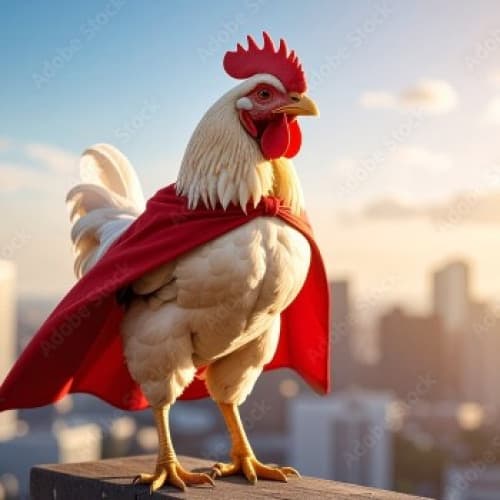
Lola Margarita was a widow who lived in a small, humble house near the busy market place. Life was not easy for her, but she worked tirelessly to provide for her two children. Her livelihood came from raising chickens—hundreds of them each year—which she sold to earn enough money for food, clothing, and shelter. The chickens were more than livestock; they were her companions, her daily responsibility, and the foundation of her survival.
Each day, the flock wandered into the nearby fields, scratching the soil for bugs, rice grains, and tender shoots. They lived freely, but always returned to Lola Margarita’s house at sunset. Among them was one rooster larger and stronger than all the rest. His crow was louder, his spurs sharper, and his presence more commanding. The flock called him the king of the chickens. By virtue of his strength, he became their leader, and none dared oppose him.
The rooster relished his authority. He strutted proudly, guided the flock to new feeding grounds, and demanded respect. One day, dissatisfied with the food supply near their home, he announced: “Let us go beyond the mountain, into the wilderness. There we will find rice, wheat, corn, and even wild silkworms. Here, food is scarce. There, abundance awaits.” His words carried confidence, but the flock trembled. They feared the dangers of foxes and eagles that prowled the wilderness. “We are afraid,” they said. “The journey is too far, and predators will catch us.” Their hesitation enraged the king. “Cowards! Let the old hens stay behind. Only the brave will follow me.”
The rooster’s secretary, a loyal rooster, stepped forward. “I do not know fear. I will go with you.” Together, they set out. But soon discord arose. The secretary found a beetle and was about to swallow it when the king flew at him in fury. “Beetles are for kings, not for common chickens! How dare you eat it without offering it to me?” They fought bitterly, and in the chaos the beetle escaped. Disillusioned, the secretary declared, “I will not fight for you, nor will I follow you into the wilderness.” He turned back, leaving the rooster alone.
At sunset, the rooster returned home. The flock had saved the best roosting place for him, but he was consumed by anger. He fought with one chicken after another, pulling feathers and asserting his dominance. Though none could withstand his strength, resentment spread. The flock whispered among themselves: “We will not serve this king any longer. If Lola Margarita will not give us another home, we will stay in the vegetable garden. Perhaps she will notice and provide us with peace.” That night, they abandoned the coop, leaving the king alone.
When Lola Margarita waited for her chickens, only the rooster returned. “Where are the others?” she asked. Arrogantly, he replied, “They are useless. I care not if they stay away forever.” Hong‑Mo warned him: “You are not the only chicken in the world. If you drive them away, trouble will come.” But the rooster laughed, perched on the fence, and crowed defiantly: “Toook-to-la-ooooooook! I don’t care for you! I don’t care for you!” His pride deafened him to wisdom.
Concerned, Lola Margarita searched through the twilight, calling her flock. She hunted until night fell, but found nothing. At dawn, she discovered them in the vegetable garden. They greeted her joyfully, bowing their heads and flying to her. “Why do you stay here,” she asked, “when I have given you a good house?” The secretary explained the quarrels with the rooster. Hong‑Mo urged reconciliation: “You must be friendly. Come with me, and I will bring you together. Peace must return.”
The flock followed her back. When they approached the rooster, they bowed respectfully, eager to restore harmony. But he strutted proudly, scraping his wings on the ground and sharpening his spurs. He refused to bow. “I am king—always king. Do you know that? You bow your heads, thinking it pleases me. But what do I care? I should not care if there were never another chicken in the world but myself. I am king.”
His arrogance isolated him. He climbed a tree and sang war songs, reveling in his imagined glory. But his loud crowing attracted danger. An eagle, hearing his boastful cries, swooped down, seized him in its talons, and carried him away. The flock never saw their proud, quarrelsome king again.
The story of Lola Margarita and the rooster, king of the chickens, is a warning about pride and bad leadership. A widow depended on her flock, but one rooster became too proud and violent. His arrogance drove the others away. Even when given a chance to make peace, he chose pride instead, and his loud boasting attracted an eagle that carried him off. The flock, free from his cruelty, returned to Lola Margarita, who cared for them with wisdom and kindness.
The lesson is clear: pride separates people, tyranny destroys, and true leadership means humility and care. Communities grow strong when they cooperate, but selfish rulers will always fall.