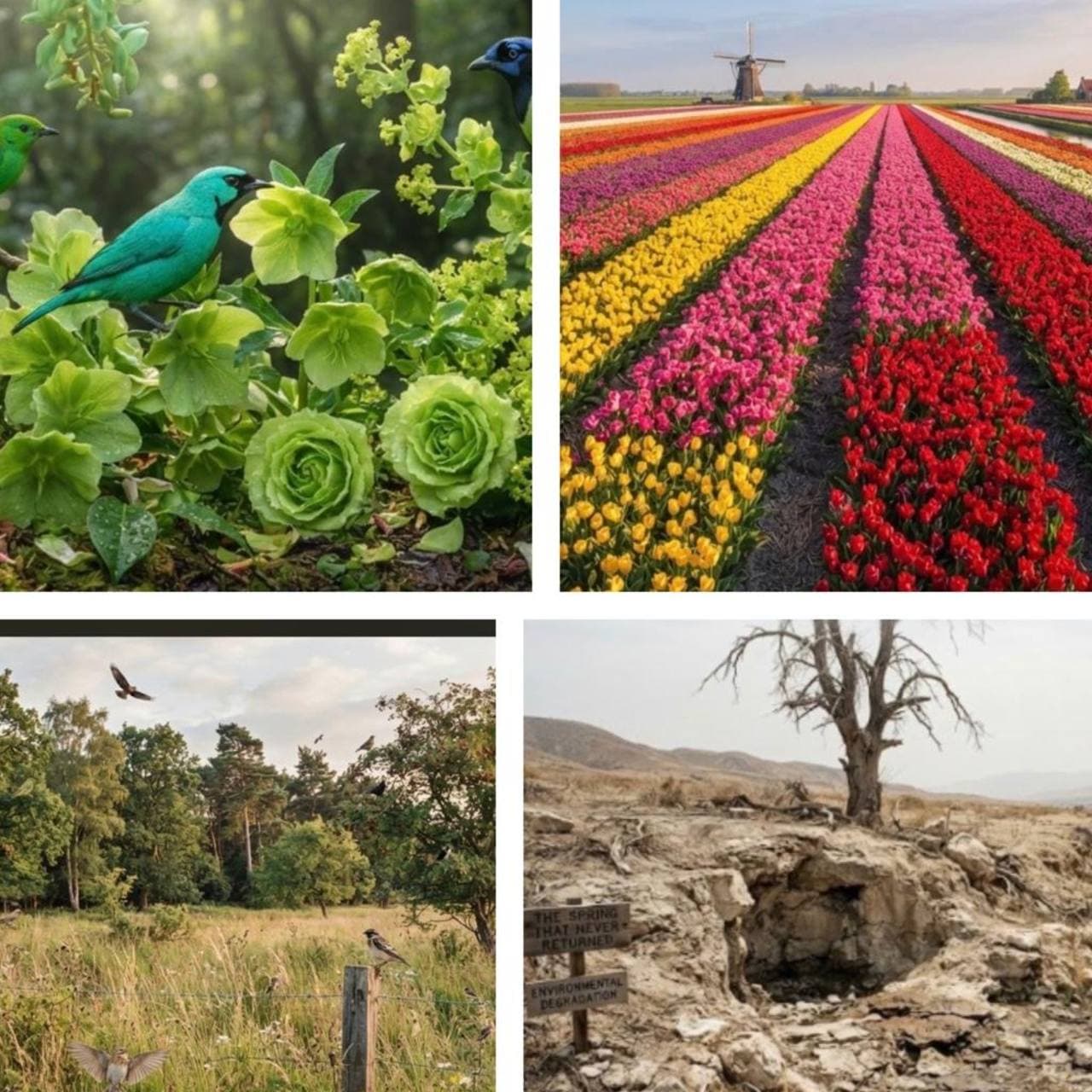

I was seven years old when the world seemed larger, greener, and infinitely more beautiful than it does today. Our house stood amidst agricultural fields, not far from a railway line. There were wheat fields, cornfields, shrubs with thorns and wildflowers, and vast open spaces beyond the boundaries of our little world. There were no mobile phones, no computers, and hardly any toys to occupy our afternoons. But we had something far more precious. We had nature. And we had childhood. My elder sister was my closest companion in those adventures. Together, we explored the fields, chased butterflies, collected strange insects, and discovered little wonders that seemed to have been placed there especially for us. We did not know that we were living through some of the most beautiful years of our lives. Nor did we know that much of the world surrounding us would one day disappear.
The Birds That Came With the Winter Sunshine
Winters were bitterly cold. Sometimes it would rain for hours, leaving the fields wet and the air heavy with moisture. Then, suddenly, the clouds would begin to disperse. A rainbow would appear across the sky, and a little sunshine would fall upon the countryside. Those were magical moments. One of the rooms in our house was used for storing wheat. Whenever the winter rain stopped and the sunshine returned, flocks of mynas and little brown sparrows with dark wings would fly into that room. Perhaps they were attracted by the grain. Perhaps they were seeking shelter from the cold. For us, their arrival was an invitation to adventure. My sister and I would quietly close the doors and begin chasing the birds around the room. They fluttered from one corner to another, desperately searching for an escape. Whenever we managed to catch one or two, our happiness knew no bounds. We would hold our little captives with excitement, admiring their feathers, their tiny eyes, and their delicate movements. Those were the days when catching a sparrow could make an entire afternoon memorable. Today, I sometimes wonder whether those little birds ever forgave us for disturbing their peaceful visits.
The Cotton Spinners of summer
Summer brought an entirely different world. The afternoons were unbearably hot. Our parents would retire indoors for their afternoon rest, expecting us to remain quietly inside the house. But my sister and I had other plans. As soon as the house became silent, we would slip outside. Beyond our home stood thorny shrubs and wild vegetation, where strange insects lived among the branches. Some were large and round, with beautifully colored wings. We called them the cotton spinners. We would catch them and place them inside small boxes containing a little cotton. Then came the fascinating part. The insects would move their strong legs through the cotton, creating movements that, to our childish eyes, looked remarkably like spinning. We could spend hours watching them. Sometimes we remained outside for two or three hours, completely forgetting the heat, our parents’ instructions, and the passage of time. By evening, we would proudly narrate our adventures to our friends. We had no photographs to show them. Our stories were enough.
A Trap Made From Horsehair
There was another summer adventure that was considerably more dangerous. We had discovered a peculiar way of catching wasps. These yellow, stinging insects frequently sat on the windows and walls of houses. We would take a hollow piece of straw and pass a strand of horse-tail hair through it, forming a small loop at one end. By pulling the hair through the straw, we could tighten the loop. Whenever we spotted a wasp resting on a window, we would cautiously approach it and attempt to slip the loop around its body. Then we would pull. The trapped insect would struggle furiously, beating its wings and attempting to escape. But we were determined to hold on to our little captive. Looking back, I shudder at the thought of what might have happened had those angry wasps stung us. Our parents would certainly have been horrified. But childhood has its own understanding of danger. For us, every successful capture was a triumph.
The Railway Line and Our Little Coins
A railway line passed through the fields near our house. Its tracks rested upon heaps of stones, and the approaching trains were among the most exciting sights of our childhood. We had discovered another mischievous pastime. Whenever the railway signal indicated that a train was approaching, we would place a coin on the track and retreat to watch from a distance. In those days, coins of one paisa, five paisa, ten paisa, fifty paisa, and one rupee were familiar parts of everyday life. Our parents sometimes gave us a little money to purchase things from the nearby shop. But we had other uses for those precious coins. As the train thundered past, its enormous weight flattened the coins beneath its wheels. Afterwards, we would collect the flattened pieces of metal and transform them into little swords, rings, and other curious objects. We were delighted with our creations. Our parents repeatedly warned us never to approach the railway tracks. They were right, of course. It was a foolish and dangerous adventure. But at seven, the excitement of turning a coin into a tiny metal sword seemed far more important than the dangers we scarcely understood.
The Beautiful Birds We Could Never Catch
Not all our adventures ended in success. High above the fields ran electric wires suspended between tall poles. Sometimes, extraordinarily beautiful birds would perch upon those wires. Some appeared entirely blue, others red, and still others a brilliant green. They had slender bodies, long beaks, and tiny legs. Their songs filled the air. We called them finches, although I cannot now say precisely which birds they were. My sister and I longed to catch just one of those magnificent creatures. We watched them, followed their movements, and waited for an opportunity. But they remained beyond our reach. Not once did we succeed. They continued to sing from the heights, free and untouchable. Perhaps those were the wisest birds of our childhood.
When the Monsoon Turned the Fields into Lakes
Then came the rains. The monsoon transformed the countryside. Heavy downpours filled the depressions in the fields, creating large temporary ponds. The dry earth became moist, the vegetation flourished, and an astonishing variety of creatures emerged. Among the most fascinating were the frogs. Some were enormous, at least to our childish eyes. They came in different colors — pale, dark, and almost white. We had devised a peculiar method of catching them. We would collect caterpillars and other insects, attach them to threads, and lower them into the ponds. The frogs would leap towards the moving bait and swallow it. Then we would pull the threads, sometimes managing to bring a frog out of the water. Whenever we succeeded, we would return home triumphantly with our unusual catch. We were enormously proud of ourselves. Today, I realize that our innocent amusement was not always kind to the creatures we caught. But we were children, discovering the world through curiosity rather than understanding.
The Plants That Gave Us Silken Pillows
The monsoon also brought strange and beautiful plants. Some had large, fleshy leaves containing a milky sap. They bore lovely flowers and attracted colorful insects. We watched with fascination as some of those insects changed over time, eventually becoming magnificent butterflies. But the plants held another surprise. They produced large, egg-shaped fruits. When the fruits matured and opened, they revealed masses of extraordinarily soft, shiny, silk-like fibers. We loved those fibers. They were light, delicate, and wonderfully smooth to the touch. We would gather the mature fruits, open them, and spread their silky contents in the sunshine. Once dried, we would carry the fibers home and give them to our mother. She would use them to fill pillows. People believed that sleeping upon these naturally filled pillows brought deep, peaceful sleep and relief from various ailments. Whether those beliefs were true, I cannot say. But I remember the pleasure of resting my head upon a pillow filled with fibers that my sister and I had gathered from the fields. It was as though a little piece of nature had found its way into our beds.
The Red Velvet Creatures beneath the Shrubs
There were also thick clusters of thorny shrubs bearing small, sweet fruits. We knew them as ber, the fruit of the jujube tree. Collecting them was a painful adventure. Their sharp thorns scratched our arms, caught our clothes, and sometimes left little wounds upon our skin. Yet we returned again and again. The sweetness of the fruits was worth the trouble. Beneath those shrubs, especially after rainfall, mushrooms appeared in the damp soil. We collected the varieties that we believed were edible. And sometimes, nearby, we noticed tiny holes surrounded by exceptionally fine, loose earth. There we encountered some of the most beautiful little creatures I have ever seen. They were bright red, soft, and velvety, almost like tiny moving pieces of silk. We called them the brides. They may have been red velvet mites, creatures that appear in some landscapes during the rainy season. We would carefully gather them in little boxes and carry them home. For a while, they became our companions and objects of endless fascination. I can still picture their brilliant red bodies moving across the moist earth. I has not seen them for decades.
The Spring of Wildflowers
Of all the seasons, spring was perhaps the most beautiful. The fields were covered with tender green wheat. Among the young plants appeared flowers of extraordinary beauty. There were flowers we called tulips and daffodils, along with countless other varieties whose names I never learned. Some were tiny and delicate. Others stood proudly above the grass. Their colors transformed the fields into a living tapestry. My sister and I would wander among them, gathering little bouquets with our hands. Some flowers contained sweet nectar. We discovered that we could draw out their sap and taste its delicate sweetness. It was a pleasure beyond description. No confectionery shop could have offered us anything more delightful. We did not need money to enjoy those flowers. We did not need permission to admire the butterflies. And we did not need anyone to teach us how to love the countryside. Nature was our playground, our teacher, and our greatest source of happiness. We belonged to that landscape. And that landscape belonged to our childhood.
Then, One by One, They Disappeared
As I grew older, something began to change. At ten, I still recognized much of the world I had known at seven. At seventeen, I began noticing differences. By twenty, many familiar things had already disappeared. The ponds were no longer there. The beautiful frogs had vanished. The strange plants with their silky fruits became difficult to find. The colorful insects were disappearing. The red velvet creatures no longer emerged from the soil where I remembered them. The wildflowers grew fewer. And the open fields gradually surrendered to buildings. Where wheat once swayed in the spring breeze, houses began to rise. Where rainwater once collected in ponds, roads and residential developments appeared. The thorny shrubs were cleared. The open spaces vanished. The countryside of my childhood was slowly transformed into an urban landscape. And with every disappearing field, something else disappeared too. A bird. A butterfly. A frog. A flower. A little creature whose name we never knew. I did not understand the significance of those changes at the time. I only knew that the world was becoming different. And somehow, quieter.
When I Read Silent Spring
Years later, after completing my graduation, I read Rachel Carson’s remarkable book, Silent Spring. Published in 1962, it warned of the ecological consequences of indiscriminate pesticide use, particularly the damage inflicted upon birds and other living creatures. As I read, memories of my childhood returned with extraordinary clarity. I remembered the sparrows in our wheat-storage room. The brilliantly coloured birds on the electric wires. The frogs in the monsoon ponds. The butterflies emerging among the milky plants. The red velvet creatures crawling across the wet soil. And the wildflowers growing among the wheat. Carson had described how human activities could disrupt the delicate relationships sustaining the natural world. My own village had undergone a transformation whose causes were broader and more complicated. Urbanization, the destruction of habitats, changes in agricultural practices, pollution, and possibly changing climatic conditions had all played their parts. I could not scientifically measure the contribution of each. But I had witnessed the consequences. An entire landscape that once supported an extraordinary variety of life had gradually lost much of its natural character. I began to understand that environmental destruction does not always announce itself through catastrophe. Sometimes it arrives quietly. A pond disappears. A field becomes a housing colony. A familiar bird stops visiting. A butterfly is no longer seen. And one day, we realize that the sounds, colours, and living creatures of our childhood have become memories. That, to me, was the most powerful lesson of Silent Spring.
The Boy Who Still Lives Among Those Fields
Today, more than half a century later, I can close my eyes and return to that little world. I can see the rainbow appearing after a winter shower. I can hear the fluttering wings of sparrows in the room filled with wheat. I can see my elder sister standing beside me, excitedly holding a little box containing our latest discovery. I can feel the sharp thorns of the jujube shrubs scratching my hands. I can see the train passing through the fields, its heavy wheels flattening our precious coins. I can remember the soft, silky fibers that we gathered for our pillows. And I can almost taste the sweet nectar of the spring flowers. Those memories are extraordinarily vivid. Yet the places where they were created have changed beyond recognition. Children growing up there today may have better houses, modern schools, mobile phones, and countless conveniences that we could never have imagined. But how many have seen a monsoon pond filled with colorful frogs? How many have gathered natural silk from wild plants? How many have watched strange insects transform into butterflies? How many have tasted nectar from a flower growing freely among the wheat? Progress has brought many blessings. But it has also taken away things whose value we recognized only after losing them. I sometimes wish I could return to that village for just one afternoon. Not to reclaim my childhood. That would be impossible. But simply to walk once more through those green fields, listen to the birds, watch the butterflies, and feel the earth beneath my feet. I would like to see my elder sister and myself as we once were — two little children wandering through the countryside, completely unaware that the world around us was slowly becoming part of history. Perhaps I would tell that little boy to look more carefully. To remember every flower. Every bird. Every butterfly. Every pond. Because one day, he would search for them and find that they were gone. And perhaps I would tell him something else. That the natural world is not merely a place where children play. It is a living inheritance. One generation receives it from another, and each has a responsibility to preserve it for those who follow. We cannot bring back the childhood that has passed. But perhaps we can still protect something of the natural world for the children who come after us. Alas, the spring of my childhood will never return. But if we learn to value what remains, perhaps the springs of our grandchildren need not fall silent.