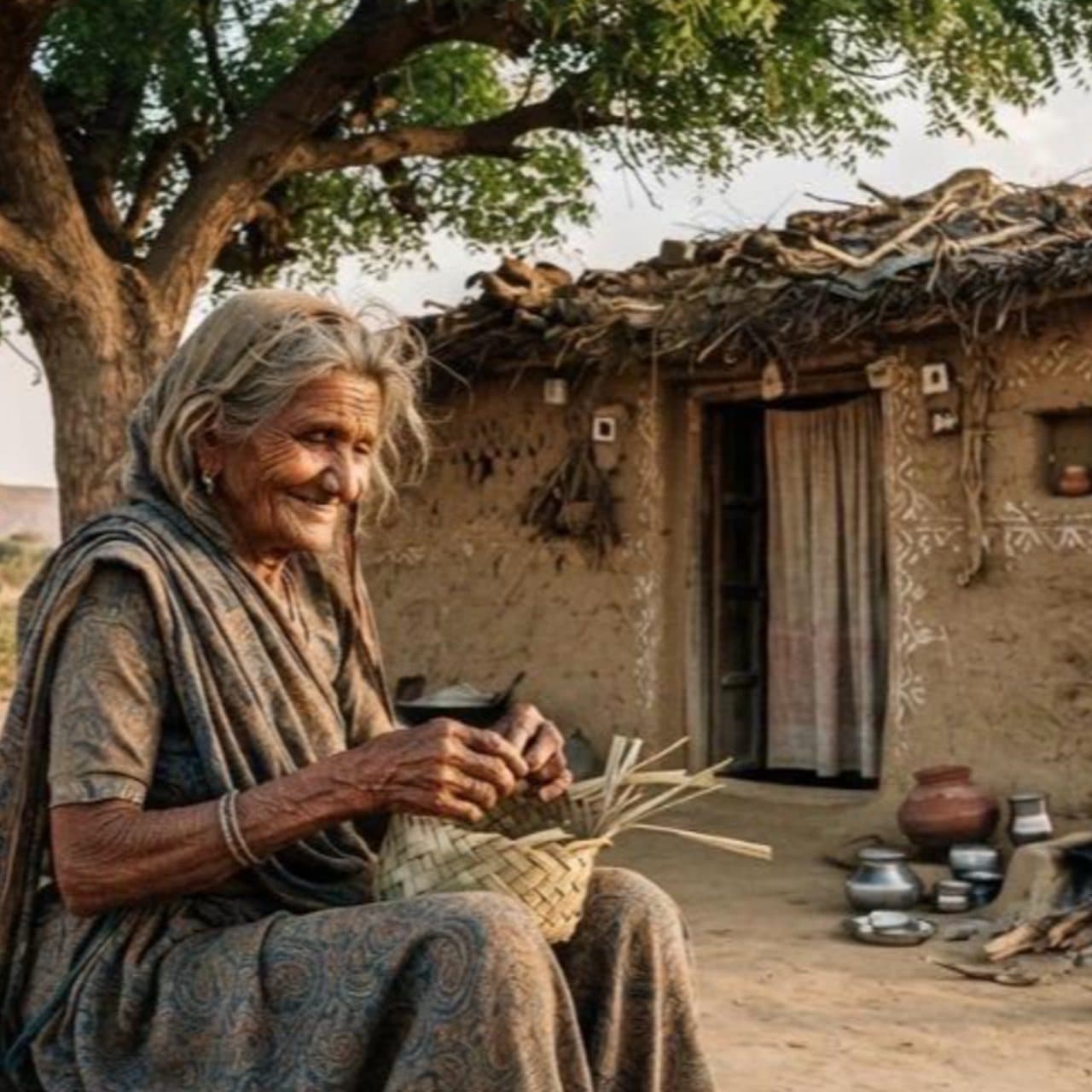

Almost a century ago, an elderly woman lived at the edge of the Sahara Desert beneath a solitary fig tree.
No one knew her age, yet her spine had undoubtedly grown old. Her skin had grown rough in the hot desert climate. Her face bore countless wrinkles that seemed to go on forever.
Her whole tribe had abandoned her.
She may once have had children, a husband, brothers and sisters, but her life had grown so long that almost no one remained by the time she became the well-known old lady under the fig tree.
She had nowhere else to go.
She built a small mud house beneath the fig tree. Though her house was hardly a proper house, it gave her shelter from the harsh desert winds, and its branches offered her some shade.
Now and then, tribesmen would pass by.
Some would be hunting. Some would be gathering sticks and twigs.
They would see her sitting under the tree.
She would look up,
Smile.
But she would not reach out to them.
She would not ask for food.
She would not ask for water.
She would not ask them to stay.
They would go, and she would remain beneath her tree.
The years would go by.
The winds would blow. The dunes would move. Summer would give way to Winter, and Winter would give way to Summer again.
One day she would be gone.
She had died quietly.
There was no funeral service. There was no headstone. There was no inscription.
Even her little house started to fade away.
Now and then the rain would make her house grow soft. The winds would make her house fall apart. The sand would slip through the cracks. The fig tree would grow. Putting out large roots.
In time, these roots would wrap around the house.
The years would stretch into decades.
She would be forgotten.
But the tree would not.
The tree would grow to an enormous size.
The branches would now spread over the spot where her little house once stood. Offering some shade.
Many years afterward, a family came passing through. One of the children was named Rima.
When the adults saw the crumbling mud, a fleeting thought of the old woman crossed their minds. Yet Rima looked down.
The ground felt cool.
She rested her hand on the ground.
Beyond the tree, the desert was intensely hot and bright with sun. But beneath the vast tree, the air felt different.
She would return.
And once more.
Before long, the tree had become her refuge.
She would sit beneath it with her water bottle and schoolbooks. She would read while the insects moved through the soil. She would remain there for hours.
As she got older, she began to wonder.
Why could the tree survive here?
Why was the soil darker?
Why is it that small plants sprout around the roots after it rains, but not in other places?
She began to grow curious.
Curiosity turned into research.
In time, this took her far from the desert.
She began to study botany. She grew captivated by plants able to survive in some of the harshest environments. In time she achieved considerable academic success and won a scholarship to go to Australia.
In Sydney, thousands of miles from her village, she found herself surrounded by laboratories, libraries and scientists from around the globe.
Even so, her thoughts often returned to the Sahara.
At times, staying late in the library, she would shut her eyes and picture the great fig tree.
The shade. The broken pieces of her home and the old woman.
Years afterward, she was offered a chance to go back.
Her doctoral research became tied to an international environmental project focused on restoring deserts, planting trees and growing suitable fruits in communities threatened by desertification.
She knew where to begin.
She went back.
This time she carried scientific equipment with her. She collected soil samples from beneath the tree and took additional samples farther away. She labelled them and analysed the soil's physical and chemical properties.
She was captivated.
The soil surrounding the old house was far richer than the barren soil located further away.
The pH level was at a good value. Organic matter was abundant. Key nutrients were present. The large canopy had kept the soil from evaporating. The leaves had dropped and broken down. The roots had grown, died off, and grown again. Microorganisms, insects, animals, moisture, and time had all played a part.
Although humans had regarded this area as empty, Nature had been quietly at work.
She started to experiment.
Carefully selected species were planted. They flourished.
More were planted. They grew.
She would gather some of the rich soil in gunny bags and place it in the dry gardens around her community. Mixing it carefully with the local soil helped create a thriving environment for vegetables and young fruit.
She would photograph.
Measure.
Compare.
Record.
Test.
Her passion for the tree had grown into her doctoral dissertation.
Her research set her apart and opened the way to a career in international environmental work.
Yet nothing mattered more to her than a single afternoon many years later.
She stood beneath the fig tree.
Flowers surrounded her. Young fruit trees had taken root and grown. Children played nearby, and a few students sat underneath with their books.
She looked down.
Beneath those massive roots, a small mud house had once stood.
Inside lived an elderly lady whom almost everyone had left behind.
Science could account for why the soil had changed.
Leaves had fallen and decomposed. The roots had recycled nutrients. Shade had retained the moisture. Organic matter had accumulated. Countless tiny organisms had transformed the ground.
She knew all of this.
She was a scientist.
And yet, there was something else.
The final dwelling of a forgotten woman had turned into the spot where a little child had learned to wonder.
Wonder had turned into knowledge.
Knowledge had turned into service.
Service had returned to the desert.
The old woman possessed nothing.
Nothing to possess. Nothing to make her wealthy. No monument. Not even a grave that could be identified.
Yet flowers blossomed beneath the tree where she had lived and died.
Fruits dangled from young branches. Children rested in the shade. At times Rima would watch from a distance and smile.
She never built a monument.
There was no need for one.
The tree was her monument. The garden was her memory.
Each new leaf would continue the story of a woman the world believed had left nothing behind.
But the earth had her remembered.