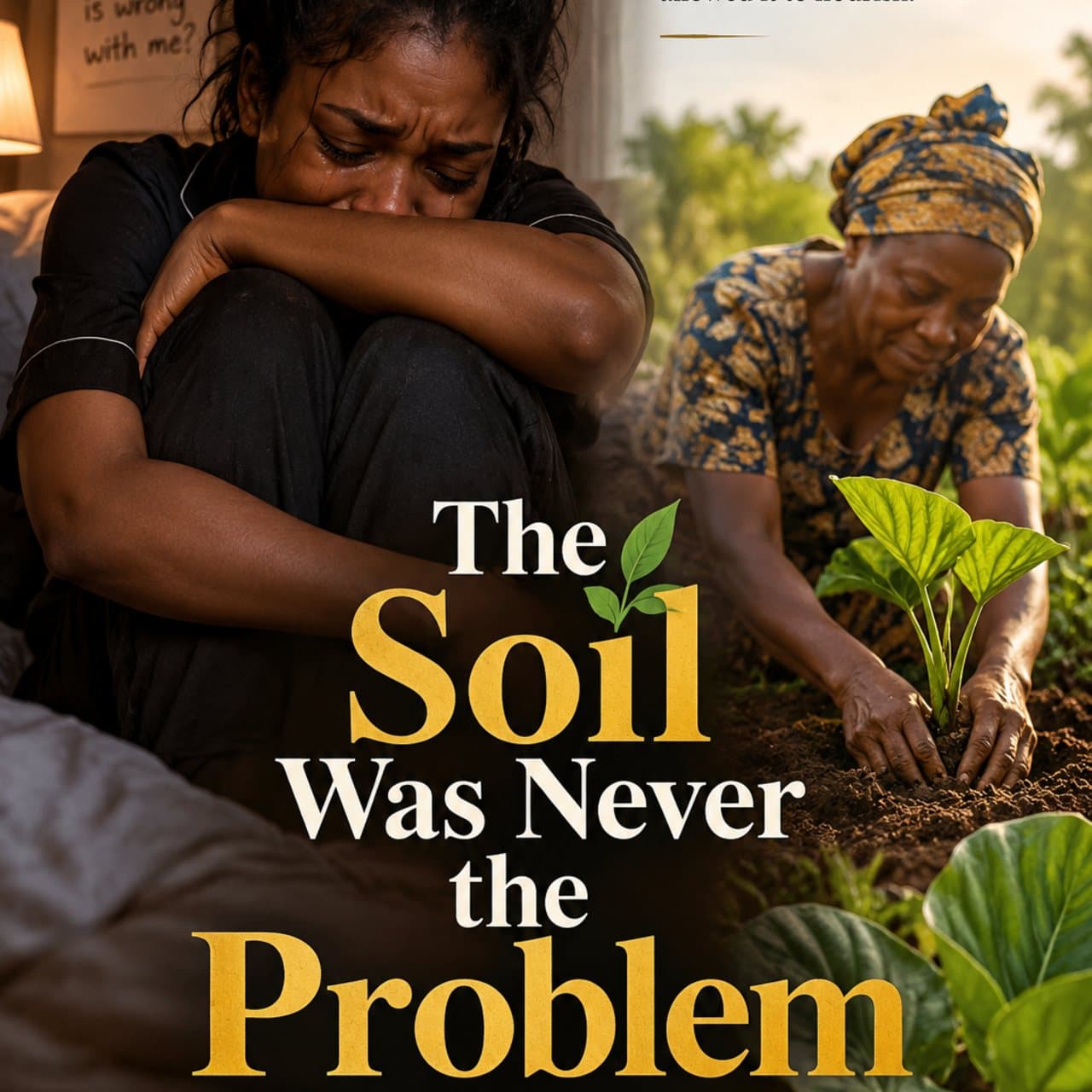
One afternoon, I stood in the garden watching my mother plant cocoyam.
She knelt in the earth, made a small hole with her fingers, placed the plant inside, and pressed the soil gently around its roots.
I watched her hands.
Then I looked at the plants already growing around her.
They belonged to the same family, yet they did not all grow under the same conditions.
Some needed more water.
Some needed deeper soil.
Some needed shade.
Others could survive where the ground was harder.
I did not know then that those simple plants were about to make me confront something I had buried for years.
There had been a night when I finally broke.
It had been a long day.
I had spent hours being the woman everyone expected me to be.
I answered questions.
I smiled.
I carried on.
But by the time I entered my room, I felt as though I had nothing left inside me.
I closed the door.
The moment the latch clicked, my body changed.
My chest suddenly tightened.
I tried to take a deep breath, but the air seemed to stop halfway down.
I loosened my clothes around my neck.
Still, I could not breathe properly.
I sat on the edge of the bed and pressed both hands against my chest.
“Calm down,” I whispered.
But my hands were trembling.
Then my lower lip began to shake.
I tried to stop it.
I couldn't.
A tear slipped down my cheek.
I wiped it away.
Another followed.
Then everything collapsed.
A sob tore out of me so violently that I bent forward.
I covered my mouth with my hand, terrified that someone might hear.
But the harder I tried to silence myself, the more my body shook.
My shoulders were trembling.
My fingers had gone cold.
My breathing became uneven.
I tried to stand, but my knees felt strangely weak, so I sank back onto the bed.
I pressed my palms against my eyes.
The tears kept coming.
My whole body seemed to be crying before my mind could catch up.
I gasped for air between sobs.
I could feel my heart pounding against my ribs.
For several moments, I could not even form a complete sentence.
Then, through the tears, I whispered the words I had been carrying for years.
“What is wrong with me?”
The question came out broken.
I said it again.
“What is wrong with me?”
Then I completely lost control.
I slid from the bed onto the floor.
My back rested against the side of the mattress.
I pulled my knees towards my chest and buried my face against them.
I could not remember the last time I had cried like that.
There was no graceful wiping away of tears.
No quiet sadness.
My face was wet.
My nose was running.
My breathing was coming in short, broken bursts.
I was shaking so badly that I had to grip the edge of the bed to steady myself.
And underneath all of it was one unbearable thought:
Maybe I had spent all these years trying so hard, and it still wasn't enough.
That thought hurt more than anything.
I pressed my forehead against my knees.
For a moment, I wished I could disappear.
Not die.
Just disappear from the expectations.
From the comparisons.
From the pressure to keep proving that I was doing well.
From the exhausting responsibility of appearing strong when I did not feel strong at all.
Then came the shame.
It arrived after the storm.
I slowly lifted my head.
The room was silent.
I looked at my hands.
They were still trembling.
I wiped my cheeks and stared at the tears on my fingers.
And suddenly I felt embarrassed.
Embarrassed that I had lost control.
Embarrassed that I had allowed myself to become this vulnerable.
Embarrassed that the woman who could handle so much had ended up sitting on her bedroom floor, struggling to catch her breath.
I looked towards the mirror.
My eyes were swollen.
My face was wet.
My hair was dishevelled.
I hardly recognised myself.
I immediately stood up and began cleaning my face.
I washed it once.
Then again.
I splashed cold water onto my cheeks until my skin felt numb.
I looked at myself and whispered,
“Nobody must know.”
That sentence stayed with me.
Because the next morning, I did exactly what I had always done.
I got up.
I dressed.
I smiled.
I continued.
Nobody knew that the night before, my knees had given way beneath me.
Nobody knew that I had sat on my bedroom floor shaking.
Nobody knew that I had been fighting for air between sobs.
Nobody knew how frightened I had been by my own helplessness.
And I carried the shame of that night quietly.
Until years later, when I stood beside those cocoyam plants.
My mother was still working the soil.
She did not rush.
She did not compare one plant with another.
She simply gave each one what it needed.
And suddenly, something inside me became painfully clear.
I had spent years looking at other people's harvests and blaming myself for not producing the same fruit.
I had never stopped to ask whether we had been planted in the same soil.
That question changed everything.
Because perhaps I had not failed.
Perhaps I had been trying to flourish in conditions that were never right for me.
Perhaps my exhaustion had not been weakness.
Perhaps my tears had not been shameful.
Perhaps that night my body had simply said what my mouth had been too proud to admit:
“I cannot carry everything anymore.”
I looked at the small cocoyam plant in my mother's hand.
It did not look impressive.
It did not look powerful.
But beneath the soil, unseen roots were beginning their work.
And I realised something about my own life.
There had been seasons when I thought nothing was happening.
I was wrong.
Something was happening beneath the surface.
I was learning.
Enduring.
Changing.
Finding myself.
Growing roots.
The cocoyam taught me that belonging to the same family does not mean needing the same soil.
And perhaps that is true of people too.
We can begin from similar places and still require completely different conditions to flourish.
So I no longer look at another person's harvest and use it to condemn my own season.
I remember the woman sitting on the floor that night.
I remember her shaking hands.
Her swollen eyes.
Her desperate attempt to silence her sobs.
And instead of feeling ashamed of her, I feel tenderness for her.
She was not weak.
She was overwhelmed.
She was carrying more than she had allowed herself to admit.
And she survived the night.
That matters.
Because sometimes the seed does not need to be changed.
Sometimes the soil does.