
Until the same situation touches us differently.
That is when things become interesting.
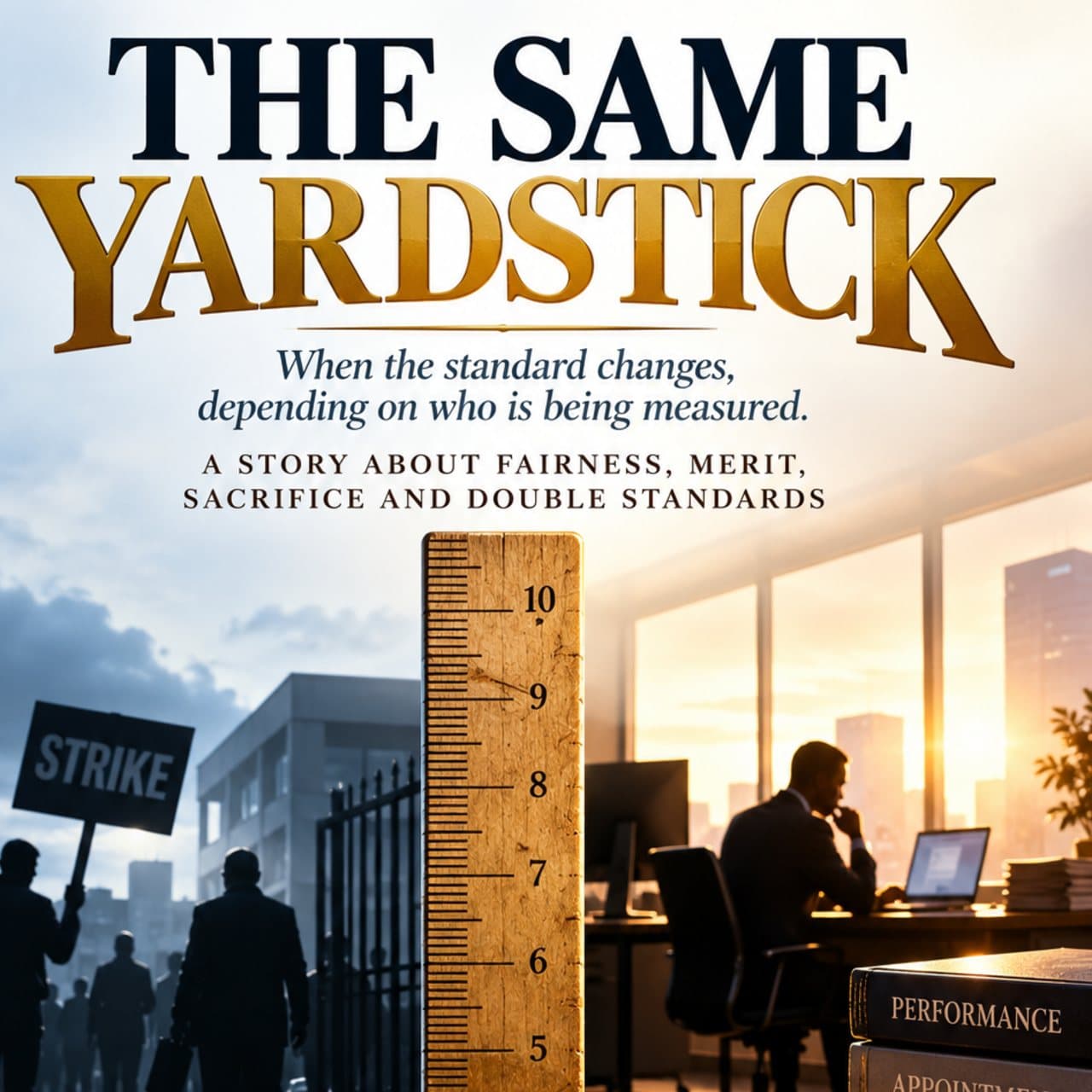
Take a workplace during a strike.
The decision is collective. Workers are expected to withdraw their services and stay away from work so that the institution will feel the weight of their absence.
And so, on that morning, the familiar workplace becomes strangely quiet.
The corridors lose their usual movement. Offices remain closed. Desks sit untouched.
But not everyone stays away.
Some people still walk through the gates.
They take their seats, switch on their computers,and begin the day's work.
There are files that cannot wait.
There are calls that must be answered.
There are responsibilities that still have to be carried.
They work quietly while the strike continues around them.
Perhaps they are protecting essential services. Perhaps they have personal reasons. Perhaps they simply believe that certain duties must still be performed.
Whatever the reason, the institution continues to breathe.
It does not come to a complete standstill.
And then the month draws to a close.
Payday arrives.
Everyone has bills.
Everyone has responsibilities.
Everyone has somewhere their salary needs to go.
The salary arrives, and with it comes relief.
But beneath that relief lies a question that is easy to avoid:
What happens when we want the benefits of a system that we are simultaneously trying to bring to a standstill?
It is not an easy question.
Perhaps a strike is meant to demonstrate collective strength. Perhaps the people who continue working are simply ensuring that essential services survive. Perhaps there are legitimate reasons for the different choices people make.
But whatever the explanation, one thing becomes clear.
The moment a principle meets real life, it becomes more complicated.
And that is where the story moves beyond the strike.
Because the same tension appears whenever we begin talking about standards.
Especially the standard we call performance.
In the workplace, performance can determine who moves forward and who remains where they are.
Someone works for years.
They gain experience.
They wait for an opportunity.
Then a position becomes available.
They hope.
They apply.
And eventually, they are told that their performance does not meet the required standard.
It hurts, but at least the reason appears clear.
There is a measure.
There is a yardstick.
The person may walk away disappointed, but perhaps with the belief that the standard is the standard.
Until another appointment is made.
Someone else receives the position.
And questions begin to circulate about that person's performance too.
That is the moment the earlier decision takes on a different meaning.
The person who was denied may not be asking why someone else was chosen.
They may be asking something much more fundamental:
Was the same standard applied to both of us?
And suddenly, the question raised by the strike returns.
Who decides when a principle applies?
When is an exception justified?
When does a difference in circumstances explain a different outcome, and when does it simply look like a different rule for a different person?
These are uncomfortable questions because the answer is not always obvious.
People have different experiences.
Decisions may involve information that is not visible to everyone.
Two situations that appear similar from the outside may not actually be identical.
That is why fairness requires more than simply announcing a rule.
It requires consistency in how that rule is understood and applied.
Otherwise, people begin to lose confidence.
The person who was denied an opportunity may wonder whether performance truly mattered.
The person who watched the appointment may wonder whether merit was being applied consistently.
And the people watching from the outside begin to form their own conclusions.
This is how trust can quietly disappear.
Not through one dramatic event.
Not through one angry confrontation.
But through a series of moments when people begin to feel that the measure changes depending on who is being measured.
That is the danger of the double standard.
It can make a reasonable decision look unreasonable.
It can turn disappointment into suspicion.
And it can make people question whether hard work, sacrifice and performance really mean what we say they mean.
That is why I keep returning to the image of a yardstick.
A yardstick has no favourite.
It does not know the person being measured.
It does not become longer because the person is powerful.
It does not become shorter because the person is unknown.
It simply measures.
Perhaps our standards should be like that.
If performance is important, it should matter consistently.
If sacrifice matters, it should be recognised honestly.
If a rule is important enough to impose on others, we should be prepared to live by it ourselves.
That does not mean everyone must receive the same outcome.
Fairness does not promise identical results.
It asks something more difficult.
It asks whether the reasoning behind those different outcomes can withstand the same scrutiny.
Because it is easy to believe in fairness when we benefit from it.
It is harder when we are the ones who lose.
It is easy to defend a standard when it protects someone else.
It is harder when the same standard stands between us and an opportunity.
And perhaps that is the true test.
Not what we say when the rules work in our favour.
But what we say when the same rules work against us.
So before we ask whether a decision is fair, perhaps we should ask one simple question:
Would I still consider it fair if I were standing on the other side?
If the answer is yes, then perhaps we have found something stronger than convenience.
We have found principle.
Because circumstances may change.
People may change.
Positions may change.
But if fairness is truly what we seek, perhaps one thing should remain constant.
The same yardstick.