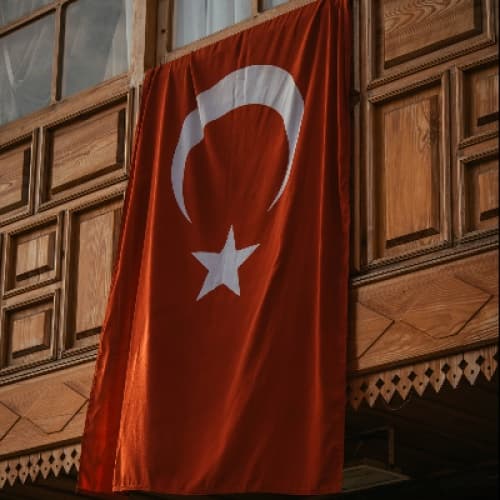

The wind of the Central Asian plains sang a sorrowful song. It swept through the grass like whispers of ghosts, carrying the scent of smoke, death, and broken dreams. Beneath the vast blue sky, the banners of the Kayı tribe fluttered torn, burned, and bloodstained.
The Mongols had come like locusts endless, merciless, unstoppable.
Their arrows darkened the sun, their horses trampled kingdoms, their swords silenced tribes that had survived for centuries.
Now, only a few hundred Kayı tents remained, scattered along the riverbank near the great Euphrates. Children wept. The elderly prayed. Warriors sharpened blades dulled by too many battles.
In the midst of this chaos, Ertuğrul, son of Suleyman Shah, stood upon a hill, his wolf-skin cloak flapping in the wind. His face was marked with exhaustion, yet his eyes still burned with defiance.
Below him, a funeral pyre crackled flames devouring the body of his father. The old Bey had died trying to lead his people across the raging Euphrates, swept away by the cold waters of fate.
As the smoke rose to the heavens, Ertuğrul dropped to one knee, grasped the earth with trembling hands, and whispered:
“Father… your body may rest beneath the soil, but your dream will not.
I swear before the Eternal Sky the Turk will not vanish.”
He drew his sword and held it upright, the crescent-shaped blade glinting in the dying sun.
“By this sword,” he said, voice low but strong,
“I take The Oath.
I will lead our people to a land where no enemy will chain us again.”
The warriors who gathered around him bowed their heads.
None spoke, but their eyes told the same story of loyalty, of hunger, and of a fierce, stubborn hope that refused to die.
That night, the sky was an ocean of stars. The cold bit deep into flesh, yet Ertuğrul could not sleep.
He stood outside his tent, staring toward the west the direction the wolf in his dream had led him.
The dream had come three nights in a row.
A gray wolf with eyes like fire stood atop a mountain. It howled to the west, where the sun sank in golden flame, and when it turned to Ertuğrul, its gaze was neither beast nor spirit but destiny itself.
He knew the meaning.
Tengri, the Sky God, was guiding him calling him to the unknown lands beyond the mountains.
But others saw only madness.
At dawn, the council of elders gathered in the largest tent. The air was thick with incense and grief.
Among them sat Sungurtekin, Ertuğrul’s elder brother proud, sharp-tongued, and bitter from loss.
“Enough of dreams,” Sungurtekin said, slamming his palm on the wooden table. “We have lost our father, our land, and half our warriors. The Mongols are near. We cannot fight the wind, brother.”
Ertuğrul met his gaze calmly. “Then would you have us kneel?”
Sungurtekin’s jaw tightened. “I would have us survive. We can join the Dodurga tribe seek refuge. Or pledge loyalty to the Mongols until the storm passes.”
“The Mongols know no loyalty,” Ertuğrul said coldly. “They burn their allies and enslave their friends.”
An elder, old and weary, sighed. “Ertuğrul Bey, your courage is known, but the west is unknown land. Beyond the mountains lie Byzantine lords, strange tongues, strange gods. What will you find there but death?”
Ertuğrul rose slowly. His shadow fell across the tent as sunlight streamed through the flaps.
“Death comes whether we wait or march.
But honor — honor lives only in those who walk toward destiny.”
He turned to his warriors Turgut, the fierce axeman; Bamsı, loyal and fearless; Doğan, quick as the wind.
They placed their right hands over their hearts.
“Where you go, Beyim,” Turgut said, “we go.”
The elders murmured. Sungurtekin’s expression darkened. But the tribe began to shift that morning. Horses were saddled. Tents were packed. Mothers whispered prayers.
The Kayı were moving — not away from death, but toward a dream.
Days passed as they journeyed west. The steppes turned to rocky hills, then forests. Food was scarce; wolves stalked the nights. Many times, they faced raiders desperate men who had lost everything.
Yet through it all, Ertuğrul rode at the front, his crescent sword gleaming in the sun.
One night, as the tribe rested near a valley, they saw smoke in the distance. Ertuğrul led a small party to investigate.
There by the flicker of fire stood a scene of horror.
A group of Byzantine soldiers had ambushed a caravan, slaughtering the guards. A handful of prisoners women and children knelt in chains.
Among them was one woman who did not bow. She stood tall despite the blood on her face, her dark eyes burning with defiance.
When the Byzantines mocked her, she spat at their leader’s boots.
Ertuğrul watched from the shadows, heart pounding.
He whispered to his men,
“Turgut, take the flank. Doğan, the archers.
Tonight, the wolf hunts.”
With a cry that echoed across the valley, the Kayı warriors charged from the darkness.
Steel clashed. Arrows flew. The Byzantines, unprepared for the fury of the Turks, broke ranks.
When the dust cleared, the captives were free.
The woman looked at her rescuer the tall warrior with the crescent sword and whispered,
“Who are you?”
Ertuğrul wiped his blade clean and sheathed it.
“A son of the steppe,” he said softly. “A man who follows his oath.”
She stared at him for a long moment, then bowed her head.
“Then may God bless the path you walk. My name is Halime.”
And so, on that night beneath the cold stars, the Oath of the Turks found its second guardian a woman of courage and a man of destiny.
The next morning, as the sun rose over the distant mountains, Ertuğrul looked west once more.
The wolf of his dream appeared at the edge of the forest silent, watching.
Ertuğrul smiled faintly.
“Lead the way, old friend,” he murmured. “We will not stop until the Turks have a home again.”
And so began the long march toward Söğüt toward empire, honor, and legend.