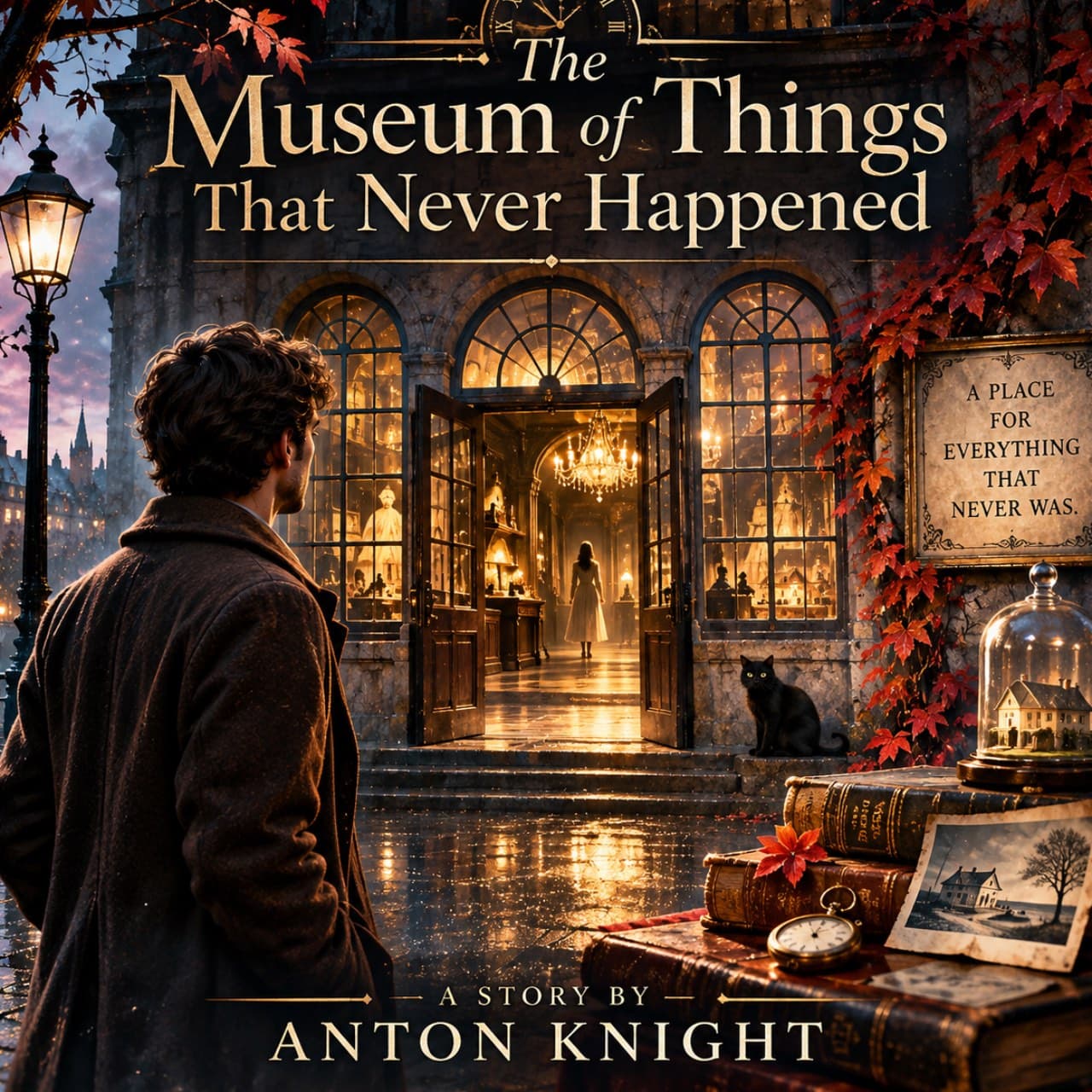

Genre: Magical Realism · Dark Fantasy · Mystery · Psychological Fiction Setting: An old European city, an abandoned museum, and a world suspended between memory and time.
I. The Museum at the End of the Street
There was a museum at the end of Bellweather Street that nobody remembered visiting.
It had stood there for as long as anyone could recall, occupying an enormous stone building between an abandoned railway station and a narrow canal. Its architecture belonged to another century. Tall arched windows overlooked the street, their glass permanently clouded by dust. Above the entrance, carved into the limestone, were six words:
A PLACE FOR EVERYTHING THAT NEVER WAS.
People walked past it every day. Some believed it had once been a natural history museum. Others insisted it had been a private collection belonging to a wealthy family. A few claimed it had never opened at all.
Yet every evening, precisely at 6:17, a warm golden light appeared behind its windows.
And every morning, it disappeared.
Arthur Vale had never been particularly interested in museums. He preferred railway stations, old cafés, secondhand bookstores, and places where people seemed to be waiting for something they could no longer name.
But on a rainy Thursday afternoon, he received a letter. There was no return address. The envelope was red, its edges softened by age. His name had been written in elegant handwriting, although he could not recognize it.
Inside was a single sentence:
You have forgotten something here.
Beneath it was an address.
Bellweather Street.
Arthur read the letter several times. Then he looked toward the window.
Across the street, a woman in a red coat was standing beneath a streetlamp. She was holding an umbrella, although it wasn’t raining where she stood.
When Arthur blinked, she was gone.
II. Admission Is Free
The museum’s entrance was unlocked. A small brass bell rang when Arthur pushed the door open.
Inside, the air smelled of polished wood, old photographs, and something faintly sweet, like flowers left too long in a closed room.
A reception desk stood beneath a magnificent chandelier. Behind it sat an elderly woman with silver hair. She was reading a newspaper that appeared to be several decades old.
“Good afternoon,” Arthur said.
The woman lowered her newspaper.
“You’re late.”
Arthur glanced at his watch.
“I didn’t know I had an appointment.”
“Nobody ever does.”
She opened a large leather-bound register.
“Name?”
“Arthur Vale.”
Her finger moved down the page.
“Yes. Here you are.”
She turned the register toward him. His name appeared on the final line. Beside it was a date.
November 10, 1986.
Arthur frowned.
“That’s impossible.”
“Most things in this building are.”
The woman reached beneath the desk and produced a small brass key.
“Second gallery. Room number seventeen.”
Arthur took it.
“What’s in there?”
The woman returned to her newspaper.
“Something you left behind.”
As Arthur walked away, she spoke again.
“One more thing.”
He turned.
“Whatever you see, don’t try to correct it.”
“Why?”
She looked at him with an expression that was almost sadness.
“Because some things become real only when someone remembers them.”
III. The Exhibition of Unfinished Lives
The first gallery contained hundreds of glass display cases. Inside them were objects that seemed entirely ordinary. A wedding invitation. A broken pocket watch. A child’s drawing of a house. A pair of blue gloves. A train ticket with no destination. Each object had a small description beneath it.
THE WEDDING THAT WAS NEVER CELEBRATED.
THE LAST CONVERSATION THAT NEVER TOOK PLACE.
THE HOUSE THAT WAS NEVER BUILT.
Arthur stopped before a photograph. It showed a young man standing in front of a seaside hotel. He wore a dark coat and held a suitcase.
Arthur recognized the man immediately. It was himself.But the photograph was dated 1972. He stepped closer. The man in the photograph was looking directly into the camera, smiling. Arthur had never been to that hotel. He had never owned that suitcase. And yet he remembered the smell of the sea. He remembered the cold wind. He remembered someone standing beside him, laughing.
A name surfaced in his mind. Margaret. He hadn’t heard that name in thirty years. Perhaps longer.
A faint sound came from the corridor. Footsteps. Then a whisper.
“Chut.”
Arthur turned.
A little girl stood at the far end of the gallery. She wore a yellow dress and carried a paper boat.
“Are you lost?” he asked.
The girl shook her head.
“No. I’m waiting.”
“For whom?”
She looked at him.
“For the man who promised he would come back.”
Then she disappeared behind a doorway.
IV. Room Seventeen
The second gallery was darker.
A long corridor stretched toward a single wooden door. A small plaque identified it:
ROOM 17 — THIS SECTION IS PROHIBITED.
Arthur examined the brass key. It fitted perfectly.
Inside was a living room. His living room. The same faded green wallpaper. The same wooden floorboards. The same fireplace that had stood in his childhood home. Except the room was immaculate. A record player rested on a small table. A cup of tea sat beside it. And on the sofa was a woman.
She appeared to be in her early thirties, wearing a simple white blouse and a long dark skirt. Her hair fell loosely over her shoulders.
She looked up.
“Arthur.”
He couldn’t speak.
The woman smiled.
“You took your time.”
“Margaret?”
She nodded.
For several seconds, neither moved.
Then Arthur approached her.
“I thought you were…”
“Don’t.”
Her voice was gentle.
He sat opposite her.
Outside the window, the rain had stopped.
“How is this possible?” he asked.
Margaret looked toward the fireplace.
“Do you remember the summer we planned to leave?”
Arthur swallowed.
The memory returned slowly. A small apartment near the sea. A train ticket. Two suitcases. A future they had imagined in extraordinary detail. He remembered the promise. He remembered the railway station. And then he remembered something else. He had never arrived.
“I waited,” Margaret said.
Arthur lowered his eyes.
“I know.”
“No. You don’t.”
She stood and walked toward the window.
“You spent your entire life remembering the things that happened. But what about everything that almost happened?”
He had no answer.
“Do you remember the little house?”
“The one near the water?”
“Yes.”
“The garden?”
“With the apple tree.”
“And the blue door.”
Margaret smiled.
“You remember.”
Arthur looked around.
“Why is this place showing me these things?”
She turned toward him.
“Because this museum doesn’t collect objects, Arthur. It collects possibilities.”
V. The Curator of Forgotten Futures
A clock began ticking somewhere behind the walls.
Arthur noticed that the hands were moving backward.
“How much time do I have?” he asked.
Margaret didn’t answer.
The door opened.
The elderly woman from the reception desk entered carrying a small silver tray.
“Tea?”
Arthur stared at her.
“Who are you?”
“The curator.”
“What’s happening?”
She placed the tray on the table.
“Every person has several lives. The one they live, the ones they imagine, and the ones that disappear before they can begin.”
She gestured toward Margaret.
“Some possibilities are too important to vanish completely. So we preserve them.”
Arthur looked at the woman.
“Is Margaret real?”
The curator considered the question.
“More real than you think. Less real than you wish.”
Arthur stood.
“Can I take her with me?”
The curator’s expression changed.
“No.”
“Why not?”
“Because she belongs to a moment that no longer exists.”
Arthur turned toward Margaret. She was looking at him with the same expression he remembered from the railway station. Not anger. Not disappointment. Something quieter. Something that had survived longer than either of them expected.
The curator approached the door.
“Visitors must leave before the final bell.”
“What happens then?”
“The museum closes.”
Arthur looked at the clock.
6:16.
The curator paused.
“And when it opens again, someone else will come looking for something they cannot name.”
VI. The Last Exhibition
Arthur noticed a final display case near the door. It had been covered with a black velvet cloth. He pulled it away.
Inside was a small wooden house. It was beautifully made, with tiny windows, a blue front door, and an apple tree in the garden. A miniature version of the life he and Margaret had planned. Beneath it was a handwritten description:
THE LIFE OF ARTHUR VALE AND MARGARET ELLIS.
Two people who intended to grow old together. Never completed.
Estimated duration: Forty-seven years.
Arthur stared at the words. Forty-seven years. A lifetime. He looked toward Margaret.
She was standing beside the window again.
“Did we have children?” he asked.
She smiled.
“A daughter.”
“What was her name?”
“Clara.”
Arthur closed his eyes.
He could almost hear a child running through the garden. He could almost smell fresh bread in the kitchen. He could almost feel the warmth of another person’s hand in his. But none of it had happened. And somehow, that made the memory no less beautiful.
The bell rang.
Once.
Margaret approached him.
“Arthur, listen to me.”
He looked at her.
“You cannot spend your remaining years searching for a life that never happened.”
“But I remember you.”
“Then remember me properly.”
She took his hand.
“Not as the woman you lost. As the woman who loved you in every life we never had.”
The bell rang again.
The museum lights began to fade.
Arthur leaned forward, but Margaret gently stepped away.
“Will I see you again?”
She considered the question.
“Perhaps. But not here.”
“Where, then?”
She smiled.
“Somewhere you haven’t been yet.”
And with those words, the room became dark.
VII. The Things We Carry
Arthur found himself standing outside the museum. The rain had stopped. The streetlights reflected in the wet pavement. A tram passed in the distance, its windows illuminated like small moving rooms.
He looked at his watch. 6:17. The museum doors closed behind him. He turned to look at the building. Every window was dark.
The following morning, Arthur returned. There was no museum. Only an empty stone building with boarded windows and a faded sign above the entrance. A real estate notice had been attached to the door.
PROPERTY CLOSED SINCE 1972.
Arthur stood there for a long time. Then he noticed something beneath the notice. A small envelope. Yellow. His name was written across it. Inside was a photograph. It showed a little wooden house beside the sea. A woman stood in the garden, holding the hand of a little girl. A man was standing behind them. Arthur recognized all three.
On the back of the photograph, someone had written: Somewhere, in a life that never happened, we are still waiting for you. He placed the photograph inside his coat and began walking.
For the first time in many years, he didn’t feel the need to look behind him.
VIII. The New Arrival
Several months passed.
Arthur moved to a small apartment overlooking the canal. He bought flowers on Saturdays, learned to cook properly, and began taking long walks through unfamiliar streets.
He never spoke about the museum.
But every evening, at precisely 6:17, he placed a cup of tea beside the window. Not because he expected anyone to arrive. Simply because some rituals deserved to survive.
One winter afternoon, while browsing through an old bookshop, he discovered a photograph tucked between the pages of a novel.
It showed the museum. The building stood beneath a clear summer sky. On its front steps sat the elderly curator. And beside her stood a young woman Arthur had never seen before. She was holding a small envelope. On the back, in handwriting he now recognized, were four words:
THE NEXT STORY BEGINS.
Arthur turned the photograph over. A new sentence had appeared beneath the first.
There are places where the past waits, but there are also places where the future comes looking for you.
He looked toward the shopkeeper.
“Where did this come from?”
The old man adjusted his glasses.
“An interesting thing about that photograph.”
“What?”
“It was taken tomorrow.”
Arthur looked down again.
The young woman in the picture was no longer standing beside the curator. She was standing behind him.
He slowly turned.
Nobody was there. Only a narrow corridor leading toward the back of the bookshop. At its end stood a blue door.
Arthur approached it.
A small brass plaque had been attached to the wood.
ADMISSION IS FREE.
He placed his hand on the handle.
From the other side came a familiar whisper.
“Chut.”
Then a voice he had never heard before.
“Arthur Vale?”
He opened the door.
And somewhere, beyond the ordinary boundaries of time, another impossible story began. Somewhere between what happened and what might have been, there is a place where nothing is ever truly lost. Perhaps the greatest mystery of life is not the future we cannot see, nor the past we cannot change, but the quiet possibility that somewhere, somehow, another version of ourselves is living the story we were once afraid to begin.