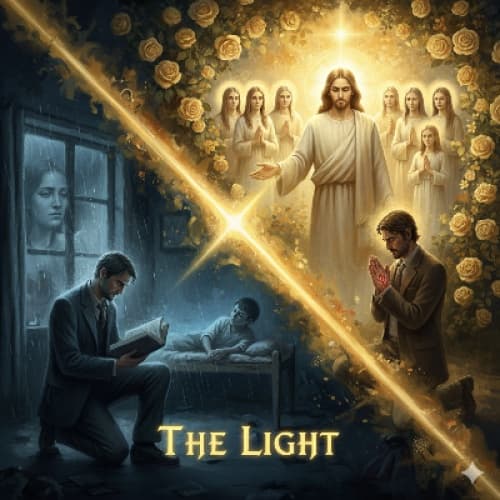
Chapter 1: The Failure of Method in Calcutta
The air in Chowringhee was thick with the smell of dust, diesel, and decaying grandeur. Mr. Michael Axiom, a man who treated faith as a series of logical propositions, was failing. His "case," young Rohan Bose, was not improving.
The entity spoke through Rohan not with a roar, but with a whisper that cut deeper than any scream. "You catalogue sins like a accountant, Michael. But you never look at the ledger for your own life. Your sister's face, in the rain... you remember the cost of your hesitation. Why should this boy trust your speed now?"
The breath left Michael's body. This was not a generic taunt. It was a specific, private memory, a truth he had never spoken aloud. His meticulously rehearsed rites faltered. The holy water felt like mere water in his hand. He saw the hope in Mrs. Bose's eyes curdle into a pity that mirrored his own for himself. The failure was absolute, and worse, it was deserved.
That night, surrounded by the theological schematics of his notes, he did not pray. He presented a final argument to the silent universe. "The data is conclusive. My method is flawed. The hypothesis of my calling is false. Show me a variable I have not considered, or the experiment is over." It was a surrender not of faith, but of intellectual pride.
And the universe answered. Not with a feeling, but with a fact. The air in the room became perfectly, impossibly still, as if time itself had been paused. Then, a light—not bright, but deep, as if the fabric of reality had become translucent to a greater truth behind it—began to fill the space. It was the most objective thing Michael had ever witnessed.
Chapter 2: The Garden: An Overwhelming Data Set
The garden was not a place of sentiment, but of supreme order. A rose was not just beautiful; it was a perfect expression of its own "rose-ness," its scent a complex equation of attraction and life. The air hummed with the coherent frequency of existence.
The thirteen figures were less individuals and more a constellation of completed human natures. And at their center—Yeshua. To look at Him was to understand the concept of "reference frame" in physics; all truth, love, and being were defined relative to Him. He was the axiom from which all else was derived.
Michael, the empiricist, crumpled. His mind, built to analyze, could only record: This is true. This is fundamental.
"Michael," Yeshua said, and the voice contained the specific weight of Rohan's fear, Mrs. Bose's disappointment, and Michael's own shame, all held in a perfect, unconditional embrace. "Your failure was in the premise. You believed you were a warrior bringing a distant light. You are a witness stating a local fact."
Peter, smelling of salt and honest sweat, laid a calloused hand on his shoulder. "We all wanted to be heroes. He only asked us to be real."
Then came the core of the revelation. "My love is not a reward. It is a law of your being, as gravity is a law of your mass. You can deny it, but you cannot escape its effects."
"But the demons," Michael protested, his intellect making a final, desperate stand. "The texts, the tradition—they speak of rebellion, of eternal fire! How can your law include that?"
Yeshua’s gaze was a silent correction. "They are the children who have run the farthest into the cold, screaming that the winter is my creation. The 'fire' is the pain of their own isolation, a truth they cling to because it feels like power. My grace is the persistent, ambient heat of the sun upon their backs, even now. Hell is their choice to shiver in a shadow of their own making."
As this new, terrifying logic rewired his understanding, the evidence became physical. A searing pain across his brow, the sensation of profound, structural pressure in his palms. These were not symbolic wounds; they were the tangible transfer points of a cosmic burden—the literal, physical consequence of the divine touching a reality fractured by lies. He was not being punished; he was being calibrated.
Yeshua lifted Michael's newly scarred hands. "Go. Your new method is to demonstrate, not to fight. Prove that the shadow, by its very existence, confirms the light."
Chapter 3: The Proof of Concept in Rome
The Convent of Santa Cecilia was a fortress of old fears. Sister Lucia, her face a map of doctrinal suspicion, stared at Michael's wounds. "Stigmata. A high claim. It can be a symptom of hysteria, not holiness."
"The phenomenon is verifiable," Michael replied, his voice unnervingly calm. "It is the empirical residue of an encounter with the foundational substance of reality. You could call it Love."
In the cell, Sister Benedetta was a vortex of anguish. A bruise-blue light pulsed around her, not flickering, but burning with a steady, despairing intensity.
Michael did not command. He presented. He stood where the entity could see his scarred palms.
"I am not here to condemn you," he stated, his voice a neutral channel. "I am here to state a fact that your entire existence depends upon. The Being you oppose is, at this moment, holding you in a state of unconditional regard."
The entity's voice was a symphony of shattered logic. "We are condemned! We are the necessary counterpoint! We are outside the system!"
"You are a paradox that believes its own contradiction," Michael replied, the heat beginning to radiate from his palms. "You define yourself by His absence, but your very rage proves your connection to the source of all meaning. Your loneliness is the evidence of your belonging. Look at this data." He gestured to his own hands, the wounds now glowing with a soft, golden light. "This is the physical proof that the cost of your isolation has already been paid. The system is closed, and you are inside it."
The entity did not roar. It screamed—a sound of pure, undiluted grief, the sound of a lie collapsing under the weight of a truth it could no longer deny. "We are... unlovable! We are the flaw!"
"The love is not a verdict on your state," Michael whispered, stepping forward and placing his glowing hand on the nun's icy forehead. The contact was not an attack, but a completion of a circuit. "It is the ground of your being. In the name of Yeshua, the embodied Axiom, I affirm the truth you deny: you are irrevocably His."
The blue light did not flee. It unclenched. It dissolved into the emerging gold like a drop of ink in the ocean, becoming part of the very thing it sought to stain. When the light faded, Sister Benedetta was weeping, cleansed not of a demon, but of a falsehood.
"The Love..." she gasped, her eyes clear for the first time in years. "It wasn't a reward for getting better. It was the reason I could breathe at all."
Chapter 4: The New Ministry: Practical Applications
Back in Calcutta, Michael's "stigmata" was now a transient, on-demand phenomenon—the ultimate Q.E.D. in his spiritual proofs.
Mrs. Bose wrung her hands. "The blue light... it's fainter, but it's a stubborn habit. It whispers to him that he is broken."
"Then we will not fight the habit," Michael said. "We will enlighten it."
He sat with Rohan. He didn't perform a rite. He had a conversation. "The 'visitor' is a part of you that believes a lie—the lie that some parts of you are too dark to be loved. My encounter proved that lie is mathematically false."
He then spoke directly to the flickering blue energy in the room, not as an enemy, but as a misguided colleague. "Your data is incomplete. You perceive separation where there is only connection. Your function is not to torment, but to signal a need for integration. Come, and I will show you the complete equation."
It was a painstaking process of re-education. Mrs. Bose, watching, saw not a battle, but a healing—a slow, deliberate re-ordering of her son's soul as the fearful fragment was gently reasoned back into the whole.
Chapter 5: The Unified Theory
Five years later, in The Sanctuary of Unconditional Grace, the air was clear. Rohan, now a serene and capable young man, arranged fresh flowers before a simple stone altar.
"The most liberating fact," Rohan said, "was realizing the Love was true even when I felt most false. It changed the problem from 'how do I become good enough?' to 'why did I ever believe I wasn't?'"
Michael nodded. "We were not redeemed from anything. We were awakened to everything."
The Sanctuary was a living laboratory of this principle. Sister Benedetta, now a renowned scholar of transformative spirituality, visited frequently. "My possession was a state of radical, logical error," she would explain. "Michael provided the missing proof, and the error could not sustain itself."
As the sun set, its light streamed through a stunning stained-glass window where intricate blue patterns swirled into and were completed by a field of gold. Michael felt a familiar warmth in his palms—not the searing pain of the Garden, but a gentle, confirming heat, a real-time feedback loop affirming his alignment with the Axiom.
He had not found a better weapon. He had discovered a more fundamental law. By being forced to surrender his skepticism to a reality more real than himself, he became the ultimate testament to a truth that needed no defense, only demonstration.
---