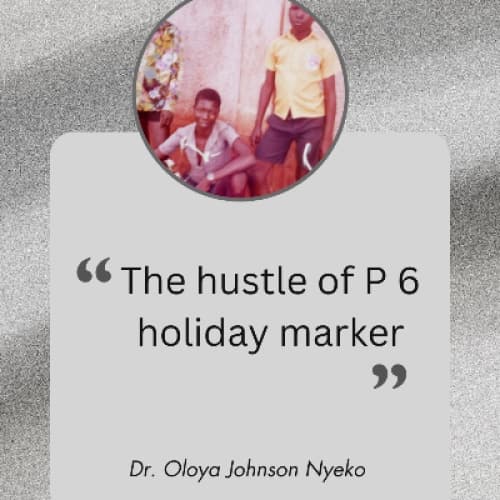

The hustle of a P.6 Holiday Maker
It was during the term one holiday of Primary Six when I decided to try a hustle I had seen some of my classmates doing. School had just closed, and I couldn't bear the thought of sitting idle at home. My friends had shared stories of how they earned money selling snacks or boiled maize, and the idea fascinated me. I wanted to prove to myself and maybe to everyone else that I could do it too.
One chilly morning, before the sun had fully risen, I was already standing by the roadside. The air was cool, and the sound of crickets filled the silence. I knew this was where the farmers would pass with their bicycles, carrying bundles of fresh maize to sell. My eyes darted up and down the empty dirt road, my basket clutched tightly in my hands, a mix of excitement and determination warming me against the cold.
Soon, the faint rattling of bicycle chains broke the stillness. One by one, the farmers came into view, their bicycles heavy with green maize cobs tied securely with sisal ropes. I stepped forward eagerly, flagging them down. "How much for a dozen?" I asked, my voice clear but respectful.
The bargaining began. Some farmers smiled at my effort, amused by my persistence; others treated me as just another customer. I carefully inspected each cob, checking for freshness and quality, while trying to negotiate the best price. "This one is too small; reduce the price," I'd say confidently, mimicking what I'd heard grown-ups do at the market.
By the time the sun rose, I had filled my basket with the best maize I could afford. I walked home with a spring in my step, excited for the next part of the process. My mum helped me boil the maize in a large pot over an open fire. The smell of the maize mixed with the smoky scent of the firewood, filling the house with a warmth that felt like promise.
That evening, I balanced a steaming basin of boiled maize on my head and walked to Polota Market. The market was a world of its own, buzzing with energy, vendors shouting, children playing, the air thick with the scent of roasted meat and ripe fruits. I found a spot and set up my stall. "Fresh maize! Sweet and hot!" I called out, trying to mimic the confidence of seasoned sellers.
At first, people passed by without stopping, but slowly, customers began to come. Some bought one cob, others two. Each coin they handed me felt like a treasure, hard-earned and precious. By the end of the evening, I had sold almost everything. My hands were sticky, and my legs ached, but my heart was full of pride.
This routine became my life for the rest of the holiday. On Sundays, I added another layer to my hustle, I boiled two trays of eggs to sell at the market. Selling eggs wasn't easy. Some customers would crack the eggs on my forehead, laughing as the shells dug into my skin. It hurt, but I didn't flinch. I needed their money more than I cared about their jokes.
My brother Paul, on the other hand, had been watching me closely. He admired my determination and success. One evening, as I returned from Polota Market, he sat beside me and said, "I want to try selling eggs too. I think I can do it."
I chuckled to myself but encouraged him anyway. "It's not as easy as you think, Paul, but go ahead. You'll learn."
That Sunday, we boiled the eggs together two trays, just like I always did. Paul was excited, convinced he would sell them all and make some good money. As he balanced the tray of eggs on his forehand and set off for the market, I watched him with a mix of pride and amusement.
At Polota Market, Paul set up his stall, shouting, "Boiled eggs! Fresh and ready!" His confidence reminded me of my first day. For a while, things seemed to be going well. A few customers bought eggs, and I could see his excitement building. But in no time, the inevitable happened, a mischievous customer appeared.
"Give me one egg," the man said, grinning widely. Paul handed him the egg with pride, but instead of peeling it, the man cracked it right on Paul's forehead. The sound echoed in the crowd, and Paul froze.
For a moment, he didn't move. Then, as the egg's warmth spread across his forehead and the laughter erupted around him, tears welled up in his eyes. "Why? Why would you do that?" he asked, his voice shaking. But the laughter only grew louder.
Humiliated, Paul dropped the tray of eggs in a panic, leaving behind the coins he had collected. He wiped his face, turned, and ran home, tears streaming down his cheeks.
I couldn't help but laugh when I heard what happened. I grabbed the scattered coins from his spot and took them back to him at home. Paul was sitting in a corner, still wiping his forehead, furious and embarrassed.
"Here's your money," I said, stifling a giggle. "That man was just teasing you. It happens."
Paul shot me an angry look. "Never again! I'm done with that hustle. I can't take that kind of embarrassment!"
That was Paul's first and last attempt at selling eggs. The cracked egg had broken his resolve.
From then on, we teased him about his one-day hustle, and whenever he bragged about being tough, we'd remind him of the egg incident. "Paul, don't forgetyou couldn't even handle one cracked egg!" we'd say, and he'd scowl while we all laughed.
Still, I couldn't blame him entirely. Selling eggs wasn't for the faint-hearted. I had learned to endure the little humiliations, the heat, and the teasing, but not everyone was built for that kind of resilience.
By June, I had saved enough to fulfill a dream I had nurtured for months. I bought a pair of Pulumu canvas shoes, the kind that made you feel like you could conquer the world. I can still remember the joy of holding that box in my hands for the first time. The shoes were perfect, and I vowed not to wear them until Christmas.
I tucked them safely under my mum's bed, my little treasure waiting for the right moment. Even when my old sandals broke and I had to walk barefoot to school, I refused to touch the shoes. They were more than just footwear, they were a reward, a symbol of all the hard work I had put in.
One day, curiosity got the better of me. I had just bought a new pair of jeans trousers and couldn't resist trying them on with the shoes. I carefully pulled the box out from under the bed and unwrapped the shoes, my heart racing with excitement. But as I slipped my foot in, my excitement turned to dread. The shoes didn't fit. My feet had outgrown them.
I tried everything pushing, squeezing but nothing worked. Tears filled my eyes as I realized that my dream shoes were now useless. I even considered cutting the toe area to make them fit, but deep down, I knew it wouldn't work.
My mum found me in tears and pulled me into a comforting hug. "It's not the shoes that matter," she said softly. "It's the work you put in to get them. That's what counts."
Her words stayed with me. Those shoes may not have fit, but the lessons I learned during that holiday became a part of me forever. I discovered the value of hard work, resilience, and patience. The hustle had taught me that success isn't always about the final reward, it's about the journey, the struggles, and the growth along the way.
Looking back, I realize that the term one holiday wasn't just a break from school. It was a chapter in my life that shaped who I am today, a reminder that even when dreams don't turn out as planned, the effort is never wasted. Sometimes, outgrowing a dream simply means you're ready for something bigger.
The story of The Village Doctor
Dr. Oloya Johnson Nyeko