The rain tasted like pennies and regret.
Marcus Holloway hit the sidewalk hard, his shoulder cracking against the wet concrete with a sound like a gunshot. The casino doors—those golden, glittering portals that had swallowed six years of his life—slammed shut behind him with the finality of a coffin lid. Through the smeared glass, he could see the security guard who'd thrown him out, a mountain of a man named Ricky, already turning away. Already forgetting him.
"Please," Marcus had said five minutes ago, his voice cracking like a teenager's. "Just one more hand. I've got money coming. I swear to Christ, Ricky, I've got—"
But Ricky had heard it all before. They all had. The Bellagio didn't care about promises or tomorrow's paychecks or the sure thing that was definitely, absolutely going to hit this time. The Bellagio cared about money in hand, and Marcus's hands were empty. Had been empty for three months now. Empty except for the shakes.
He lay there on the rain-slicked sidewalk at three in the morning, watching the neon reflections bleed across the puddles like watercolor paint. Red. Gold. Electric blue. The colors of dreams and lies. His shirt was soaked through, plastered to his ribs. He could feel each individual bone beneath the fabric. When had he gotten so thin?
You're forty-two years old, he thought, and you're dying on a Las Vegas sidewalk in the rain.
The thought should have horrified him. Instead, it felt like relief.
He closed his eyes.
"Pathetic."
The voice came from above him, smooth as aged whiskey, tinged with something Marcus couldn't quite place. Amusement, maybe. Or pity. He opened his eyes.
A man stood over him, backlit by the casino's neon glow so that his face was cast in shadow. But even in silhouette, Marcus could see the quality of him—the cut of his suit, the shine of his shoes, the way he held himself with the casual confidence of someone who'd never been thrown out of anywhere in his life. Behind him, a limousine idled at the curb, black and sleek as a panther. The rain beaded on its hood and rolled off like mercury.
"I've seen corpses with more dignity," the man continued. He didn't offer a hand. Just stood there, looking down at Marcus like a scientist observing an insect. "How much do you owe?"
Marcus's laugh came out as a wet cough. "Which casino?"
"All of them."
"Hundred and forty thousand. Give or take." He didn't mention the loan sharks. The broken kneecap from last month. The eviction notice. What was the point?
The man tilted his head, considering. In the shifting neon light, Marcus caught a glimpse of his face—sharp cheekbones, pale skin, eyes that reflected the casino lights in a way that seemed wrong somehow. Too bright. Too steady.
"I have a proposition for you, Mr. Holloway."
Marcus hadn't told him his name.
"I'm hosting a private game tonight," the man continued. "High stakes. Very high stakes. I find myself... indisposed. I need someone to take my seat. Play in my stead." He paused, and when he smiled, his teeth caught the light like polished ivory. "Win or lose, you walk away with two hundred and fifty thousand dollars."
The number hit Marcus like a fist to the solar plexus. Two hundred and fifty thousand. Enough to clear his debts. Enough to start over. Enough to—
"What's the catch?"
"No catch. Simply play the game. Follow the rules. Represent my interests." The man's smile widened. "Do we have an accord?"
Marcus knew, somewhere in the reptile part of his brain that still functioned, that this was wrong. That men in thousand-dollar suits didn't stop their limousines at three in the morning to offer quarter-million-dollar deals to degenerate gamblers lying in the gutter. That there were always catches, always angles, always a house edge.
But the rain was cold, and his bones ached, and two hundred and fifty thousand dollars was two hundred and fifty thousand dollars.
"Yeah," he said. "Yeah, we have a deal."
The man's hand, when he finally extended it, was cold as marble.
The limousine's interior smelled like leather and something else. Something sweet and cloying that reminded Marcus of funeral flowers. He sank into the seat, feeling the butter-soft upholstery conform to his body. Across from him, the man sat perfectly still, hands folded in his lap, watching Marcus with those too-bright eyes.
"What's your name?" Marcus asked.
"You may call me Mr. Scratch."
Of course. Of course his name was something out of a fairy tale. Marcus laughed, but it died in his throat when Mr. Scratch didn't join him.
The limousine pulled away from the curb, gliding through the rain-slicked streets. They passed the Strip—that glittering mile of excess and neon—and Marcus watched it recede in the rear window like a drowning man watching the shore disappear. Then they turned east, away from the lights, into the darkness beyond the city's edge.
"Where exactly is this game?" Marcus asked.
"Not far."
But they drove for what felt like hours. The city lights faded behind them until there was nothing but darkness and rain and the occasional flash of lightning illuminating the desert scrub. The road grew narrower, rougher. Marcus could feel every bump and pothole through the limousine's suspension.
He should ask more questions. Should demand details. Should—
But the money. Two hundred and fifty thousand dollars. He could taste it, metallic and sweet on his tongue.
"Mr. Holloway," Mr. Scratch said softly, "do you believe in hell?"
Marcus looked up sharply. "What?"
"Hell. Damnation. The eternal consequence of poor choices." Mr. Scratch's smile was gentle, almost kind. "Do you believe?"
"I believe in the rake and the house edge," Marcus said. "Everything else is just stories."
"Stories." Mr. Scratch nodded slowly. "Yes. We tell ourselves stories, don't we? To make sense of the senseless. To justify the unjustifiable." He leaned forward, and in the darkness of the limousine, his eyes seemed to glow with their own light. "What story are you telling yourself right now, Mr. Holloway?"
Marcus's mouth was dry. "That I'm going to play some cards and walk away rich."
"Ah. Yes. That's a good story." Mr. Scratch settled back into his seat. "Let's see how it ends."
The limousine slowed, then stopped. Through the rain-streaked window, Marcus could see a house. Just a house—single-story, stucco, the kind of anonymous dwelling you'd find in any desert suburb. A light burned in one window. Nothing special. Nothing remarkable.
Nothing that should make his skin crawl the way it did.
"We're here," Mr. Scratch said, and opened the door.
The rain had stopped, but the air was thick and wet, pressing against Marcus's face like a damp cloth. He followed Mr. Scratch up the cracked concrete walkway to the front door. Somewhere in the distance, a dog howled—a long, mournful sound that raised the hair on the back of Marcus's neck.
Mr. Scratch opened the door without knocking.
Sound hit Marcus like a physical force—laughter and music and voices all tangled together in a cacophony that made his teeth ache. The interior of the house bore no resemblance to its modest exterior. The entry hall stretched impossibly long, lined with doors that seemed to breathe, expanding and contracting with some hidden rhythm. The walls were covered in red velvet that looked wet in the flickering light of chandeliers that hung too low, their crystals tinkling like wind chimes.
And the people.
They filled the hall, the rooms beyond, pressed together in a mass of bodies that writhed and swayed to music Marcus couldn't quite hear. They wore costumes—or were they costumes?—garish and grotesque. A woman in a dress made of peacock feathers that seemed to have eyes that blinked. A man with a pig's head, his tuxedo splattered with something dark and wet. A pair of twins in harlequin makeup, their grins stretched too wide, showing too many teeth.
"What the fuck is this?" Marcus whispered.
"A party," Mr. Scratch said simply. He moved through the crowd with ease, and the revelers parted before him like water. Marcus followed, trying not to look too closely at the faces that turned toward him. Trying not to see the wrongness in their eyes, the way their mouths moved out of sync with their laughter.
The smell was overwhelming—sweat and perfume and something underneath it all, something rotten and sweet like meat left too long in the sun. Marcus's stomach churned. He thought of the money. Two hundred and fifty thousand dollars. He could endure anything for that.
They passed through room after room, each more bizarre than the last. A dining hall where the guests ate from plates piled with food that seemed to move. A ballroom where couples danced to music that sounded like screaming. A library where the books whispered secrets in languages Marcus didn't recognize.
"How big is this house?" he asked, but Mr. Scratch didn't answer.
Finally, they reached a door at the end of a long corridor. Unlike the others, this one was plain—just dark wood with a brass handle. Mr. Scratch stopped, turned to face Marcus.
"Beyond this door is the game," he said. "You will play until it's finished. You will follow the rules. You will not leave the table until the dealer releases you." His smile was gone now, his face serious. "Do you understand?"
"Yeah, I understand. I play cards, I get paid. Simple."
"Simple," Mr. Scratch echoed. "Yes. Let's hope so." He opened the door. "Good luck, Mr. Holloway. You're going to need it."
Then he was gone, melted back into the crowd, and Marcus was alone.
He stepped through the door.
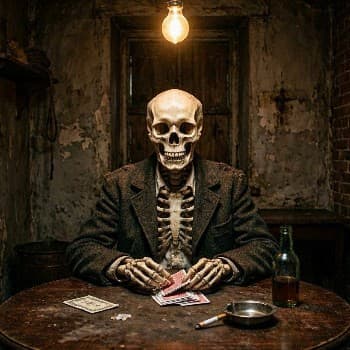
The room beyond was small, intimate. A single table sat in the center, illuminated by a hanging lamp that cast everything in shades of amber and shadow. The walls were bare, the floor concrete. After the chaos of the house, the silence was deafening.
And at the table, waiting, was the dealer.
At first, Marcus thought it was a man in a costume. An elaborate Halloween getup, skeleton makeup applied with expert precision. But as he moved closer, as his eyes adjusted to the light, he realized his mistake.
The dealer was a skeleton.
Not a costume. Not makeup. Actual bone, yellowed and ancient, held together by strips of rotting flesh that hung in ribbons from the joints. The skull grinned at him—it had no choice, having no lips—and in the empty sockets, two points of red light burned like distant stars.
Marcus's legs locked. His breath came in short, sharp gasps. This wasn't real. Couldn't be real. He'd finally snapped, that was it. Years of stress and sleepless nights and the constant grinding anxiety of debt had finally broken something in his brain, and now he was hallucinating in a gutter somewhere while his body shut down.
"Sit," the skeleton said. Its voice was dry leaves and grinding stone. "We've been waiting for you."
Marcus sat. What else could he do?
The table was covered in green felt, and on it sat a deck of cards. Not poker chips. No neat stacks of clay and plastic. Instead, there were... pieces. Chunks of meat, glistening and wet. A finger, still wearing a wedding ring. An ear. Something that might have been a tongue.
And in the center of the table, placed carefully on the felt like a trophy, was a human foot. Pale. Bloodless. With a distinctive scar across the ankle where Marcus had cut himself on a broken bottle when he was twelve.
His foot.
Marcus looked down. His right shoe was gone. His pant leg ended in a ragged tear. And below that, where his foot should have been, there was nothing. Just a stump wrapped in bandages that were already soaking through with red.
He tried to scream, but no sound came out. His throat had closed, his lungs had forgotten how to work. He stared at the foot on the table—his foot—and watched as a drop of blood fell from the severed ankle and splashed onto the felt.
"Blackjack," the skeleton said, and began to deal. The cards made a wet slapping sound as they hit the table. "You wanted to play. So let's play."
"No," Marcus finally managed. The word came out as a croak. "No, I don't—I can't—"
"You made a deal, Mr. Holloway." The skeleton's jaw clicked with each word. "You shook his hand. You accepted the terms. And the house always collects."
It dealt him two cards. Marcus looked down at them through tears. A seven and a four. Eleven.
"Hit or stand?" the skeleton asked.
Marcus's hand moved without his permission, reaching for the cards. His fingers—he still had his fingers, thank God, he still had his fingers—trembled as they touched the felt.
"I want to leave," he whispered. "Please. I'll give back the money. I'll do anything. Just let me leave."
The skeleton laughed. It was the sound of bones rattling in a box, of dirt falling on a coffin lid. "But we're just getting started. You've barely lost anything yet."
It flipped its own cards. Blackjack. Natural twenty-one.
"House wins," it said, and reached across the table.
Marcus felt the pain then—a white-hot agony that started in his left hand and shot up his arm like lightning. He looked down and watched, unable to look away, as his pinky finger simply... detached. Fell onto the table with a soft thump. Blood welled from the stump, running down his palm, dripping onto his lap.
He screamed then. Finally, fully, the sound tearing from his throat like something alive and desperate. He screamed and screamed, but no one came. The door remained closed. The party continued somewhere beyond, laughter and music and the sound of people having a wonderful time.
"Next hand," the skeleton said, gathering the cards. Its bony fingers moved with practiced efficiency, shuffling, dealing. "You're doing wonderfully, Mr. Holloway. Most players don't last this long."
Marcus tried to stand, but his legs wouldn't work. Tried to run, but his body wouldn't obey. He was trapped in the chair, trapped at the table, trapped in this room with this thing that was taking him apart piece by piece.
The skeleton dealt again. Marcus looked at his cards through a haze of pain and tears.
A two and a three.
"Hit or stand?" the skeleton asked, and its laughter echoed off the bare walls, bouncing back and forth, growing louder and louder until it was all Marcus could hear.
He looked at the pile of body parts growing on the table. His foot. His finger. And he knew, with the cold certainty of a man who'd finally seen the cards the house was holding, that he would never leave this room. That he would sit here, hand after hand, losing piece by piece, until there was nothing left of him but screams and regret.
The skeleton grinned its permanent grin and waited for his answer.
Outside, in the impossible house at the edge of town, the party continued. The music played. The guests danced and laughed and drank. And somewhere in the crowd, Mr. Scratch smiled and checked his watch.
It was almost dawn. Time to find another player.
After all, the house always needed fresh blood.
And in Las Vegas, there was never a shortage of desperate men willing to make a deal.