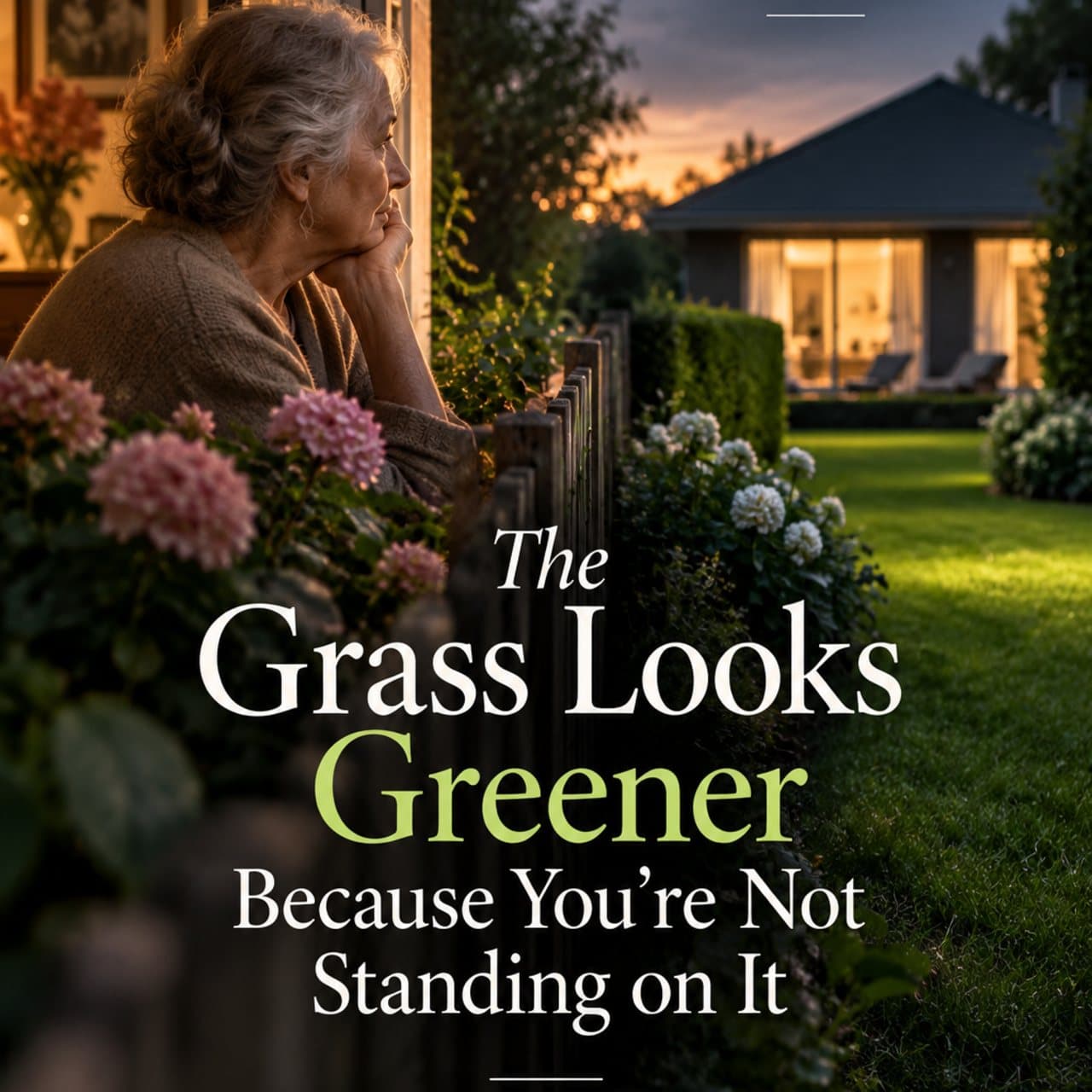

At night, the married woman sometimes lay beside her sleeping husband and quietly wished she were alone.
Across town, a single woman turned off the lights in her empty apartment and cried because there was no one beside her.
Neither woman knew the other was awake.
Neither knew that, behind the walls they could not see, they were both aching for the life they believed the other possessed.
One feared being trapped.
The other feared being forgotten.
And somewhere between those two fears lived the great illusion of human life:
We often envy the very thing someone else is secretly trying to survive.
The night the old woman finally understood this, she was standing in the rain.
She was seventy-eight years old, and for most of her life she had believed that happiness lived somewhere beyond her reach—just over the fence, just a little farther down the road, inside somebody else's house.
That evening, she stood at her window watching her neighbour's garden.
It was beautiful.
The grass was thick and green.
The flowers were carefully arranged.
The hedges were perfectly trimmed.
Everything looked peaceful.
She had envied that garden for years.
Then she noticed something she had never noticed before.
The house was completely dark.
No children's voices.
No laughter.
No footsteps running through the rooms.
No one calling from the kitchen.
Just silence.
She stared at it until the beauty began to feel different.
Then she turned toward her own house.
Her husband's old chair stood beside the fireplace.
He had been gone for eleven years.
On the mantel sat a faded photograph of her children, now scattered across distant cities.
On the wall was a small pencil mark where her youngest son had once measured his height.
She reached out and touched it.
And suddenly, the house felt unbearably full.
Not of people.
Of memories.
Her husband's laughter.
Her daughter's footsteps.
Her mother's voice calling her home.
The arguments she once wished would end.
The noisy meals she once wanted to escape.
The ordinary afternoons she had thought would come again tomorrow.
She stood there with her hand against the wall and felt something inside her break.
She had spent years wishing for a different life.
Only now did she understand what she had been wishing away.
She walked outside into the rain.
Her garden was neglected.
Weeds had swallowed the flower beds.
The old bench where her husband used to sit was covered in moss.
The mango tree where her children had played still stood at the edge of the yard.
She moved slowly toward it.
Then she saw a small flower growing beneath the weeds.
Bent by the rain.
Almost hidden.
Still alive.
She knelt.
For a long moment, she simply looked at it.
Then she began pulling away the weeds.
Not because her life had suddenly become perfect.
It hadn't.
Her husband was still gone.
Her children were still far away.
The years were still behind her.
But something had changed.
She was no longer looking over the fence.
She was finally looking down at her own ground.
And perhaps that is what we forget.
We see someone's smile, not the nights they cried.
We see the marriage, not the loneliness inside it.
We see the freedom, not the emptiness that sometimes follows it.
We see the success, not the sacrifices buried underneath it.
We see the garden.
We never see the gardener's hands.
So we compare our unfinished lives with other people's carefully framed moments.
And then we wonder why our own lives feel small.
But time has a cruel way of revealing what we refused to value.
Children grow.
Parents age.
People leave.
Voices disappear from rooms.
The hands we once held become photographs.
And the ordinary life we complained about becomes the life we would give anything to touch again.
The old woman stayed in the garden until the rain stopped.
The next morning, she repaired the broken fence.
She cleared the weeds.
She watered the flowers.
She sat beneath the mango tree for the first time in years.
A month later, people began noticing her garden.
They stopped at the fence.
They admired the flowers.
Some asked her what she had done.
The old woman only smiled.
She knew the truth.
She had not learned how to grow a better garden.
She had learned something much harder.
How to stop grieving for a life she never had—and finally love the one that was hers.