
I was seven years old when I learned how easily adults place suspicion into the hands of children.
We lived in a conservative Muslim neighborhood in Pakistan, the kind where morality lived in whispers and reputation traveled faster than truth. Our building was three stories high, twenty-four apartments arranged around narrow stairwells that carried voices from one floor to the next. Nothing stayed private for long.
They moved in quietly. A family already spoken about before anyone had truly seen them.
She was fourteen, and I called her baji.
I remember her in white. Always white. A plain shalwar kameez, a dupatta draped carefully over her head, as though she was holding herself together with fabric. She was not what people in our world called beautiful. Too small, too thin, her golden-brown skin shadowed by large, piercing black eyes that unsettled more than they invited. There was a seriousness about her that did not belong to someone her age.
She looked like someone who had already lived too much.
Her mother, by contrast, refused to disappear. Bright clothes clung tightly to her body. Her makeup was heavy, deliberate. Her dupatta—if she wore one at all—rested carelessly. Men came and went at night. The neighbors noticed. They always notice.
They talked.
My mother listened.
“Stay away from that house,” she told me. “Don’t go there.”
But children don’t understand reputations. We understand loneliness.
And hers called to me.
One afternoon, she leaned over the balcony and called me and my friend. She said she was alone. She asked if we wanted to come over and play.
There was something hopeful in her voice. Something fragile.
We went.
Her apartment surprised me. It was small—two rooms—but arranged with care. Cushions placed neatly, curtains chosen with intention, small details suggesting someone was trying to create beauty where little had been given. It didn’t match the stories I had heard.
She smiled more that day. A quiet, hesitant smile, as if she wasn’t used to having reasons to use it. She brought out dolls. She sat with us. She played.
For a moment, she seemed like a child.
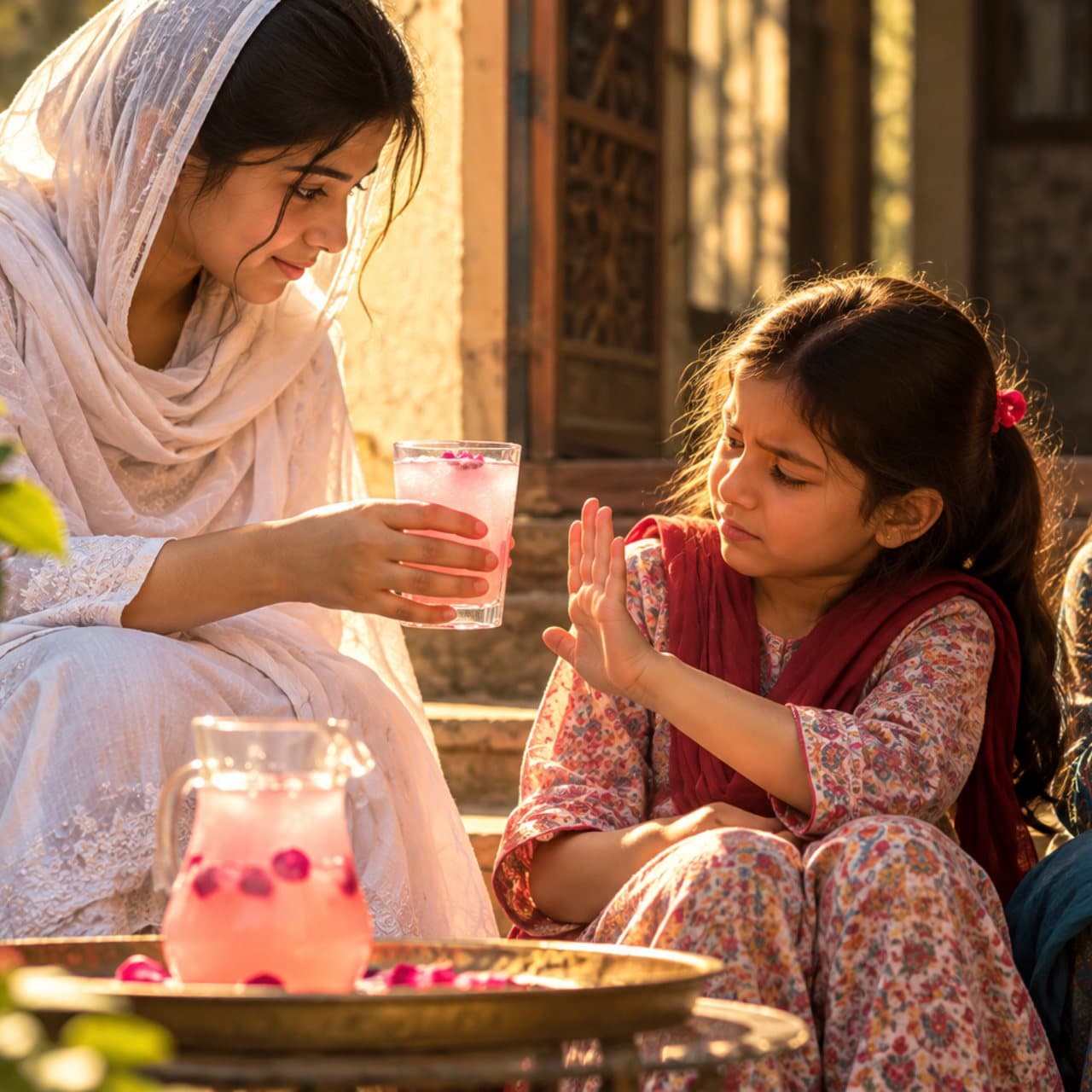
Then she went to the kitchen and returned with glasses of sherbet, the liquid bright and inviting in the afternoon light.
“I can’t drink it,” I said.
She paused, then smiled again, assuming shyness. “It’s okay,” she said softly. “Have some.”
“I can’t,” I repeated.
She asked why.
And because I was seven—because I carried my mother’s fears as truth—I said what should never have been said.
“What if there’s alcohol in it?”
The air shifted.
I watched her face change in a way I did not yet know how to understand. The smile disappeared first. Then something deeper fractured—something quiet and invisible but unmistakably real.
“How could you even think that I would do such a thing?” she asked.
Her voice wasn’t angry. It was wounded.
I felt the fear rise in me then—fear of being there, fear of being caught, fear of the punishment waiting at home. Shame came later. Much later.
I don’t remember how we left. I don’t remember if I apologized.
What I remember is that they did not stay long. The neighborhood ensured that. Quiet disapproval has a way of becoming action. One day they were there, and then they weren’t.
And life moved on.
I forgot her.
Until today.
Thirty years later, she returned to me not as a memory I searched for, but as one that surfaced uninvited. A face without a name. Eyes I could not forget. And with it, a sudden, overwhelming understanding of what I had done.
She wasn’t offering me sherbet that day.
She was offering me trust. A small act of kindness. Perhaps the only kind of friendship she was allowed.
And I handed her suspicion.
I don’t know where she is now. I don’t know what became of her. I don’t even remember her name.
But I remember her face in that moment—how something inside her folded quietly into itself.
And I wonder if she learned that day what I only understand now:
That sometimes, cruelty doesn’t come from intention.
Sometimes, it comes dressed as obedience.
A Note from the Author
The Glass of Sherbet is a childhood memory that stayed with me for decades.
If you enjoyed this story, I invite you to visit my website, The Stories We Hide, where you can read more of my stories, poetry, and its companion piece, The Elixir of Courage, told through the eyes of the fourteen-year-old girl.
Read more:https/burgandyred2.wixsite.com/the-stories-we-hide
With gratitude,
Saadia Monast