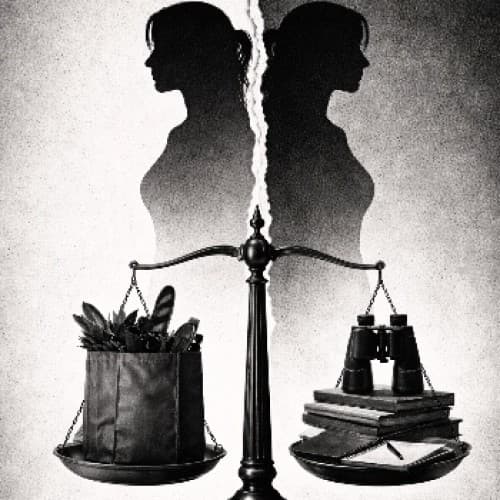

"You need to choose your wife who will be a partner, not a dependent," John's words echoed in Margaret's ears as they drove back from a baseball game, talking about family and relationships. He had said it casually to Tim, as advice.
An uneasy feeling swept through Margaret’s mind: Did John think of her as a partner or a dependent? She knew if she asked, he would dismiss it as nonsense or cover it with praise. So she stayed silent, while the words moved through her like a gusty wind, and questions rose like waves against a restless shore.
Back home, settled with a glass of wine in her favorite chair, the words returned.
Margaret had married John right after college. He was five years older, well established, with a stable job. She had once wanted to be a marine biologist, but that would have meant leaving town—something she couldn’t afford as the third of five children.
She had grown up in a world where patriarchy was revered almost like faith. From a young age, she learned to cook not what she liked, but what her father and brothers preferred. Over time, she came to understand that marriage meant shaping herself around expectations—doing things the way her husband would want.
When she first met John at a family gathering—likely arranged—she felt nothing in particular. Later, when her mother asked how she felt about him, Margaret took a full minute before answering. She had no real impression, no more than she would have of a grocery store clerk. But seeing what her mother wanted to hear, she said yes. It was easier to please than to question.
Over the years, Margaret perfected the art of living for others. Her own needs and thoughts, slowly neglected, faded into something almost non-existent.
She no longer remembered what being a marine biologist meant. She had become skilled in grocery shopping and housework instead.
John had always been kind. Perhaps the age gap had helped. He was a good father, a dependable provider. He had asked what she liked once, long ago, in the early days of courtship—but not since. He had his own world: work, friends, routines. Margaret fit into it, neatly.
Like a hotel bed—perfectly made, inviting at first glance, yet somehow incapable of giving real rest. People blame the unfamiliar setting, but what it lacks is the quiet warmth of home—the kind that doesn’t need to look perfect to feel right.
So had she been a dependent all these years, and not a partner?
The thought lingered.
Her heart grew heavy. Perhaps she should have built something of her own, not leaned on John for everything. Even when his decisions hurt her, she had said nothing. Perhaps that was not what a partner does. A partner speaks, questions, resists.
The thoughts gathered like small tornadoes, circling, pulling at everything she had quietly accepted.
And then, as always, they settled.
Life returned to normal.
On a summer evening, they set out for a friend’s place, stopping on the way to pick up a bottle of wine. As John tried to park, he nearly clipped a car backing out without warning.
A burly man stepped out, already shouting.
John froze, caught off guard, words failing him. The man moved closer, louder now, pushing, provoking.
Margaret stepped out.
She walked straight to him, met his eyes, and said, her voice cold and steady,
“Touch my car or my husband, and I will make sure you regret it for the rest of your life. Be a man—accept your mistake and move.”
The man paused. Something in her tone held. He muttered under his breath, stepped back, and drove off.
It was over in seconds.
Margaret returned to the car. They parked, picked up the wine, and continued.
After a while, as the silence softened, John forced a small smile.
“What was that?”
Margaret looked ahead.
“Being a partner.”
John glanced at her, surprised, a question forming—but he let it go. He turned back to the road.
They drove the rest of the way in silence.
That night, long after the house had grown quiet, Margaret lay awake.
For the first time in years, the silence did not feel the same.