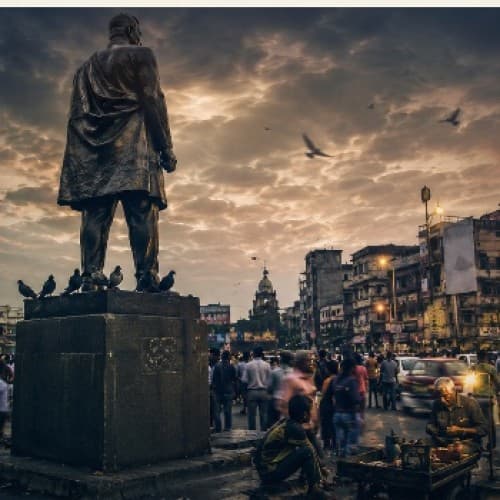

I have stood tall in this place for ages. When they first built me, there was great fanfare. People of high social stature arrived in polished cars, speeches were delivered beneath bright banners, and cameras flashed endlessly. It was comforting, in a strange way, to hear them speak of what a good man I had been — of how much I had sacrificed for the country.
The early days were wonderful. People traveled from distant places just to catch a glimpse of me — their revered hero, immortalized in copper and stone, standing tall and victorious. To them, I was more than a monument. I was a symbol of hope, integrity, and moral courage.
Days passed. Times changed. I remained where I had always been, watching silently. I watched the vendor selling his goods, struggling endlessly to make the smallest profit, and the buyer bargaining just as relentlessly, desperate to save a few coins. I often wondered who truly decides what a fair price is.
In those early years, the streets belonged mostly to men. They laughed loudly, cursed openly, argued without restraint. Women and children were rarely seen alone; most walked a few steps behind the male members of their families, waiting quietly for direction before crossing a street or entering a shop. I watched this for years and often found myself wondering whether men truly believed they were the only navigators of the world.
But there were women too — very few of them — and they mostly appeared after sunset. They stood beneath dim streetlights as though waiting for someone, or perhaps for something that never arrived. I often wondered why they were there so late into the night. Did they not have families waiting for them? Children to feed? Elderly parents to care for?
Then, slowly, I began to notice the pattern. Men would arrive, exchange a few words, and disappear with them into the darkness for an hour or two before the women returned once again to the very same spot. Some nights this happened many times. Other nights they simply stood there endlessly, watching the road in silence until the city grew tired and the night finally let them go empty-handed.
I loved the festivals. During those days the streets transformed completely. People moved with laughter instead of urgency. There was no desperate rushing, no endless struggle to be first. Families walked slowly beneath strings of lights, talking and smiling as though time itself had softened for a while. Even the vendors seemed happier; there was less bargaining, fewer arguments over small coins.
For those brief days, people appeared different to me — lighter somehow, less burdened by life.
But I also noticed something else. The women of the night disappeared during festivals. I never saw them standing beneath the streetlights when the city was celebrating.
When I was young, I often heard educated men say, “Days will change.” The phrase floated everywhere like a promise carried by the wind.
I dreamed of simple freedoms — the day I would be allowed to walk to school by myself, or eat from a street vendor without being scolded or restricted. My best friend dreamed of something else entirely: that one day his favorite football club would finally defeat their greatest rivals.
But I often found myself wondering about the small shoe repairman who sat quietly at the corner of the street. All day he waited for people to arrive with torn sandals and worn-out shoes. With patient hands he stitched broken soles back together, only to bargain afterward for a few coins.
Did he too believe that days would change?
And what did his children dream of? I often saw them sitting beside him instead of going to school, helping their father learn the trade that life had already chosen for them. I remember feeling ashamed sometimes — while I was being taught the ways of the world, they were being taught how to survive it.
Time moves strangely through the world. For some, it rushes forward like a storm. For others, it barely moves at all.
Now I see angry people everywhere. They march through the streets shouting slogans, their faces tense with rage and agitation. In many ways they remind me of myself when I was young. Yet I struggle to understand where this anger comes from now.
We are ruled by our own people at last. Was this not what we had dreamed of?
My youth, my strength, my entire adulthood were spent fighting for the belief that one day we would govern ourselves, shape our own future, speak in our own voice. We believed freedom itself would heal the wounds of ordinary people.
But as I watch these crowds pass beneath me, carrying new flags and new anger, I cannot help wondering something I once believed impossible:
Did I make a mistake?
Some of them throw stones at me now. Others hurl abuses and call me names I never imagined I would hear. Traitor. Broker. Coward.
I want to cry out in my defense, but stone cannot speak.
I was never a traitor. Never a coward. I fought for what I believed was right with all the strength I had. Perhaps I was wrong — I do not know anymore. But I was never dishonest in my convictions.
We fought with the understanding and knowledge we possessed in our time. None of us knew whether our beliefs would remain true in the future, or whether history itself would one day turn against us.
Then one day I witnessed violence again.
A crowd of angry demonstrators flooded the streets, shouting, pushing, breaking through barricades with furious energy. Soon the peacekeepers arrived, and the two sides collided with terrible force. The sounds were familiar to me — the screams, the running, the crack of sticks against flesh, the chaos that turns human beings into frightened animals.
I had seen such clashes before in my youth. I had stood inside them, bloodied, bruised, humiliated, driven forward by rage and conviction.
But in those days, we believed the men opposing us were not truly our own people. They came from another part of the world. They spoke differently, looked different, prayed to a different God.
Even then, violence had never fully made sense to me. I never truly understood why one human being should wish to harm another. Yet I justified it to myself because the other side did not feel like us.
Now, as I watch our own people strike one another beneath the same sky, I wonder if hatred was ever about nations at all.
Eventually, things became normal again. They always do.
The demonstrators of yesterday became the official peacekeepers of today. Order returned to the streets, speeches returned to the stages, and people once again spoke confidently about a better future. For a while, things seemed peaceful.
But after some time, everything began to change once more. New anger replaced old anger. New slogans replaced old slogans. Faces changed, uniforms changed, flags changed — yet the cycle remained the same.
And slowly, I began to question myself.
What exactly had I done for my people?
I still stand tall in the same place, but my birthdays are no longer celebrated with fanfare. Few people even look up at me now as they pass. The excited tourists are gone. Only the pigeons remain loyal; they still rest upon my shoulders every evening without fail.
I still see angry men in the streets. I still see the women who wait through the night — though now I finally understand why they stand there. I see more cars than before, beautiful cars shining beneath city lights. And beside them, I still see the vendors, newer faces carrying the same old exhaustion, still bargaining endlessly over what a fair price should be.
And sometimes, as the city moves around me without memory or pause, I find myself whispering into the silence:
“Oh, change… what did you truly change?”