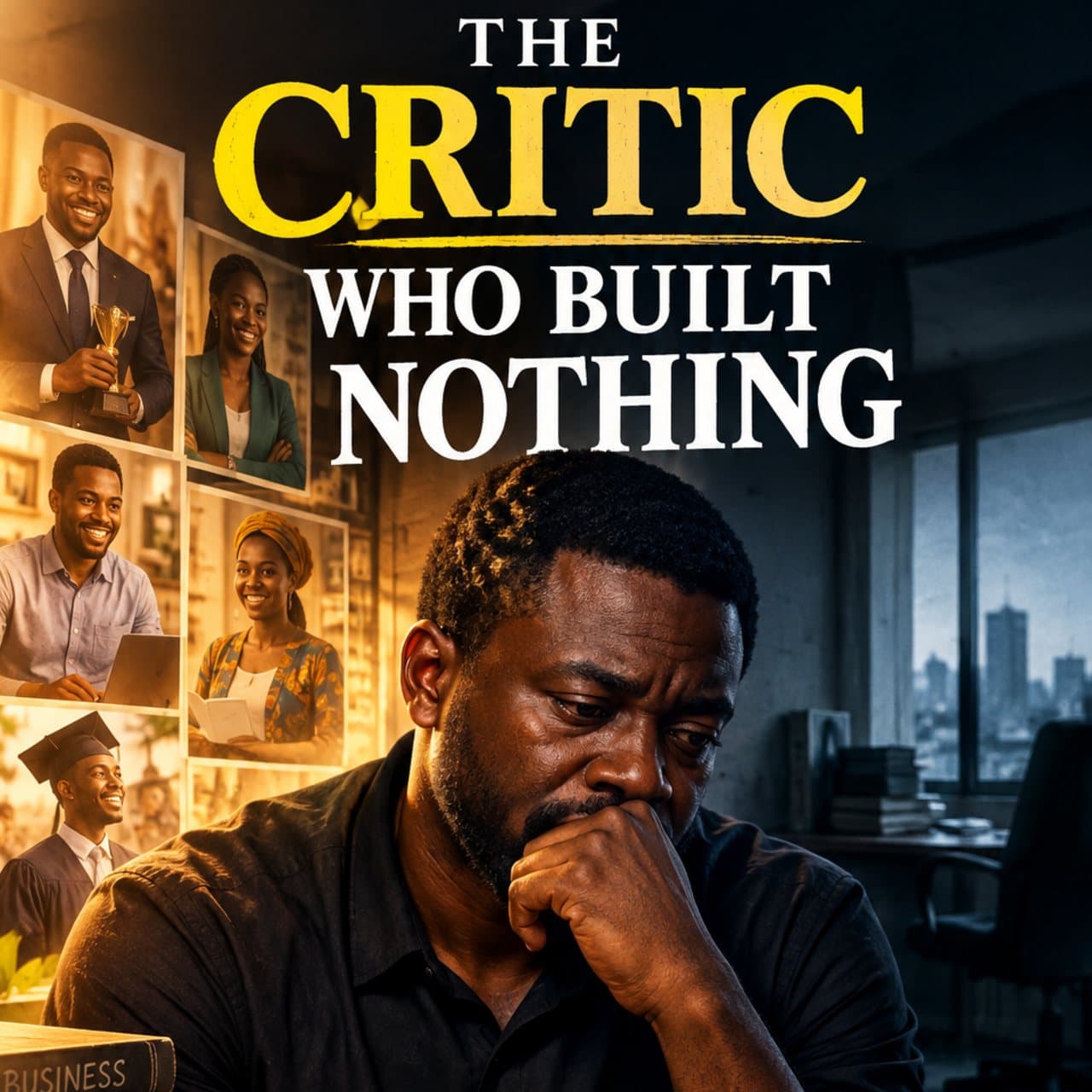

The room went silent when they asked Kwasi the question.
“After all these years, what have you achieved?”
Kwasi looked up.
For once, there was no clever response.
No sharp observation.
No explanation.
No criticism.
Only silence.
He had spent most of his life being the man with an answer.
If someone announced a new business, Kwasi immediately saw the danger.
If a colleague proposed an idea, he found the weakness before the presentation was over.
If a friend spoke excitedly about a new opportunity, Kwasi could reduce the excitement to a list of reasons it would fail.
If someone published a book, he read it looking for mistakes.
If someone succeeded, he searched for the circumstances that had made the success possible.
He rarely said, “Well done.”
There was almost always a “but”.
People began to respect him for his sharp tongue.
“Ask Kwasi. He will tell you what is wrong with it.”
And they did.
They brought him proposals.
They sought his opinion.
They listened when he spoke.
Kwasi enjoyed being the person everyone consulted.
He liked the authority that came with seeing what others could not see.
But there was a dangerous difference between seeing a problem and having the courage to solve one.
Kwasi discovered that difference too late.
Years passed.
The people he had criticised did not always succeed.
Some failed badly.
Some lost money.
Some were embarrassed.
Some had to begin again.
But they had something Kwasi had gradually lost.
They had stories of trying.
Kwasi had explanations.
He had once wanted to establish a business.
The idea excited him.
He prepared a proposal and carried it everywhere.
Then he began thinking about everything that could go wrong.
What if the market changed?
What if customers did not come?
What if he lost his money?
What if people laughed at him?
The questions multiplied until the dream became frightening.
So he put the proposal away.
He told himself he was waiting for a better opportunity.
He never noticed that the opportunity was waiting for him to take a risk.
Then he wanted to write.
He bought notebooks.
He chose a title.
He even imagined his name printed on the cover.
But instead of writing, Kwasi became an expert on why other people's writing was not good enough.
The years slipped away.
One by one, the people around him changed.
A young man whose first business proposal Kwasi had dismissed eventually built a successful company.
A woman whose ambitions he had once laughed at became a respected leader.
A writer whose first manuscript he had called ordinary published book after book.
Kwasi watched from a distance.
He always found an explanation.
Luck.
Connections.
Money.
Timing.
Anything except the uncomfortable truth.
They had dared to begin.
One evening, an old friend sat with Kwasi beneath the fading evening light.
“You know what worries me about you?” the friend asked.
Kwasi smiled.
“What?”
“You know how to examine everybody's life.”
Kwasi laughed.
“And?”
“I don't think you have ever examined your own.”
The smile disappeared from Kwasi's face.
The friend continued quietly.
“You have spent years telling people what they should not do. When will you tell yourself what you should do?”
Kwasi said nothing.
The question followed him long after his friend had left.
Years later, he found himself sitting in a hall filled with people celebrating achievements.
Photographs decorated the walls.
Kwasi recognised faces from his past.
People he had corrected.
People he had doubted.
People whose dreams he had once questioned.
Now their achievements were hanging on the walls for everyone to see.
Kwasi stood before one photograph for a long time.
He remembered exactly what he had said to that person years earlier.
It will never work.
It had worked.
He moved to another photograph.
He remembered another criticism.
That person had succeeded too.
Then he saw his own reflection in the glass.
For a moment, he barely recognised the man staring back at him.
Someone approached.
“Kwasi.”
He turned.
“People always valued your opinion.”
Kwasi smiled faintly.
“Yes.”
The person looked around the hall.
“Did you ever act on your own?”
The question cut deeper than the first one.
Kwasi lowered his eyes.
That was when he remembered the folder.
The old proposal.
Twenty years ago.
His first real dream.
He had not failed.
He had abandoned it.
There was a difference.
He went home that night and searched through the cupboard.
His hands trembled as he pulled out the folder.
Dust covered it.
He opened it carefully.
The pages were yellow.
His younger handwriting stared back at him.
There was excitement in those words.
Ambition.
Hope.
A man who still believed his future was waiting for him.
Kwasi read every page.
Then he reached the final paragraph.
He stopped.
His eyes filled with tears.
The dream had not been foolish.
It had not been impossible.
It had simply been unfinished.
Kwasi sat down slowly.
A painful truth settled over him.
He had not spent his life failing.
He had spent his life avoiding the possibility of failure.
And while he was busy finding reasons why other people would not succeed, he had quietly buried the person he might have become.
He pressed the old pages against his chest.
“How did I become this man?” he whispered.
The room gave him no answer.
Only the ticking of the clock.
For the first time, Kwasi understood that criticism had given him something success could not.
Safety.
He could never be laughed at for failing if he never attempted anything.
He could never lose money if he never invested.
He could never be rejected if he never stepped forward.
He could always appear intelligent from the sidelines.
But there was a terrible price.
He had become a spectator in his own life.
That night, Kwasi cried.
Not because someone had insulted him.
Not because someone had taken his opportunity.
He cried because nobody had taken anything from him.
He had given it away himself.
The next morning, Kwasi opened a fresh notebook.
For several minutes, he simply stared at the empty page.
Then he wrote:
I have spent enough time judging what others built. Now I will build something of my own.
He knew it might fail.
For once, that did not frighten him.
He began anyway.
And perhaps that was the lesson Kwasi had needed all along.
A sharp eye can find every crack in another person's wall.
But if all you ever do is point at the cracks, you may wake up one day and realise that you never built a house of your own.