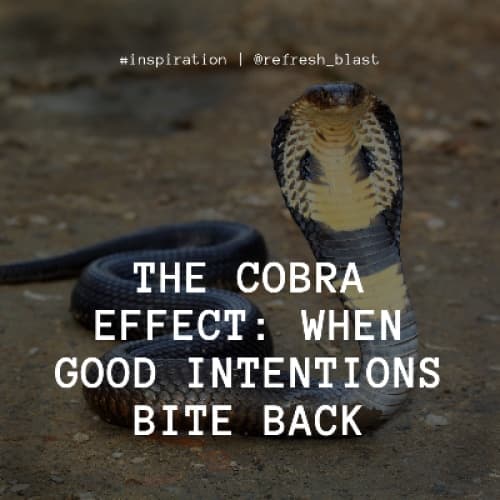

What Is the Cobra Effect?
Ever notice how the harder we try to fix something, the worse it sometimes gets? That’s the Cobra Effect — when good intentions collide with bad incentives.
Elon Musk recently pointed out how throwing money at homelessness hasn’t solved the problem. Konstantin Kisin reminded him of the Cobra Effect, and suddenly, millions of us realized: it’s not enough to mean well — we must think well.
The Cobra Bounty Gone Wrong
British India, Delhi. Too many cobras. Solution? Pay people for every dead cobra.
Sounds smart, right? Nope.
People started breeding cobras to cash in. The government scrapped the program. Breeders released their snakes. End result? More cobras than ever.
Lesson: Humans don’t follow intentions. They follow incentives.
Quote:
“Every system is perfectly designed to get the results it gets.” – Paul Batalden
Mexico City’s Pollution Plan
Ban cars one day a week. Easy fix, right?
Nope. People just bought more cars with different plates. Pollution got worse.
Fun Fact: Mexico City’s policy doubled the number of old, smog-belching cars on the road. Oops.
Racial Tensions and Incentives
Want less racism? Great. But when eliminating discrimination becomes an industry, the “business” model demands racism never ends.
Eric Hoffer nailed it:
“Every great cause begins as a movement, becomes a business, and eventually degenerates into a racket.”
The push to monetize racism sometimes invents new problems — like microaggressions — just to stay alive.
Intentions ≠ Outcomes.
California’s Homelessness Crisis
Deinstitutionalization was meant to free the mentally ill from cruel asylums. Good intention, yes. But no safety net, no family support, no social cohesion? Now California’s streets overflow with tents.
It wasn’t lack of care. It was lack of foresight.
Why This Matters
From communism to cobra breeding, from smog to social breakdowns — the story is the same: good intentions without smart structures lead to disaster.
But here’s the exciting part: if misaligned incentives can destroy, then aligned incentives can build.
Actionable Step: Align Intention With Incentive
Before jumping into solutions — pause. Ask:
1. What behaviors will this policy reward?
2. How could someone game the system?
3. What would this look like in the long run?
Do this, and you turn cobras into wisdom instead of multiplying snakes.
Conclusion: Smarter Solutions, Brighter Future
The Cobra Effect isn’t a story of failure — it’s a wake-up call.
It tells us: don’t just celebrate good intentions. Build systems that reward the right actions.
Because in the end, the real victory isn’t killing cobras — it’s creating a world where no one wants to breed them in the first place.
One-Liner: Good hearts light the way. Good incentives pave the road.