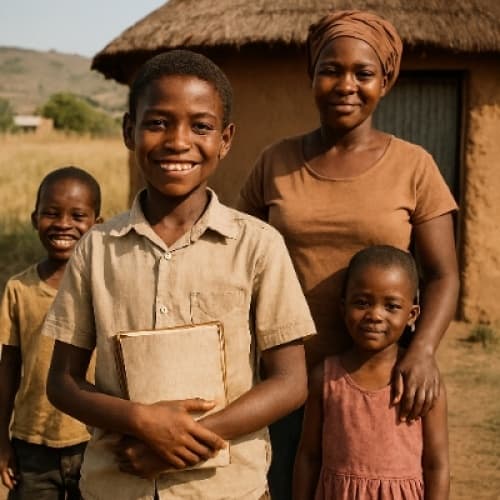

In the quiet village of Emadlangeni, nestled between rolling hills and whispering sugarcane fields, lived a boy named Sipho. He was twelve, barefoot most days, and known for asking questions that made grown-ups pause. Sipho lived with his mother, Thandi, and his two younger siblings—Lebo, who loved chasing chickens, and Zanele, who could sing before she could speak.
Their home was modest: a two-room rondavel with a tin roof that sang when it rained. Thandi worked hard, weaving baskets and selling vegetables at the market. She had a laugh that could chase away sorrow, and eyes that saw the potential in her children even when the world didn’t.
Sipho was different. He didn’t just learn—he absorbed. He’d fix broken radios with wire and bottle caps, build toy cars from scrap metal, and once crafted a sundial from stones and sticks to tell time when their old clock stopped working. His mind was a map of ideas, and he dreamed of becoming an engineer, though he’d never seen a real one.
One day, while walking back from the river, Sipho found a rusted bicycle frame. Most would’ve seen junk. Sipho saw opportunity. Over weeks, he scavenged parts—an old chain from the mechanic’s shed, tires from a neighbor’s broken wheelbarrow, and handlebars from a discarded lawnmower. He rebuilt the bike, not just to ride, but to teach his siblings about gears and balance.
Word spread. The village elders began calling him “uSipho wekhono”—Sipho of talent. A teacher from the nearby town heard about him and brought books, including one on mechanical design. Sipho devoured them by candlelight, his fingers tracing diagrams like they were treasure maps.
But the real turning point came when a local NGO visited the village to install solar panels. Sipho asked so many questions that the technician invited him to help. By the end of the week, Sipho was wiring panels himself, explaining voltage and current to wide-eyed neighbors.
The technician, impressed, helped Thandi apply for a scholarship. Months later, Sipho was accepted into a science academy in Durban. The day he left, his siblings clung to him, and Thandi whispered, “Go show the world what a boy from Emadlangeni can do.”
And he did.
Years later, Sipho returned—not just as an engineer, but as a mentor. He built a learning center powered by solar energy, filled it with books and tools, and taught children to dream beyond the hills.
Because Sipho knew: brilliance doesn’t need a city to be born. Sometimes, it just needs a curious mind, a loving family, and a village that believes.