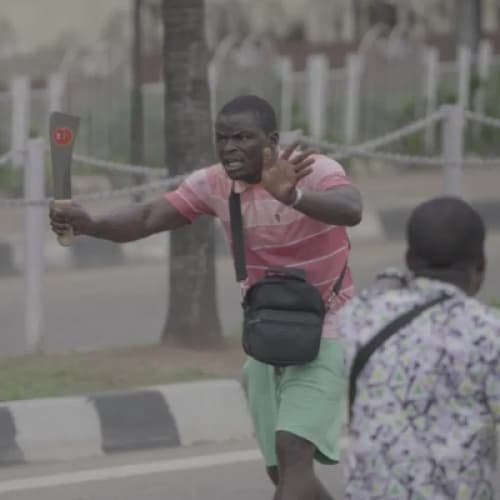

Badagry was hot, sleepy, and slow a world away from the chaos of Lagos. Sonto, now limping slightly from the bullet wound, lived in a shack near the lagoon, surrounded by fishermen and salt air. The water calmed him. Amara had arranged everything food from a local priest, a borrowed mattress, even a small teaching gig with street kids. It was the closest thing to peace Sonto had ever known.
But peace has a price.
One morning, as Sonto was walking back from the market with a bag of garri and plantain chips, he noticed a white Corolla parked near his shack. He froze. The car was too clean for this part of town. Two men stepped out. Tall. Broad shoulders. Faces like carved stone. One had tribal marks. The other had the unmistakable tattoo of the Red Crows a blood-red crow perched on a Kalashnikov.
They’d found him.
He dropped the bag and ran.
Through back alleys. Past chickens. Over muddy canals. His leg ached, but fear pushed him forward. He dove into a boatyard and hid behind a rusted engine. The men searched, shouting his name in pidgin.
“Sonto! You be ghost? Come out now or we go burn this whole place!”
He didn’t move. Didn’t breathe. Minutes passed like hours. Then, finally, silence.
That night, Amara cried. “You have to leave. Go farther. Maybe Ghana. Or Togo. I can help you cross.”
But Sonto shook his head. “I run now, I run forever.”
Three days later, he went to the police.
Not because he trusted them but because he was tired.
At the Badagry police station, he asked to speak to Inspector Nwachukwu, a hardened officer known for his work against armed gangs.
“I have names,” Sonto said. “Locations. Arms routes. The Red Crows. I’ll give you everything. But I want something in return.”
Nwachukwu raised an eyebrow. “You think you’re in a Hollywood movie?”
“I want protection. For me. And for her,” he said, motioning to Amara, who waited nervously outside.
The inspector stared at him for a long moment, then sighed. “Talk.”
In the weeks that followed, Sonto became an informant. He led police to a stash house in Agege. Exposed a fake trucking company used to smuggle arms. Gave up locations of gang meetings, phone numbers, and even some dirty officers on the Red Crows’ payroll.
Raids began.
Arrests were made.
And Papa Kay?
He vanished.
But Sonto knew it wasn’t over.
One rainy night, the phone rang. A voice he hadn’t heard in over a year.
“You think you win?” Papa Kay said, calm as a snake. “You forget blood never washes away.”
“I'm done, Kay.”
Kay laughed. “Nobody leaves the street. We bury the street in them.”
The line cut.
That was the last time Sonto saw Amara alive.
They came in the night. Silent. Ruthless.
Amara had just returned from a vigil service. Sonto wasn’t home. He’d gone to meet the inspector for a briefing. When he returned, he found the door broken, the room torn apart, and Amara’s body bloodied, lifeless on the floor.
Her eyes were open, staring upward as if still praying.
Sonto didn’t scream. Didn’t cry.
He sat there, her head in his lap, the gospel radio still playing in the corner.
The funeral was small. Simple. A white cloth, some flowers, and a soft hymn.
Inspector Nwachukwu stood beside him, silent. “We’ll find them,” he said.
But Sonto shook his head. “No. I will.”
He went underground.
Disappeared from police radar.
Stopped reporting. Changed phones. Changed names.
And just like that the legend of Oga Blak returned.
Makoko had changed in his absence, but not enough. Red Crows were still there — fewer in number, but more vicious. Kay had gone deeper into the arms business. Now he was moving weapons across the Sahel, using refugees as cover and war-torn villages as staging posts.
Sonto didn’t attack head-on. He poisoned from the inside. Bribed foot soldiers. Leaked fake intel. Caused chaos between rival gangs. He let fear do the bleeding.
He was no longer the teenage boy with something to prove.
Now he was a ghost with nothing left to lose.
One by one, lieutenants fell. Warehouses exploded. Trucks vanished. By the end of the third month, Kay was desperate. He called a meeting in a derelict warehouse near Apapa Wharf.
Sonto was already there.
He waited in the rafters, pistol in hand, machete on his belt.
Kay walked in with four men. Thick-necked. Armed. Paranoid.
“I know you dey here,” Kay called into the shadows. “Come finish it.”
Silence.
Then a shot one of Kay’s men dropped.
Chaos.
Another shot. Another scream.
Sonto dropped down like a phantom.
Kay turned. “You?”
“For Amara.”
The fight was brutal.
Kay was stronger, older, but slower. He swung with rage. Sonto dodged with grief. They wrestled to the floor, knocking over crates and barrels. At one point, Kay had the upper hand, choking him against a pillar.
“You think love go save you? Love dey die for here.”
Sonto pulled the machete from his side and buried it deep in Kay’s ribs.
“Exactly,” he whispered.
Kay collapsed.
It was over.
Sonto didn’t run.
He waited for the police. Told them everything. This time, there was no deal.
He was sentenced to 22 years.
But prison didn’t break him.
He started a program From Thug to Thought teaching inmates to read, write, and rethink.
He told them about Amara. About choices. About how the street only loves you when you’re useful and buries you when you’re not.
The program became a movement.
Inmates wrote letters. Painted. Forgave. Some even left prison with job offers.
News spread. A journalist wrote about him: “The Gangster Who Chose Redemption.”
Sonto just laughed.
“I didn’t choose it,” he said. “She did. I just followed.”